Saint Ignatius of Antioch: The Bishop Who Wrote Seven Letters on the Road to Being Eaten Alive
Saint Ignatius of Antioch: The Bishop Who Wrote Seven Letters on the Road to Being Eaten Alive
A disciple of the Apostle John. Third bishop of a city where the disciples were first called Christians. Marched across the Roman world in chains, guarded by ten soldiers he nicknamed leopards, writing letters at every stop that would outlast the empire that killed him.
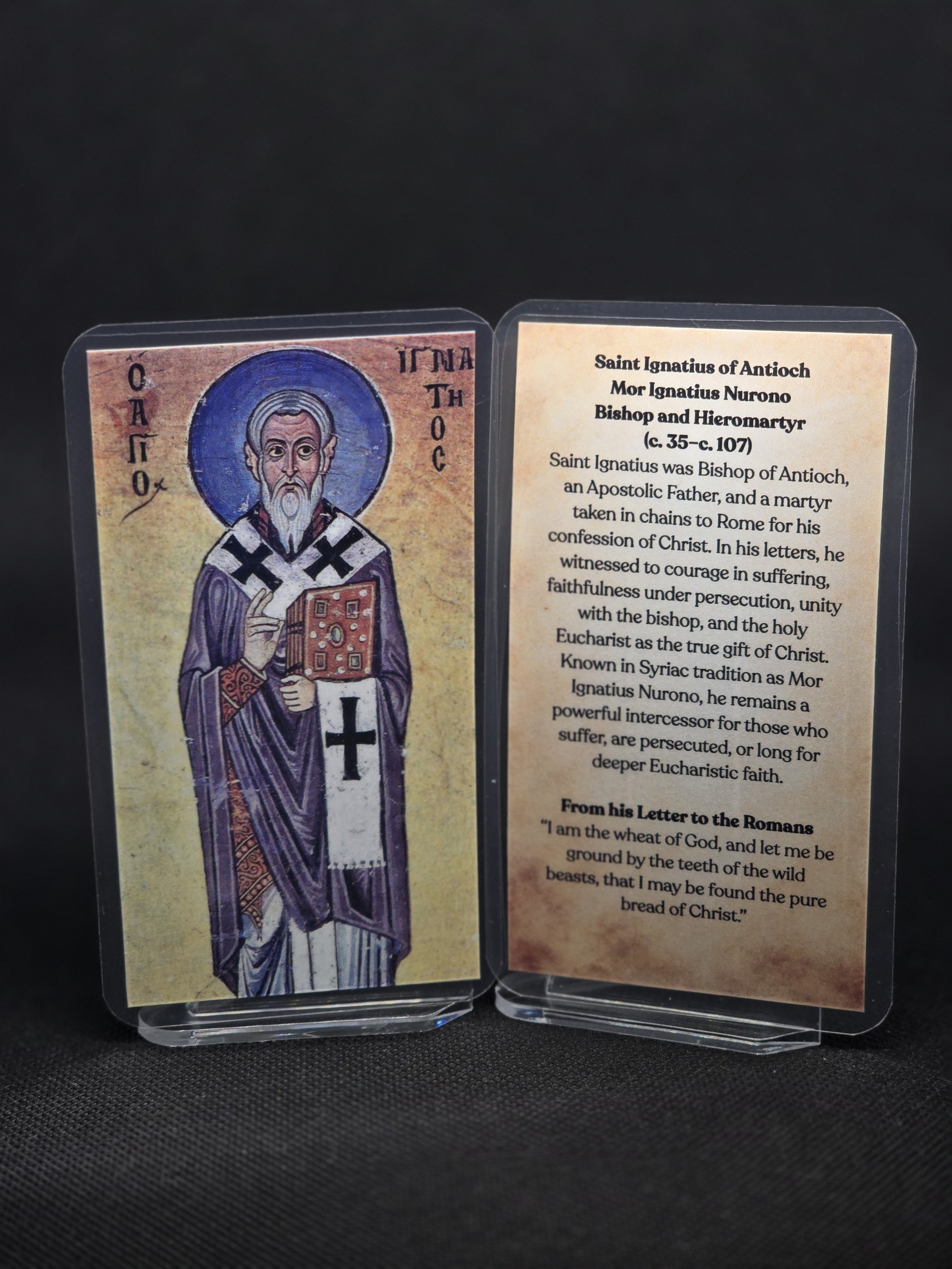
Saint Ignatius of Antioch at a Glance
- Also Known As
- Ignatius Theophorus, "the God-bearer"
- Born
- Date and place unrecorded; likely Syria, mid to late first century
- Died
- c. 107 to 110, martyred in the arena at Rome under Emperor Trajan
- Venerated In
- The Eastern Orthodox Church, the Catholic Church, and the wider Christian world
- Canonized
- Pre-congregation; venerated from the earliest generations of the Church
- Feast Days
- December 20 (Eastern Orthodox); October 17 (current Roman Catholic calendar; formerly February 1)
- Title
- Bishop and Hieromartyr; Apostolic Father; Theophorus, "the God-Bearer"
- Served As
- Second or third Bishop of Antioch, successor to Bishop Evodius
- Known For
- Seven letters written en route to martyrdom; earliest recorded use of the phrase "the Catholic Church"
- Relics
- Basilica of San Clemente, Rome, beneath the high altar
- I. The Child Christ Blessed: Origins and the Name "God-Bearer"
- II. Third Bishop of Antioch, Successor to Evodius
- III. Summoned Before Trajan
- IV. Ten Leopards: The Journey to Rome Begins
- V. Smyrna: Four Letters and an Old Friend, Polycarp
- VI. The Letter to the Romans: "I Am God's Wheat"
- VII. Troas: Three Final Letters
- VIII. Martyrdom in the Roman Arena
- IX. His Relics: Antioch, Then Rome, 637
- X. Traditions of Wonders and the Heart Inscribed With Christ's Name
- XI. His Companions: Connections to Other Saints
- XII. His Writings: The Seven Authentic Letters
- XIII. Where His Relics Rest Today, With Links
- XIV. Legacy: The Bridge Between the Apostles and the Church
- Prayer for the Intercession of Saint Ignatius of Antioch
- Frequently Asked Questions
The Child Christ Blessed: Origins and the Name "God-Bearer"
Almost nothing is recorded of Ignatius's birth, family, or early life. He appears in history already formed: a bishop, a writer, and, in the final weeks of his life, a prisoner. Tradition, preserved in the Eastern Church, holds that he was the very child Christ took into his arms while teaching the disciples about humility, saying, "Whosoever shall humble himself as this little child, the same is greatest in the Kingdom of heaven." Whether or not this identification is historically precise, it captures something essential about how the earliest Christians remembered him: a man whose whole life was framed as having been physically held by God before he ever held the office of bishop.
Ignatius called himself Theophorus, "God-bearer," a name the tradition explains two ways at once: because he bore God's name and presence unceasingly in his heart and on his lips, and because he had, according to the same tradition, once literally been held in the arms of God incarnate. He was, by the testimony of Saint Polycarp of Smyrna and the historian Eusebius, a disciple of the Apostle John the Theologian, the same relationship that connected him to Polycarp, who studied under the same apostle and would himself later be martyred for the faith.
Part II
Third Bishop of Antioch, Successor to Evodius
Ignatius governed the church of Antioch, in the Roman province of Syria, the very city where, according to the Acts of the Apostles, believers in Jesus were first called Christians. Sources count his place in the succession slightly differently depending on convention: Eastern tradition counts him as the second bishop of the city, successor to Bishop Evodius; Western tradition, counting the Apostle Peter as the city's first bishop before Evodius, counts Ignatius as the third. Either way, Ignatius stood extraordinarily close to the apostolic generation itself, governing a church still within living memory of the Apostles who had founded it.
As bishop, Ignatius is remembered as a zealous and devoted shepherd who spared no effort in building up his flock. Eastern tradition also credits him with introducing antiphonal chanting into the Church, the practice of two choirs singing psalmody in alternation, a form of worship he is said to have learned through a vision of angels praising God in this manner in heaven. This detail belongs to devotional tradition rather than to any of Ignatius's own surviving writings, and is presented here as such.
Part III
Summoned Before Trajan
Around the year 106 to 107, the Emperor Trajan, fresh from a military victory, ordered that all subjects of the empire offer thanksgiving sacrifice to the pagan gods, on pain of death for any Christian who refused. When Trajan's travels brought him through Antioch itself, informants told him of a bishop who openly confessed Christ and taught his people to despise wealth, live virtuously, and preserve chastity. According to the tradition recorded in the Eastern synaxarion, Ignatius came forward voluntarily to stand before the emperor, specifically in order to draw the threatened persecution onto himself and spare the wider Christian community of Antioch from wider reprisal.
Trajan urged, then threatened, Ignatius to offer sacrifice to the idols, even dangling the possibility of elevation to the Roman senate in exchange. Ignatius refused every inducement. Rather than have him executed on the spot, Trajan ordered him bound in irons and shipped to Rome, to be thrown to the wild beasts in the arena as public spectacle and warning to the empire's Christian population.
Part IV
Ten Leopards: The Journey to Rome Begins
Ignatius's journey from Antioch to Rome, under guard of ten Roman soldiers he nicknamed "leopards" in his letters for their cruelty, became, almost by accident, one of the most consequential journeys in the history of Christian literature. Rather than being shipped directly, he was marched overland through Asia Minor, along a route that carried him through or near a succession of major early Christian communities: Philadelphia, and then an extended stay at Smyrna, where representatives from several neighboring churches came to meet him and pay their respects to a bishop already renowned for his coming martyrdom.
Part V
Smyrna: Four Letters and an Old Friend, Polycarp
At Smyrna, Ignatius was reunited with Polycarp, the city's own bishop and an old friend from their shared discipleship under the Apostle John. Delegations from the nearby churches of Ephesus, Magnesia, and Tralles arrived to honor him, and in response Ignatius composed and dispatched letters to each of these three communities, thanking them for their support, urging unity around their bishops, and warning against the Docetist heresy then spreading through Asia Minor, which denied that Christ had truly suffered and died in a real human body. While still in Smyrna, Ignatius also wrote a fourth letter, this one addressed ahead to the Christians of Rome, the city where his journey and his life would both end.
Part VI
The Letter to the Romans: "I Am God's Wheat"
The Letter to the Romans is the most personally revealing and, for many readers across the centuries, the most startling of all Ignatius's surviving writings. He had learned that Christians in Rome, a community with real influence, might attempt to intervene on his behalf and secure his release. Ignatius wrote specifically to forestall any such rescue, framing his approaching death not as a tragedy to be averted but as the one thing in his life he most urgently wanted to reach.
He asked the Roman church for nothing except their prayers and their restraint, writing that his one request was to be permitted to offer what he called the libation of his own blood to God. This was not despair or a death wish in any ordinary sense; Ignatius understood his martyrdom as the completion of his discipleship, the moment he would finally become, in his own phrase, a true disciple of Christ rather than merely a bishop who taught about him.
Part VII
Troas: Three Final Letters
From Smyrna, Ignatius's guards moved him on to Troas, on the coast of Asia Minor. It was here that he received welcome news: the persecution against the Christians of Antioch, the very crisis he had presented himself to Trajan in order to avert, had ended. From Troas, in evident relief and continuing pastoral concern for churches he would never see again, Ignatius wrote three more letters: to the Christians of Philadelphia, to the church at Smyrna he had just left, and a final, deeply personal letter to his friend Bishop Polycarp himself, offering him pastoral counsel on the burdens of episcopal leadership. From Troas he sailed on toward Neapolis in Macedonia and the final overland stages of his journey toward Rome, through Thrace, Macedonia, and Epirus.
Part VIII
Martyrdom in the Roman Arena
Ignatius reached Rome and was delivered to the arena during public games, where he was thrown to the lions before a crowd. According to the traditional accounts, the animals tore him apart and devoured him almost entirely, leaving behind only a few of his larger bones and, notably, his heart. Ignatius met his death, by every account that survives, without resistance and without regret, having spent the entire final stretch of his life explicitly preparing himself and his readers for exactly this outcome. The precise year is not certain; ancient and modern sources place it anywhere between roughly 107 and 110, during the reign of the Emperor Trajan.
Part IX
His Relics: Antioch, Then Rome, 637
Ignatius did not travel to his death alone. A group of deacons and companions from his own church had accompanied him for at least part of the journey, and it was they who gathered what remained of his body after the execution, wrapped it in linen, and carried it back to Antioch for burial, a devotion that let his own flock reclaim at least this much of their bishop. His relics were venerated at Antioch for centuries afterward.
Long after, in the year 637, in the turbulent years of the early Arab conquests of the Levant, Ignatius's relics were brought west to Rome, according to tradition carried by Syrian Christian refugees fleeing the region. They were enshrined in the Basilica of San Clemente, where they remain to this day, resting beneath the basilica's high altar alongside the relics of Pope Saint Clement I. An inscription on the altar itself records the fact in Latin: Hic requiescunt corpora SS Clementis Papae et Ignatii, "Here rest the bodies of Saints Clement the Pope and Ignatius."
Part X
Traditions of Wonders and the Heart Inscribed With Christ's Name
One striking legend attached itself to Ignatius's martyrdom almost immediately: that when his heart was recovered from the arena and later examined, it was found, according to the story, to bear the name of Jesus Christ written in gold letters through its very substance, as though his own repeated declaration that he carried God within him had left a literal, physical mark. This account appears in later hagiographic sources rather than in Ignatius's own genuine letters, and should be understood as devotional legend rather than documented fact, though it captures, in vivid symbolic form, exactly what Ignatius himself claimed in writing: that he was, in the fullest sense, a God-bearer.
Beyond this specific legend, the Eastern synaxarion states broadly that Ignatius has appeared many times after his death and worked wonders, and that he continues to this day to help all who call upon him. As with several other saints profiled on this site whose primary historical footprint is theological or literary rather than miraculous, this article presents that general devotional claim honestly as tradition, since no source consulted here documents specific, individually attested post-mortem miracle accounts in the same level of detail available for saints such as Nicholas of Myra or Spyridon of Trimythous.

Part XI
His Companions: Connections to Other Saints
Ignatius's short life is threaded directly through the founding generation of the Church:
Saint Polycarp of Smyrna
A fellow disciple of the Apostle John and Ignatius's personal friend, reunited with him at Smyrna during the final journey. Polycarp later collected and preserved Ignatius's letters, sending copies to the church at Philippi, and was himself martyred decades later, around 155 to 167.
Saint Evodius of Antioch
Ignatius's immediate predecessor as bishop of Antioch, traditionally regarded as having been appointed directly by the Apostles.
The Apostle Peter
Regarded in Western tradition as the first bishop of Antioch before Evodius, making the city's episcopal succession, and therefore Ignatius's own office, directly traceable to the chief of the Apostles.
The Apostle John the Theologian
Ignatius's own teacher, according to tradition, alongside Polycarp, connecting him directly to one of the twelve Apostles and to the same apostolic circle that produced the Gospel and Epistles of John.
The Apostle Paul
Though not Ignatius's personal teacher, Paul's own ministry at Antioch, recorded in the Acts of the Apostles, established the church Ignatius would later govern as the very place where believers were first called Christians.
Pope Saint Clement I
Not a personal contemporary of Ignatius, but the saint whose relics share his resting place at the Basilica of San Clemente in Rome, uniting two of the earliest and most important Apostolic Fathers beneath a single altar.
Part XII
His Writings: The Seven Authentic Letters
Unlike many early saints whose personal words are lost entirely, Ignatius left behind seven genuine letters that rank among the most important surviving Christian texts outside the New Testament itself: to the Ephesians, the Magnesians, the Trallians, the Romans, the Philadelphians, and the Smyrnaeans, and to Polycarp personally. Their authenticity was, for centuries, genuinely contested, since later forgers produced an expanded and heavily interpolated collection, the so-called Long Recension, mixed with spurious additional letters. Rigorous nineteenth-century textual scholarship, particularly the work of the English patristic scholar J.B. Lightfoot, definitively separated this shorter, genuine Middle Recension from the later forgeries, restoring confidence in the seven letters as authentic products of Ignatius's own final journey.
Theologically, these letters are foundational in ways that are difficult to overstate. In his Letter to the Smyrnaeans, Ignatius provides history's earliest known recorded use of the phrase "the Catholic Church," writing that wherever the bishop is present, there the community should be, just as wherever Christ Jesus is, there is the Catholic Church. His letters also provide the earliest clear evidence for the threefold structure of bishop, priests, and deacons as the normal governing pattern of local churches, insist forcefully against the Docetist heretics that Christ suffered and died in a genuine human body, and describe the Eucharist in the strongest possible terms as the true body and blood of Christ, calling it, in a phrase still quoted in liturgical and theological writing today, the medicine of immortality.
Part XIII
Where His Relics Rest Today, With Links
Two sites stand out for readers wishing to connect with Ignatius's ongoing physical and devotional presence:
Basilica of San Clemente, Rome, Italy
A three-tiered complex spanning nearly two thousand years of continuous Christian use, cared for by the Irish Dominican Fathers since the seventeenth century, and the site where Ignatius's relics have rested beneath the high altar since 637, alongside those of Pope Saint Clement I. basilicasanclemente.com
Saint Ignatius of Antioch Parish, Antioch, California
A modern Roman Catholic parish taking its patronage directly from the saint, one of a number of churches worldwide named in his honor. stignatiusofantioch.com
Part XIV
Legacy: The Bridge Between the Apostles and the Church
Ignatius of Antioch occupies an almost impossibly compressed place in Christian history: a man about whom essentially nothing is known except the final weeks of his life, and yet a man whose surviving words, written under armed guard on the road to his own execution, shaped the Church's understanding of its own bishops, its own Eucharist, and its own unity for the two thousand years that followed. He is sometimes called the bridge between the New Testament and the wider Church of the second century, and the description holds up: he had personally known the Apostle John, and he wrote in language that would be immediately recognizable to any Christian reading the Nicene Creed three centuries later.
What makes his witness distinct even among the martyrs is the sheer, deliberate clarity of his desire for death. Where many martyrs faced execution with courage born of necessity, Ignatius approached his own with something closer to longing, framing it not as an ending to be endured but as a birth into real life he was determined nothing would interrupt.
Holy Trinity, Father, Son, and Holy Spirit, to You be glory, honor, and blessing, for having given to Your holy Church Saint Ignatius of Antioch, the God-bearer, as a model of fearless witness, unity around Christ's Church, and true devotion to the Body and Blood of Christ.
We ask You humbly: just as You gave him the courage to welcome death rather than deny You, be pleased to grant us, through his intercession, courage to profess our faith openly, unity within Your Church, and the grace we now ask with confidence.
Through Christ our Lord. Amen.
An original English-language devotional prayer composed for use with the Saint Ignatius of Antioch prayer card, drawing on the traditional themes of his veneration across the Catholic and Orthodox Churches.
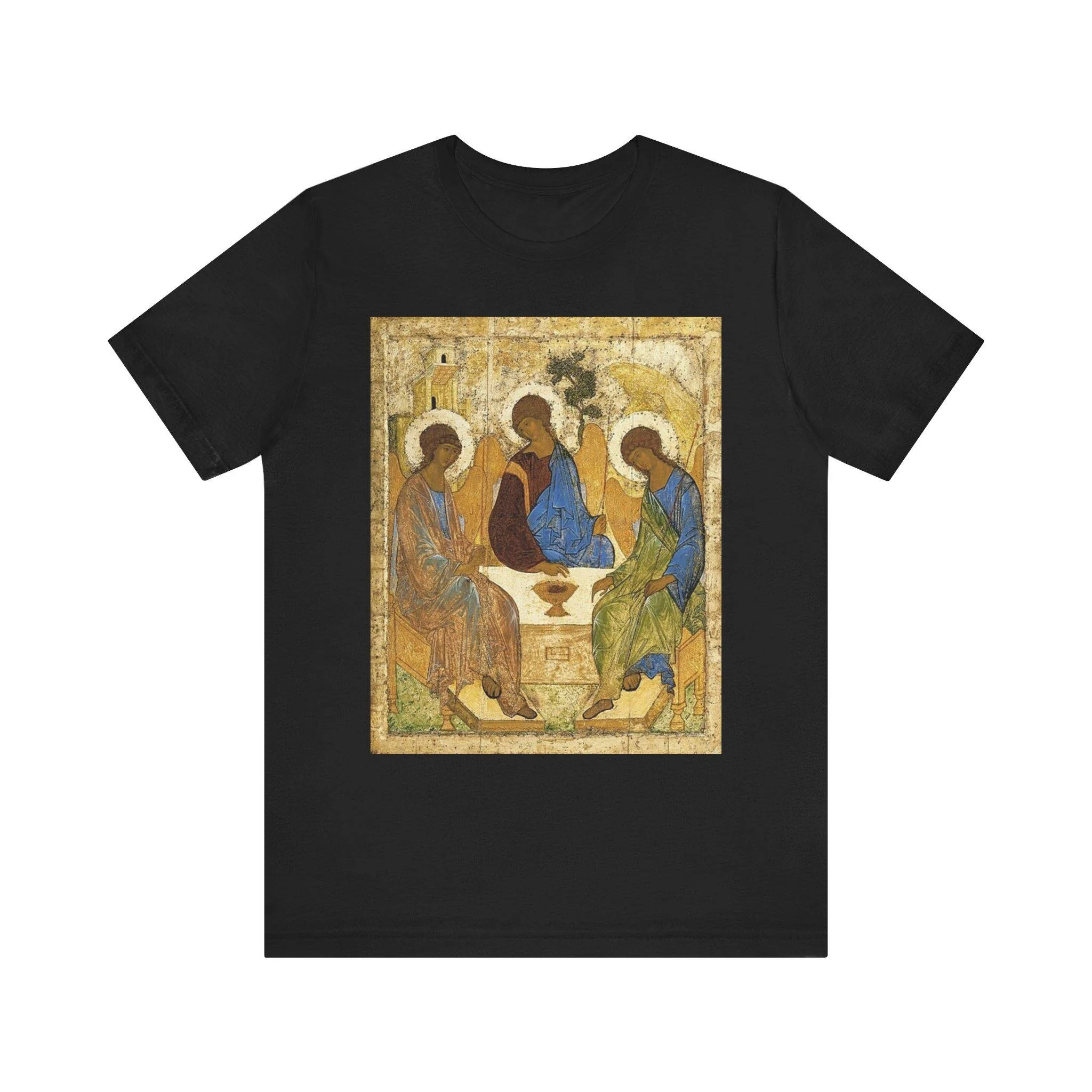
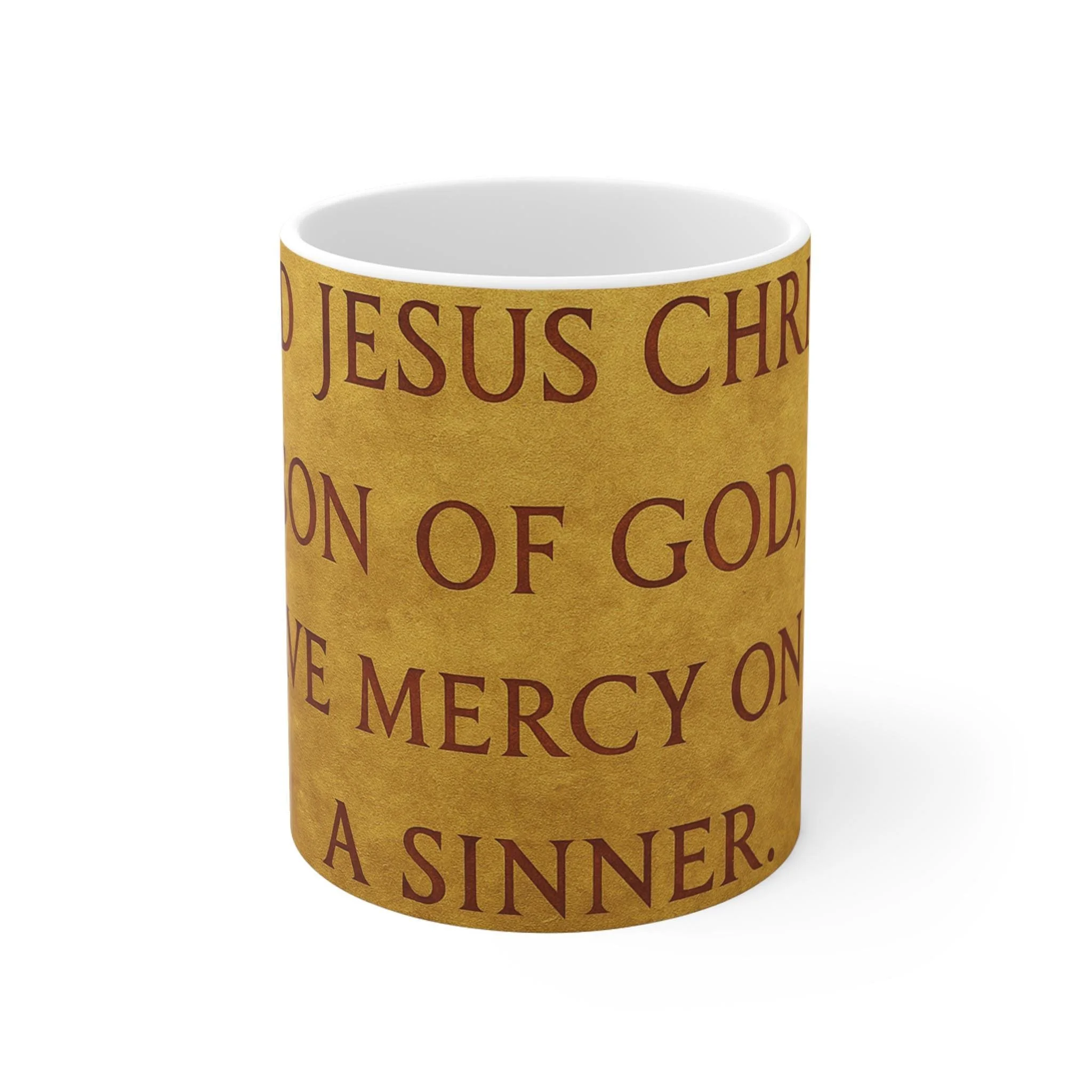
More From Our Store, In Honor of the Apostolic Fathers
FAQ
Frequently Asked Questions About Saint Ignatius of Antioch
He Asked to Be Eaten Alive, and the Church Has Never Stopped Reading What He Wrote on the Way.
Saint Ignatius of Antioch left behind no monastery, no cathedral he built with his own hands, no decades of quiet pastoral ministry to look back on. What he left was roughly two weeks of forced marching under armed guard, and seven short letters, written at whatever stops his captors allowed, to churches he would never see again. In those letters he gave the infant Church its first clear language for its own bishops, its own unity, its own real and physical Eucharist, and its own name, Catholic, meaning whole, meaning universal, meaning gathered wherever Christ himself is present.
Ask his intercession. Say his prayer. Remember a bishop who did not merely accept martyrdom when it came for him, but who, chained and guarded by ten leopards, wrote letter after letter begging no one interrupt it.
Get the Saint Ignatius of Antioch Prayer Card →