Saint Mark the Evangelist: Author of the Second Gospel, Companion of Peter and Paul and Traditional Founder of the Church of Alexandria
The companion of apostles who wrote the earliest Gospel and carried the faith to Egypt
At a Glance
- Also known as
- John Mark (traditional identification)
- Born
- UNCERTAIN, first century; Jerusalem or Cyrene
- Died
- UNCERTAIN, traditionally about 68 in Alexandria
- Feast
- April 25 (Latin and Byzantine); 30 Baramouda in the Coptic calendar
- Title
- Evangelist, Apostle, Martyr
- Symbol
- Winged lion
- Who Was Saint Mark the Evangelist?
- Early Life and Family
- A Failure and a Restoration
- The Gospel According to Mark
- Founder of the Church of Alexandria
- Context and Controversies
- Martyrdom and Relics
- What Is Firm and What Is Tradition
- The Winged Lion and Devotion
- Why He Matters to the Eastern Churches
- Frequently Asked Questions
Who Was Saint Mark the Evangelist?
Saint Mark is honored by Catholic, Orthodox and Oriental Orthodox Christians as the Evangelist who wrote the Gospel according to Mark. Christian tradition identifies him with John Mark, the young man of Jerusalem who appears in the Acts of the Apostles and in several letters of the New Testament. That identification is ancient and widely accepted, but the Gospel itself never names its author.
He was not one of the Twelve. In the New Testament he appears as a helper and companion: of Barnabas, of Paul, and of Peter. Later tradition gives him a larger role, as the first bishop of Alexandria and the founder of the Church of Egypt.
The firm historical core is small. It rests on a few verses in the New Testament and on early testimony about the Gospel. Everything else, including his birthplace, his death and his relics, is marked TRADITION or UNCERTAIN in this article.
Early Life and Family
Acts 12:12 mentions a woman of Jerusalem named Mary, whose son was John, also called Mark. Her house was a place where believers gathered to pray. When Peter was freed from prison, he went there. This is the clearest picture the New Testament gives of Mark's family, and it shows that they belonged to the first Christian community.
Colossians 4:10 calls Mark the cousin of Barnabas. Some older translations and traditional lives say nephew, but the Greek word means cousin. UNCERTAIN: the name of his father, his childhood, his education, his birthplace and the year of his birth are not recorded. Jerusalem is the usual guess because of his mother's home, and an Orthodox tradition names Cyrene in North Africa.
TRADITION: some Christian writers say that Mary's house was the place of the Last Supper, and that Mark was the young man who fled naked at the arrest of Jesus in Mark 14:51 and 52. The Gospel does not name that young man, and Acts does not say where the Last Supper took place. These ideas are possible but unproven. Early testimony preserved by Papias also says that Mark did not follow Jesus during His ministry, so he should not be called an eyewitness disciple.
A Failure and a Restoration
The New Testament does not describe Mark's conversion or baptism. TRADITION: later accounts say that Peter taught or baptized him. First Peter 5:13 calls Mark Peter's son, which is usually understood as spiritual language and fits a close bond between the two men.
Mark first travels with Barnabas and Saul (Paul) in Acts 12:25 and helps them on Cyprus in Acts 13:5. At Perga in Pamphylia he leaves the mission and returns to Jerusalem (Acts 13:13). Acts does not explain why.
The departure caused a sharp dispute. In Acts 15:36 to 39, Paul refused to take Mark on the next journey, while Barnabas wanted him. The two missionaries parted, and Barnabas took Mark to Cyprus. Later letters show the breach healed: Philemon 24 and Colossians 4:10 list Mark among Paul's co-workers, and 2 Timothy 4:11 asks that Mark be brought because he is useful for ministry. The story of Mark is a story of a failure that was forgiven and turned into service.
The Gospel According to Mark
Mark's greatest work is the Gospel that carries his name. The text itself is anonymous. The attribution comes from early Christian witnesses. Papias of Hierapolis, quoted by Eusebius, called Mark the interpreter of Peter and said that he wrote down Peter's teaching accurately, though not in strict order. Irenaeus of Lyons also describes Mark as the disciple and interpreter of Peter.
Most scholars today regard Mark as the earliest of the four Gospels, written around the time of the fall of Jerusalem in the year 70. UNCERTAIN: the exact date, the place and the identity of the author are debated. Rome is the traditional place, and some scholars propose Syria.
The Gospel is short and moves quickly. It centers on the Kingdom of God, the miracles of Jesus, His conflicts, and above all His suffering, death and Resurrection. Mark 8:34 links discipleship with taking up the cross. At the Crucifixion, the centurion's confession in Mark 15:39 gives the Gospel's high point.
UNCERTAIN: Mark 16:9 to 20, the Longer Ending, is missing from some of the earliest Greek manuscripts, and many scholars regard it as a later addition. It remains part of the biblical text used by Catholic and Orthodox Churches.
Founder of the Church of Alexandria
The Coptic Orthodox Church venerates Mark as its founder and first patriarch. Eusebius, writing in the fourth century, reports that Mark preached in Egypt and established churches at Alexandria, and he names Annianus as Mark's successor.
UNCERTAIN: the year of Mark's arrival, the length of his ministry and the shape of the earliest church in Alexandria cannot be established from independent evidence. The Catholic Encyclopedia notes that Clement of Alexandria and Origen do not clearly mention Mark in connection with the city in the writings that survive. This silence calls for care, but it does not prove the tradition false.
TRADITION: Mark started a school of Christian teaching in Alexandria and composed a liturgy that grew into the Alexandrian rite. The Liturgy of Saint Mark is an important witness to early worship in Egypt, but its surviving forms cannot be shown to come from Mark himself.
Context and Controversies
Mark lived in the first generation of the Church, when Christianity was moving from its Jewish roots into the wider Roman world. His companions faced disputes over the place of Gentile believers and opposition from religious and civil authorities.
The clearest personal controversy in his life is the quarrel between Paul and Barnabas over him in Acts 15. Acts does not blame either side. Later letters show that Mark was fully accepted as a fellow worker.
Another question is the link between Mark's Gospel and Peter. Papias and Irenaeus preserve an early connection, but scholars disagree about how much of the Gospel comes directly from Peter's preaching. UNCERTAIN: the extent of persecution in Alexandria during his lifetime cannot be reconstructed, and later martyrdom accounts are not eyewitness records.
Martyrdom and Relics
Mark is traditionally venerated as a martyr who died at Alexandria, but the date and circumstances are disputed. Jerome, in his book On Illustrious Men, places Mark's death in the eighth year of Nero, about 62 or 63. Coptic and Greek Orthodox traditions usually give about 68. The Vatican City State account suggests a date between 68 and 72. These accounts cannot be reconciled into one certain chronology.
TRADITION: during a pagan festival, a crowd seized Mark, tied a rope around him and dragged him through the streets. He was imprisoned and died of his injuries. Later versions add that Christ appeared to him in prison. UNCERTAIN: no contemporary account survives, and the Catholic Encyclopedia notes that explicit evidence for his martyrdom does not appear before the fourth century.
Venetian tradition says that merchants brought Mark's remains from Alexandria to Venice in 828. TRADITION: they are said to have hidden the body under pork to avoid inspection by Muslim officials. The relics came to rest in the Basilica of Saint Mark. In 1968, a relic attributed to Mark was given by Pope Paul VI to the Coptic Orthodox Church in Egypt, in the time of Pope Cyril VI. The authenticity of the relics cannot be proven from documents. There is no formal canonization date, because he was venerated from the earliest centuries.
What Is Firm and What Is Tradition
For Mark, the strongest evidence is the New Testament record of his place among the early missionaries and the early testimony that links his Gospel to Peter. These points are shared by Catholic, Orthodox and Oriental Orthodox readers and are accepted by most historians.
The weakest points are his birth, his link to the young man in the garden, the exact order of his Egyptian mission, the circumstances of his death and the authenticity of particular relics. A careful biography can say that Mark is the traditional founder of the Church of Alexandria without claiming that every detail of his work there is proven.
This kind of honesty does not weaken devotion. The Church has always honored Mark as an Evangelist because of what his Gospel has given to the faithful, and that gift does not depend on settling every historical question.
The Winged Lion and Devotion
TRADITION: Coptic accounts say that when Mark came to Alexandria, his sandal broke, and he gave it to a shoemaker named Anianus to mend. The shoemaker hurt his hand with an awl, and Mark healed it by prayer. Anianus accepted the faith and later became Mark's successor. This story is central to the Coptic memory of its apostolic origins, but it is a tradition and not a documented event.
TRADITION: other accounts speak of visions in prison and of the body being preserved from destruction by a miracle so that Christians could bury it. Some Coptic tales also describe Mark facing dangerous lions. This is separate from the winged lion used as his symbol in art.
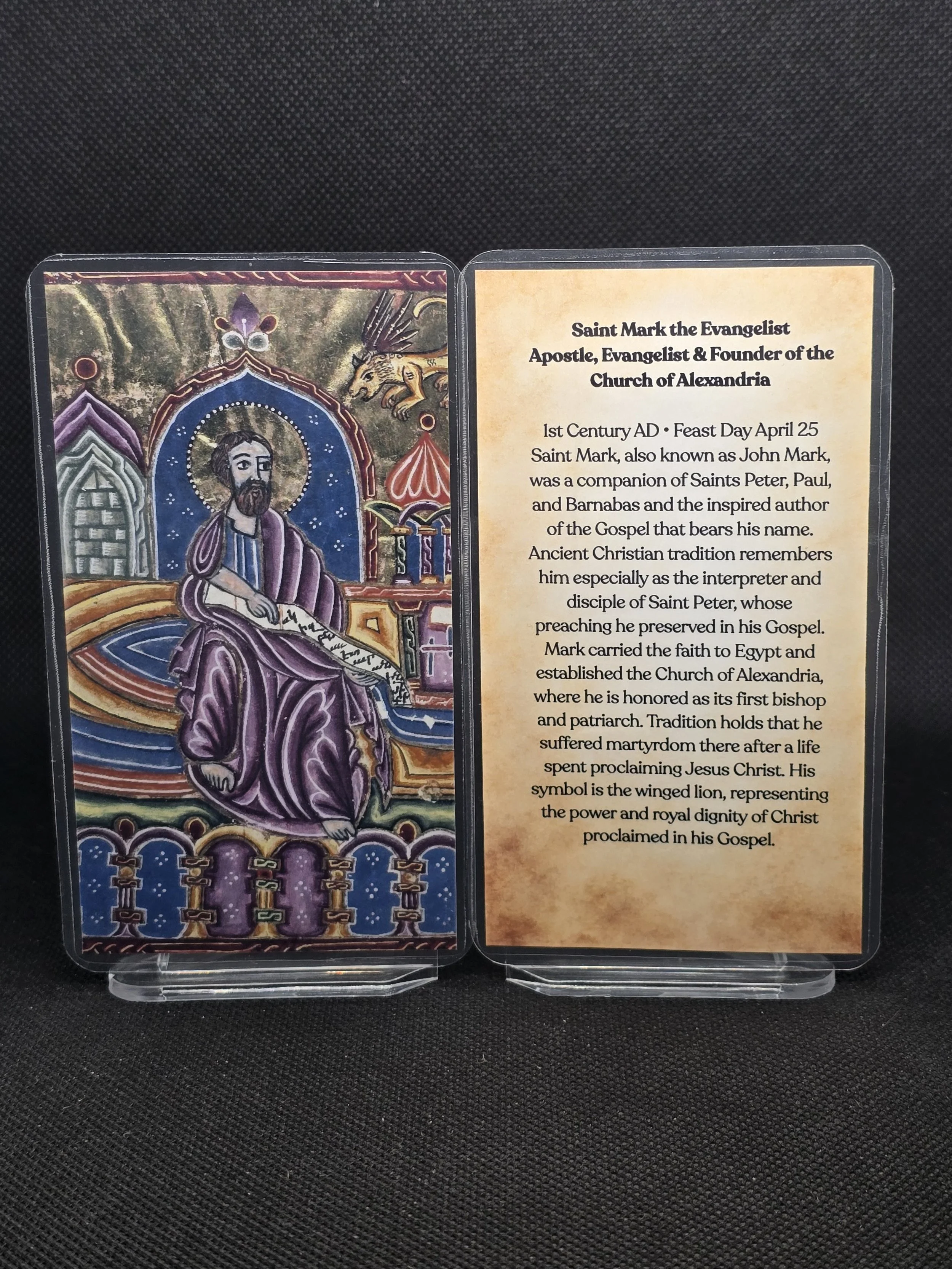
The winged lion comes from the four living creatures in Ezekiel 1:10 and Revelation 4:7, which Christian writers linked to the four Evangelists. Mark is usually given the lion, often explained by the voice crying in the wilderness at the start of his Gospel. The lion is prominent in Byzantine icons and in the civic art of Venice, where Mark is patron.
Lord Jesus Christ, You called Your servant Saint Mark to proclaim the Gospel and raised him up after his weakness. Through his prayers, forgive our failures, make us faithful in service, and teach us to follow You along the way of the Cross. Amen.
This is a short original prayer written for this article. It is not an official liturgical text. The Greek Orthodox Archdiocese of America publishes the official apolytikion for his feast.
Why He Matters to the Eastern Churches
Mark holds a special place for the Coptic Orthodox Church, which traces its line of patriarchs to him, and for the Coptic Catholic Church, which shares the Alexandrian heritage in communion with Rome. The Alexandrian tradition shaped distinct forms of prayer, biblical interpretation and worship.
Eastern Orthodox and Byzantine Catholic Christians honor him as an apostle and evangelist, with his feast on April 25. The Greek Orthodox Archdiocese notes that the feast may be moved to Bright Tuesday when April 25 falls on or before Pascha. The Coptic Church commemorates his martyrdom on 30 Baramouda, which usually falls on May 8, and keeps another commemoration around November 9 or 10.
Mark also stands for a shared witness. His Gospel belongs to every Christian tradition, and his link to Peter and Paul ties him to the Church before the later divisions between East and West. In the Eastern Churches he is honored as a teacher of the faith and as a sign that failure can be healed by grace.
Frequently Asked Questions
Ask His Prayers
Saint Mark is asked for help by writers, by those who carry the Gospel to others and by anyone who has failed and wishes to begin again. You may wish to keep a prayer card of Saint Mark near you as a reminder to pray for those who proclaim the Gospel.
View Prayer Card