Saint Paraskeva the New: Ascetic of Epivates, Also Known as Saint Petka of the Balkans and Patroness of Iasi
A medieval Byzantine ascetic whose relics travelled across the Balkans and now rest at Iasi
At a Glance
- Also known as
- Petka, Parascheva, Paraskevi of Serbia
- Born
- UNCERTAIN, traditionally tenth or eleventh century, Epivates in Thrace
- Died
- UNCERTAIN, traditionally eleventh century, near Epivates
- Feast
- October 14 (October 27 on the Old Calendar in this century)
- Title
- Venerable Mother, Ascetic, Wonderworker
- Relics
- Metropolitan Cathedral, Iasi, Romania
- Who Was Saint Paraskeva the New?
- Early Life and Family
- Her Call to Radical Discipleship
- A Life of Prayer and Poverty
- Questions About Her Life
- Death and the Journey of Her Relics
- Healing, Visions and Popular Devotion
- Pilgrimage to Iasi Today
- Three Saints Named Paraskeva
- Why She Matters to the Eastern Churches
- Frequently Asked Questions
Who Was Saint Paraskeva the New?
Saint Paraskeva the New is a Byzantine ascetic who lived, according to tradition, in the tenth or eleventh century. She is known by many names: Paraskevi, Parascheva, Petka, Petka of Tarnovo, Paraskeva of Serbia and Paraskeva of Epivates. These names reflect the many places that honored her, and not different persons.
Her life was lived in quiet. She was not a martyr, a queen or an abbess. She was a woman who gave away her goods and sought God in prayer and solitude. Her story survives mainly in medieval Lives, which were revised over time, so many personal details are marked TRADITION or UNCERTAIN in this article.
What is better documented is the journey of her relics. They passed through Tarnovo, Serbian lands, Constantinople and finally Iasi, and they made her a saint who linked several peoples of the Balkans.
Early Life and Family
According to her traditional Life, Paraskeva was born at Epivates, also written Epibatai, a village on the Sea of Marmara near Constantinople, in Thrace. Her parents were devout Christians, and the family had enough means for her charity to be noticed.
The Orthodox Church in America names an older brother, Euthymius, who became a monk and later bishop of Madytos. This detail comes from the hagiographical tradition, and independent records of her family are scarce.
TRADITION: during a service in her youth she heard the words of Matthew 16:24, that whoever wishes to follow Christ must deny himself and take up his cross. She gave clothing and goods to the poor, and relatives disapproved. TRADITION: after her parents died she entered monastic life at about fifteen. UNCERTAIN: the exact sermon, the dates and her age cannot be verified.
Her Call to Radical Discipleship
Paraskeva was raised a Christian, so her story has no conversion from another religion. Her turning point was a decision to follow Christ without reserve. In the tradition she gave up possessions, entered the monastic life, and then set out to find a place for deeper prayer.
The Greek Orthodox Archdiocese says she travelled to Constantinople and then to the Holy Land, where she lived for years in the wilderness near the Jordan before returning to Thrace. TRADITION: an angel appeared to her and told her to return home. The Orthodox Church in America places this when she was about twenty-five and says she lived two more years in her homeland.
UNCERTAIN: some accounts speak of a long life in the desert, while others give her age at death as twenty-seven. These cannot both be taken literally. Her age and the length of her ascetic life remain uncertain.
A Life of Prayer and Poverty
Paraskeva's fame rests on holiness and not on an institution. No authentic writings by her are known. There is not enough evidence to credit her with founding a monastery, writing a rule or holding church office.
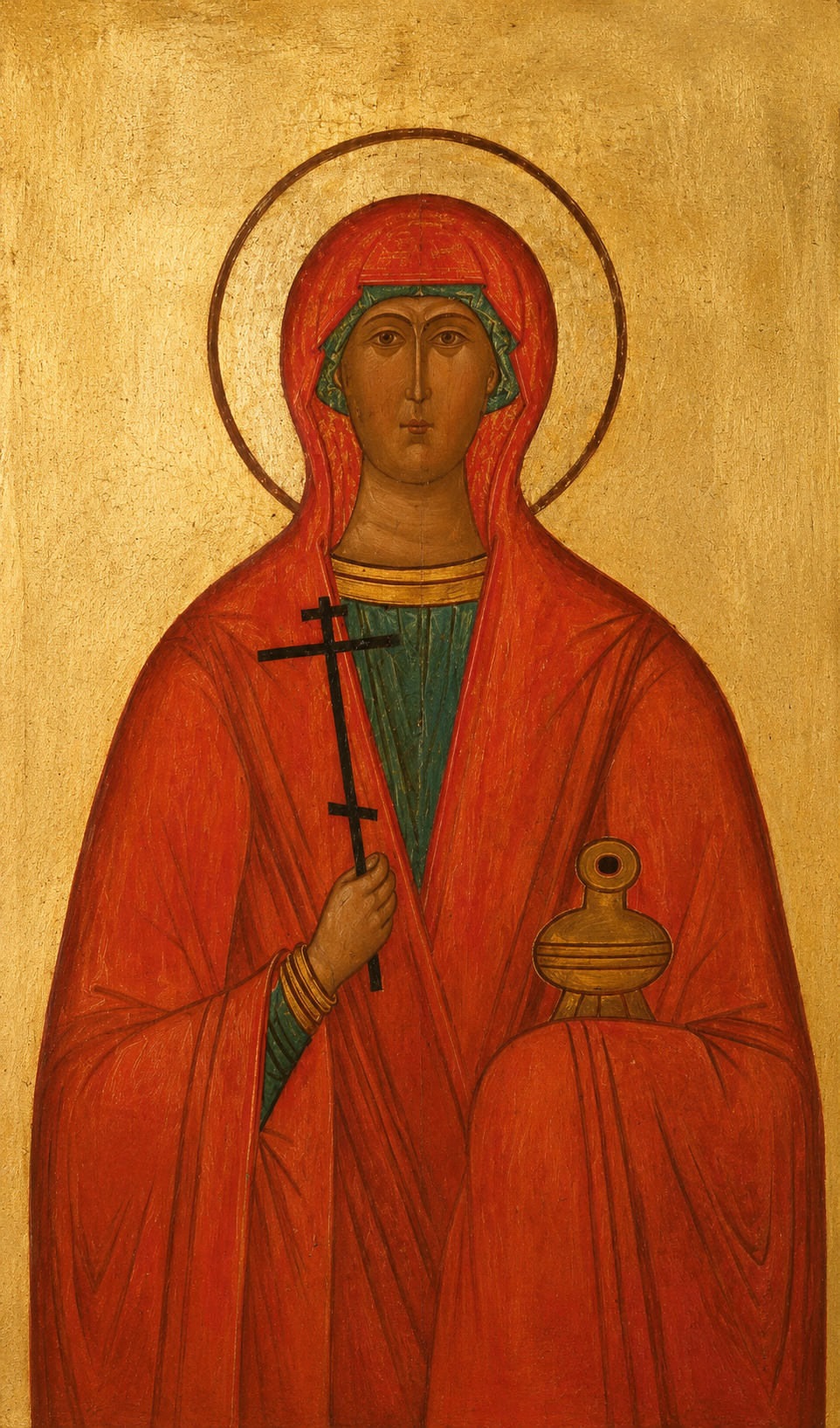
Her reported practice was prayer, fasting, poverty, tears, vigilance and silence. These themes echo the Desert Fathers of Egypt and Palestine, although her setting is the Byzantine world of a later age. The hymns of the Church honor her love of solitude and her struggle against temptation. They show how the Church understands her sanctity, but they do not prove every event of her biography.
Her later literary legacy is solid. Patriarch Euthymius of Tarnovo wrote an influential medieval Life of the saint, which helped to spread her veneration in Bulgaria and nearby lands. She left no writings of her own, but others wrote about her, and that literature became important in medieval Slavic religious culture.
Questions About Her Life
No reliable early source says that Paraskeva was imprisoned, tortured or killed for her faith. Her struggles were spiritual: poverty, solitude and the battle against the passions.
The main difficulty is the record itself. Her Life circulated in several forms. The Byzantine canonist Theodore Balsamon reports that Patriarch Nicholas IV Mouzalon, who served from 1147 to 1151, ordered an unsatisfactory Life to be replaced by a better account written by an imperial deacon. This shows that the story was reshaped by the Church, and warns readers against treating every detail as an unchanged eyewitness memory.
Scholars such as Evelina Mineva have studied the Byzantine and South Slavic Lives and the movement of her relics, separating the growth of her cult from the story of her personal life. By the thirteenth century possession of her relics had become a mark of religious prestige in the Balkans, which explains why her name is linked with so many peoples. Her birthplace was in Byzantine Thrace, and modern national labels would be anachronistic.
Death and the Journey of Her Relics
TRADITION: Paraskeva returned to the area of Epivates, lived in prayer and poverty, and died peacefully. She was buried near a church, without public recognition of her holiness. Another version places her last home near the Church of the Holy Apostles at Kallikrateia, close to her birthplace.
TRADITION: visions led local Christians to find her grave, and her body was said to be incorrupt. The later history of the relics has a firmer historical footing. They were moved to Tarnovo under the Second Bulgarian Empire. The Romanian Patriarchate gives 1235, while the Orthodox Church in America gives 1223, so the year of the move is UNCERTAIN. The relics later came into Serbian hands and were kept at Belgrade. The order and dates of this stage are UNCERTAIN.
After the Ottoman capture of Belgrade in 1521, the relics were taken to Constantinople, which is documented by modern research. On June 13, 1641, they reached Iasi in Moldavia, through the gratitude of Prince Vasile Lupu toward the Ecumenical Patriarchate. A fire in 1888 damaged the shrine, and the relics were later placed in the Metropolitan Cathedral of Iasi, where pilgrims venerate them today. No formal date of canonization or glorification is known, since her cult grew before modern procedures.
Healing, Visions and Popular Devotion
TRADITION: the Romanian Patriarchate tells that a sailor was buried near her forgotten grave and that visions led Christians to open it and find her remains whole and fragrant. This is religious testimony and cannot be verified by historical method.
TRADITION: the sick and afflicted are said to have found healing after venerating her relics at Iasi. Pilgrims come in large numbers each October. The survival of the relics in the 1888 fire is commemorated as a miracle by Romanian devotion. The fire itself is documented, while the claim of supernatural protection is a matter of faith.
In popular devotion she is a protector of women, families and travellers. Scholars such as Desislava Vutova have studied her role as heavenly protector, including shrouds and miracle-working icons. Researchers at the University of Zurich also note that her cult mixed with older South Slavic folk customs, including motifs linked to the figure of Mokosh. This does not make Paraskeva herself a pagan figure. It shows how a Christian saint was received in societies that kept old customs.
Pilgrimage to Iasi Today
Each year around October 14, large crowds gather at the Metropolitan Cathedral of Iasi to venerate the relics of Saint Paraskeva. Many pilgrims queue for hours and travel long distances, and the feast is one of the largest religious gatherings in Romania. The pilgrimage keeps alive a devotion that has lasted for centuries.
For the faithful, the visit is a form of prayer with the body: waiting, walking and kneeling at the shrine. They ask for health, for the safety of their families and for peace of heart. The Church teaches that honor given to a saint passes to Christ, who is the source of all healing.
Visitors should remember that the shrine is a place of prayer and not only a landmark. The historical journey of the relics is documented, and the spiritual meaning of the pilgrimage rests on faith and long tradition, not on proof of any particular cure.
Three Saints Named Paraskeva
Several saints share the name Paraskeva, which means Friday, and readers often confuse them. Paraskeva the New, the saint of this article, is an ascetic of Epivates whose feast is October 14.
Martyr Paraskeva of Rome is remembered as a second century virgin martyr, with her feast on July 26. Great Martyr Paraskeva of Iconium, called Pyatnitsa in Russian, is a martyr of the third century with her feast on October 28. The Orthodox Church in America keeps separate commemorations for all three.
Folk devotion and icons sometimes blend features of these saints, especially in Slavic lands. A careful reader keeps them apart: Paraskeva the New is the monastic woman whose relics rest at Iasi, while the other two are martyrs.
Lord Jesus Christ, You called Saint Paraskeva to deny herself and take up the cross. Through her prayers, teach us to love prayer and silence, to share what we have with the poor, and to bring comfort to the sick and to all who travel. Amen.
This is a short original prayer written for this article. It is not an official liturgical text. The Orthodox Church in America publishes the official troparion for her feast.
Why She Matters to the Eastern Churches
For Orthodox Christians in Bulgaria, Serbia, Romania and Greece she is a loved saint whose feast is October 14. The Orthodox Church in America, the Greek Orthodox Archdiocese and the Romanian Patriarchate all keep this day. On the Old Calendar the same date falls on October 27 in this century. Her shrine at Iasi is among the largest pilgrimage sites in Romania.
Her memory is also found among Eastern Catholics. A Byzantine Catholic parish in California publishes the October 14 commemoration of Our Venerable Mother Paraskeva of Trnovo and a hymn in her honor. There is no evidence that she has a feast in the universal Roman calendar, or that every Eastern Catholic Church keeps her feast in the same way.
Her story shows holiness outside ordained ministry. A woman of means chose poverty, prayer and charity, and her relics became a sign of unity for several peoples across changing borders.
Frequently Asked Questions
Ask Her Prayers
Saint Paraskeva is asked for help by pilgrims, by the sick and by women and families. You may wish to keep a prayer card of Saint Paraskeva near you as a reminder to pray for the poor, the sick and the traveller.
View Prayer Card