Saint John of Damascus: Priest-Monk, Doctor of the Church, Hymnographer and Defender of Holy Icons
A Christian scholar of Umayyad Syria who gathered the faith of the Fathers and defended the holy icons
At a Glance
- Also known as
- John Damascene, Mansur
- Born
- UNCERTAIN, about 650 to 675, Damascus
- Died
- UNCERTAIN, about 750, probably in Palestine
- Feast
- December 4 (East and West); March 27 in older Roman calendars
- Title
- Venerable Father, Doctor of the Church
- Known for
- Fountain of Knowledge, defense of icons, hymns
- Who Was Saint John of Damascus?
- Early Life and the Mansur Family
- From Government Service to the Monastery
- The Fountain of Knowledge
- The Defense of Holy Icons
- Hymns, Homilies and Their Limits
- Controversy, Islam and the Council of Hieria
- Death, Relics and Recognition
- The Severed Hand and Other Stories
- Why He Matters to the Eastern Churches
- Frequently Asked Questions
Who Was Saint John of Damascus?
Saint John of Damascus, also called John Damascene, was a Christian of Syria who lived under the early Muslim rule of the Umayyad caliphs. He became a monk and priest in Palestine, and is remembered as a theologian, a preacher, a writer of hymns and the strongest defender of holy icons in his age.
His writings survive in large number, but his life is poorly documented. The scholars Andrew Louth and Sidney Griffith stress that much of the familiar story comes from lives written long after his death. This article therefore marks later stories as TRADITION and unproven points as UNCERTAIN.
His historical importance does not depend on the miracles told about him. It rests on his books, on his place in the long defense of icons, and on the way he passed the teaching of the Greek Fathers to later generations.
Early Life and the Mansur Family
John was born in Damascus into a Christian family known by the Arabic name Mansur. UNCERTAIN: his birth is placed anywhere from about 650 to about 675, and Orthodox lives often give about 675 to 680. His grandfather, Mansur ibn Sarjun, is said to have served in financial administration under Byzantine rule and to have stayed influential after the Arab conquest. His father, Sarjun ibn Mansur, held an important post under the Umayyad government. The exact family relations are hard to rebuild from the surviving chronicles.
The family shows that Christians continued to serve in government after the Muslim conquest of Syria. John grew up where Greek Christian theology, Syriac speaking Christianity and Arabic speaking Islamic rule met.
TRADITION: later Greek lives call his father Sergius and tell that he adopted an orphan named Cosmas, who became John's foster brother. They say that a learned monk, also named Cosmas, was freed from captivity and taught both boys philosophy, rhetoric and theology. These details cannot be confirmed from contemporary records, but John's writings show deep learning in Scripture, the Fathers and Greek philosophy.
From Government Service to the Monastery
John was raised a Christian, and there is no evidence of a conversion from another faith. His turning point was a change of life, from public administration to the monastery.
UNCERTAIN: the office he held is unclear. Later accounts call him a chief counselor, minister or treasurer, but historians do not accept these titles without proof. Louth thinks he left government service about 705, and Pope Benedict XVI placed his entry into the monastic life about 700. Both dates are estimates.
He became a monk in Palestine. Tradition names the monastery of Mar Saba near Jerusalem, and this has shaped his memory in both East and West, but Louth notes that the identification with Mar Saba is a fairly late tradition. John became a priest, though the date of his ordination is not recorded. His main calling was to preserve, arrange and explain the received teaching of the Church in a time of great change.
The Fountain of Knowledge
John's best known work is the Fountain of Knowledge, which has three parts. The Philosophical Chapters introduce the logic and terms needed for theology, drawing on Aristotle and later commentators. On Heresies surveys teachings that John judged to be wrong. An Exact Exposition of the Orthodox Faith sets out the teaching on God, the Trinity, creation, Christ, salvation, the sacraments and the Christian life.
Louth stresses that John worked as a gatherer and arranger of earlier authorities and not as an inventor of a new system. His book passed the theology of the Greek Fathers on to the Middle Ages, in the East and, through Latin translation, in the West.
John also wrote against groups divided over Christ's natures, wills and actions. His work On Composite Nature against the Leaderless survives as a witness to these debates. UNCERTAIN: the story of Barlaam and Joasaph, long credited to him, is rejected or doubted by most scholars, so it should not be counted among his certain works. No monastery or order is securely known to have been founded by him.
The Defense of Holy Icons
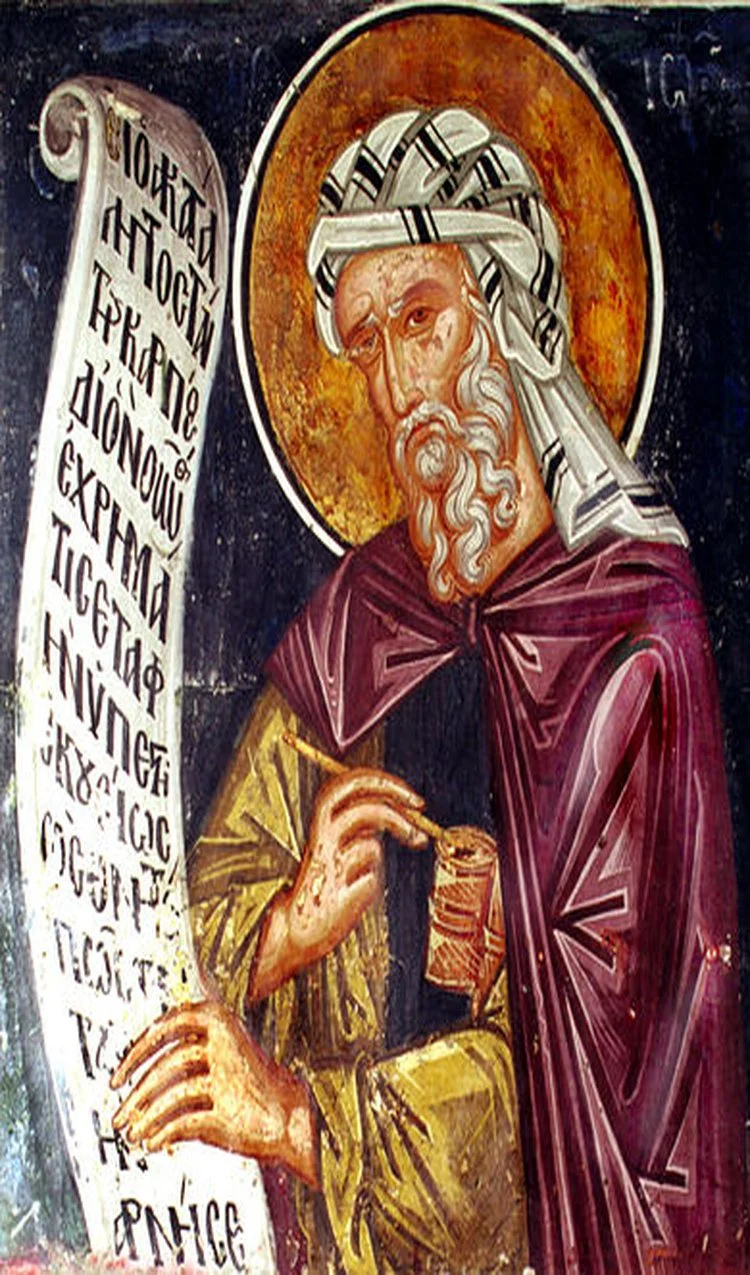
John's most influential argument concerned the holy icons. In his Three Treatises on the Divine Images, he explains that the invisible God cannot be shown according to His divine nature. But the Son of God truly became man, and so Christ may be depicted according to His visible humanity.
He taught that Christians do not worship wood, paint or stone. Honor given to an icon passes to the person it shows, while worship in the strict sense belongs to God alone. John separated this worship from the veneration that may be shown to saints and sacred images.
His first defense of icons is usually dated to about 730. UNCERTAIN: the early course of imperial iconoclasm is still debated among historians. John lived outside the empire, under the caliphs, and so could write with a freedom that theologians in Byzantine lands lacked.
Hymns, Homilies and Their Limits
John is also a major figure of Byzantine hymnography. Orthodox tradition links him with liturgical canons, with Paschal hymns and with the Octoechos, the cycle of eight tones used in Byzantine worship. Historians still study which hymns are truly his and how large his part was in shaping the Octoechos. It would be misleading to credit the whole collection to him.
He also left homilies, including sermons on the Dormition of the Mother of God, a feast loved in Byzantine devotion.
His life of prayer and writing shows how study and worship were joined in the monastery. For John, doctrine was not only for argument, but for singing, and his hymns still carry his theology to people who have never read his books.
Controversy, Islam and the Council of Hieria
John lived under the Umayyad caliphate, when Christians of Syria and Palestine adapted to Muslim rule. His book On Heresies contains one of the earliest Christian discussions of Islam. It is a polemical text, which classes Islam among errors from a Christian viewpoint and does not aim at a neutral description. Modern readers should keep this in mind.
His chief controversy was iconoclasm. Emperor Leo III, who ruled from 717 to 741, is traditionally linked with the first imperial campaign against icons. In 754 the iconoclast Council of Hieria condemned John by name, using his family name Mansur, which shows that his writings were known in Byzantine circles. The Second Council of Nicaea in 787 upheld the veneration of icons and reversed that position.
Pope Benedict XVI, in a general audience of May 6, 2009, linked John's arguments with the teaching of Nicaea II.
Death, Relics and Recognition
UNCERTAIN: the year of John's death is unknown. Traditional lives give about 749 or 750, and Louth places it about 750. The Council of Hieria spoke of him as already dead in 754, which gives a firm limit. The older Catholic Encyclopedia gave a range from 754 to 787, but this does not fit the evidence of Hieria.
Tradition places his burial at the monastery of Saint Sabbas, Mar Saba. UNCERTAIN: the history of his remains and any later movement of relics is not clearly documented, so claims about particular relics need checking against monastery records.
There is no documented formal canonization. His holiness was recognized by veneration in the Eastern Church. Pope Leo XIII proclaimed him a Doctor of the Church in 1890, which honored his authority as a teacher and was not his canonization. His feast is December 4 in Byzantine calendars and in the present Roman calendar, and it was March 27 in older Roman calendars.
The Severed Hand and Other Stories
TRADITION: the best known story says that Emperor Leo III sent a forged letter to the caliph that made John seem a traitor. The caliph ordered John's right hand cut off. John prayed before an icon of the Mother of God, and in the night she restored his hand and told him to keep writing in defense of the faith. The caliph is said to have offered John his office again, but John chose the monastic life. This story appears in later lives and is not confirmed by evidence from John's time.
TRADITION: John is said to have fixed a silver hand to the icon in thanks, and so the icon came to be called the Theotokos of the Three Hands. Orthodox tradition links it with Hilandar Monastery on Mount Athos. The Orthodox Church in America remembers the icon on June 28 and July 12, and these are liturgical dates and not dates for the story.
TRADITION: monastic tales also say that an elder forbade John to write, and that he went to Damascus to sell baskets at a very high price as a lesson in humility. These stories teach obedience and the cure of pride. Their historical details are UNCERTAIN.
Lord Jesus Christ, You became man and made Yourself visible to us. Through the prayers of Saint John of Damascus, teach us to honor Your holy images with reverence, to love the faith of the Fathers, and to sing Your praise with a clear mind and a pure heart. Amen.
This is a short original prayer written for this article. It is not an official liturgical text. The Orthodox Church in America publishes the official troparion for his feast.
Why He Matters to the Eastern Churches
John belonged to the Christian world of the eastern Mediterranean before the later split between East and West, and both traditions honor him. His teaching draws on Scripture, the councils and the Fathers, and so belongs to a shared inheritance.
For Orthodox Christians his defense of icons is basic to understanding sacred images, which rest on the Incarnation. For Byzantine Catholics, his writings and hymns are part of the worship and theology they received. For Catholics more widely, his title of Doctor of the Church shows the place of Eastern theology in the universal Church.
His life also shows that Greek Christian thought grew in lands ruled by Muslim caliphs and not only inside the Byzantine Empire. He is a Syrian, a monk of Palestine and a teacher of the whole Church.
Frequently Asked Questions
Ask His Prayers
Saint John of Damascus is asked for help by teachers, writers, singers and iconographers. You may wish to keep a prayer card of Saint John near you as a reminder to pray for those who teach the faith and make sacred art.
View Prayer Card