Saint Marina the Great Martyr: Virgin Martyr of Antioch in Pisidia, Also Known as Saint Margaret
A young martyr of Asia Minor remembered in East and West under two names
At a Glance
- Name
- Marina in the East, Margaret in the West
- Place
- Antioch in Pisidia, Asia Minor
- Martyred
- UNCERTAIN, traditionally about 270 or about 304
- Feast
- July 17 (Byzantine), July 20 (traditional Latin)
- Title
- Great Martyr, Virgin Martyr
- Patronage
- Women in childbirth (Western devotion)
- Who Was Saint Marina the Great Martyr?
- Early Life and Family
- Her Confession of Christ
- Her Witness and Her Acts
- Trials and Torments in the Story
- Martyrdom and Relics
- The Dragon and the Legends
- How Scholars Read Her Story
- Saint Margaret and Joan of Arc
- Why She Matters to the Eastern Churches
- Frequently Asked Questions
Who Was Saint Marina the Great Martyr?
Saint Marina is a virgin and martyr who has been honored by Christians for well over a thousand years. In the Greek and Slavic East she is Marina, and in the Latin West she is Margaret of Antioch. According to the traditional accounts, she lived in Antioch in Pisidia, a Roman city in Asia Minor, and not in the better known Antioch on the Orontes in Syria.
Her biography is unusually hard to establish. Her martyrdom is often placed around 304, during the persecution under Diocletian, but the Greek Orthodox Archdiocese gives about 270, under the emperor Claudius II. The Catholic Encyclopedia admits that even the century is uncertain. No independent writing from her own time describes her life.
This article therefore separates what is firm from what is legend. The firm part is her ancient and widespread veneration. The details of her story come from later accounts called the Acts or Passion of Marina, and are marked TRADITION. Points that cannot be settled are marked UNCERTAIN.
Early Life and Family
TRADITION: Marina was born at Antioch in Pisidia. Her father is said to have been a pagan priest. Western versions sometimes name him Aedesius, and other versions call him Theodosius. The fact that his name changes shows how hard it is to rebuild her history.
TRADITION: her mother died when she was very small, and her father sent her to be raised by a nurse in the countryside. The nurse was a Christian and introduced the girl to the Gospel. The Orthodox Church in America says she learned of Christ at about twelve, through the nurse or a traveling teacher, while other versions say she was raised Christian from childhood.
TRADITION: when her father found out that she was a Christian, he cast her out, and she stayed with her foster mother and tended sheep. UNCERTAIN: no birth record, family document or contemporary account supports the names of her parents or the details of her childhood. They belong to the hagiographical tradition and are best read as such.
Her Confession of Christ
TRADITION: the story says that Marina heard of the Incarnation, Crucifixion and Resurrection of Christ, and gave herself completely to Him and resolved to remain unmarried. In the hymns of the Church, this is described as being betrothed to Christ, and her devotion is set against the expectation that marriage and social standing should decide a woman's future.
TRADITION: a Roman official named Olymbrius, also written Olibrius, saw her and wanted to marry her. He offered marriage if she would give up Christianity, and when she refused, he tried to force her to offer sacrifice to the Roman gods. At this point the story becomes a contest between loyalty to Christ and the demands of political power.
UNCERTAIN: neither the offer of marriage nor the part played by Olymbrius is confirmed by evidence from her time. Scholars study these scenes as common features of the literature of virgin martyrs, who resisted forced marriage and forced worship, and they do not treat every detail as history.
Her Witness and Her Acts
Marina is not known for founding a monastery, leading a church, writing books or preaching in public. No authentic writings by her survive, and there is no reliable evidence that she held any church office. Her importance rests on her confession of Christianity under pressure and on her death for it.
TRADITION: in the story her chief witness comes at the interrogation, where she refuses to sacrifice to the idols and holds to her faith despite threats. The later accounts give her speeches and prayers, but these were passed down through hagiographical texts and cannot be taken as her own words.
A figure named Theotimos or Theotimus appears in some accounts as the man who wrote down or preserved the story of her martyrdom. The Orthodox Church in America notes that he appears in the Latin Life but not in the Greek Life. UNCERTAIN: no eyewitness manuscript by him has been found, so he should not be described as a proven eyewitness.
Trials and Torments in the Story
TRADITION: after she refused both marriage and sacrifice, Marina was questioned in public, beaten and put in prison, and then tortured more than once. Western versions say that her captors tried to burn her and to plunge her into boiling water, and that she survived these ordeals miraculously before being condemned to die. The Catholic Encyclopedia treats these episodes as claims made in her Acts and not as verified events.
The date of the events also depends on the version. About 304 would put her under the Great Persecution that began in 303, while about 270 would put her under Claudius II. This difference cannot be resolved from the evidence we have, and her date of death must stay UNCERTAIN.
The scholar Juliana Dresvina, in her 2016 study of the Western cult called A Maid with a Dragon, shows that the legend is historically problematic and that independent evidence has not survived. Some scholars also discuss links between the stories of Marina, Margaret and Pelagia, and suggest that literary mixing may have taken place, but these theories do not prove another identity for her.
Martyrdom and Relics
TRADITION: the story ends with her sentence of death by beheading. The Orthodox Church in America places this in 304 and says that a large number of other Christians were killed with her, giving the figure fifteen thousand. UNCERTAIN: this is a claim of the hagiographers and not a verified count, and it should not be repeated as fact. Marina is said to have been fifteen years old, which is also tradition.
TRADITION: the account says that Theotimos buried her body in a Christian shrine. Many places claim relics of her. Orthodox sources mention Constantinople before the Fourth Crusade in 1204, or Antioch until 908 and then a move to Italy. Reports also name a relic of her hand at Vatopedi on Mount Athos and a monastery of Saint Marina near Lake Ohrid. These claims document the history of her cult, but they do not prove that any remains are authentic.
There is no recorded date of a formal canonization in the Catholic Church or of a glorification in the Orthodox Church. Her cult grew in the early centuries, before modern procedures. In 1969 Margaret was removed from the General Roman Calendar because of doubts about the historical basis of her story. That decision did not declare that she had never been a saint.
The Dragon and the Legends
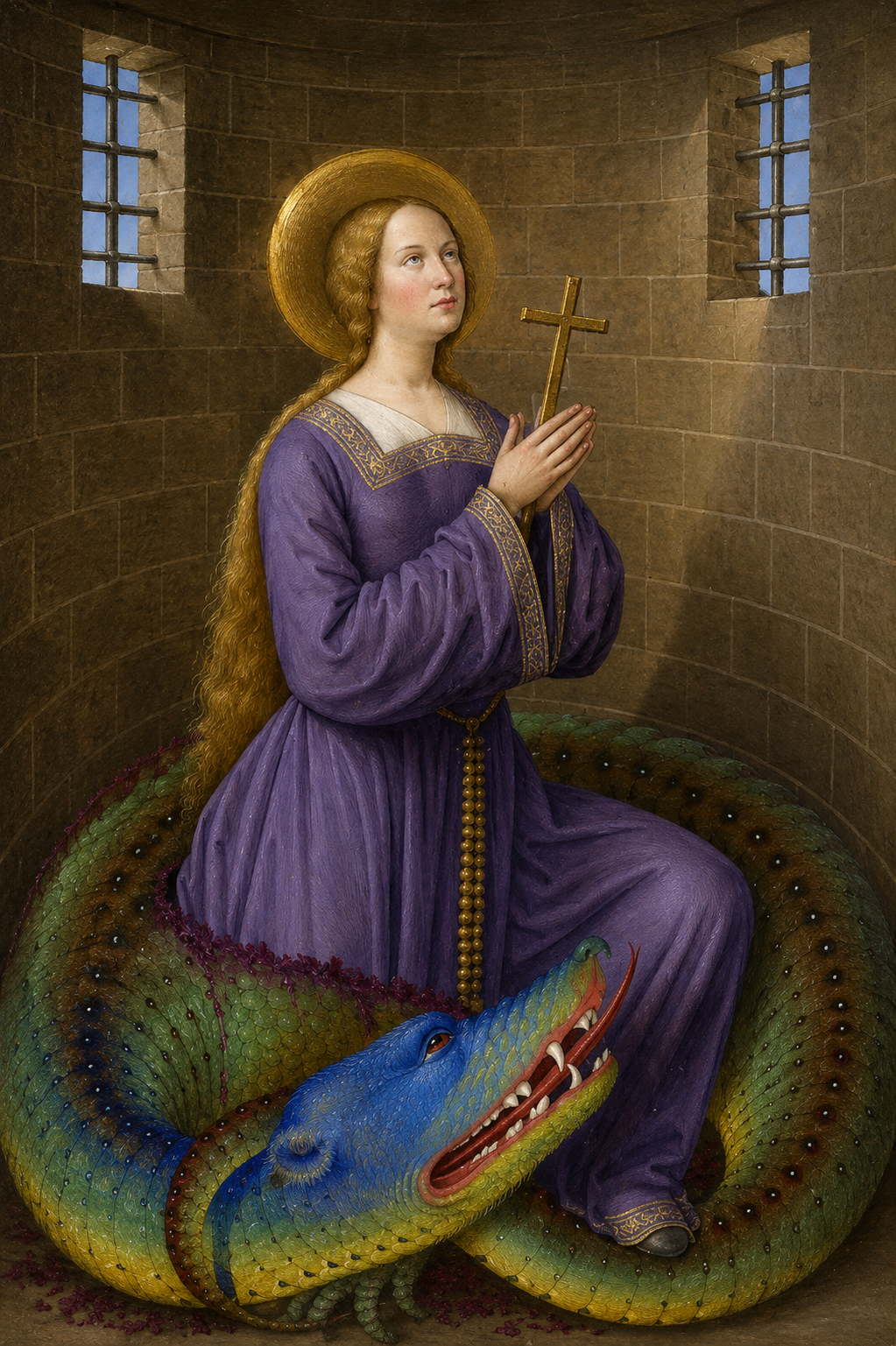
TRADITION: the best known legend says that a dragon appeared in her prison cell. In some Western versions the dragon swallowed her, and the cross she carried made the creature burst open so that she came out unharmed. Other versions show her facing a demon and striking it with a hammer. These scenes explain why she is shown in art with a dragon or a bound demon, and they are not historical events.
The dragon became a Christian symbol of evil overcome by the power of the Cross. In the East, hymns of the Church celebrate her victory over the enemy by the power of God and not by her own strength. TRADITION: some Eastern accounts describe healing in prison, with a radiant cross, a dove and the restoration of her wounded body.
TRADITION: believers also report healings connected with her relics. These are devotional claims and are not medically verified. In the West she became a patron of women in childbirth, because her coming out of the dragon was seen as a sign of a child safely born. Dresvina dates this patronage to about the eleventh century, and Margaret was counted among the Fourteen Holy Helpers.
How Scholars Read Her Story
Historians treat the Passion of Marina as a late literary text. Several Greek and Latin versions exist, and they differ on her father's name, the ruler who condemned her and the number of torments. The differences show that storytellers reshaped the account over centuries.
This does not mean that she never lived. Her cult is old and widespread, and early Christians do not usually build a shrine around an invented person. It means that the firm historical core is small: a young Christian woman of Asia Minor who was put to death for her faith.
Readers of this article are invited to hold both things together. They can honor the saint, ask for her prayers, and still be honest that the dragon, the exact date and the many details belong to tradition and not to documented history.
Saint Margaret and Joan of Arc
Western devotion to Margaret spread widely in the Middle Ages. Churches were dedicated to her, her story was told in many languages, and women prayed to her at the time of childbirth. Her name was given to many girls, and her legend appears often in paintings and stained glass.
Saint Joan of Arc said that she was guided by voices she understood to be Saint Margaret, Saint Catherine of Alexandria and Saint Michael the Archangel. This is recorded in the trial record of Joan, but her experiences remain religious testimony and are not independently verifiable. It helped to keep the name of Margaret alive in the minds of Western Christians.
In the East, the same saint is remembered as Marina and is invoked mainly against demonic affliction and for healing. The difference between the two devotions shows how one early martyr could be remembered in different ways in different Churches.
Lord Jesus Christ, You gave Your servant Saint Marina courage to confess Your name. Through her prayers, protect us from the attacks of the enemy, strengthen the young and the weak, and bring safe delivery to mothers and their children. Keep our hearts faithful to You in every trial. Amen.
This is a short original prayer written for this article. It is not an official liturgical text. The Orthodox Church in America publishes the official troparion and kontakion for her feast.
Why She Matters to the Eastern Churches
Marina remains part of the living liturgical life of the Byzantine tradition. The Orthodox Church in America and the Greek Orthodox Archdiocese keep her feast on July 17, and a Byzantine Catholic parish in California also publishes her commemoration and troparion for that date. Her veneration is therefore shared by Orthodox and Eastern Catholic Christians.
Her hymns focus on three themes: faithfulness to Christ under persecution, the dedication of virginity and martyrdom to Christ as Bridegroom, and the victory over the spiritual enemy through the power of God. These themes stand even though the individual episodes of her story are uncertain.
She also shows how Eastern and Western Christians kept the memory of an early martyr under different names and in different art. For Catholics who follow the Latin calendar, she is Margaret, with a traditional feast on July 20, though she is no longer on the General Roman Calendar.
Frequently Asked Questions
Pray for Mothers and for the Young
Saint Marina is asked for help by mothers and by those who face fear and temptation. You may wish to keep a prayer card of Saint Marina near you as a reminder to pray for mothers, for children and for the faithful who are tested.
View Prayer Card