Saint Nino of Georgia: Equal-to-the-Apostles, Enlightener of Iberia and Bearer of the Grapevine Cross
The captive Christian woman remembered as the one who brought Georgia to the faith
At a Glance
- Lived
- Fourth century, Kingdom of Iberia (eastern Georgia)
- Birth
- UNCERTAIN, traditionally Cappadocia
- Death
- UNCERTAIN, traditionally about 335, at Bodbe
- Feast
- January 14 (January 27 on the civil calendar for the Julian calendar)
- Title
- Equal-to-the-Apostles, Enlightener of Georgia
- Shrine
- Bodbe Monastery, near Sighnaghi
- Who Was Saint Nino of Georgia?
- Early Life and Family
- Her Calling and Journey to Iberia
- The Conversion of the Royal House
- Mtskheta, the Pillar and the Robe
- Writings and the Georgian Sources
- History, Politics and Open Questions
- Death, Burial and Veneration
- Traditions and Devotion
- Why She Matters to the Eastern Churches
- Frequently Asked Questions
Who Was Saint Nino of Georgia?
Saint Nino, also written Nina, is the saint who is credited with bringing the Kingdom of Iberia, in what is now eastern Georgia, to the Christian faith in the fourth century. The Georgian Church honors her as the Enlightener of Georgia and as Equal-to-the-Apostles. That title honors the apostolic character of her work, and it does not mean that she belonged to the original Twelve.
Her story rests on two layers of evidence. The earliest account, by the historian Rufinus of Aquileia around the years 402 and 403, describes a Christian captive woman among the Iberians, but it gives her no name. The name Nino and the long biography about her childhood, family and travels come from Georgian writings that were put into their present form centuries after her time.
This article keeps those layers apart. What the early sources support is stated plainly. Later Georgian details are marked TRADITION, and points that cannot be settled are marked UNCERTAIN.
Early Life and Family
The Georgian biography says that Nino was born in Cappadocia in Asia Minor. It names her father as Zabulon, a Roman military officer, and her mother as Sosana, from a distinguished Christian family. Some versions say she was related to Saint George, and that her mother was the sister of Juvenal, Patriarch of Jerusalem. UNCERTAIN: none of this is supported by evidence from her own time. The historical Juvenal lived in the fifth century, which is later than the period given for Nino, so that link causes a clear problem of dates.
According to the version summarized by the Orthodox Church in America, her parents moved to Jerusalem. Her father became a monk and her mother served the Church as a deaconess. Nino was placed in the care of an elderly Christian woman named Sara Niaphor, who taught her the Scriptures and the faith.
TRADITION: Sara told her about the robe that Christ wore before the Crucifixion, which Georgian tradition says was carried to Mtskheta. This story links Jerusalem, the Passion of Christ and Georgia. Rufinus gives no name, no family and no childhood for the woman he describes, so the biography in the Georgian books is the memory of the Church and not a record that can be checked.
Her Calling and Journey to Iberia
There is no evidence that Nino came to Christianity from another religion. Both the early account and the Georgian tradition present her as a Christian when her mission began.
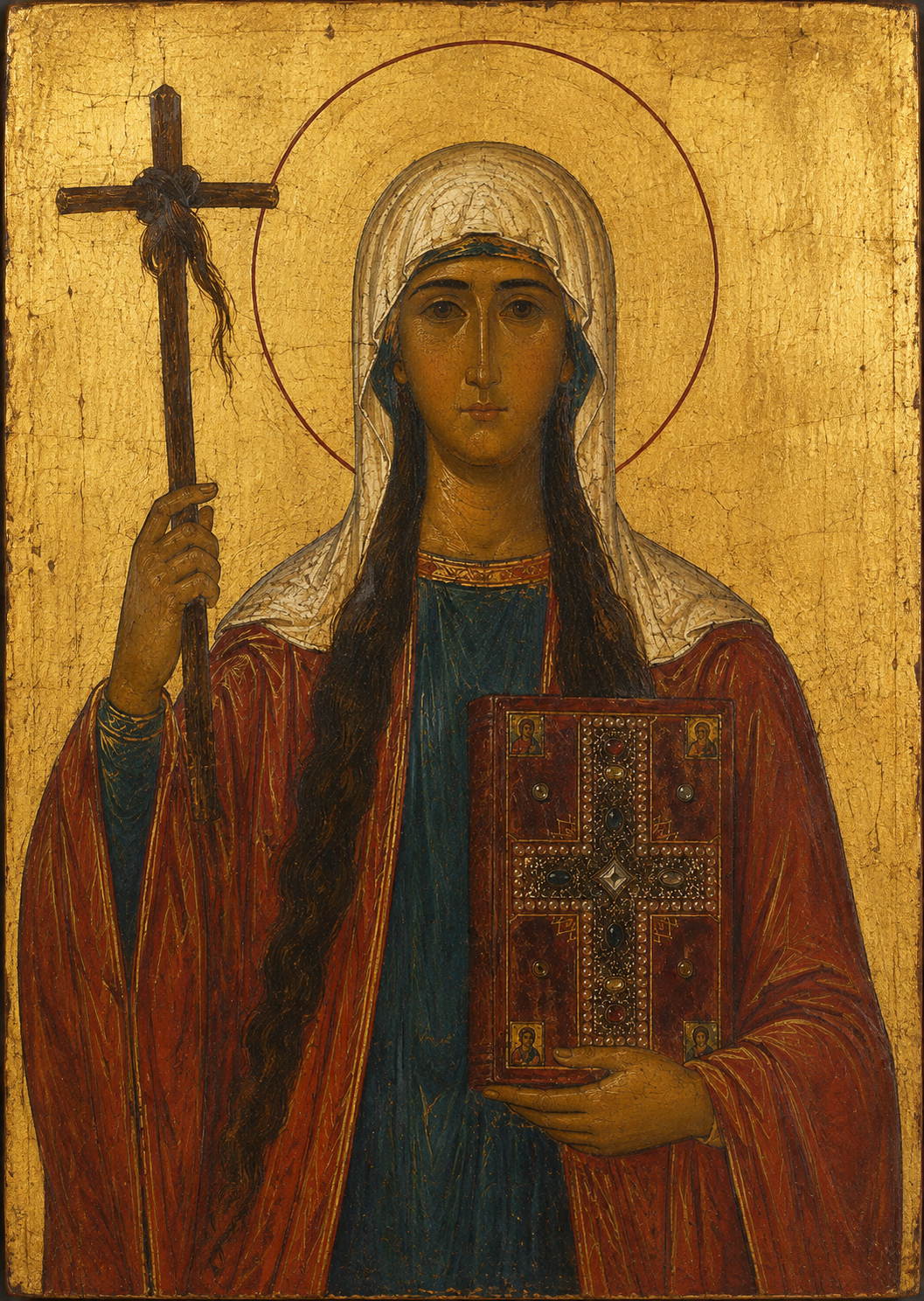
TRADITION: The Georgian account says she prayed to the Mother of God for leave to go to Georgia to venerate the robe of Christ and to preach the Gospel. The Virgin appeared to her in a dream, sent her to evangelize the country and gave her a cross made of grapevine branches, which Nino bound with strands of her own hair. This cross, with its drooping arms, became the sign of Georgian Christianity.
TRADITION: Some Georgian narratives place her in the company of the Christian women Rhipsime and Gaiane, who were martyred in Armenia, and say that Nino escaped and passed by Lake Paravani on the way to Mtskheta. UNCERTAIN: the route, the dates and the link with the Armenian martyrs cannot be confirmed. Rufinus supports only the broad picture of a Christian woman living as a captive among the Iberians, whose fasting, chastity and prayer drew attention.
The Conversion of the Royal House
According to Rufinus, a family brought a sick child to the Christian woman, because the local custom was to ask any passerby for a cure. She prayed to Christ, and the child recovered. The report reached the queen, who was ill, and after she was healed she accepted the Christian faith.
The king at first held back. Rufinus says he became lost in a strange darkness while hunting, called on the Christ of the woman, and found his way out in the light. He then supported Christian worship. Later Georgian tradition names these rulers as King Mirian III and Queen Nana. UNCERTAIN: the year when Christianity became the royal religion is given as 326, 327 or 337 in different accounts, and none of these should be called certain.
After the royal conversion the king asked the Roman emperor for clergy, and churches were built. This fits the larger picture of Christianity spreading beyond the Roman frontier. The influence of the woman did not come from wealth or office. Rufinus stresses that she had neither, and her influence grew from prayer, healing and example.
Mtskheta, the Pillar and the Robe
Nino is linked with the first Christian community of Mtskheta and with the place where the cathedral of Svetitskhoveli later stood. Its name means life giving pillar. The buildings seen today belong to many later centuries and should not be credited to her.
TRADITION: Rufinus and later Georgian writers tell that workmen could not raise a heavy column for a new church, and that after the woman prayed through the night it rose into place. This story became central to the religious memory of Svetitskhoveli. It is a report of a miracle and it cannot be tested.
TRADITION: Georgian sources say that Nino spoke with the Jewish community of Mtskheta, whose memory was tied to the robe of Christ, and that the robe lies at Mtskheta. UNCERTAIN: the origin and path of the robe cannot be established. Georgian scholars still study how these stories developed.
Writings and the Georgian Sources
No writings by Nino herself survive. Later Georgian texts such as the Conversion of Kartli and the Life of Saint Nino contain speeches and prayers that are said to be hers, and even an account in her own voice, but these cannot be treated as words of the fourth century. Their manuscripts come from a much later time, and scholars such as Zaza Alexidze have shown how complicated their development was.
These books still have great value. They hold the memory of the Georgian Church and also its political and theological ideas. The honest approach is to read them as witnesses of tradition and not as eyewitness history.
The early Greek and Latin historians, among them Rufinus, Socrates Scholasticus and Theodoret, tell the story of the conversion of the Iberians through a captive woman. They depend on one another, and Rufinus is the most detailed of them.
History, Politics and Open Questions
Nino's mission took place in a region shaped by Roman, Persian, Armenian and local Iberian influences. Iberia was not the same as all of modern Georgia. Its royal center was Mtskheta, and its position between the two great powers made religious loyalty a political matter. Christianity had already reached the Caucasus, and Armenian Christianity and contacts with the Roman world helped to prepare the conversion.
The Georgian Church also keeps a tradition that the apostles Andrew and Simon preached in its lands. This is important to Georgian identity, but its details are UNCERTAIN. TRADITION: later narratives say Nino faced the pagan cult of Armazi near Mtskheta, and that a violent storm broke the idols after her prayer. This should be treated as hagiography and not as a documented event.
Modern scholars also ask what it meant that she was a captive, and how far the later books reflect the needs of later centuries. The plain conclusion is that the Christianization of Iberia is real history, while the sequence of events found in the medieval accounts includes religious memory and symbolism.
Death, Burial and Veneration
According to Georgian tradition, Nino spent her last years in Kakheti and died at Bodbe. UNCERTAIN: the Greek Orthodox Archdiocese gives about 335, while other Georgian accounts give later dates such as 347, and no contemporary record settles the matter.
TRADITION: she asked to be buried at Bodbe. King Mirian wished to move her body to Mtskheta, but the coffin could not be moved, and so her wish was kept. A church of Saint George is linked with the burial place. Bodbe is today a major place of pilgrimage near Sighnaghi. The monastery was closed under Soviet rule in 1924, and monastic life came back after the Soviet period.
Georgian tradition also honors a grapevine cross as a national relic and says it is kept at Sioni Cathedral in Tbilisi. UNCERTAIN: the history of the surviving cross cannot be traced to the fourth century. There is no formal canonization date, because her veneration grew in the early Georgian Church before modern procedures. Her feast is January 14 in calendars that use fixed dates, which is January 27 on the civil calendar for churches that keep the Julian calendar, and a second commemoration of her arrival in Georgia is kept in May.
Traditions and Devotion
The earliest reports of healings are the sick child and the ill queen in the account of Rufinus. They are written reports of miracles, and no medical record exists. The lost king and the returning light are in the same account, and they remain religious testimony.
TRADITION: pilgrims link Nino's tomb and a nearby spring at Bodbe with healing and spiritual renewal. These are signs of continuing devotion and should not be mistaken for medically confirmed cures.
The grapevine cross has become one of the best known signs of Georgian Christianity. Georgian Christians value it as a sign of her mission and of the country's faith, and Georgian churches often use its shape. The legend of its giving is TRADITION, while its place in the life of the nation is a historical fact.
Lord Jesus Christ, You called Your servant Saint Nino to carry Your Gospel to a distant land. Through her prayers, strengthen all who share the faith with others by prayer and patient example. Keep Your people united, bless the land of Georgia, and give us courage to carry the cross in simple ways. Amen.
This is a short original prayer written for this article. It is not an official liturgical text. The Orthodox Church in America publishes the official troparion and kontakion for her feast.
Why She Matters to the Eastern Churches
Nino lived long before the separation between the Catholic and Orthodox Churches. She belongs to the early Christian heritage that both traditions remember. For the Georgian Orthodox Church she is the national enlightener, and her work is tied to the beginning of a lasting Christian nation.
Catholic readers also have reason to honor her. The Holy See reports that Pope John Paul II spoke of her role in the conversion of the Georgian king and people when he visited Georgia in November 1999, and that Pope Francis spoke of her and her grapevine cross when he met Patriarch Ilia II in Tbilisi in 2016.
For Eastern Catholics she is an example of how the Gospel crossed the Roman frontier and took root in local language and worship. We found no evidence that she is the formal patron of any particular Eastern Catholic Church, and no such claim is made here.
Frequently Asked Questions
Carry the Cross With Patience
Saint Nino reminds us that faith can be passed on quietly. You may wish to keep a prayer card of Saint Nino of Georgia near you as a reminder to pray for the Georgian people and for all who share their faith.
View Prayer Card