Saint Raphael of Brooklyn: First Orthodox Bishop Consecrated in North America and Shepherd of Arab Immigrants
The Syrian Orthodox priest from Damascus and Beirut who gathered scattered believers across America
At a Glance
- Born
- 1860, Beirut, to a family from Damascus (exact date unknown)
- Died
- February 14, 1915 (Julian), February 27 (Gregorian), Brooklyn
- Arrived in America
- November 2, 1895, New York
- Consecrated Bishop
- 1904, Saint Nicholas Cathedral, Brooklyn
- Glorified
- March 29, 2000, Orthodox Church in America
- Feast
- February 27 (Orthodox)
- Who Was Saint Raphael of Brooklyn?
- Early Life and Family
- From Halki and Kiev to Moscow
- Founding a Mission in America
- Bishop of Brooklyn
- Books, Magazine and the Use of English
- Disputes and Hard Questions
- Death, Burial and Glorification
- Traditions and Devotion
- Why He Matters to the Eastern Churches
- Frequently Asked Questions
Who Was Saint Raphael of Brooklyn?
Saint Raphael of Brooklyn, born Raphael Hawaweeny (in Arabic, Rafla Hawaweeny), was a priest and bishop of the Orthodox Church who helped to build organized Orthodox life among Arabic speaking immigrants in North America. His family came from Damascus, he was born in Beirut, and he was educated in Constantinople and Russia before he crossed the Atlantic.
He arrived in New York in 1895, founded a chapel, traveled across the continent to find scattered believers, published books in Arabic, and in 1904 was consecrated Bishop of Brooklyn. He is often called the first Orthodox bishop consecrated on North American soil. That is a precise claim, because other Orthodox bishops had worked on the continent before him, especially in Alaska.
His life is documented in church records and in the official biography of the Orthodox Church in America. Some details still differ between accounts, and those points are marked UNCERTAIN in this article. Devotional reports are marked TRADITION.
Early Life and Family
Raphael was born in 1860, most likely in Beirut, to Michael Hawaweeny and his second wife Mariam, the daughter of an Orthodox priest from Damascus. His family had left Damascus in the violence against Christians that year. The Orthodox priest Saint Joseph of Damascus was among those killed. UNCERTAIN: the exact day of his birth is not known. November 8 and November 20 appear in different accounts, and a few biographies name Damascus as the birthplace, while the official glorification text supports Beirut.
He was baptized Rafla at Theophany in 1861, and the family later returned to Damascus. He showed academic ability as a boy, and in 1874 money problems threatened his schooling. Deacon Athanasius Atallah, later Metropolitan of Homs, recommended him for support through the Patriarchate of Antioch.
He became a teaching assistant in 1877 and taught Arabic and Turkish in 1878. On March 28, 1879, Patriarch Hierotheus tonsured him a monk, and he then served as the patriarch's attendant, which gave him experience of church administration.
From Halki and Kiev to Moscow
There is no record of a conversion from another faith. Raphael was raised Orthodox and stayed Orthodox. His path was a monastic and priestly calling. The theological school at Balamand had closed in 1840, so he studied instead at the Orthodox school on Halki near Constantinople. He was ordained deacon on December 8, 1885 and finished his studies in 1886.
He then studied at the Kiev Theological Academy and was ordained priest in 1889. He became an archimandrite and took charge of the Antiochian representation church in Moscow.
A dispute over leadership in the Patriarchate of Antioch became a turning point. Raphael argued for more native Arab clergy in a hierarchy then led mainly by Greek bishops. After a period of suspension and its later resolution, he moved to Russian church jurisdiction and taught Arabic at the Kazan academy. His decisive step came in 1895, when a Syrian Orthodox society in New York asked for a priest. Raphael accepted and arrived in New York on November 2, 1895.
Founding a Mission in America
Raphael found Arabic speaking Orthodox immigrants scattered over a very large area with few priests. Soon after his arrival he opened a chapel dedicated to Saint Nicholas in Manhattan. He saw that a community needs more than a visit. It needs priests, permanent churches, the sacraments, religious teaching and contact with other communities.
In the summer of 1896 he made a missionary journey through about thirty cities between New York and San Francisco. He celebrated the Divine Liturgy in homes, baptized children, blessed marriages, heard confessions and organized parishes. Further journeys followed in 1898 and 1899. He brought qualified priests from Syria and looked for men who could be ordained, always under the authority of the Russian Orthodox bishops of North America.
The official glorification text credits him with founding thirty parishes, and the Orthodox Church in America estimates about 25,000 members of the mission by his death. UNCERTAIN: a Greek Orthodox biography gives thirty-six parishes, and these are church estimates and not figures taken from parish registers.
Bishop of Brooklyn
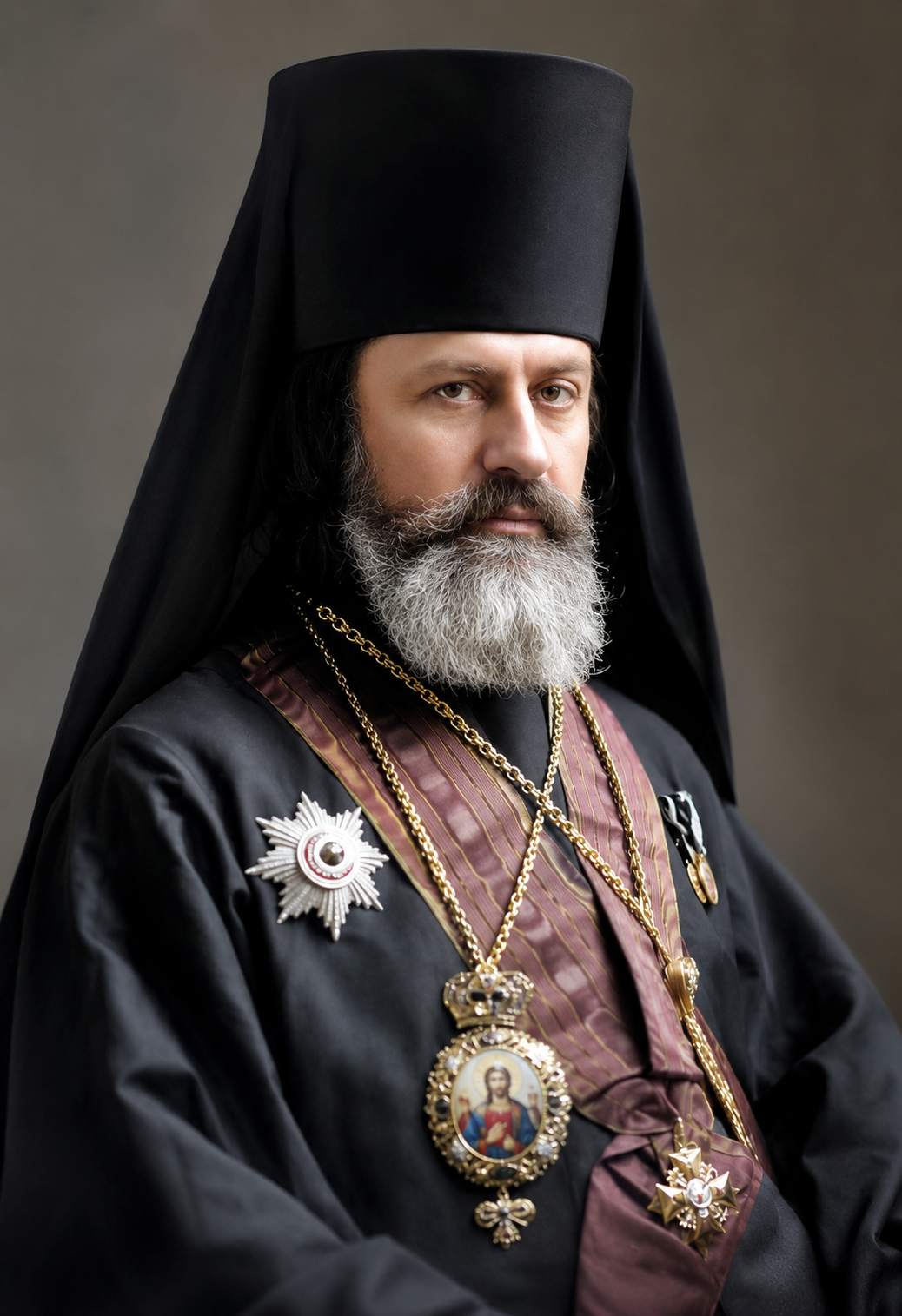
In 1903 the Russian Holy Synod chose Raphael as Bishop of Brooklyn, while he kept care of the Syro-Arab Mission. He was consecrated on the third Sunday of Lent in 1904 at Saint Nicholas Cathedral in Brooklyn by Bishop Tikhon, the future Patriarch of Moscow, together with another bishop. He served as an auxiliary bishop in the Russian Orthodox diocese.
Books, Magazine and the Use of English
He understood the value of the written word. In 1898 he issued an Arabic service book, The Book of True Consolation in the Divine Prayers. In January 1905 he began the Arabic magazine Al-Kalimat, The Word, which offered teaching, news and church announcements and became part of Antiochian Orthodox life in America.
He also supported teaching and the gradual use of English in worship. He recommended Isabel Hapgood's English service book, because the American born children of immigrants might not understand the languages of their parents. In this way he worked for both the old language and the new one.
These efforts were practical and pastoral. Raphael did not write a large theological work. His lasting writings are service books, a magazine, letters and pastoral instructions, and they show a bishop who wanted ordinary believers to understand the faith they prayed.
Disputes and Hard Questions
Raphael's work took place in a time of immigrant poverty, distance, rivalry and arguments about authority. During his years in Russia he criticized Greek dominance in the Antiochian hierarchy. After the election of Patriarch Spyridon in 1891, he refused to commemorate him in the liturgy and was suspended. UNCERTAIN: the official biography records accusations about how that election was won, but those charges should not be treated as proven without independent evidence. The suspension and later reconciliation are better established.
His attitude toward Anglicans also changed. He first allowed limited help from Episcopal clergy for isolated Orthodox believers. After studying Anglican teaching, he decided the permission had been misunderstood. In a pastoral letter of 1912, he withdrew it and told the faithful to receive the sacraments in the Orthodox Church. The letter survives in a later collection. It shows the difference between friendly cooperation among Christians and sacramental communion.
His work was also done inside the Russian church structure, before the many overlapping Orthodox jurisdictions of today appeared. For this reason he is better described as a leader of a multiethnic mission than as the head of a separate Antiochian church in America. UNCERTAIN: a Greek Orthodox biography mentions a criminal accusation against him that was later dropped, but the dates and records are not clear, so we do not describe the case.
Death, Burial and Glorification
In late 1912 Raphael developed heart trouble. He went on traveling to parishes in 1913 and 1914, and in early 1915 he stayed at home in Brooklyn during his last illness. He died on February 14, 1915 by the Julian calendar, which is February 27 by the Gregorian calendar. Accounts give slightly different times.
His funeral was held at Saint Nicholas Cathedral on March 7, 1915. He was first buried in a crypt, moved to Mount Olivet Cemetery in 1922, and moved again to Antiochian Village near Ligonier, Pennsylvania, on August 15, 1988. The Holy Synod of the Orthodox Church in America proclaimed him a saint on March 29, 2000, with celebrations at Saint Tikhon's Monastery on May 28 and 29. The act called his remains holy relics.
The Antiochian Archdiocese also reports a translation and washing of his relics at Antiochian Village on July 18, 2024. His feast is February 27. Other communities remember him on other days, for example on the first Saturday of November in Antiochian usage, so readers should follow the calendar of their own church.
Traditions and Devotion
The Church honors Raphael for his holiness, his pastoral service and his lasting influence, and the glorification text does not rest on a list of investigated miracles. TRADITION: Orthodox services ask for his prayers and speak of healing. These are devotional statements and not medical conclusions.
TRADITION: one Orthodox publication says his remains were partly incorrupt when moved to Pennsylvania. UNCERTAIN: we found no medical or forensic record, so this should be read as a church tradition and not as a scientific finding.
Devotion to him is shown in his hymns, in the veneration of his relics and in parishes named for him. We did not find a collection of verified miracles. He should not be confused with Saint Raphael of Lesbos, a different saint whose miracle stories belong to another tradition.
Lord Jesus Christ, Good Shepherd, You search for the scattered and bring them home. Through the prayers of Your servant Saint Raphael, watch over those who live far from their homeland, and strengthen all who serve them as pastors and teachers. Give us hearts that welcome the stranger and keep faith across every language. Amen.
This is a short original prayer written for this article. It is not an official liturgical text. The Orthodox Church in America publishes the official troparion and kontakion for his feast.
Why He Matters to the Eastern Churches
For Orthodox Christians, Raphael is an example of mission that crosses ethnic lines. He served Arabic speaking people, worked with Russians and Greeks, and helped to join them in one church structure. He also showed that immigrants could keep their inherited faith while introducing English in teaching and worship.
For Eastern Catholics, especially those from the Antiochian tradition, his story is valuable for the study of migration and of Arabic liturgical heritage outside its homelands. It is important to say clearly that he was an Orthodox bishop and not an Eastern Catholic one, and his views on communion and on sacraments given outside the Orthodox Church were not the same as Catholic teaching.
We found no Catholic canonization and no place for him in the Roman calendar. His glorification was an act of the Orthodox Church in America, and Catholic readers can admire his pastoral work without hiding those differences.
Frequently Asked Questions
Pray for the Stranger
Saint Raphael invites us to look for those who are far from home. You may wish to keep a prayer card of Saint Raphael of Brooklyn near you as a reminder to pray for immigrants and for those who serve them.
View Prayer Card