Saints Peter and Paul: The Holy Apostles, Pillars of the Church and Martyrs of Rome Honored Together on June 29
Two very different apostles, a fisherman from Galilee and a Pharisee from Tarsus, remembered together as witnesses to Christ in Rome
At a Glance
- Peter
- Born Simon at Bethsaida in Galilee; death in Rome under Nero, traditionally 64 to 68, by crucifixion (UNCERTAIN date)
- Paul
- Born Saul at Tarsus in Cilicia; death in Rome under Nero, traditionally by beheading (UNCERTAIN date)
- Titles
- Peter, Prince of the Apostles; Paul, Apostle to the Gentiles
- Feast
- June 29 in the Catholic and Orthodox calendars; on churches using the Julian calendar it falls on July 12 on the civil calendar
- Veneration
- Honored from the earliest centuries; no formal canonization or glorification date exists
- Patronage
- Together, the city of Rome; Peter, fishermen; Paul, missionaries
- Who Were Saints Peter and Paul?
- Early Life and Family
- The Call of Peter and the Conversion of Paul
- Peter in Jerusalem, Antioch and Rome
- Paul, the Missionary and Letter Writer
- Disagreement, Persecution and the Roman World
- Martyrdom and the Two Tombs
- Miracles, Legends and Devotion
- Prayer and Pilgrimage Today
- Why They Matter to the Eastern Churches
- Frequently Asked Questions
Who Were Saints Peter and Paul?
Peter and Paul stand at the head of the apostolic age. Peter belonged to the Twelve whom Jesus called during His earthly ministry, and the Gospels show him as the disciple who often spoke first. Paul was not one of the Twelve. He first persecuted the Church, then met the risen Christ and became its most traveled missionary and its earliest great letter writer.
Both are honored as apostles and martyrs, and both are linked in Christian memory with the city of Rome. The Catholic Church and the Orthodox Churches keep their joint feast on June 29. The feast does not claim that they died on the same day, and the evidence does not show that they did. It honors two witnesses who together stand for the unity of the apostolic faith.
This article draws mainly on the New Testament and on early Christian writers. It marks what is certain from those sources, what is UNCERTAIN, and what belongs to TRADITION, such as stories first told in later writings.
Early Life and Family
Peter was born Simon, the son of John, also called Jonah in Matthew, and came from Bethsaida on the Sea of Galilee. He later lived in Capernaum and worked as a fisherman with his brother Andrew. The Gospels mention his mother-in-law, and Paul refers to Cephas, which is Peter's Aramaic name, traveling with a believing wife. His birth year is UNCERTAIN.
Paul was born Saul in Tarsus, a major city of Cilicia in what is now southern Turkey. He writes that he was an Israelite of the tribe of Benjamin and a Pharisee, and Acts says he was a Roman citizen by birth and studied in Jerusalem under Gamaliel. Acts also says he worked as a tentmaker. His birth year, his parents and his marital history are UNCERTAIN.
The two men could hardly have started from more different places. One was a working fisherman of the Galilean countryside, and the other an educated city Pharisee at home in the Greek speaking world. Both ended up speaking for the same Lord to the same wider world.
The Call of Peter and the Conversion of Paul
In the Gospel of John, Andrew brings his brother to Jesus, who gives him the name Cephas, rendered Peter, meaning rock. The other Gospels show Jesus calling him from his boat. Peter then stood among the closest disciples at the raising of Jairus's daughter, the Transfiguration and the prayer in Gethsemane. At Caesarea Philippi he confessed Jesus as the Christ, the Son of the living God.
Peter also failed. In the hours of the Passion he denied that he knew Jesus three times. After the Resurrection the Gospel of John tells of Jesus asking him three times whether he loved Him and commissioning him to feed His sheep. For many Christians this scene is a lasting picture of repentance and forgiveness.
Saul was present at the stoning of Stephen and describes himself in his own letter to the Galatians as a persecutor of the Church. Acts tells of his encounter with the risen Christ on the road to Damascus, his blindness and his baptism through Ananias, and Paul himself points to a revelation of Christ. The year is UNCERTAIN. Scripture does not say that Saul was renamed at that moment. Acts says he was also called Paul.
Peter in Jerusalem, Antioch and Rome
After Pentecost, Peter became a leading voice of the Church in Jerusalem. Acts records his preaching, the baptism of about three thousand people, the healing of a man at the Temple gate, and his defense of the apostolic message before the authorities. He later worked in Lydda and Joppa, where Acts tells of the healing of Aeneas and the raising of Tabitha.
In Acts 10 a vision led Peter to the house of the centurion Cornelius, and the Holy Spirit came upon that Gentile household. This became a turning point, because it showed that Gentiles could receive the Gospel without first becoming Jewish. Peter took part in the discussion of Acts 15 about this question.
Tradition places Peter at Antioch and then in Rome. Early witnesses support his presence in Rome, but the length and dates of his stay are UNCERTAIN. Two letters in the New Testament bear his name. The Churches receive both as Scripture, while modern scholars debate how they were composed, and the authorship of Second Peter in particular is more doubted.
Paul, the Missionary and Letter Writer
Paul traveled through Cyprus, Asia Minor, Macedonia and Greece, and Acts describes his work in cities such as Philippi, Thessalonica, Corinth and Ephesus. He taught, appointed leaders, wrote to the communities he had founded, and answered questions about worship, morality, unity and the resurrection.
Thirteen New Testament letters carry his name. Scholars broadly agree that seven are authentic: Romans, First and Second Corinthians, Galatians, Philippians, First Thessalonians and Philemon. Others, including Ephesians, Colossians, Second Thessalonians, First and Second Timothy and Titus, are disputed. The Letter to the Hebrews was long linked with Paul, especially in the East, but its author is unknown.
Paul did not walk with Jesus during His earthly ministry, so he defended his apostleship by pointing to his meeting with the risen Lord. He also organized a collection among his Gentile communities for the poor in Jerusalem. That gift expressed his belief that Jewish and Gentile believers belonged to one body.
Disagreement, Persecution and the Roman World
The two apostles worked in a time when the Church was still taking shape within Judaism and spreading through the Roman Empire. A major question was whether Gentile believers needed to be circumcised and follow the Law of Moses. Acts 15 describes a council at Jerusalem that decided not to impose circumcision on them.
The New Testament does not hide that apostles could disagree. In Galatians Paul says that he opposed Peter at Antioch because Peter had withdrawn from eating with Gentile believers. Paul also writes that he visited Peter in Jerusalem, so the two knew each other personally. The sources show a disagreement within a shared mission, not a break between them.
Both men met danger. Acts tells of Peter being imprisoned and released, and Paul lists beatings, prison and shipwreck in his letters. The Roman historian Tacitus describes Nero punishing Christians after the fire of Rome in 64, but he does not name Peter or Paul. First Clement, written near the end of the first century, holds up both apostles as examples of endurance.
Martyrdom and the Two Tombs
Early writers agree that both apostles died in Rome under Nero, and Ignatius of Antioch and Irenaeus mention them together in connection with the Roman Church. Eusebius of Caesarea, writing in the fourth century, reports that Peter was crucified and Paul was beheaded. The exact years and days are UNCERTAIN, and the traditional range is 64 to 68. Acts ends before Paul's death.
TRADITION: Peter asked to be crucified upside down because he felt unworthy to die as Christ did. Eusebius reports this through the earlier writer Origen, but the New Testament does not mention it. Peter's traditional tomb lies beneath the high altar of Saint Peter's Basilica in Vatican City, where excavations found an early memorial that drew pilgrims before the time of Constantine.
Paul's traditional tomb lies beneath the Basilica of Saint Paul Outside the Walls on the Ostian Way. In 2009 Pope Benedict XVI reported that tests on bone fragments from the sarcophagus gave a date between the first and second centuries. UNCERTAIN: that fits the tradition but does not prove that the remains are Paul's. The same caution applies to the remains under Saint Peter's. The joint feast is very old, and the Roman calendar of 354 records a June 29 commemoration whose exact origin is UNCERTAIN.
Miracles, Legends and Devotion
The New Testament tells of miracles through both apostles, including the healing at the Temple gate and the raising of Tabitha by Peter, and the healing at Lystra and the restoring of Eutychus by Paul. These are the Church's scriptural accounts of what God did through them, not findings from independent historical research.
TRADITION: a later work known as the Acts of Peter tells of Peter meeting Christ on the Appian Way while leaving Rome, and Christ saying He was going to be crucified again. This is the story known as Quo Vadis, and it should not be treated as established history. TRADITION: Paul's head struck the ground three times, producing three springs at the site called Tre Fontane in Rome, a detail not found in the earliest witnesses.
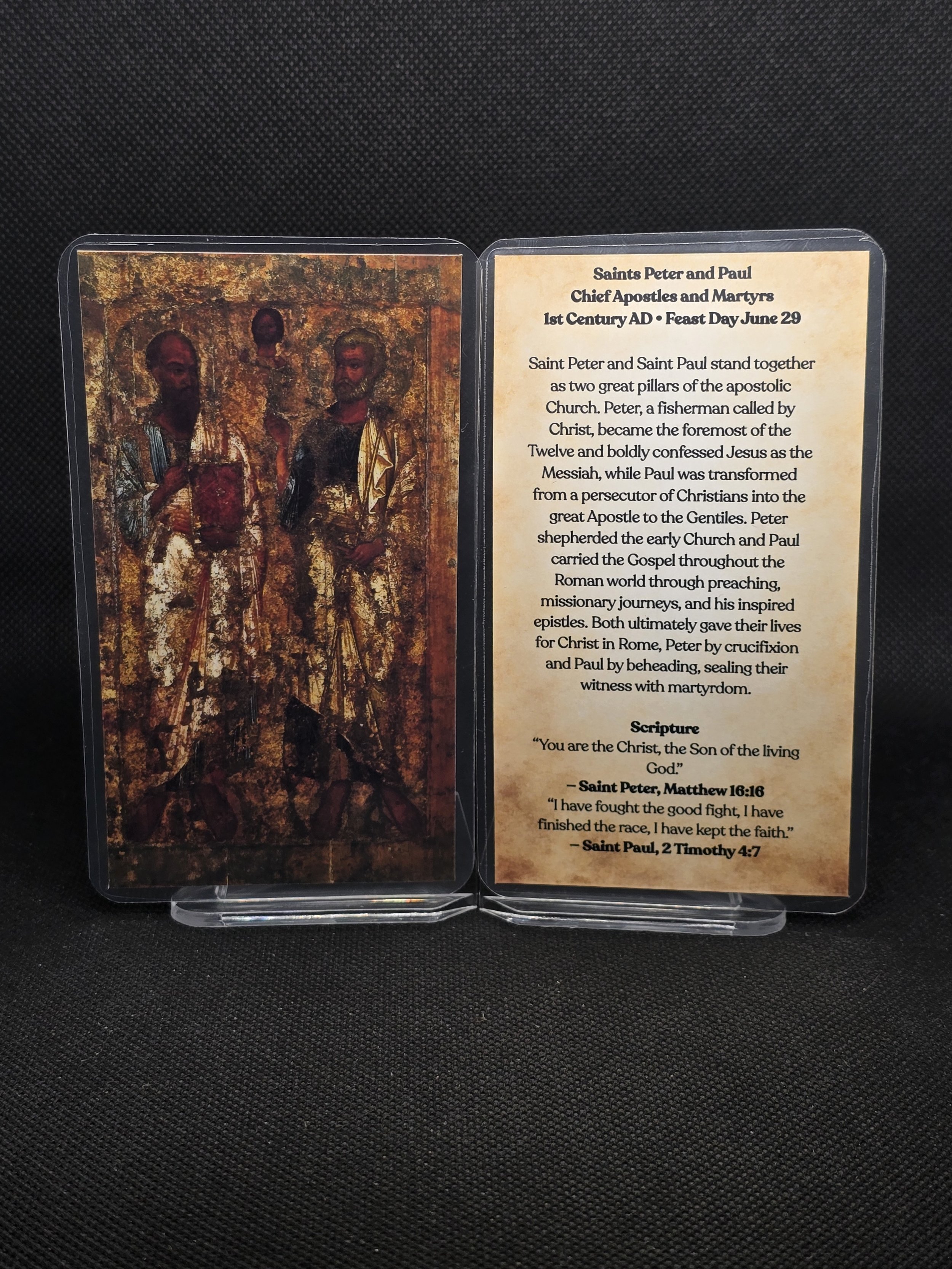
Christian art shows Peter with keys, from the words of Jesus in Matthew 16, and Paul with a book or sword, for his teaching and for the manner of his death. Icons often show the two apostles embracing or holding up a church between them, a sign that their different gifts served one faith. Their example of failure forgiven and zeal redirected has encouraged Christians for centuries.
Prayer and Pilgrimage Today
Pilgrims still travel to Rome to pray at Saint Peter's Basilica and at Saint Paul Outside the Walls. The feast of June 29 is the patronal feast of Rome, and the Orthodox Churches keep the day after a fast known as the Apostles' Fast.
On churches that follow the Julian calendar for fixed feasts, the feast falls on July 12 on the civil calendar. The Orthodox Churches also keep a gathering of the twelve apostles on the following day in the Church calendar, June 30.
The Orthodox Church in America publishes the official troparion and kontakion for the feast, and this site does not reproduce those texts. Below is a short original prayer for those who wish to ask the apostles to pray for them.
Holy apostles Peter and Paul, you loved Christ and gave your lives for Him. Pray for us, that we may be faithful when we fail, brave in sharing the Gospel, and united with those who differ from us. Teach us to trust in the Lord, who forgave Peter and called Paul. Amen.
This is a short original prayer written for this article. It is not an official liturgical text. The Orthodox Church in America publishes the official troparion and kontakion for the feast of June 29.
Why They Matter to the Eastern Churches
Peter and Paul are among the foremost saints of the Byzantine tradition, and the Orthodox and Eastern Catholic Churches keep their feast on June 29. Their sanctity is not a Catholic or Orthodox possession, because it comes from the first generation of the Church, before the later separations.
Catholics and Orthodox differ over how Peter's place among the apostles relates to the Bishop of Rome. Catholics see it as the basis for the pope's universal ministry. Orthodox Christians honor Peter as first among the apostles but generally do not accept the Catholic understanding of papal jurisdiction. This article does not try to settle that question.
Representatives of the Ecumenical Patriarchate have taken part in the feast in Rome in recent years, which shows that both Churches treat the day as a shared celebration. Eastern Catholic readers will find that the feast belongs fully to their own liturgical life as well.
Frequently Asked Questions
Ask Their Prayers
Christians have asked Peter and Paul for prayer since the early centuries, for faith, for courage and for unity. If you would like a prayer card of Saints Peter and Paul for your prayer corner, you can find one below. They remind us that God calls very different people to serve the same Lord.
View Prayer Card