Saint Catherine of Alexandria: Great Martyr, Wise Virgin of Alexandria and Patroness of Students and the Sinai Monastery
A young scholar of Alexandria remembered for confessing Christ before philosophers, with her shrine at the foot of Mount Sinai
At a Glance
- Born
- Traditionally Alexandria, about 282; UNCERTAIN
- Died
- Traditionally about 305 to 310, under the persecution linked to Maximinus Daia; UNCERTAIN
- Titles
- Great Martyr, Virgin and Martyr, All-Wise Catherine
- Feast
- November 25 in the Byzantine and Roman calendars; the Orthodox Church in America lists November 24
- Veneration
- Ancient cult; no formal canonization date; Roman optional memorial
- Patronage
- Students, philosophers, teachers and preachers, young women, wheelwrights
- Who Was Saint Catherine of Alexandria?
- Early Life and Family
- A Bride for Christ
- The Debate with the Philosophers
- Persecution and the Question of Eusebius
- The Wheel and the Sword
- Miracles, Intercession and Devotion
- What Is Documented and What Is Devotion
- Saint Catherine's Monastery on Mount Sinai
- Why She Matters to the Eastern Churches
- Frequently Asked Questions
Who Was Saint Catherine of Alexandria?
Saint Catherine of Alexandria is one of the most widely honored women saints of the Christian world. The Orthodox Church calls her the Great Martyr and the All-Wise, and the Catholic Church remembers her as a virgin and martyr. Her story has moved pilgrims, scholars and artists for more than a thousand years.
According to tradition, she was a young woman of high rank and great learning in Alexandria in Egypt. She confessed Christ in front of the emperor, defeated his philosophers in debate, and was beheaded after surviving an attempt to kill her on a spiked wheel.
This article is careful about what is known. The Catholic Encyclopedia notes serious historical problems with her traditional biography, and the details come from hagiography, which means writing about saints, composed long after the events. Her cult is firmly documented. Her life story is largely TRADITION, and the dates of her life are UNCERTAIN.
Early Life and Family
TRADITION: Catherine was born into a noble family in Alexandria, traditionally around the year 282. Orthodox sources name her father differently, as Cestus, a patrician, or as Konstos, a governor. That difference shows how uneven the details of the tradition are.
The hagiography describes a young woman of unusual beauty and intelligence who studied philosophy, poetry, medicine and languages, including the thought of Plato and Aristotle. UNCERTAIN: no school record, family document or contemporary witness confirms her ancestry or her education.
Alexandria is nevertheless a fitting setting for the story. It was one of the great intellectual centers of the Roman world, with Greek philosophers, Jewish scholars and a lively Christian school of teaching. A learned Christian woman there is not an impossible figure, even though Catherine herself cannot be verified.
A Bride for Christ
TRADITION: Catherine refused every offer of marriage, saying that she would accept only a husband who surpassed her in nobility, wisdom, wealth and beauty. Her mother, who in the story was a secret Christian, took her to a Christian elder. He told her that Christ alone fits that description.
She was instructed and baptized. The Orthodox account describes a vision of the Virgin Mary and the Christ Child and a later vision in which Christ accepted her as His bride and gave her a ring. This scene lies behind her title Bride of Christ and behind the Sinai custom of giving pilgrims commemorative rings.
UNCERTAIN: the date of her baptism, the identity of the elder, her mother's faith and the visions cannot be confirmed independently. They belong to the tradition and not to eyewitness biography. The story shows a person who did not give up learning but placed it in the service of Christ.
The Debate with the Philosophers
Catherine's work in the tradition is a public witness and not an organization. TRADITION: when the emperor persecuted Christians, she approached him and challenged the worship of the old gods. Unable to answer her, he gathered fifty philosophers and orators to debate her.
According to the Orthodox account, she defeated them so well in argument that they accepted Christianity, and the emperor had them put to death by fire. The scene presents Christian wisdom as stronger than the learning of the schools, without the use of force.
UNCERTAIN: the debate, the number of philosophers and their conversion are not recorded in any contemporary source. No authentic writings of Catherine survive, and no monastery or school can be attributed to her. Later hymns, sermons and prayers in her honor were not written by her.
Persecution and the Question of Eusebius
The best historical background for her story is the persecution of Christians in the early fourth century under the tetrarchs. Eusebius describes the eastern ruler Maximinus Daia in his Ecclesiastical History. The later Passion of Catherine often names the persecutor as Maximian or Maximinus, and those two rulers are not the same person, which is one reason that no date can be fixed.
Eusebius also describes an unnamed, wealthy and learned Christian woman of Alexandria who refused the advances of Maximinus. He says the ruler confiscated her property and sent her into exile. Some later writers have linked her with Catherine.
UNCERTAIN: she cannot be firmly identified as Catherine, and Eusebius speaks of exile, not death. The honest conclusion is not that Catherine has been proved fictional. It is that her existence and the circumstances of her death are not well documented, while her veneration is certain.
The Wheel and the Sword
TRADITION: when Catherine would not give up her faith, the emperor ordered her torture. A machine of wheels set with iron spikes was prepared, and the story says an angel shattered it as she approached. Her courage is said to have moved members of the imperial household, including an empress called Augusta, the officer Porphyrius and his soldiers.
The Orthodox calendar remembers these companions with her, though their identities and the details of their deaths cannot be verified. The tradition ends with the saint being beheaded after she refused a marriage offer from the emperor and declared her loyalty to Christ.
The traditional death date falls in the early fourth century, usually given as about 305 to 310. The exact year is UNCERTAIN. Spiked wheels became the emblem of her image in Western art, which is why she is often called Catherine of the Wheel, and she is shown with a sword and the palm of martyrdom.
Miracles, Intercession and Devotion
TRADITION: the angels, after her death, carried her body from Alexandria to a mountain near Sinai, where monks later found it. This account is told in hagiography but has no contemporary support.
In the medieval West Catherine became one of the Fourteen Holy Helpers, a group of saints invoked in times of need. Philosophers, preachers, students and craftsmen who worked with wheels took her as a patron. She was also invoked for help in difficult childbirth.
TRADITION: Saint Joan of Arc said that she heard the voices of Catherine, Margaret and Saint Michael. That Joan said so is documented in the records of her trial. Whether the voices were what she believed cannot be shown by history, but it tells us how well loved Catherine was in the late Middle Ages.
What Is Documented and What Is Devotion
The firm points are these. A cult of Saint Catherine existed in both East and West, her feast has long been celebrated, her Passion was widely copied in the Middle Ages, and the monastery at Sinai has long been tied to her relics. Scholars study how the story grew over time, and much of the surviving narrative belongs to a period well after the events it describes.
The Latin Church removed her feast from the general calendar in 1969 and restored it as an optional memorial in 2002. That change dealt with how the calendar was arranged. It was not a judgment that she had never lived or that she was no longer a saint.
For readers, the right balance is to honor what the Churches commemorate, to say plainly what the earliest sources do and do not show, and to treat the vivid details of her Passion as pious tradition. She does not need to be turned into a modern historical reconstruction in order to be honored.
Saint Catherine's Monastery on Mount Sinai
The most important center of her devotion is Saint Catherine's Monastery at the foot of Mount Sinai in Egypt. The monastery is older than its link with her. Egyptian heritage authorities date its building under the Emperor Justinian to the years 548 to 565, and its first dedication was linked to the Burning Bush and to the Virgin Mary.
The monastery says that the head and left hand of Catherine are kept in reliquaries in its main church. UNCERTAIN: accounts differ on when her body was found there. The Egyptian authorities give the ninth century, while the Orthodox Church in America presents a sixth century tradition. The two should not be merged into one history, and the origin of the relics cannot be verified.
The shrine, the pilgrimage and the monastery's life are real and continue today. Pilgrims receive small rings that recall the ring of her vision, and the monastery is also remembered for its ancient manuscripts and icons.
Lord Jesus Christ, You gave Your servant Saint Catherine courage to confess You before the learned and the powerful. Through her prayers, give wisdom to students and teachers, honesty to all who seek the truth, and faith to those who suffer for You. Amen.
This is a short original prayer written for this article. It is not an official liturgical text. The Orthodox Church in America publishes the official troparion and kontakion for her feast.
Why She Matters to the Eastern Churches
Catherine is a major saint of the Byzantine tradition. She is called Great Martyr in the liturgy, and her feast is kept on November 25 in Greek practice, while the Orthodox Church in America lists November 24. Churches that use the Julian calendar keep the day on a later civil date. These are differences in calendar and not signs of different saints.
Her story speaks to a theme dear to Eastern Christian writers, the right relationship between reason and revealed faith. The tradition shows an educated believer who uses her gifts to confess Christ and not to win honor for herself. The hymns of her feast speak of Christ as the heavenly Bridegroom and ask for her prayers.
Eastern Catholics who follow the Byzantine tradition share this veneration, and Latin Catholics also keep her feast as an optional memorial. This shared honor does not prove every episode of her Passion. It shows that Christians in East and West have long asked her to pray for them.
Frequently Asked Questions
Ask Her Prayers
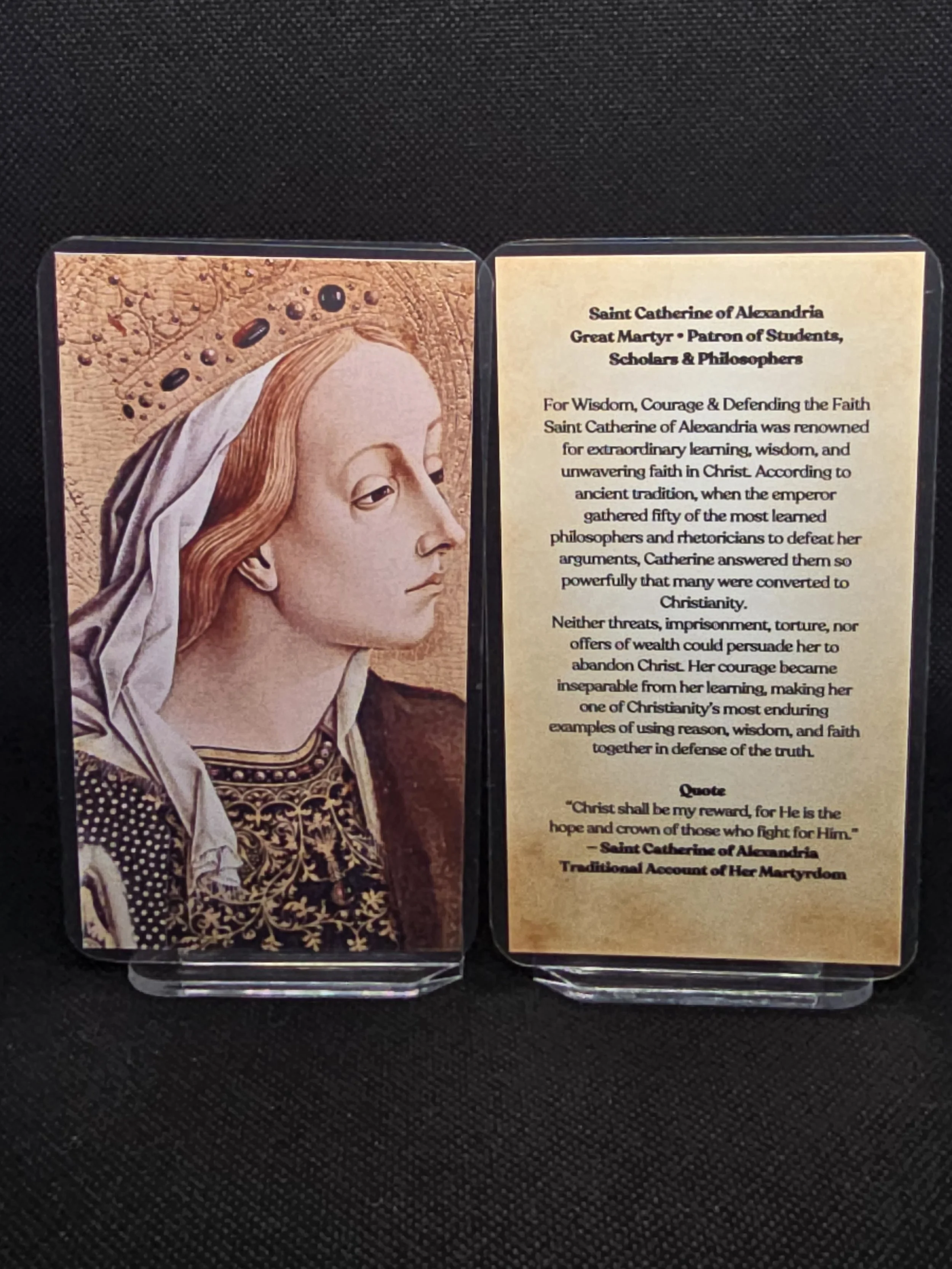
Christians in East and West have asked Saint Catherine for wisdom, courage and honest minds for many centuries. If you would like a prayer card of Saint Catherine for a student or for your own prayer corner, you can find one below. She reminds us that learning and faith can walk together.
View Prayer Card