Saint Mary Magdalene: Myrrh-Bearer, Equal-to-the-Apostles and First Witness of the Resurrection
A disciple of Jesus who stood at the Cross and was sent to tell the apostles that Christ is risen
At a Glance
- Born
- Traditionally Magdala on the Sea of Galilee; date UNCERTAIN
- Died
- UNCERTAIN; the New Testament does not record her death
- Titles
- Myrrh-bearer, Equal-to-the-Apostles, Apostle to the Apostles
- Feast
- July 22 in the Roman and Byzantine calendars; August 4 on the civil calendar for the Julian calendar; also with the Myrrh-bearing Women
- Veneration
- Ancient cult; no formal canonization date; Roman feast raised in rank on June 3, 2016
- Patronage
- Traditionally penitents, converts, contemplatives, perfumers
- Who Was Saint Mary Magdalene?
- Where She Came From
- Healed and Called
- At the Cross, the Tomb and the Garden
- Three Women, or One? The Question of Identity
- Ephesus, Provence and the Question of Her Relics
- Legends of the Red Egg and the Cave
- What Is Gospel and What Is Later Tradition
- The Myrrh-Bearing Women and Her Feast
- Why She Matters to the Eastern Churches
- Frequently Asked Questions
Who Was Saint Mary Magdalene?
Mary Magdalene was one of the women who followed Jesus during His public ministry. The Gospels name her more often than almost any other woman, and they place her at three key moments: the Cross, the burial and the empty tomb. In John's Gospel she is the first person the risen Jesus speaks to, and He sends her to tell His disciples.
For this reason the Church in the West has long called her the Apostle to the Apostles, and the Eastern Churches call her Equal-to-the-Apostles and Myrrh-bearer. A myrrh-bearer is one of the women who went to the tomb with sweet spices to anoint the body of Jesus.
The sources are mostly the four Gospels. Many popular ideas about her do not come from them. This article puts her biblical witness first, and it marks as TRADITION the later stories about her travels, and as UNCERTAIN the facts of her birth, death and relics.
Where She Came From
The title Magdalene is generally understood to mean that she was from Magdala, a town on the western shore of the Sea of Galilee. That is nearly all the New Testament says about her background. It does not name her parents, her relatives, a husband, children or a trade. Her birth year is UNCERTAIN.
Luke 8:1 to 3 lists her among women who supported Jesus and the disciples from their own resources. This shows that she took part in the material support of the group. It does not prove that she was personally rich, and that question is UNCERTAIN.
Later stories describe her as beautiful, wealthy or sinful before she met Christ. None of these details are found in the Gospels, and a historical biography should not state them as facts. The only direct statement about her past is that Jesus had driven seven demons out of her.
Healed and Called
Luke 8:2 says that Mary Magdalene was one of the women whom Jesus had healed, and that seven demons had gone out of her. Mark 16:9 says the same, though that verse belongs to the longer ending of Mark, whose place in the original Gospel is disputed. The Gospels do not explain what her affliction involved.
The text gives no basis for saying that she was a prostitute. Demonic affliction in the Gospels is not described as sexual sin. After her healing she traveled with Jesus and the other women, including Joanna and Susanna, as He proclaimed the Kingdom of God.
The Gospels do not describe the moment she first met Jesus or any conversation at the beginning of her discipleship. What they do show is a person who stayed with Him for the rest of His earthly life.
At the Cross, the Tomb and the Garden
Mary Magdalene remained when many of the disciples fled. Mark and Matthew place her among the women who watched the Crucifixion, and John places her near the Cross with the mother of Jesus. Mark and Matthew also say that she saw where Jesus was laid.
John 20 gives the fullest account of Easter morning. She came to the tomb while it was still dark and found the stone moved. She told Peter and the beloved disciple, then stayed outside weeping. She mistook Jesus for the gardener until He spoke her name. He then sent her to tell His brothers, and she announced to the disciples that she had seen the Lord.
Careful readers note that the Gospels arrange the Easter appearances differently. John presents Mary as the first individual witness, and Matthew describes Jesus meeting Mary Magdalene and the other Mary. The safest statement is that she was a principal and very early witness to the Resurrection. Her ministry is her discipleship and her testimony. No church, monastery or school can be firmly linked to her, and no authentic writings of hers survive.
Three Women, or One? The Question of Identity
The greatest historical question about her is whether she is the same as other women in the Gospels. Western tradition combined three figures: Mary Magdalene, Mary of Bethany who anointed Jesus in John 12, and the unnamed sinful woman who anointed His feet in Luke 7. The Gospels never say they are one person.
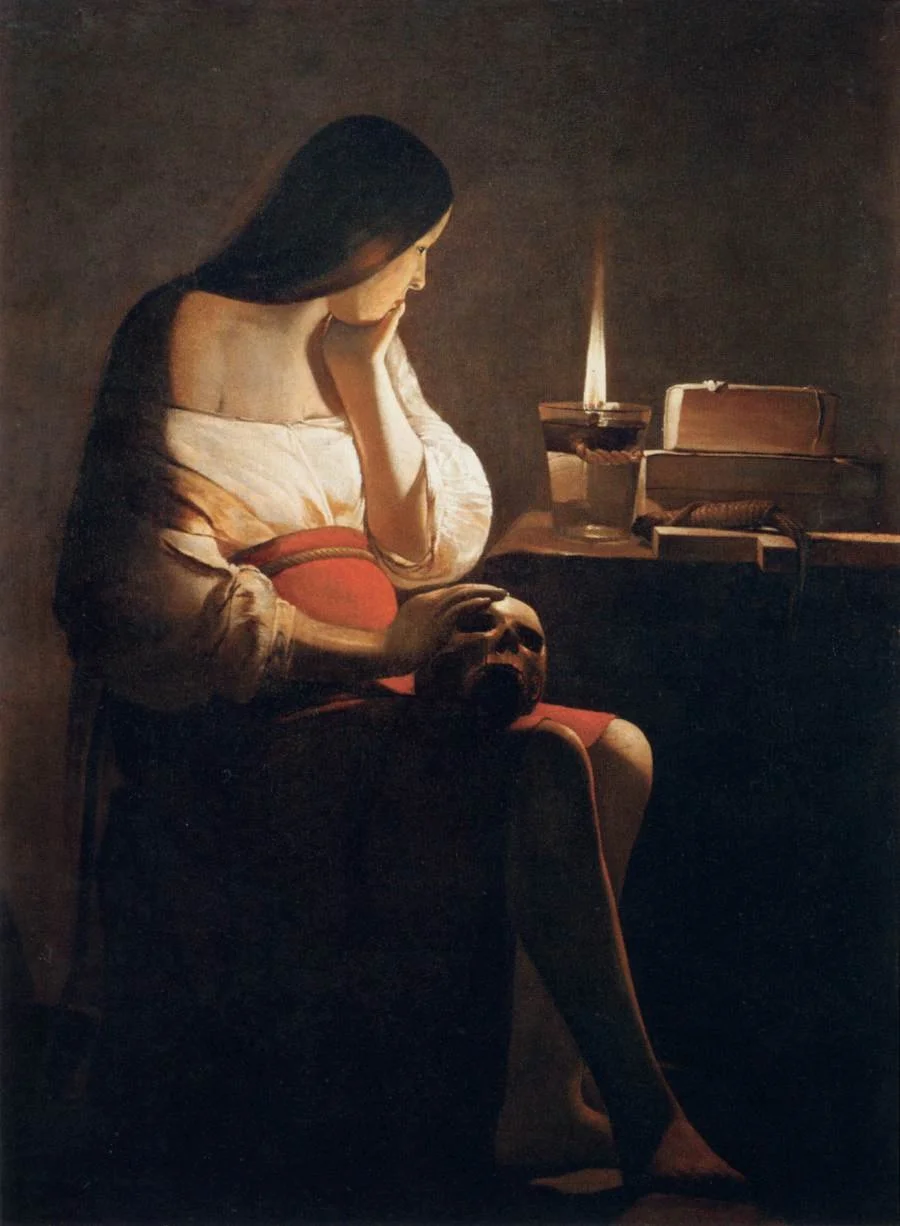
Pope Saint Gregory the Great, in his Homily 33 on the Gospels, linked Mary Magdalene with the sinful woman of Luke 7. His preaching shaped Western art and devotion for centuries and gave rise to the picture of her as a repentant sinner. Eastern tradition generally kept the women distinct, and modern scholars mostly treat them as separate. The Greek Orthodox Archdiocese says that neither Scripture nor its hymns call her a fallen woman.
Popular books today sometimes claim that she was the wife of Jesus or the mother of His children. No reliable early evidence supports these claims, and the Gospels do not say them. The Gospel of Mary, an apocryphal text that features a Mary, is generally dated to the second century and is not a writing of the Magdalene herself.
Ephesus, Provence and the Question of Her Relics
The New Testament does not tell how Mary Magdalene died. UNCERTAIN: later traditions differ. TRADITION in the East says she lived at Ephesus, died there and was buried there. Gregory of Tours in the sixth century knew of a tomb at Ephesus, and the tradition says her relics were later moved to Constantinople under Emperor Leo VI, in the late ninth century.
TRADITION in the West says she traveled with Lazarus and others to southern Gaul, preached in Provence and spent her last years praying in a cave near Sainte-Baume. These accounts became very influential in the Middle Ages, but they are not supported by documents from the time of her life.
Rival shrines at Vezelay and Saint-Maximin-la-Sainte-Baume in France each claimed to hold her body, and relics were reported found at Saint-Maximin in 1279. UNCERTAIN: no collection of relics can be proven to belong to the Gospel's Mary Magdalene. No canonization decree exists. Her veneration is older than formal canonization.
Legends of the Red Egg and the Cave
TRADITION: Eastern hagiography says that Mary Magdalene went to Rome and stood before the emperor Tiberius, announcing the Resurrection. She is said to have held out an egg and said that Christ is risen, and the egg turned red in her hand. The Orthodox Church in America presents this as tradition. No Roman document confirms it, but the story is the root of the custom of red Easter eggs in Eastern Christian culture.
TRADITION: in the West, she is said to have lived thirty years in a cave in Provence in prayer and penance, and angels are said to have carried her to receive Communion at the end of her life. These accounts grew in the Middle Ages and reflect the Western image of her as a model of penance.
Art differs between the two traditions. Eastern icons show her as a myrrh-bearer with a jar of ointment, and sometimes with a red egg. Western paintings often show her with an ointment jar, long hair, a book or a skull. Neither tradition's art is a record of what she looked like.
What Is Gospel and What Is Later Tradition
The secure portrait of Mary Magdalene is the biblical one. She was healed by Jesus, she helped to support His ministry, she stayed through the Crucifixion and burial, and she was an early witness to the Resurrection. In John's Gospel she is also given a commission to announce it.
Everything about her later life, such as her journey to Rome, her years in Ephesus or Provence, and the details of her relics, belongs to later tradition. These stories matter for the history of her cult, and they should be told as stories and not as findings.
In 2016 the Congregation for Divine Worship decreed that her celebration in the Roman calendar would be raised from a memorial to a feast. The date of July 22 stayed the same. This was a change in rank. It was not a canonization, and it was explained as a recognition of her role as the witness who announced the Resurrection.
The Myrrh-Bearing Women and Her Feast
Mary Magdalene is honored on July 22 in both the Roman and the Byzantine calendars. Churches that keep the Julian calendar celebrate it on a later civil date, August 4 in this century. The Byzantine Churches also remember her on the third Sunday of Pascha with the Myrrh-bearing Women.
The Menaion, the Eastern book of the feasts, calls her Myrrh-bearer and Equal-to-the-Apostles. Equal-to-the-Apostles does not mean that she was one of the Twelve. It honors a person who had an exceptional share in spreading the faith, and in her case it points to her announcement of the Resurrection.
The Greek Orthodox Archdiocese publishes the official hymns for her feast, and this site does not reproduce them. Below is a short original prayer for those who would like to ask for her intercession.
Lord Jesus Christ, You called Mary Magdalene by name and sent her to tell that You are risen. Through her prayers, help us to stay near You in sorrow, to hear Your voice when we are weeping, and to announce Your resurrection with joy. Amen.
This is a short original prayer written for this article. It is not an official liturgical text. The Greek Orthodox Archdiocese of America publishes the official hymns for her feast.
Why She Matters to the Eastern Churches
Mary Magdalene has a clear place in Byzantine worship. Her feast and the Sunday of the Myrrh-bearing Women are part of the Paschal season, and the hymns speak of her as a faithful disciple and a messenger of the Resurrection. They stress her discipleship more than any past sin.
For Eastern Catholics and Orthodox Christians she is a shared saint of the early Church, honored by both Churches on the same day. The Roman Church's 2016 decision to raise her feast and to speak of her as Apostle to the Apostles drew the two traditions closer in how they honor her.
The differences between East and West are mostly in the stories told after the Gospels, such as Ephesus and Provence, and in whether she is blended with other women. On the Gospel witness itself, East and West agree. She followed Christ, stayed at the Cross and was sent to proclaim that He is risen.
Frequently Asked Questions
Ask Her Prayers
Christians have asked Saint Mary Magdalene for prayer for centuries, especially in grief, in repentance and in the joy of Easter. If you would like a prayer card of Saint Mary Magdalene for your prayer corner, you can find one below. She reminds us that the Resurrection was first announced by someone who stayed faithful at the Cross.
View Prayer Card