Saint Spyridon the Wonderworker: Shepherd Bishop of Tremithous in Cyprus and Patron of Corfu
A married Cypriot shepherd who became a bishop, kept his sheep, and is honored by millions as a wonderworker
At a Glance
- Born
- Cyprus, traditionally late third century; UNCERTAIN
- Died
- About 348 to 350, traditionally in Cyprus; UNCERTAIN
- Office
- Bishop of Tremithous in Cyprus
- Feast
- December 12; on the Julian calendar it falls on December 25 on the civil calendar
- Veneration
- Ancient cult; no formal canonization date
- Patronage
- Corfu; shepherds, farmers, travelers and the poor
- Who Was Saint Spyridon?
- A Shepherd of Cyprus
- From Flock to Bishop
- Charity and Hospitality
- Nicaea, Sardica and a Lesson on Scripture
- Death and the Journey of His Relics
- The Miracles Told of Him
- What Is History and What Is Legend
- Saint Spyridon of Corfu
- Why He Matters to the Eastern Churches
- Frequently Asked Questions
Who Was Saint Spyridon?
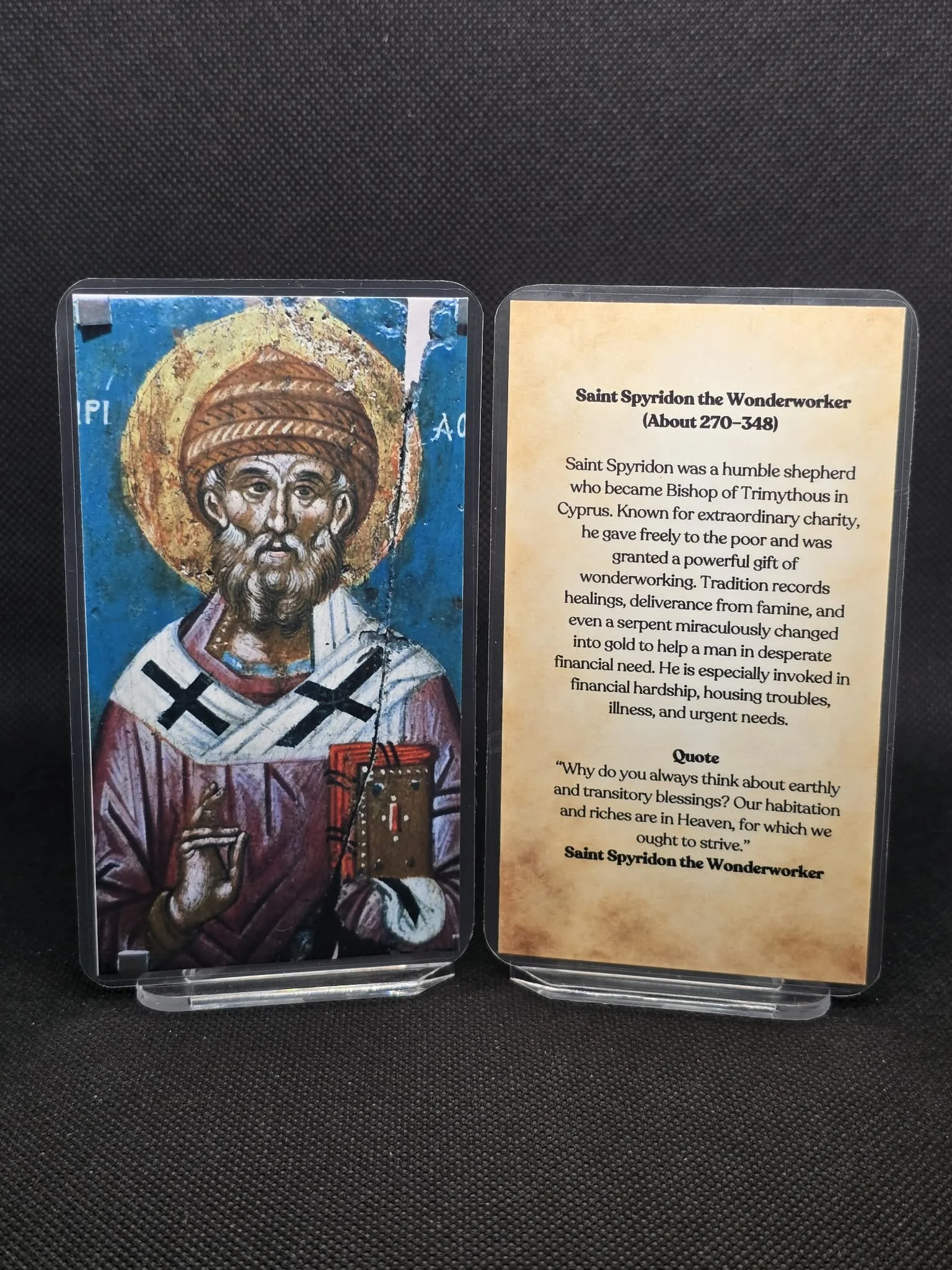
Saint Spyridon was a bishop in Cyprus during the fourth century, in the age of the Emperor Constantine and the First Council of Nicaea. He is one of the best loved saints of the Byzantine Church, and his icon is easy to recognize because he wears a round woven cap, a reminder that he was a shepherd.
Two fifth century historians, Socrates Scholasticus and Sozomen, wrote about him. They say he was a married man who kept his sheep even after he became bishop, and they tell stories that show his simplicity, generosity and mercy.
The historical bishop is well attested. The large body of miracle stories is another matter. This article marks which accounts come from the early historians, which come from later hagiography, and which dates are UNCERTAIN.
A Shepherd of Cyprus
Spyridon was born in Cyprus, traditionally toward the end of the third century. His birthplace, his parents and his exact birth date are unknown. The early historians describe him as a country man and shepherd, and not as a member of the educated city elite.
Socrates says that he kept tending sheep after he became a bishop, and Sozomen also writes of his rural life and plain household. They present this simplicity as a strength.
He was married and had a daughter, Irene, whom both historians name. TRADITION: later biographies say his wife died before he became a bishop. The wife's name, the date of her death and the details of his ordination are UNCERTAIN.
From Flock to Bishop
No early source tells how Spyridon came to the Christian faith. A story about a conversion experience, a baptism or a spiritual teacher would be guesswork. The early historians simply show him as a devout Christian whose goodness led the Church of Tremithous to choose him as its bishop.
According to the Orthodox Church in America, he became bishop of Tremithous during the reign of Constantine, who ruled from 306 to 337. The exact year is UNCERTAIN.
The change in office did not change his way of life very much. The picture of a bishop who stayed a shepherd, with a crook in his hand and a cap on his head, became central to his memory. It is a living picture of what a pastor of souls can be.
Charity and Hospitality
Spyridon's ministry centered on his diocese and on care for ordinary people. The early historians remember him for feeding the poor, helping debtors and giving fair judgment to those who were wronged. His household stayed modest.
Sozomen tells that he kept his farm produce in a store that anyone in need could use, taking food or a loan without close supervision. The story presents a bishop who trusted conscience more than suspicion, and who saw his goods as resources for his neighbors.
No dependable evidence says that he founded a monastery or a school, and no writing of his survives. A bishop of Cyprus named Triphyllius of Ledra was reported to have written his life in verse, but that work is not by Spyridon. His influence came through his remembered conduct and through the Church's worship, not through books.
Nicaea, Sardica and a Lesson on Scripture
Spyridon lived through the Arian controversy, which asked whether the Son is fully divine and equal to the Father. The Council of Nicaea in 325 rejected the teaching of Arius. Tradition places Spyridon at that council, and the Catholic Encyclopedia names him as present.
UNCERTAIN: his name is missing from the surviving Nicene subscription list, so his attendance is traditionally accepted but not proved. Saint Athanasius preserved a list connected with the Council of Sardica, usually dated 343, and a Spyridon appears among the Cypriot bishops. The list includes bishops who accepted the council's decisions without attending, so his presence there is also UNCERTAIN.
Sozomen records that Spyridon once corrected Triphyllius, who had replaced a plain word in a Gospel reading with a more elegant one in a sermon. Spyridon objected to changing the words of Scripture. The story shows the saint's respect for the text of the Gospel over fine speaking. Later accounts of imprisonment under Maximian or Galerius are UNCERTAIN, since the early histories do not confirm them.
Death and the Journey of His Relics
Spyridon is said to have died in peace in Cyprus around 348 to 350. The date and his age are UNCERTAIN. He was buried at Tremithous, and the Inventory of Byzantine Churches on Cyprus shows that Tremithous was a center of his cult by at least the seventh century.
According to tradition his relics were carried to Constantinople, perhaps because of raids in the seventh century, and from there to Corfu after the fall of Constantinople in 1453. The Corfu Port Authority dates their arrival to 1456, and church accounts name a priest, George Kalochairetes, as the one who brought them. UNCERTAIN: the route, the stops and the custody differ among the accounts.
No canonization decree exists. He was recognized as a saint through ancient veneration, long before formal procedures. Today his principal shrine is the Church of Saint Spyridon in Corfu Town.
The Miracles Told of Him
Socrates tells of thieves who tried to steal his sheep and were held fast until morning. Spyridon released them, urged them to give up theft and gave them a sheep. Socrates and Sozomen also tell of his daughter Irene, who after her death was said to have answered her father from the tomb when he asked where she had put a valuable item entrusted to her. TRADITION: these stories are early, but they remain unverified.
Sozomen also tells of a hungry traveler who came to his house during a strict fast. Spyridon had meat served to the guest and ate with him, which illustrates the principle that care for a person comes before outward displays of discipline. TRADITION: the famous brick miracle says that at Nicaea he held a brick from which fire rose, water ran down and clay stayed in his hand, as a sign of the Trinity. This story cannot be verified from records of the council.
Later hagiography credits him with raising the dead, healing the sick, ending droughts and hearing unseen angels sing in church. These accounts are TRADITION and cannot be independently confirmed. The claim that his relics are incorrupt should also be attributed to Church tradition, since no independent medical report is available.
What Is History and What Is Legend
The historical foundation is solid. Socrates and Sozomen describe him as a real bishop, with a family, a flock and a reputation for charity. Athanasius preserves a Cypriot bishop's name that matches his, and archaeology shows an early cult at Tremithous.
The points that need care are his dates, his presence at Nicaea and Sardica, the movement of his relics, and the historical status of the miracles. The scholar Paul van den Ven studied the legend of Saint Spyridon in a work published in 1953, and the story of his life grew over time.
A fair account can tell the stories in full and still say which are early reports and which are later tradition. That respects both the faith of those who honor him and the work of historians.
Saint Spyridon of Corfu
In Corfu he is simply called the Saint, and his name is given to many islanders. His relics lie in the church that bears his name in Corfu Town, and his body is carried in procession several times a year.
The islanders link the processions with deliverances from famine, plague and the Ottoman siege of 1716. These processions are public and well documented. The belief that the saint caused those rescues is a matter of faith, and local sources differ on the years of some of the earlier events.
Pilgrims also honor him in Cyprus and across the Orthodox world. He is asked for help by travelers, by the poor and by families in need of food or work. He is a good example of how the memory of a plain pastor can last for sixteen centuries.
Lord Jesus Christ, Good Shepherd, You gave Saint Spyridon a humble heart and a generous hand. Through his prayers, help the poor and the traveler, give pastors a shepherd's love for their people, and teach us to be merciful, as You are merciful. Amen.
This is a short original prayer written for this article. It is not an official liturgical text. The Orthodox Church in America and the Ukrainian Greek Catholic Eparchy of Edmonton publish the official troparion and kontakion for his feast.
Why He Matters to the Eastern Churches
Spyridon is a major saint of the Byzantine tradition, and his feast on December 12 is kept by the Orthodox Churches. Churches that follow the Julian calendar celebrate it on December 25 on the civil calendar. Some Orthodox calendars also remember him on Cheesefare Saturday.
He is also honored by Byzantine Catholics. The Ukrainian Greek Catholic Eparchy of Edmonton publishes a commemoration for him on December 12, with a troparion and kontakion. His veneration is older than the division between Rome and Constantinople, so he belongs to the shared inheritance of both Churches. He is not in the General Roman Calendar, and in the Latin Church his observance is mostly local.
His message is simple and fits both traditions: a bishop is a shepherd. He showed pastoral humility, respect for Scripture, hospitality to strangers and mercy to wrongdoers. He also stands as an early defender of the Nicene faith in the Trinity.
Frequently Asked Questions
Ask His Prayers
Christians in Cyprus, Corfu and far beyond have asked Saint Spyridon for help for sixteen centuries, in need, in travel and in hard times. If you would like a prayer card of Saint Spyridon, you can find one below. He shows us that a good shepherd can be simple and wise at the same time.
View Prayer Card