Saint Thomas the Apostle: The Twin, Witness of the Risen Christ and Apostle of India
The apostle who said My Lord and my God, remembered in Syria, India and Italy
At a Glance
- Born
- Traditionally Galilee; date and place UNCERTAIN
- Died
- Indian tradition says near Chennai in 72, by spear; UNCERTAIN
- Titles
- Holy Apostle, Didymus the Twin, Apostle of India
- Feast
- October 6 in the Byzantine calendar; July 3 in the Roman and Syro-Malabar calendars; Thomas Sunday after Pascha
- Veneration
- One of the Twelve; no formal canonization date
- Patronage
- India, Saint Thomas Christians, builders and architects
- Who Was Saint Thomas the Apostle?
- The Twin
- From Loyalty to Doubt to Confession
- The Mission to Parthia and India
- Questions About His Journey
- Martyrdom, Mylapore and the Journey of His Relics
- Legends of the Palace and the Seven Churches
- What Is Scripture and What Is Tradition
- Thomas Sunday and Dukrana
- Why He Matters to the Eastern Churches
- Frequently Asked Questions
Who Was Saint Thomas the Apostle?
Saint Thomas was one of the Twelve Apostles. Many people know him as Doubting Thomas, but the Gospel of John shows a more complete picture. He is a loyal disciple who is ready to die with Jesus, an honest man who asks hard questions, and a believer who gives one of the clearest confessions of Christ's divinity in the Gospels.
Beyond the New Testament, early Christian writers connect him with missions to the East. The Christians of southern India, who call themselves Saint Thomas Christians, honor him as the founder of their faith. His relics are linked with Edessa and, later, with the Italian town of Ortona.
This article marks three levels of certainty. What the New Testament says is secure. What early writers report about his mission to the East is old and important. The exact dates, places and relic journeys are UNCERTAIN, and many stories belong to TRADITION.
The Twin
The Gospels say little about Thomas before he followed Jesus. He appears in the lists of the Twelve in Matthew, Mark and Luke, and among the apostles gathered after the Ascension in Acts. His name comes from a Semitic word meaning twin, and the Greek name Didymus has the same meaning.
UNCERTAIN: nobody knows who his twin was. Ideas that he was the twin of Jesus or of another person in the New Testament have no basis in the Gospels. Some Syriac writings stress that he was very close to Christ, but that is a theological image and not family history.
TRADITION: the Orthodox Church in America describes Thomas as a fisherman from a village in Galilee who left his work to follow Jesus. That comes from later hagiography and not from Scripture. Nothing reliable tells us about his parents, a marriage or his trade.
From Loyalty to Doubt to Confession
The first words of Thomas in John come at the raising of Lazarus. When Jesus decided to go back toward Judea in spite of the danger, Thomas told the other disciples that they should go as well and die with Him. Pope Benedict XVI pointed to this moment as proof of the courage of a disciple later remembered for his doubts.
At the Last Supper Thomas admitted that the disciples did not know where Jesus was going or how to follow. His honest question led to the words of Jesus that He is the way, the truth and the life. Thomas thus helped to draw out one of the great teachings of the Gospel.
After the Resurrection Thomas was absent when Jesus first appeared to the others. He said he would believe only if he could see the marks of the nails. Eight days later Jesus came and invited him to examine His wounds, and Thomas answered, My Lord and my God. John does not actually say that Thomas touched Him, although art and preaching often show it. He appears again at the Sea of Tiberias and with the apostles in Acts.
The Mission to Parthia and India
The New Testament does not describe the later travels of Thomas. The best early report comes from the historian Eusebius, who preserved a statement from Origen that Parthia was assigned to Thomas as his mission field. This shows that early Christians linked him with lands to the east of the Roman Empire. It does not prove that he went to southern India.
The Acts of Thomas, an apocryphal book most likely written in Syriac in the third century, tells of his work in India. It names a merchant and an Indo-Parthian king called Gondophares. Gondophares is a real royal name known from coins and inscriptions of the first century. That does not show that Thomas met him, and the book also contains symbolism and legend. UNCERTAIN: scholars disagree about how much it preserves from real memory.
No writing by Thomas survives. The Gospel of Thomas, a collection of sayings, the Acts of Thomas and the Book of Thomas the Contender all carry his name, but none can be shown to be written by the apostle, and the Catholic and Orthodox Churches do not include them in the Bible.
Questions About His Journey
The first test in his story is the one in the Gospel, the days between the Resurrection and his confession. His doubt was followed by a direct profession of faith. After that, his hardships are known only through tradition and not through eyewitness reports.
TRADITION: the Acts of Thomas shows him confronting royal courts, being imprisoned and giving offense by teaching conversion and chastity. These scenes reflect the interests of the Syriac Christians who wrote the book, and they cannot all be treated as history.
Eusebius names Parthia, and the Acts name India, but the two need not conflict, since trade linked Mesopotamia, Persia and India. Ancient writers also used the word India loosely. Scholars such as Nathanael Andrade study how Christianity moved eastward along trade networks, which helps explain how Christians came to India even where the claims about Thomas himself cannot be proved.
Martyrdom, Mylapore and the Journey of His Relics
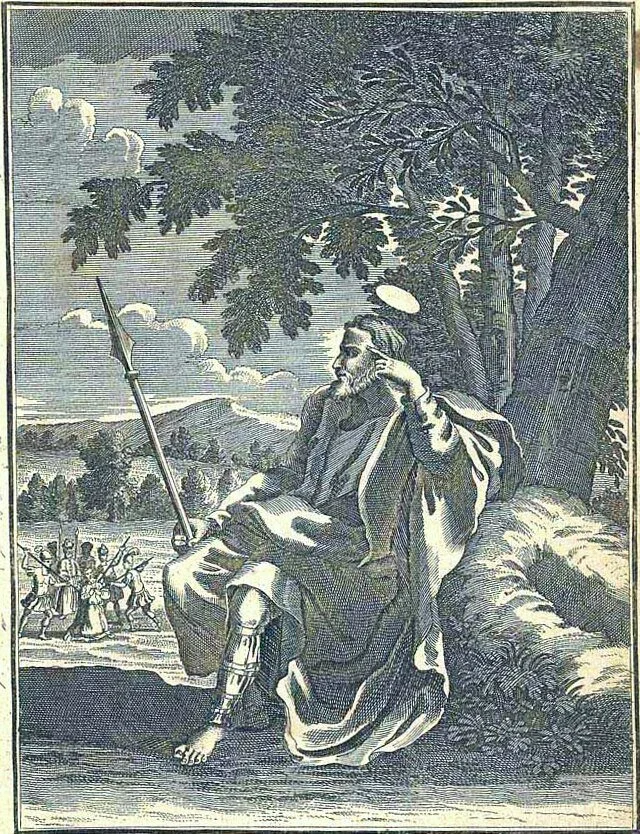
TRADITION: the Saint Thomas Christians say that Thomas came to Kodungallur on the Kerala coast in 52 and that he was killed near Mylapore, in the region of modern Chennai, in 72, struck by spears. These dates are traditional and cannot be independently verified.
In the fourth century Saint Ephrem the Syrian wrote hymns that speak of an apostle killed in India whose relics were at Edessa, and that apostle is named as Thomas. This shows that the link between Thomas, India and Edessa was already told in Syriac Christianity. It does not fix the date of his death or prove that the relics are his.
Church accounts say his relics went from India to Edessa, then to the island of Chios in the twelfth century and to Ortona in Italy in 1258. UNCERTAIN: the dates and the continuity of all the remains cannot be established with equal certainty. He was never canonized in a modern sense. He is honored as an Apostle by ancient veneration.
Legends of the Palace and the Seven Churches
The Gospels do not credit Thomas with a miracle of his own, though as one of the Twelve he shared the commission to preach and to heal. Later tradition tells many stories about him.
TRADITION: in the Acts of Thomas, a king gives Thomas money to build a palace, and Thomas gives it to the poor. The king learns in a vision that Thomas has built him a dwelling in heaven through those gifts. It is a teaching about generosity and not a record of a building. Another story places him in prayer at Malayattoor in Kerala, where the Virgin Mary is said to have encouraged him. These stories are later devotion.
The Saint Thomas Christians also keep the memory of seven and a half churches founded by the apostle, including Kodungallur, Palayur, Niranam and Kollam. The religious weight of these traditions is great, but the foundation story of each church cannot be proved.
What Is Scripture and What Is Tradition
Scripture establishes that Thomas was one of the Twelve, followed Christ, saw the risen Lord, confessed Him as Lord and God, and remained among the apostles. These points are secure.
Early Christian testimony supports a link between Thomas and the East, and the Syriac Church honored his memory and his relics by the fourth century. Eusebius and Ephrem show that these beliefs are ancient. They do not prove every detail.
The year 52 for his arrival in India, the founding of particular churches, the year 72 for his death, the manner of his death and the path of his relics belong to TRADITION or are UNCERTAIN. The long and continuous life of the Indian Christian community is real, and it gives weight to the memory.
Thomas Sunday and Dukrana
The Byzantine Churches honor Thomas on October 6 and also on the Sunday after Pascha, called Thomas Sunday or Antipascha, when the Gospel of the appearance to Thomas is read. They also remember him with the Twelve on June 30.
The Roman calendar keeps his feast on July 3. The Syro-Malabar Church in India keeps the same day as Dukrana, the commemoration of Thomas, which joins the memory of his martyrdom with the identity of the Churches that call him their apostle.
The Orthodox Church in America publishes the official troparion and kontakion for October 6, and this site does not reproduce them. A short original prayer follows for readers who would like to ask for his prayers.
Lord Jesus Christ, You welcomed the honest questions of Your apostle Thomas and gave him faith. Through his prayers, strengthen us when we doubt, give us courage to follow You, and help us to say with all our hearts, My Lord and my God. Amen.
This is a short original prayer written for this article. It is not an official liturgical text. The Orthodox Church in America publishes the official troparion and kontakion for his feast of October 6.
Why He Matters to the Eastern Churches
Thomas connects three kinds of evidence: the New Testament, the early Syriac literary tradition and the living Christian communities of India. For the Syro-Malabar Catholic Church he is the father of its apostolic faith. The wider Saint Thomas Christian family also includes the Syro-Malankara Catholic Church and several Indian Orthodox and other Syriac Churches.
For Byzantine Catholics and Orthodox Christians, his confession on Thomas Sunday is central to the Paschal season. It affirms that the risen Lord is the same incarnate Lord who was crucified, and the wounds are part of the recognition of who He is.
Catholics of the Latin Church honor him on July 3, and the Orthodox on October 6. The difference in dates comes from different liturgical histories and not from any dispute about his place among the apostles. Thomas is a saint that East and West share.
Frequently Asked Questions
Ask His Prayers
Christians in India, Syria and across the world have asked Saint Thomas for faith and courage. If you would like a prayer card of Saint Thomas the Apostle, patron of India, you can find one below. His story teaches us that honest questions can lead to deeper faith.
View Prayer Card