Saints Joachim and Anne: Fifty Childless Years, One Answered Prayer, and the Grandparents of God
Saints Joachim and Anne: Fifty Childless Years, One Answered Prayer, and the Grandparents of God
A wealthy, devout couple grown old without a child, turned away from the Temple as unworthy, who went into the wilderness and the garden to weep and pray separately, and were answered by the same angel on the same day. Their daughter would become the Mother of God.
Saints Joachim and Anne at a Glance
- Also Known As
- Joachim and Anna; the Ancestors of God; Hannah (Hebrew form of Anne)
- Lived
- 1st century BC to 1st century AD, by tradition; the written account dates to the 2nd century AD
- Venerated In
- The Roman Catholic Church, the Eastern Orthodox Church, and the wider Christian world
- Canonized
- Pre-congregation; venerated from antiquity
- Feast Days
- July 26 (Roman Catholic, both together); September 9 (Eastern Orthodox, both together, following the Nativity of the Theotokos); December 9 (Orthodox, Conception of the Theotokos by Saint Anne); July 25 (Orthodox, Dormition of Saint Anne)
- Title
- Ancestors of God; parents of the Theotokos
- Primary Source
- The Protoevangelium of James, c. 150 AD, not part of the New Testament canon
- Patronage
- Married couples, childless couples, parents, grandparents; Saint Anne also patroness of Quebec and of expectant mothers
- Daughter
- The Virgin Mary, Mother of God
- Grandson
- Jesus Christ
- I. Who Were Joachim and Anne, and Where Their Story Comes From
- II. Fifty Years of Childlessness and a Public Humiliation
- III. The Wilderness and the Garden: Two Separate Prayers
- IV. The Angel's Visit and the Meeting at the Golden Gate
- V. The Birth of Mary
- VI. The Presentation of Mary in the Temple
- VII. A Note on the Immaculate Conception: East and West
- VIII. Their Deaths and Early Veneration
- IX. Their Relics: Jerusalem, Apt, and Quebec
- X. Sainte-Anne-de-Beaupre and Its Documented Healings
- XI. Their Family: Connections to Other Saints
- XII. On the Protoevangelium of James and Why It Isn't Scripture
- XIII. Churches and Shrines, With Links
- XIV. Legacy: The Ancestors of God
- Prayer for the Intercession of Saints Joachim and Anne
- Frequently Asked Questions
Who Were Joachim and Anne, and Where Their Story Comes From
Saints Joachim and Anne appear nowhere in the four Gospels. Everything the Christian tradition knows, or believes it knows, about the parents of the Virgin Mary comes from a single early text, the Protoevangelium of James, also called the Gospel of James or the Nativity of Mary, likely put into its final written form in the early second century, roughly a hundred years after the events it describes. The text claims the authorship of the Apostle James, the brother of the Lord, though modern scholarship generally regards this attribution as pious convention rather than historical fact.
The Church's relationship with this document has always been complicated and worth stating plainly. Church councils repeatedly declined to recognize it as an authentic apostolic writing, and it was never included in the New Testament canon. Despite this, its influence on Christian devotion, art, and liturgy has been enormous and largely unbroken for nineteen centuries: the names Joachim and Anne themselves, the entire narrative behind several major feast days of the Virgin Mary, and countless works of Christian art all trace back to this one uncanonized text.
Within its narrative, Joachim is described as a wealthy and devout man of the tribe of Judah, a descendant of King David. Anne, whose Hebrew name Hannah recalls the Old Testament mother of the prophet Samuel, was the daughter of a priest named Matthan, of the tribe of Levi, the same priestly line as Aaron. The couple lived, according to the same tradition, in or near Nazareth, later associated by devotional tradition with the area near the Sheep Pool in Jerusalem as well.
Part II
Fifty Years of Childlessness and a Public Humiliation
Joachim and Anne had been married for decades, by tradition some fifty years, without conceiving a child, a source of profound personal grief and, in the social world the Protoevangelium describes, public shame. Childlessness in this cultural context was widely read as a sign of divine disfavor, and the couple bore the weight of that judgment for most of their married life. Their practice throughout these years was nonetheless remembered as scrupulously devout and generous: they divided their income into three parts, one for their own household, one for the poor, and one for the Temple.
The turning point in the narrative comes on a feast day, when Joachim presented himself at the Temple to offer sacrifice and was refused by a priest, named Reuben in some versions of the text, on the grounds that a man who had produced no children was unworthy to make an offering alongside the rest of Israel. Devastated, Joachim searched the genealogical registers of the twelve tribes and found that every other righteous man in Israel had raised up children; he alone, it seemed to him, had not. He called to mind the patriarch Abraham, who in his own old age had finally been given a son, Isaac, by God's own promise.
Part III
The Wilderness and the Garden: Two Separate Prayers
Rather than return home in his grief, Joachim withdrew alone into the wilderness, where he pitched a tent and fasted for forty days and nights, telling himself that he would take neither food nor drink until the Lord looked upon him with mercy, and that prayer alone would be his food. Anne, left behind and believing herself somehow responsible for their shared sorrow, mourned in her own solitude, in the garden of their home. According to the tradition, she looked up into a laurel tree and saw a nest of newly hatched sparrow chicks, and the ordinary sight of new life undid her; she wept and prayed aloud for a child of her own, vowing that if her prayer were answered, she would offer the child back to God's service.
Part IV
The Angel's Visit and the Meeting at the Golden Gate
God sent the Archangel Gabriel to each of them separately, on the same day, with the same message: their prayer had been heard, and they would have a daughter, "most blessed, by whom all the nations of the earth will be blessed, and through whom will come the salvation of the world." Each was told to return home, and each promised, independently, to dedicate the coming child to God's service. Gabriel instructed Joachim to make his way back to the city, where he would find Anne waiting for him at the gate, and instructed Anne to go and wait there.
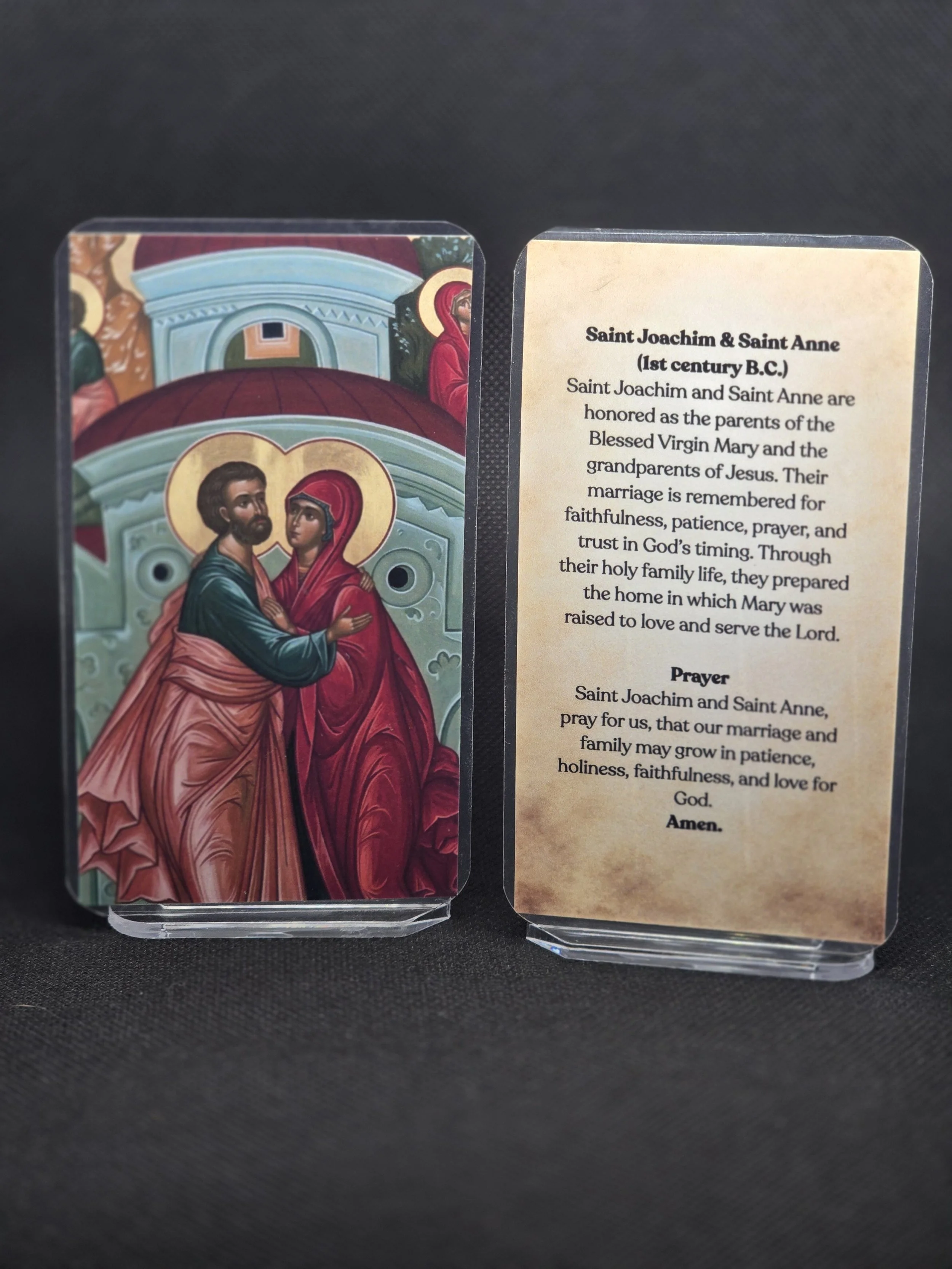
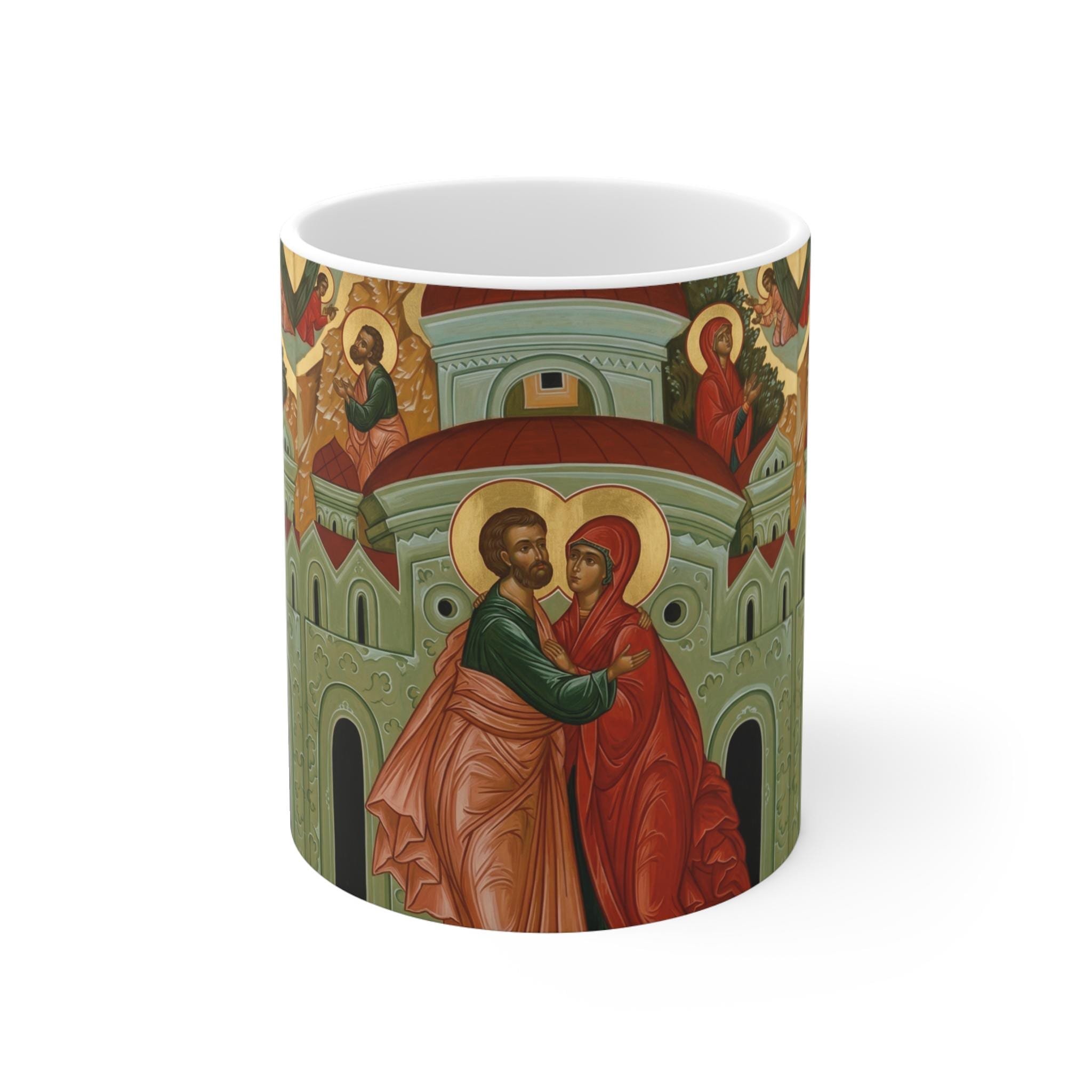
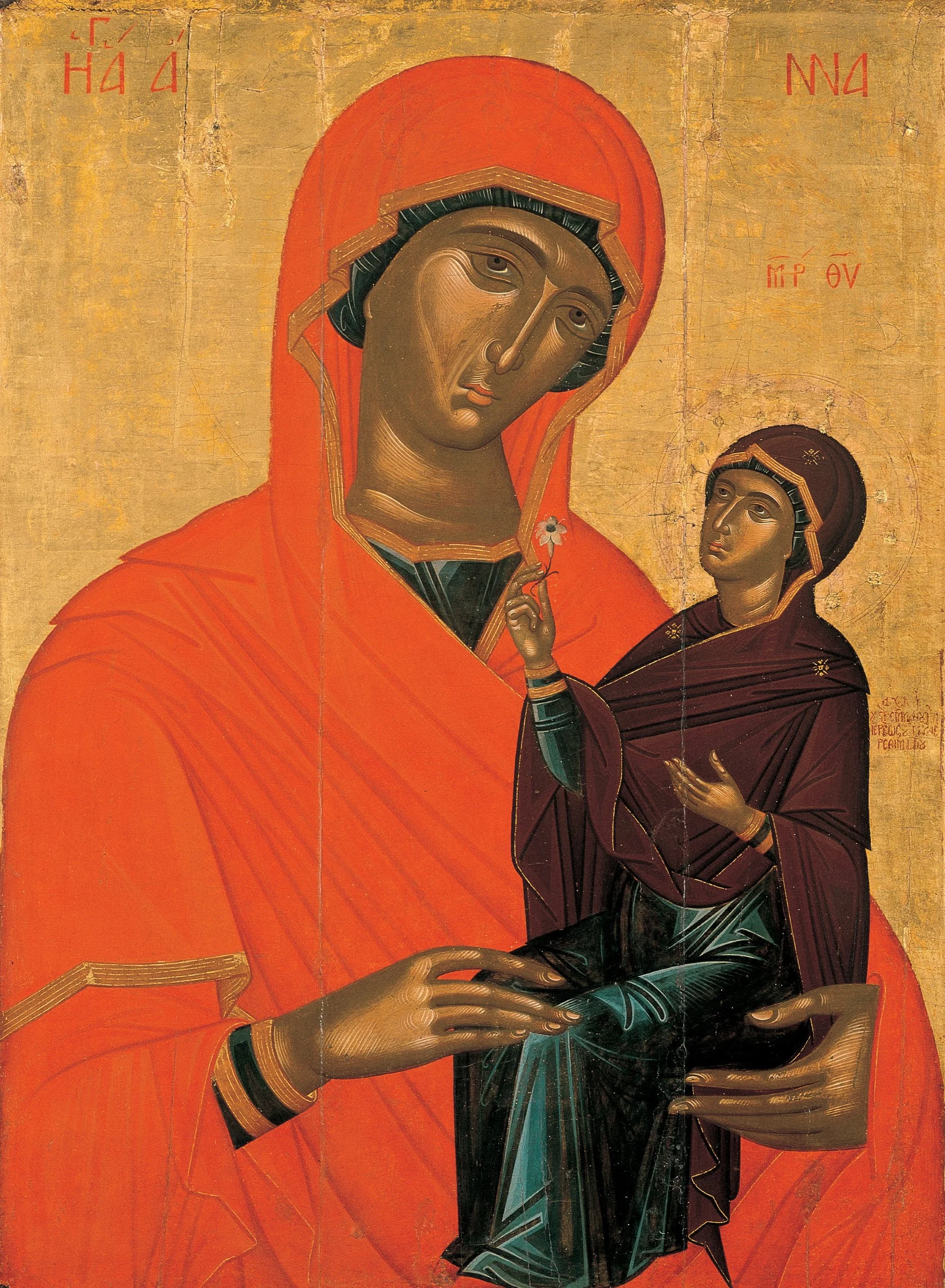
Joachim and Anne met at what tradition identifies as the Golden Gate of Jerusalem, and embraced with tears of joy, a moment so central to their story that it became one of the most frequently painted scenes in the entire cycle of the Life of the Virgin in Christian art, and remains the standard subject of their traditional icon in the Orthodox Church to this day.
Part V
The Birth of Mary
Anne conceived, and in the ninth month gave birth to a daughter. According to the Protoevangelium's own account of the moment, when told the child was a girl, Anne responded, "My soul has been magnified this day," and named her Mary. In the child's earliest months, the text describes Anne creating what it calls a sanctuary in the infant's own room, permitting nothing common or unclean near her, on account of the special holiness the couple believed marked their long-awaited daughter from the very beginning.
When Mary turned one year old, Joachim held a great feast, inviting the priests, scribes, elders, and people of Israel, and brought the child forward to be blessed, asking that God grant her an everlasting name to be honored in every generation.
Part VI
The Presentation of Mary in the Temple
When Mary turned three years old, Joachim and Anne fulfilled the vow each had separately made in their solitary prayers, bringing their daughter to the Temple in Jerusalem and presenting her to the priests to be raised in the Lord's service. Devotional tradition holds that the small child climbed the fifteen steps of the Temple entirely unaided, a detail long taken as a sign of the extraordinary grace already at work in the girl who would one day become the Mother of God. This event is commemorated in both the Catholic and Orthodox Churches as the Presentation of the Blessed Virgin Mary, one of the twelve Great Feasts of the Orthodox liturgical year.
Part VII
A Note on the Immaculate Conception: East and West
Anne's conception of Mary carries theological weight in the Catholic Church that it does not carry in quite the same way in Orthodoxy, and readers researching this topic deserve a fair, accurate account of both positions rather than one presented as though it were universal. In the Roman Catholic Church, the moment of Mary's conception by Anne is understood, through the doctrine of the Immaculate Conception, formally defined by Pope Pius IX in 1854, to have been free from the stain of original sin from its very first instant, a unique privilege granted to Mary in preparation for her role as the Mother of God. The Eastern Orthodox Church commemorates the same event, on December 9, as the Conception of the Most Holy Theotokos by Saint Anne, but does not frame it using the specific Western theological category of original sin inherited through generation in the same way, and has historically not adopted the 1854 Catholic dogma in its precise Latin formulation. Both traditions honor the same event with deep reverence; they simply articulate its theological significance somewhat differently, a distinction this article notes for accuracy rather than to argue either position.
Part VIII
Their Deaths and Early Veneration
Neither the Protoevangelium nor any other early source records the deaths of Joachim and Anne in any narrative detail. Orthodox tradition keeps a specific commemoration of the Dormition, the falling asleep, of Saint Anne on July 25, distinct from the couple's shared feast, but no comparable narrative account of the circumstances of either parent's death has been preserved. What is clear is that veneration of both parents as holy figures began extremely early in Christian history and has never significantly waned since; by the time major shrines dedicated to them were being built in the Byzantine world, their sanctity was already treated as a settled and ancient matter of devotion rather than a recent development.
Part IX
Their Relics: Jerusalem, Apt, and Quebec
Several sites across the Christian world claim a direct physical connection to Joachim and Anne. In Jerusalem, the Crusader-era Church of Saint Anne, one of the best-preserved Romanesque buildings in the city, stands on ground long identified by tradition as the site of the couple's own home, immediately beside the Pool of Bethesda described in the Gospel of John. No confirmed bodily relics of either parent are documented as resting there today; the site's significance is topographical and traditional rather than reliquary.
The Cathedral of Sainte-Anne in Apt, in the south of France, maintains one of the oldest and most persistently documented relic traditions associated with Saint Anne anywhere in the Western Church, a claim repeatedly reaffirmed across the centuries by multiple papal bulls, though, as with all relic traditions from this distance in time, the precise chain of custody in the earliest centuries cannot be independently verified today.
The clearest, best-documented modern relic history belongs to the Basilica of Sainte-Anne-de-Beaupre in Quebec, Canada. In 1892, Pope Leo XIII gave the shrine a four-inch portion of Saint Anne's forearm bone, sourced from the Basilica of Saint Paul Outside the Walls in Rome and carried to Quebec by Bishop Joseph-Calixte Canac-Marquis. In 1960, Pope Saint John XXIII gave the shrine a second forearm relic from the same Roman basilica. Both relics remain venerated at Beaupre today, in the shrine's dedicated Chapel of the Great Relic.
Part X
Sainte-Anne-de-Beaupre and Its Documented Healings
Among all the sites associated with Saint Anne, the Quebec shrine at Sainte-Anne-de-Beaupre has the most extensively documented and continuously reported history of healings attributed to her intercession. According to the founding tradition, a group of Breton sailors emigrating to Canada in 1658 were caught in a violent storm on the Saint Lawrence River and, facing near-certain death, vowed to build a sanctuary to Saint Anne if she delivered them. Their ship washed ashore safely by morning, and construction of a small chapel began almost immediately at the site.
The shrine's first widely recorded healing followed soon after, during the original chapel's construction: a laborer named Louis Guimond, who suffered severely from rheumatism, was reportedly cured after placing three stones into the building's foundation. Further healing testimonies accumulated steadily in the centuries that followed, and the shrine grew, particularly from the late nineteenth century onward, into a pilgrimage site comparable in scale and reputation to Lourdes, now welcoming close to a million visitors annually. Saint Anne was formally proclaimed patroness of the Province of Quebec in 1876, and Pope Leo XIII raised the sanctuary to the rank of minor basilica in 1887.
The Louis Guimond healing and the broader tradition of cures reported at Sainte-Anne-de-Beaupre are consistently documented across multiple independent sources spanning more than three centuries, including the shrine's own historical records and Catholic Encyclopedia entries dating to the early twentieth century. As with any tradition of this kind, readers should understand these as long and consistently reported devotional claims rather than as medically adjudicated miracles in the formal canonical sense that applies to canonization causes.
Part XI
Their Family: Connections to Other Saints
Few saints in the entire Christian calendar are connected by blood to as central a cast of figures as Joachim and Anne:
The Virgin Mary, the Theotokos
Their daughter, born in their old age after decades of prayer, and, in Christian belief, the Mother of God.
Jesus Christ
Their grandson according to the flesh, making Joachim and Anne, in the language of Orthodox hymnography, the Ancestors of God, progonoi tou Theou.
Saint Elizabeth and Saint John the Baptist
According to the genealogy preserved in the Protoevangelium tradition, Anne's father Matthan had three daughters: Mary, who bore Salome; Zoia (also recorded as Sophia), who bore Elizabeth, the mother of Saint John the Baptist; and Anne herself, who bore the Virgin Mary. In this reading, Elizabeth and Mary were first cousins, making John the Baptist and Jesus Christ cousins as well, a family connection already implied in the Gospel of Luke's account of Mary's visit to Elizabeth.
Saint Joseph
Mary's betrothed husband, who, though not a blood relative of Joachim and Anne, became their son-in-law and the earthly guardian of their grandson.
Part XII
On the Protoevangelium of James and Why It Isn't Scripture
No writings by Joachim or Anne themselves survive, since neither is presented in any tradition as an author. What exists instead, as already discussed, is the Protoevangelium of James, the single narrative source for essentially everything the wider Christian world believes about their story. It is worth restating plainly, for readers encountering this material for the first time, that this text was never accepted into the biblical canon by any major Christian body, Catholic, Orthodox, or Protestant, and that Church councils explicitly rejected its claim to apostolic authorship on multiple occasions across history.
And yet its influence has been extraordinary and largely unchallenged in devotional practice. The feasts of the Nativity of the Theotokos, the Conception of Saint Anne, and the Presentation of the Virgin in the Temple, three major feasts on both the Catholic and Orthodox liturgical calendars, all derive their narrative content directly from this one uncanonized second-century text, a testament to how thoroughly the early Church absorbed its account into lived devotion even while formally declining to grant it scriptural status.
Part XIII
Churches and Shrines, With Links
Two sites stand out as the primary active pilgrimage destinations connected to Joachim and Anne today:
Church of Saint Anne, Jerusalem
Built by the Crusaders around 1131 to 1138 on ground long identified as the site of the couple's own home, immediately beside the excavated Pool of Bethesda. Administered since 1878 by the Missionaries of Africa, known as the White Fathers. ste-anne-jerusalem.org
Sanctuary of Sainte-Anne-de-Beaupre, Quebec, Canada
The major North American shrine dedicated to Saint Anne, founded in 1658 and holding two documented relics of her forearm, welcoming close to a million pilgrims annually and administered by the Redemptorist Fathers. sanctuairesainteanne.org
Part XIV
Legacy: The Ancestors of God
Joachim and Anne hold a place in Christian devotion unlike almost any other saints: they are venerated not for anything they themselves did in ministry, teaching, or martyrdom, but simply for who they were to someone else, the parents of the woman who would become the Mother of God, and, through her, the grandparents of God himself in the flesh. Their entire recorded story is a story of waiting: fifty years of childlessness, public shame, separate solitary grief, and finally, on the same day, the same angelic answer to two people praying alone in two different places.
For exactly this reason, Joachim and Anne have become, across two thousand years, the natural patrons of every couple who has ever waited on a child that seemed like it might never come, and of every grandparent who has watched, from one generation back, a story unfold that they helped make possible simply by remaining faithful long enough to see it.
Holy Trinity, Father, Son, and Holy Spirit, to You be glory, honor, and blessing, for having given to Your holy Church Saints Joachim and Anne, the parents of the Virgin Mary, as a model of patient faith through long years of waiting and unshaken trust in Your providence.
We ask You humbly: just as You heard their prayer after fifty years of childlessness and gave them a daughter through whom the world's salvation would come, be pleased to grant us, through their intercession, patience in our own waiting, strength for couples longing for children, and the grace we now ask with confidence.
Through Christ our Lord. Amen.
An original English-language devotional prayer composed for use with the Saints Joachim and Anne prayer card, drawing on the traditional themes of their veneration across the Catholic and Orthodox Churches.
More From Our Store, In Honor of the Holy Family

FAQ
Frequently Asked Questions About Saints Joachim and Anne
They Waited Fifty Years for a Daughter Who Would Change the World.
Saints Joachim and Anne never preached a sermon, wrote a letter, founded a monastery, or died a martyr's death recorded in detail by history. What they did was wait, together and then separately, through fifty years of shame and grief, praying in a wilderness tent and a garden under a laurel tree, until the same angel found each of them on the same day and told them their waiting was over. Their daughter became the Mother of God. Their grandson became the salvation of the world. And they, the ordinary, aging couple who simply refused to stop hoping, became the Ancestors of God.
Ask their intercession. Say their prayer. Remember a husband and wife who prove that some of the most consequential lives in salvation history belonged to people whose only recorded virtue was patience that never gave out.
Get the Saints Joachim and Anne Prayer Card →