Saint Monica: The Mother Who Prayed for Thirty Years
Saint Monica: The Mother Who Prayed for Thirty Years
Her son became the most influential theologian in Western Christianity. But first, he spent decades in concubinage, heresy, and philosophical wandering — while his mother wept, fasted, and refused to stop.
At a Glance
- Born
- c. 331 AD, Tagaste, North Africa (modern Algeria)
- Died
- 387 AD, Ostia, Italy (age ~56)
- Feast Day
- August 27 (Roman Calendar)
- Canonized
- Pre-Congregation (ancient saint)
- Patronage
- Mothers, wives, widows, wayward children, converts, alcoholics
- Famous Son
- Saint Augustine of Hippo, Doctor of the Church
- Key Virtues
- Perseverance in prayer, patient suffering, maternal love
- Tradition
- Roman Catholic, Anglican
Early Life in Tagaste, North Africa
Monica was born around 331 AD in Tagaste, a small Roman city in the province of Numidia — the region that is today northeastern Algeria. North Africa in the fourth century was not the ecclesiastical backwater the name might suggest. It was one of the most intellectually vigorous and theologically alive regions in the Christian world, home to Tertullian, Cyprian, and Origen's influence. Monica was raised in this environment as a Christian, tutored by an elderly servant who had also raised her father.
Almost everything we know about Monica comes from a single extraordinary source: the Confessions of her son, Augustine of Hippo. Written around 397 AD, roughly ten years after her death, the Confessions are at once a theological autobiography, a prayer directed to God, and an extended memorial to a woman whose faith shaped one of the most consequential minds in Christian history. When Augustine writes about his mother, he is writing about a woman he watched, grieved, resisted, and ultimately followed to the baptismal font.
Monica's childhood faith was shaped by that elderly servant, whom Augustine describes as having carried Monica's father as an infant on her back. This woman taught Monica to drink water rather than wine — a discipline that would prove significant, because Augustine tells us that as a young girl Monica had developed a habit of sipping wine from the household cellar, until a servant girl called her a "winebibber" in contempt, and the shame of that taunt cured her permanently of the inclination. Augustine notes this detail not to embarrass his mother but to show how God uses even small humiliations to form character.
Her Marriage to Patricius
Monica was given in marriage to a Roman official named Patricius — a pagan, a man of violent temper, and by Augustine's own account, a man who was chronically unfaithful to her. By the standards of fourth-century Roman provincial society, the marriage was entirely ordinary. A Christian woman married to a pagan husband was not unusual, and the expectation was not that a wife would change her husband's religion, but that she would bear his moods, manage his household, and raise his children.
What Monica did was rather more than this. Augustine describes how other women in Tagaste — women whose husbands were gentler men — would come to Monica with bruised faces, bearing the marks of beatings, and she would counsel them. Her advice was not what we would expect: she told them that their marriage contracts had made them, in effect, servants of their husbands, and that they should remember this when they were tempted to speak back. Augustine presents this not as submission to abuse but as tactical wisdom — Monica understood that an angry man is inflamed by argument and disarmed by patience.
Her patience with Patricius extended to prayer. She prayed for his conversion without ceasing, and he was baptized — finally, late in life — not long before his death. Augustine records this as one of the fruits of her persistence. She had spent years being a Christian witness in a household that did not share her faith, and she had done it without drama or ultimatum, simply by living what she believed.
She also had a difficult relationship with her mother-in-law, who initially disliked her and reported unfavorably on her to Patricius. Monica's response was consistent patience and service, until the older woman's hostility softened into affection and she became Monica's advocate in the household. Augustine sees in this the pattern of his mother's entire life: not force, not argument, but the long, slow work of faithful love.

Augustine's Long Wandering
If Monica's marriage tested her patience, her son tested something deeper. Augustine of Hippo was, by his own confession, a young man of spectacular gifts and spectacular failures. Intellectually restless, sexually incontinent, spiritually hungry but resistant to the Christianity of his mother, he spent the better part of two decades in a wandering that would eventually produce the most read autobiography in Western history.
At seventeen, Augustine took a concubine — a woman he loved deeply, whose name he never records in the Confessions (a silence scholars have long noted), and with whom he would live for thirteen years and have a son, Adeodatus. Monica was deeply distressed by this arrangement, but she did not cut off her son. She wept for him, prayed for him, and continued to love him in the only way she knew: by refusing to stop.
More theologically troubling to Monica was Augustine's adoption of Manichaeism — a Persian-influenced dualist religion that portrayed the material world as evil and divided existence into realms of light and darkness. The Manichaeans were sophisticated, intellectually serious, and utterly incompatible with Catholic Christianity. For Monica, a woman for whom the Church was not a cultural habit but a living reality, her son's nine years among the Manichaeans were a grief that went beyond ordinary maternal worry.
At one point Monica refused to eat at the same table with Augustine — not out of cruelty, but because Manichaeism was considered a heresy serious enough to require separation. But she had a dream: she saw herself standing on a wooden rule, weeping, and a radiant young man asked her why she wept. She told him she mourned her son's ruin. He told her to look — and where she stood, Augustine stood beside her. When she told Augustine the dream, he dismissed it, offering a clever reinterpretation: perhaps she would come to stand where he stood. Monica replied without hesitation: "He did not say where he is, there you shall be — he said where you are, there he shall be." Augustine admits he was more disturbed by this answer than by the dream itself.
She went to a bishop — unnamed in the Confessions — and begged him to speak with Augustine, to reason with him, to argue him out of his errors. The bishop, who had himself been raised Manichaean and knew the arguments intimately, declined. He told Monica that Augustine was not yet ready to be reasoned with; that his pride would only harden under argument. He told her to pray, and that God's time would come. When she pressed him further, weeping, he spoke what would become the most famous words in her story: "Go; it cannot be that the son of so many tears should perish."
The Thirty-Year Prayer Vigil
The phrase "thirty years of prayer" is not an exaggeration and not a pious invention. From roughly the time Augustine reached adolescence until his baptism at age thirty-two in 387 AD, Monica prayed for his conversion with what Augustine describes as a constancy that bordered on the ferocious. She fasted. She wept at Mass — the liturgy of the catechumens especially, in which she would have been acutely aware that her son could not receive the Eucharist. She visited bishops and confessors seeking intercession. She followed Augustine across the Mediterranean.
That last detail is worth dwelling on. When Augustine, at around age twenty-eight, decided to leave Carthage for Rome — partly to escape his mother's suffocating attention, by his own admission — Monica was devastated. She wanted to travel with him. Augustine deceived her: he told her the ship was delayed, persuaded her to spend the night at a chapel near the harbor dedicated to Saint Cyprian, and sailed without her while she slept. He describes her grief at waking to find him gone, and he describes his own guilt — not minimizing it, but recording it honestly as evidence of the man he was before grace found him.
Monica did not give up. She followed him to Rome — where he had already moved on to Milan — and made the entire journey to Italy alone, crossing the Mediterranean in winter storms. In the Confessions, Augustine describes how sailors who were terrified by the sea took courage from Monica's calm. When they arrived safely she told him that she had been given a vision of their survival before they departed.
This is the texture of Monica's prayer: not a weekly intention at Mass, not a vague hope whispered before sleep, but a total orientation of her life around the salvation of her son. She structured her days around intercession. She asked God not for success in the worldly sense — Augustine was already spectacularly successful — but for his soul. She had the theological clarity to understand that fame and gifts and even philosophical brilliance meant nothing if the soul behind them was lost.
Milan, Ambrose, and the Final Approach
When Monica arrived in Milan she encountered Ambrose — bishop, theologian, ex-governor, and one of the most formidable intellects in the fourth-century Church. She immediately and unreservedly venerated him. Augustine, with some affectionate exasperation, records that she loved Ambrose "as an angel of God" because she recognized that he was the instrument through which her son was being drawn toward the faith.
Monica had to adjust some of her devotional practices in Milan. She had been accustomed, in North Africa, to bring food and wine to the tombs of martyrs on their feast days — a custom that blended Christian memorial observance with older Roman ancestor veneration. Ambrose had prohibited this practice in Milan. Monica accepted the prohibition immediately and without complaint — a detail Augustine notes as characteristic of her: she understood that the practice was local custom, not doctrine, and that the authority of the bishop was binding.
In Milan, Monica also began attending Ambrose's preaching, which was systematically dismantling the intellectual objections that had kept Augustine at arm's length from Catholicism. The great obstacle for Augustine — a man formed in the rhetorical and philosophical traditions of the Roman academy — had always been the apparent crudeness of Christian Scripture compared with Neoplatonic philosophy. Ambrose's allegorical method of interpretation showed him a way through. Monica watched this unfolding with the patience of someone who has been waiting a very long time and knows that the moment is coming.
During this period, Monica also arranged a legitimate marriage for Augustine — which meant that his concubine of thirteen years was sent back to Africa. This decision has troubled readers ever since. Augustine describes his own anguish at her departure and says that she vowed to God that she would never know another man. Monica's role in this separation is not defended or apologized for in the Confessions; it is simply recorded. What is clear is that Monica's priority throughout was Augustine's soul, and she understood — rightly or wrongly — that his irregular domestic situation was an impediment to the conversion she had spent thirty years praying for.
Augustine's Conversion: The Garden in Milan
The conversion of Augustine is one of the most described moments in all of Christian literature, and it happened in a garden. In August 386, Augustine sat weeping in a garden in Milan — overcome by the knowledge of what he should do and his inability to do it, by the distance between the life he knew and the life being asked of him. He heard a child's voice, unclear in origin: tolle, lege — take up and read. He opened Paul's letter to the Romans to a passage about putting on Christ and making no provision for fleshly desires. And the light came in.
Augustine went immediately to tell Monica. He tells us that she "leapt for joy" and gave thanks to God — and he records that she told him God had granted her more than she had ever dared to ask, because not only had her son converted, but he had been transformed beyond the pattern of a worldly marriage into the full celibate commitment she had hardly allowed herself to hope for.
There is something almost startling in this response. Monica had prayed for thirty years, and when the answer arrived she did not collapse with relief or cry with exhaustion. She leaped for joy. The prayer had not depleted her; it had been, in some sense, feeding her all along. This is what the tradition means when it says that persistent prayer forms the one who prays: Monica's thirty years had not been thirty years of frustration followed by a moment of vindication. They had been thirty years of deepening faith, thirty years of learning to hold her son before God and let God be God.
Augustine was baptized by Ambrose at the Easter Vigil of 387 AD. Monica was there. She was fifty-five years old, and she had been praying for this day for the better part of her life.
Her Death at Ostia
Monica did not live to see Africa again. After Augustine's baptism, the family — Augustine, his son Adeodatus, his brother Navigius, and Monica — gathered at Ostia, the port of Rome, preparing to sail for North Africa. It was here, in a rented house overlooking a garden, that the conversation took place which Augustine preserves as one of the most beautiful passages in the Confessions: the vision at Ostia.
Mother and son stood together at a window, looking out at a garden court, speaking about eternal life — about what it would mean to be beyond all bodily sensation, beyond time, touching that Wisdom which is God himself. Augustine describes the conversation as an ascent: they moved upward in their speaking, through created things, through the heavens, until they touched the edge of that eternal silence, and for a moment — just a moment — they touched it together. Then they came back to the world of ordinary speech. Monica said to him: "Son, for my own part I have no further delight in anything in this life. What I want here any further, and why I am here, I know not, now that my hopes in this world are accomplished."
Five days later she fell ill with a fever. She died nine days after that, at Ostia, in 387 AD. She was fifty-six years old. Her last recorded words, spoken to her sons who asked whether she minded dying far from home and not being buried near her husband, were: "Lay this body anywhere; let not the care of it trouble you: this only I request of you, that wheresoever you be, you remember me at the altar of God."
Remember me at the altar of God. Not at my tomb. Not in a monument. At the altar — in the Eucharist, in the place where the living and the dead meet in the Body of Christ. She was buried at Ostia. Her relics were later translated to Rome, to the church of Sant'Agostino, where they remain today.
Saint Monica, pray for us.
Legacy and Veneration
Monica was venerated almost immediately after her death, and her cult spread rapidly through North Africa, Italy, and eventually the entire Western Church. She was recognized not through a formal canonization process — which did not yet exist in the form it takes today — but through the simple accumulation of popular devotion, liturgical commemoration, and recorded miracles at her tomb.
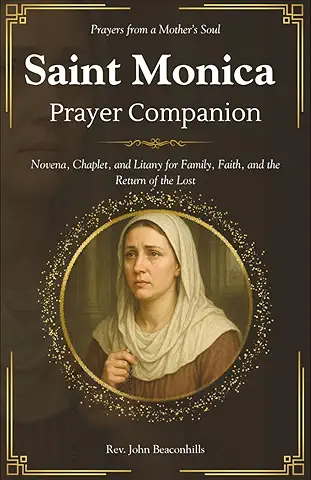
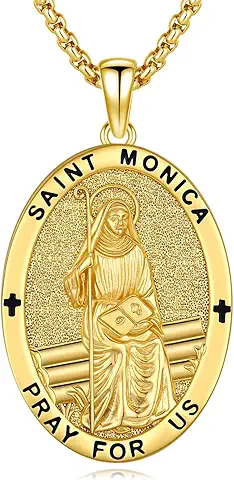
Her feast day is August 27 in the Roman Calendar, placed the day before the feast of her son Augustine — an arrangement that is theologically resonant: the mother intercedes, the son converts; the daughter of prayer precedes the Doctor of Grace. In artistic iconography she is typically shown wearing dark or monastic clothing, holding a handkerchief or wiping her tears, sometimes with a book (the Confessions) and sometimes with a small figure of Augustine beside her. The tears are the defining image: Monica is the saint of sacred weeping, of tears that are not despair but prayer.
Her relics were venerated at Ostia until 1162, when they were transferred to Rome. In 1430, Pope Martin V had them moved to the newly constructed church of Sant'Agostino in Rome, where they remain enshrined beneath the high altar. The church became a major pilgrimage site for mothers praying for wayward children, a tradition that continues today.
In the twentieth century, various associations of Catholic mothers — most notably the Archconfraternity of Saint Monica — formed around her intercession. These groups commit to regular prayer specifically for fallen-away children and estranged spouses, following Monica's model of persistent, non-confrontational, sacramentally grounded intercession.
Monica's significance for Eastern Catholic and Orthodox Christians is not liturgical — she is not formally venerated in the Eastern Churches — but her story resonates deeply with Eastern ascetic theology's emphasis on the transformation of suffering through prayer. The Desert Fathers and Mothers would have recognized immediately what Monica was doing: she was nepsis applied to maternal love, watchful and unsleeping prayer that does not flinch from the dark.
For anyone praying for a loved one who has left the faith, Monica is not simply a patron to invoke — she is a model to imitate. She did not argue her son into belief. She did not issue ultimatums or attempt to engineer circumstances. She prayed, and she waited, and she kept showing up. The great theological insight embedded in her life is that the conversion of another person is not a project we can complete — it is a miracle we can only ask for, and that asking, sustained over years and decades, is itself a form of holiness.
How to Pray the Saint Monica Novena
A novena is nine consecutive days of prayer, a form of sustained intercession that has deep roots in Catholic practice and that maps directly onto Monica's own spiritual method: not a single plea, but a persistent presenting of a need before God. The number nine connects historically to the nine days the apostles and Mary spent in prayer between the Ascension and Pentecost.
When to Pray the Monica Novena
The Monica Novena is traditionally prayed in the nine days leading up to her feast on August 27 — beginning August 18. But it may be prayed at any time, and many people find it most powerful to begin at a moment of specific crisis: when a child announces they are leaving the Church, when a spouse stops attending Mass, when a sibling has been estranged for years. The novena is not a magic formula. It is a structure for the kind of prayer Monica herself modeled: regular, humble, and unrelenting.
The Nine-Day Structure
Each day of the novena involves a short opening prayer, reflection on one aspect of Monica's witness, a specific intercession for the named person on your heart, and a closing prayer. The nine days typically correspond to nine aspects of Monica's virtue: her perseverance, her patience with a difficult husband, her willingness to follow her son across a sea, her humility before the bishop, her acceptance of Ambrose's correction, her trust in the dream she received, her joy at Augustine's conversion, her peace in dying, and her continued intercession from heaven.
Daily Prayer Text
The following may be prayed each day as the foundation of the novena:
What to Do When the Novena Ends
Monica prayed for thirty years, not nine days. The novena is a beginning, a structure for intensifying prayer, not a deadline after which God owes you an answer. Many people find it useful to repeat the novena multiple times — especially at each feast of Monica and each feast of Augustine — and to supplement it with regular Mass attendance offered specifically for their loved one's intention. The tradition of the saints for grief and loss is relevant here: the waiting is itself a form of spiritual formation, and the one who prays is being changed even when the one prayed for is not yet visibly moving.
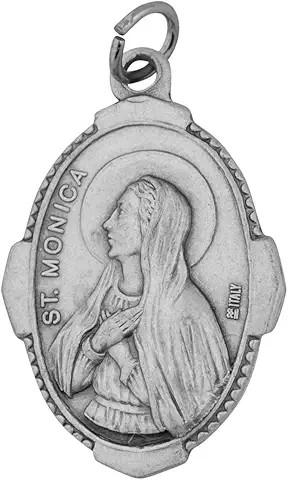
Saint Monica Devotional Products
Carry Her Intercession With You





Frequently Asked Questions
Saint Monica: Common Questions
For Thirty Years She Refused to Stop. Her Son Became Augustine. Your Turn Is Not Finished.
Monica did not live to see a quick answer. She followed her son across a sea he had crossed to escape her. She slept in a chapel while he sailed without her. She waited in Milan while Ambrose slowly, over years, dismantled the walls her son had built. And when the answer came, she leaped for joy — because thirty years of prayer had not broken her but prepared her to receive it.
If you are praying for someone who has not yet come home, you are not failing. You are doing exactly what Monica did. Carry her prayer card. Pray her novena. Ask for her intercession. And remember what the bishop told her: it cannot be that the son of so many tears should perish.
Browse our full collection of Orthodox Prayer Cards and Catholic Prayer Cards for saints who stand with you in every season of waiting.
Saints for Grief & Waiting → Browse All Prayer Cards →