Saints for Anxiety and Mental Health: Five Intercessors Who Understand the Interior Struggle
Eastern Catholic & Orthodox • Anxiety & Mental Health • Intercessory Prayer • Prayer Cards
Saints for Anxiety and Mental Health: Five Intercessors Who Understand the Interior Struggle
These saints did not theorize about anxiety from a safe distance. They bore it, counseled it, and in some cases wrote the most honest words ever spoken to the person who cannot find peace.
“Acquire peace within yourself, and thousands around you will find salvation.”— Saint Seraphim of Sarov • Russian Orthodox Elder • 19th Century
What You Will Find on This Page
- Saint Dymphna
- The Western patron of mental illness, anxiety, and emotional trauma — an Irish princess whose story has given courage to millions struggling with mental health for fifteen centuries
- Saint Paisios the Athonite
- The beloved modern Greek elder of Mount Athos — who counseled the anxious with radical simplicity, humor, and an unshakeable confidence that God handles everything
- Saint Porphyrios of Kavsokalyvia
- The elder who said anxiety is a sign of distance from God — and who spent his life helping people close that distance through joy rather than effort
- Saint Seraphim of Sarov
- The Russian wonderworker who greeted every visitor with “My joy” — whose entire ministry was the transmission of peace as a lived, embodied reality
- Saint Silouan the Athonite
- The Athonite monk who spent fifteen years in profound spiritual darkness and whose counsel remains the most honest word ever spoken to the despairing soul
- The Bundle
- All five saints as handmade prayer cards — icon on the front, saint biography and healing prayer on the back — available as a set
Anxiety, Depression, and the Eastern Christian Understanding of Interior Suffering
Anxiety is not a modern invention. The desert fathers of the fourth century catalogued it with clinical precision under the name acedia — a restlessness of the soul, a heaviness that makes prayer impossible and ordinary life unbearable. The Philokalia, the great anthology of Eastern Christian contemplative wisdom, devotes enormous attention to intrusive thoughts, spiritual darkness, loss of peace, and the interior warfare that every Christian faces. The tradition knew, long before psychology named it, exactly what anxiety and depression feel like from the inside.
What the Eastern Christian tradition offers to those struggling with mental health is neither a quick fix nor a dismissal. It does not say that anxiety is sin, or that depression is spiritual weakness, or that the right prayer will make it all go away. It offers instead a company of people — saints — who have been exactly where you are, who came through it or lived faithfully within it, and who are now in a position to pray for you with the particular authority of firsthand experience.
The five saints on this page were chosen for that reason. Saint Dymphna is the canonical Western patron of mental illness. Saint Silouan spent fifteen years in a darkness so profound he believed God had abandoned him — and found, at the other end of it, one of the most luminous theologies of humility in Christian history. Saint Paisios and Saint Porphyrios are modern elders who counseled thousands of anxious people and whose words have lost none of their precision. And Saint Seraphim of Sarov embodies the possibility at the other end of the journey: that peace is not just an absence of anxiety but a presence — a Person — who can be acquired.
How to Pray
Using These Prayer Cards When Anxiety Makes Prayer Hard
Anxiety does something particular to prayer: it makes it feel impossible while making it more necessary than ever. The mind races. The words don’t come. Sitting still feels intolerable. Formal prayer requires a kind of interior quiet that anxiety specifically removes.
A prayer card works differently from formal prayer precisely because it is physical. You pick it up. You look at the face. You say the name. That is already something — already a turning toward the saint, a small act of will in the direction of God. The Eastern tradition has always understood that we are embodied creatures who need physical anchors for interior acts, and that on the days when the interior feels inaccessible, starting with the body is not a lesser form of prayer. It is the right form of prayer for that day.
Saint Paisios told anxious people to stop trying so hard. “Leave it to God,” he said, repeatedly. The anxious person’s problem is often not that they pray too little but that they carry too much themselves. The card is a physical act of handing something over.
Saint Porphyrios taught that anxiety comes from focusing on yourself — on your symptoms, your fears, your failures — rather than on Christ. He counseled people to simply turn toward Christ, not away from anxiety. The card gives you something to turn toward.
Saint Seraphim greeted everyone with “My joy” regardless of what they brought him. He modeled the possibility that peace is not the absence of difficulty but a presence that coexists with it. Holding his card during a panic is not naive. It is reaching for the reality he embodied.
Saint Silouan’s counsel — “Keep your mind in hell and despair not” — is the most honest word in the tradition for the person in darkness. It does not ask you to feel better. It asks only that you not despair. The card is an anchor against despair when feeling better is not yet possible.
A Simple Practice for Hard Days
Hold the card. Look at the face. Say: “[Saint’s name], I cannot pray right now. Please pray for me.” That is a complete act of intercessory prayer. The saint takes it from there. You do not need to feel peace for the prayer to work. You need only to ask.
Saint One
Saint Dymphna
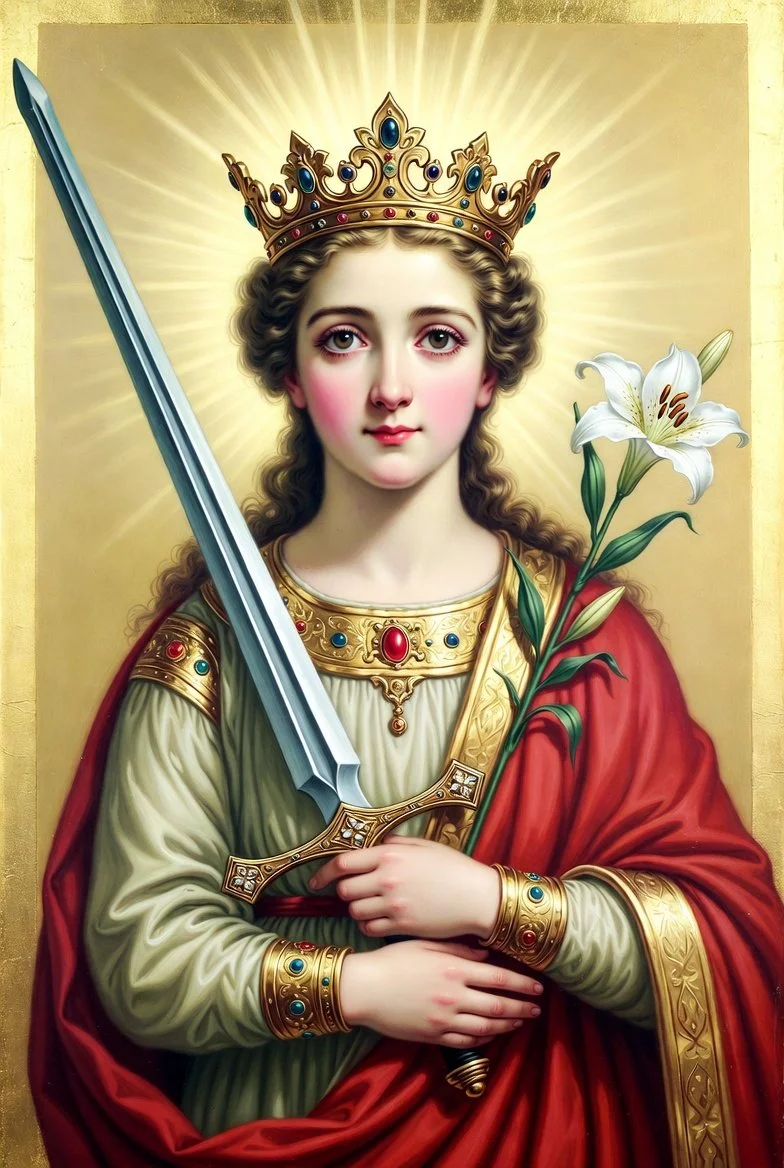
Dymphna was an Irish princess of the seventh century, the daughter of a pagan chieftain and a deeply Christian mother who died when Dymphna was still young. When her father’s grief drove him to madness — and eventually to attempting to force his daughter into marriage — Dymphna fled to Belgium with her confessor, the priest Gerebernus. Her father tracked her down. When she refused to return, he beheaded her. She was, by all accounts, a teenager.
What happened afterward established her permanent association with mental illness: pilgrims who visited her tomb in Gheel, Belgium, reported healings of mental and emotional disorders. The town of Gheel eventually developed one of the earliest community mental health care systems in history, housing the mentally ill in local families rather than institutions — a practice rooted explicitly in their devotion to Saint Dymphna. For over a thousand years, she has been the patron to whom the mentally ill, the anxious, the traumatized, and their caregivers have turned.
Her relevance to anxiety specifically is both historical and theological. She bore an extreme version of what anxiety often produces: a situation that felt genuinely impossible, with no good options, requiring a kind of trust in God that normal circumstances rarely demand. She did not escape her suffering. She went through it. And the tradition holds that she now intercedes with particular force for those in impossible interior situations — where the anxiety is not imagined, where the circumstances are genuinely hard, and where the only available move is to hold on.
Saint Two
Saint Paisios the Athonite
Arsenios Eznepidis was born in 1924 in Farasa, Cappadocia, and took the monastic name Paisios when he became a monk on Mount Athos. He spent most of his adult life as a hermit in the Athonite wilderness — but his reputation as a spiritual father spread so widely that thousands of people made the journey to find him, and he spent enormous amounts of time receiving them. He died in 1994 and was canonized by the Ecumenical Patriarchate in 2015, one of the fastest canonizations in modern Orthodox history.
What drew people to Paisios, and what has made him so beloved among those struggling with anxiety, is a specific combination: radical simplicity, genuine warmth, and a bedrock confidence in God’s providence that never felt forced or pious. He did not tell anxious people to try harder or pray more. He told them to stop worrying, that God was handling it, and that their job was simply to trust. He delivered this counsel with such obvious personal conviction — and such warmth — that people believed him.
His collected sayings, published in several volumes, are among the most-read Orthodox spiritual texts of the last fifty years. They circulate widely in anxiety and mental health communities precisely because they are practical, specific, and non-pious — he addresses the anxious person’s actual experience rather than offering spiritual platitudes. He was canonized in part because of the continuing stream of healings reported at his tomb at the Monastery of Saint John the Theologian in Souroti, Greece.
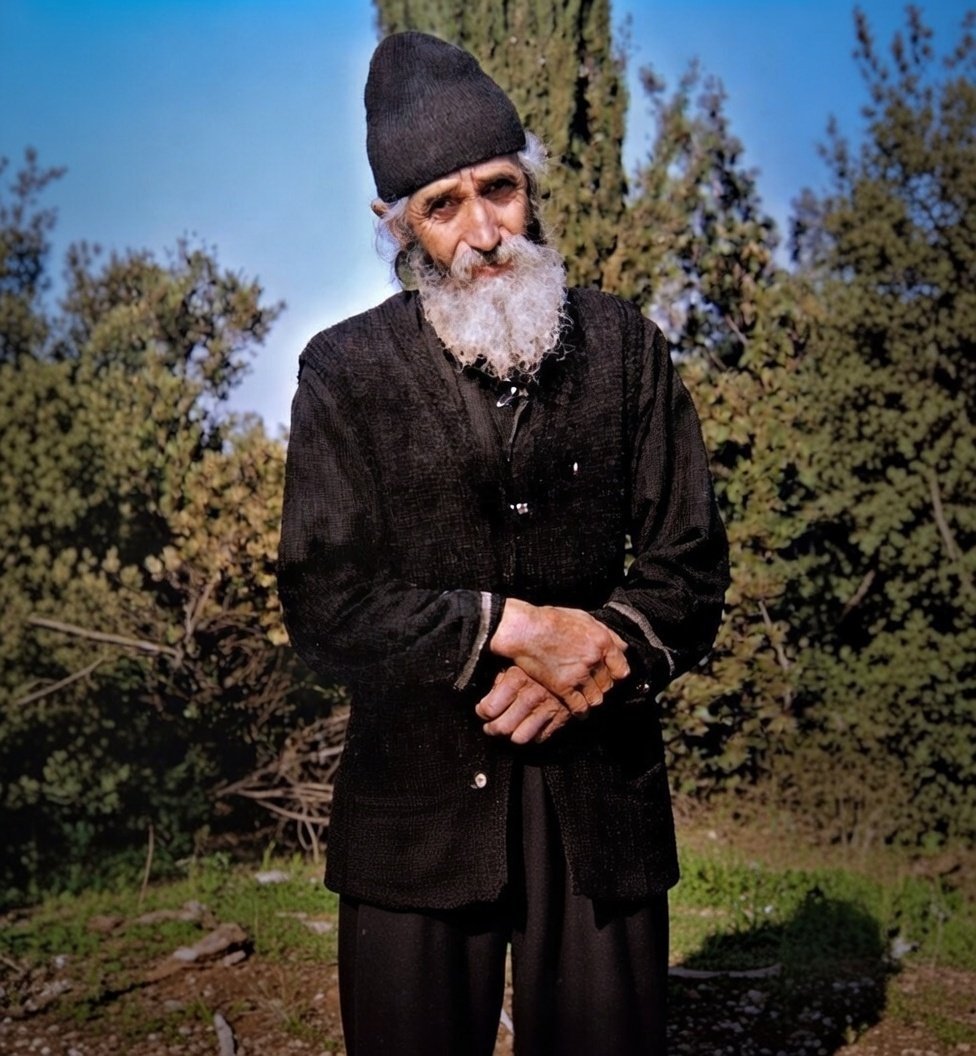
Saint Paisios’s complete life, his years on Mount Athos, his collected sayings on anxiety, and his miracles are covered in our complete biography of Saint Paisios the Athonite →
Saint Three
Saint Porphyrios of Kavsokalyvia
Evangelos Bairaktaris was born in 1906 in a small village in Evia, Greece, and became a monk on Mount Athos at the age of fourteen — without his parents’ knowledge, having simply set off alone to find the Holy Mountain. He spent years in the Kavsokalyvia skete before a serious illness forced him to leave Athos and return to the mainland, where he was ordained a priest and served for decades at a chapel in the Athens Polyclinic. He was surrounded by sick people for most of his ministry. He died in 1991 and was canonized by the Ecumenical Patriarchate in 2013.
Porphyrios had a remarkable charismatic gift: he could perceive the interior state of the people who came to him with an accuracy that left them stunned. What he told anxious people, consistently, was a version of the same thing: the problem was not the anxiety itself but where their attention was pointed. “Don’t fight your passions directly,” he taught. “Just turn toward Christ. He is the cure for everything. When you run toward Christ, the passions fall away by themselves.”
His approach to anxiety is counter-intuitive: he did not encourage fighting anxiety directly, which typically makes it worse. Instead, he redirected attention entirely — toward beauty, toward prayer, toward love of Christ — so that the anxiety lost its grip not through struggle but through replacement. His collected sayings, published as Wounded by Love, are widely read in mental health contexts and have influenced Orthodox pastoral counseling significantly.
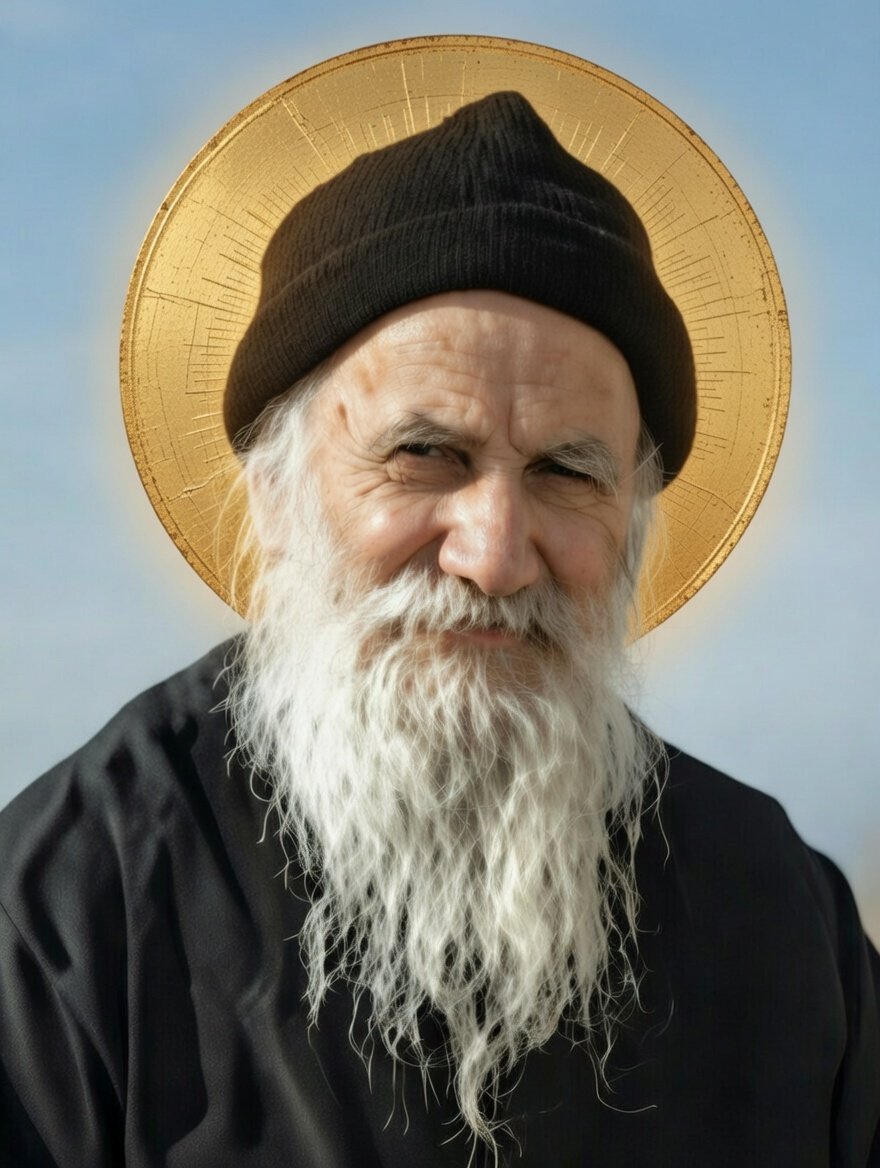
Saint Porphyrios’s complete life, his years on Mount Athos and in Athens, his teachings on anxiety and love, and the miracles attributed to him are in our complete biography of Saint Porphyrios of Kavsokalyvia →
Saint Four
Saint Seraphim of Sarov
Prokhor Moshnin was born in 1754 in Kursk, Russia, entered the Sarov Monastery at nineteen, and was tonsured a monk with the name Seraphim — meaning “burning one,” for the seraphim of Isaiah’s vision. He spent years as a hermit in the Sarov forest, then three years of complete silence, then a thousand days and nights standing on a rock in prayer — an act of ascetic discipline that permanently damaged his health. He emerged from his long retreat in 1815 and spent the remaining eighteen years of his life receiving visitors.
What those visitors encountered was something they struggled to describe: a man who radiated joy. He greeted everyone — the grieving, the sick, the despairing, the spiritually confused — with the same words: “My joy, Christ is Risen.” He said this regardless of the season. He said it to people who had traveled hundreds of miles in desperation. The effect, by all accounts, was not sentimental or dismissive. It was transformative. The peace he had acquired through decades of prayer was transmitted in the encounter.
His most famous teaching — that the goal of Christian life is the acquisition of the Holy Spirit, and that peace is the primary sign of that acquisition — makes him the patron of those whose anxiety is not just circumstantial but existential: those who feel that peace is constitutionally unavailable to them, that others may find it but they cannot. Seraphim’s entire life is the refutation of that belief. He was canonized by the Russian Orthodox Church in 1903, with Tsar Nicholas II present at the ceremony. His relics are enshrined at the Diveyevo Monastery in Russia.

Saint Five
Saint Silouan the Athonite
Simeon Antonov was born in 1866 in a village in the Tambov region of Russia, a peasant’s son with a reputation for drinking and fighting before a profound spiritual experience at nineteen sent him to Mount Athos. He entered the Saint Panteleimon Monastery and lived there for the remaining forty-six years of his life, dying in 1938. He was canonized by the Ecumenical Patriarchate in 1987.
What makes Silouan uniquely relevant to those with depression and anxiety is the specific nature of his interior life. For approximately fifteen years — the middle decades of his monastic life — he experienced profound spiritual desolation. He felt God had withdrawn. He felt abandoned. He prayed and received nothing. The darkness was not poetic or metaphorical; it was grinding, long, and real. His writings from this period have a rawness that is rare in hagiography and immediately recognizable to anyone who has experienced severe depression.
At the end of his long darkness, Silouan received an interior locution: “Keep your mind in hell and despair not.” It became the cornerstone of his theology.
This is not nihilism. It is the most honest counsel in the Christian tradition for the person in genuine darkness: you do not have to pretend it is not hell. You do not have to manufacture feelings of peace or gratitude you do not have. You do not have to perform spiritual health you cannot access. You have only to hold on — to refuse despair — while everything else is dark. The refusal of despair is itself an act of faith, even when nothing else is available.
Silouan intercedes with particular force for those in the worst moments — not for those whose anxiety is manageable, but for those for whom it has become a darkness that covers everything. He has been there. He held on. He is now in a position to help you hold on too.
His writings were collected and published by his disciple Archimandrite Sophrony (Sakharov) in the book Saint Silouan the Athonite, which remains one of the most widely read Orthodox spiritual texts of the twentieth century. His relics are at the Saint Panteleimon Monastery on Mount Athos.
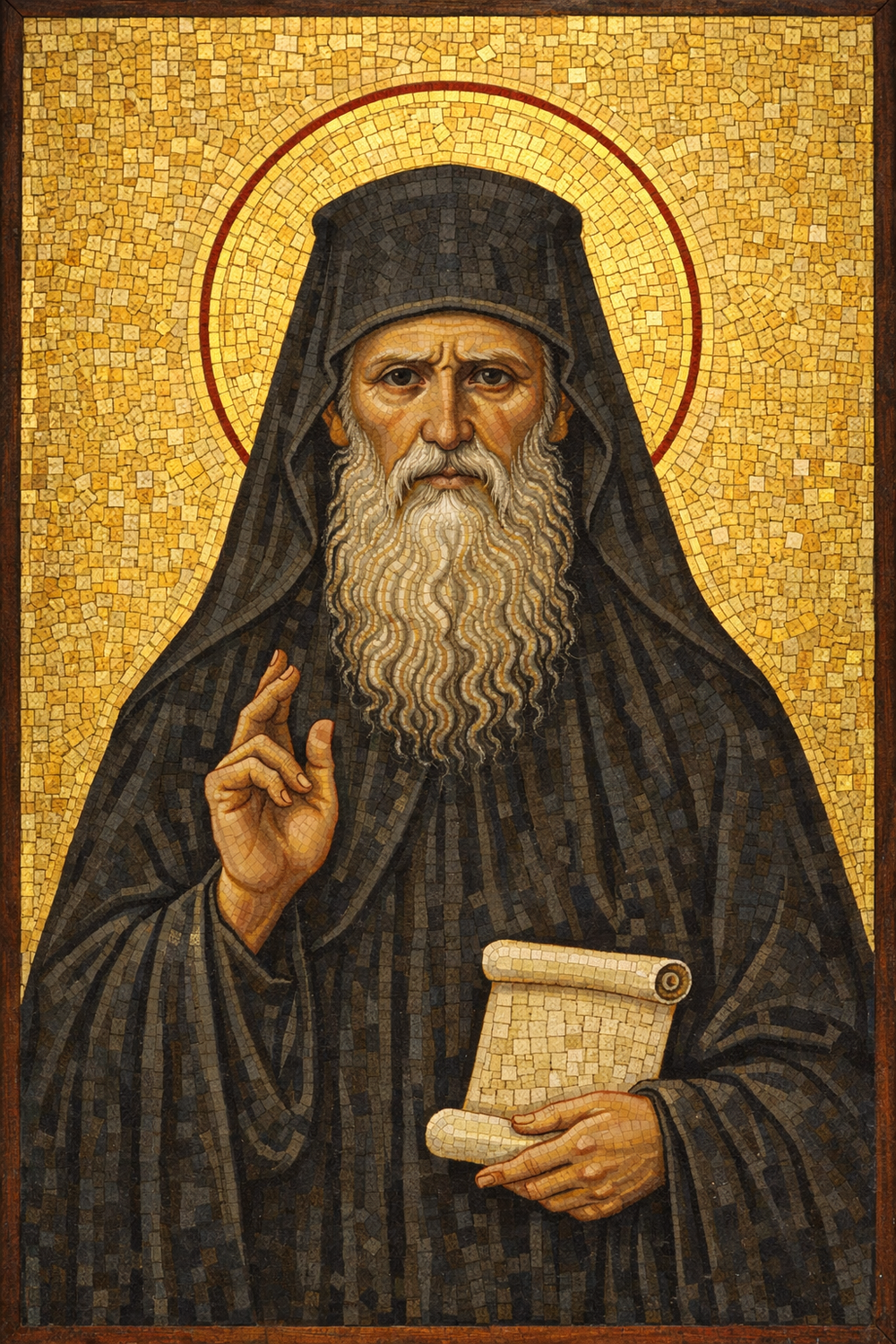
The Bundle
The Anxiety & Mental Health Saints Bundle — All Five Cards
All five saints as handmade prayer cards, shipped together. One for each kind of interior suffering: the traumatized, the chronically worried, the person whose anxiety grows when they fight it, the one who cannot find peace, and the one in genuine darkness. Each card carries an icon on the front and a saint biography and healing prayer on the back.
Get the Anxiety & Mental Health Saints Bundle
All five prayer cards, handmade and shipped together. For the person who is anxious, for the one in darkness, for the caregiver who needs something to give. Each card carries an icon, a biography, and a prayer.
Add to Cart →Frequently Asked Questions
Saints for Anxiety & Mental Health — Common Questions
You Are Not Praying Alone.
Anxiety lies to you about this: that you are isolated, that no one understands, that this particular darkness is yours alone. Every saint on this page is the refutation of that lie. They have been here. Dymphna in an impossible situation with no good options. Silouan in a darkness that lasted fifteen years. Seraphim emerging from a thousand nights on a rock. They are not distant. They are praying.
Get the Bundle →