Saints for a Happy Marriage: Eight Intercessors for Engaged Couples, Newlyweds, and the Long Arc of Married Life
Eastern Catholic & Orthodox • Marriage • Family Life • Wedding Gift • Prayer Cards
Saints for a Happy Marriage: Eight Intercessors for Engaged Couples, Newlyweds, and the Long Arc of Married Life
These are not saints who theorized about marriage. They lived it — as spouses, as parents, as partners in faith, and sometimes as the one holding the marriage together alone. They are the right people to ask for help with yours.
“True love is not a feeling. It is a decision renewed every morning.”— Attributed to Saint Louis Martin • Watchmaker • Father of Saint Thérèse • Canonized 2015
Eight Saints for Eight Dimensions of Marriage
- Saint Joseph
- The patron of husbands and fathers — the model of silent, faithful, protective love; the man who said yes without explanation
- Saint Monica
- The patron of difficult marriages — who bore an unfaithful and difficult husband for years and outlasted him through patient, persistent prayer
- Saints Joachim & Anna
- The parents of Mary — who waited decades for the child they had been promised, and whose faithful marriage became the vessel for the Incarnation
- Saints Gregory & Nonna
- The couple whose marriage produced three saints — where the wife's holiness drew the husband into faith and eventually into ordination
- Saints Louis & Zélie Martin
- The only couple canonized together in modern Catholic history — whose letters to each other survive as a model of marriage ordered entirely toward God and family
- Saints Aquila & Priscilla
- The New Testament couple who worked, traveled, and ministered alongside Paul — the original model of marriage as domestic church
- Saint Rita of Cascia
- The patron of difficult and impossible marriages — who bore violence and loss with extraordinary faith and is now the patron of those for whom marriage has been the hardest thing
- Saints Basil the Elder & Emmelia
- The parents who raised nine children, four of whom became saints — whose marriage is the model for the family that bears spiritual fruit across generations
What the Christian Tradition Actually Teaches About Marriage
The Christian tradition — Eastern and Western — has always understood marriage as something more than a legal arrangement or a romantic relationship. It is a sacrament in the Catholic and Orthodox understanding: a visible sign of an invisible grace, specifically the grace of Christ’s love for the Church. The Eastern tradition calls the couple in marriage little martyrs — crowned at the wedding ceremony with crowns that echo the crowns of martyrdom, because the love required to sustain a faithful marriage for a lifetime costs exactly that much.
What the saints on this page offer is something practical: they have been in marriage, or they have held marriages together through prayer, or they have lived the full arc of what faithful married life requires — from the joy of early love to the patience of decades to the grief of losing a spouse. They are not distant theological figures. They are people who sat where you sit, who argued and forgave, who worried about children and finances, who bore difficult spouses and difficult seasons, and who found that God was present in all of it.
Eight cards. Eight specific dimensions of what marriage actually is. No filler, no symbolic gestures — every saint on this page has a direct and traditional connection to the specific dimension of marriage they represent.
A Wedding Gift That Lasts the Life of the Marriage
The bundle is designed as a wedding or anniversary gift as much as a personal devotional set. These eight cards are for the couple who wants something for their home that connects them to the tradition they are entering — not another serving platter, not a gift card, but something with theological weight and practical use.
Card One
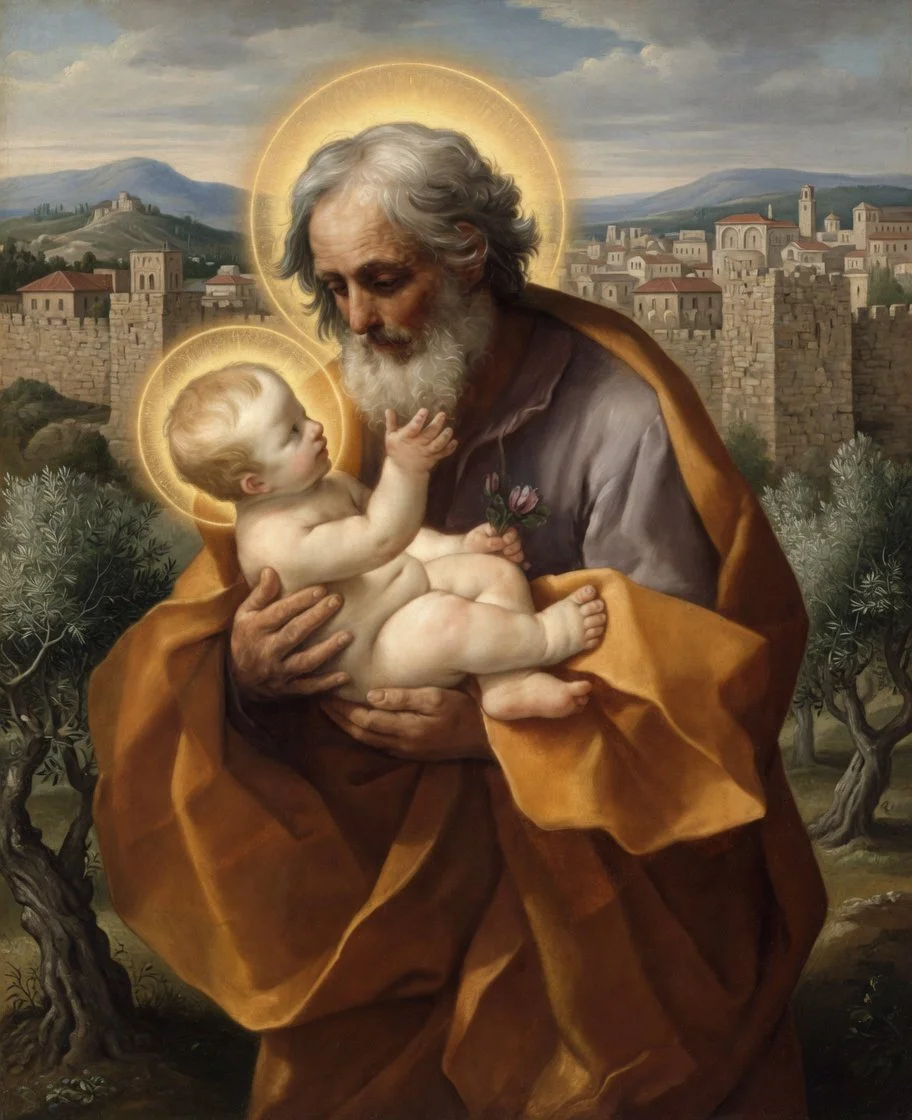
Saint Joseph
Joseph of Nazareth appears in the Gospels without a single recorded word. He receives messages from angels in dreams, acts on them immediately, and says nothing that the evangelists preserve. He protects Mary during her pregnancy. He takes the family to Egypt when Herod threatens the child. He brings them back to Nazareth. He raises the Son of God in the ordinary work of a carpenter’s shop. And then he disappears from the narrative entirely — presumably dead by the time of Jesus’s public ministry.
What the tradition has made of this silence is remarkable. Joseph becomes the patron of the hidden life — of the man whose vocation is to protect, provide, and step back. He is the model for every husband whose role in the family is not visible, not celebrated, not narrated — who simply shows up, does what is needed, and trusts that what he is protecting is worth the cost. He was asked to trust an extraordinary situation with no explanation he could have fully understood, and he said yes. That yes is the model for the husband’s vocation.
Card Two
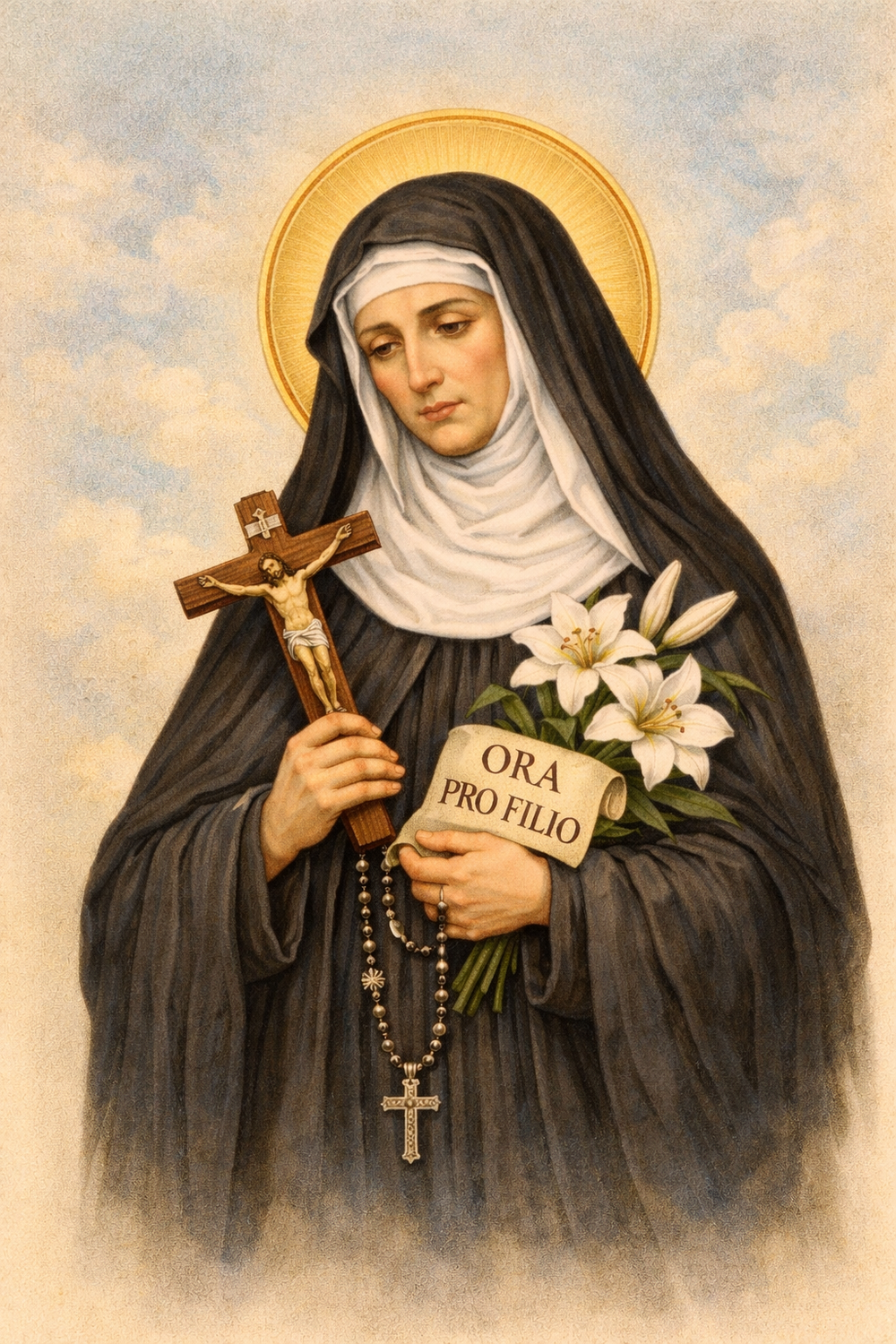
Saint Monica
Monica was born in North Africa around 331 AD and was given in marriage to Patricius — a Roman official who was pagan, quick-tempered, and unfaithful. She bore his temper without retaliation, his infidelity without public complaint, and his paganism with patient, consistent prayer. He converted to Christianity shortly before his death. She outlasted him and spent the remaining decades of her life praying for her wayward son Augustine — whose conversion became one of the most celebrated in Christian history. She died in 387, days after Augustine’s baptism, having watched the prayer of her marriage and her motherhood both finally answered.
What makes Monica the patron of difficult marriages is not that her marriage ended well — Patricius died shortly after converting, and their years together were genuinely hard. It is that she found a way to remain faithful inside a marriage that gave her little to work with, and that her fidelity outlasted the difficulty. She is the patron for the wife whose husband has not yet become the man she prayed he would be, for those whose marriages are harder than they expected, and for anyone who is holding a marriage together largely alone.
Monica’s strategy in her difficult marriage was specific and documented in Augustine’s Confessions: she prayed, she refused bitterness, and she outlasted. She did not retaliate against Patricius’s temper. She did not campaign against him publicly. She absorbed the difficulty of the marriage without letting it deform her interior life, and she prayed consistently for decades for outcomes she did not live to see partially until near the very end.
Augustine credits her tears and prayers explicitly for his own conversion. The tradition holds that no faithful prayer for a spouse is wasted, even when the answer comes slowly — which is Monica’s particular contribution to the theology of marriage.
Card Three
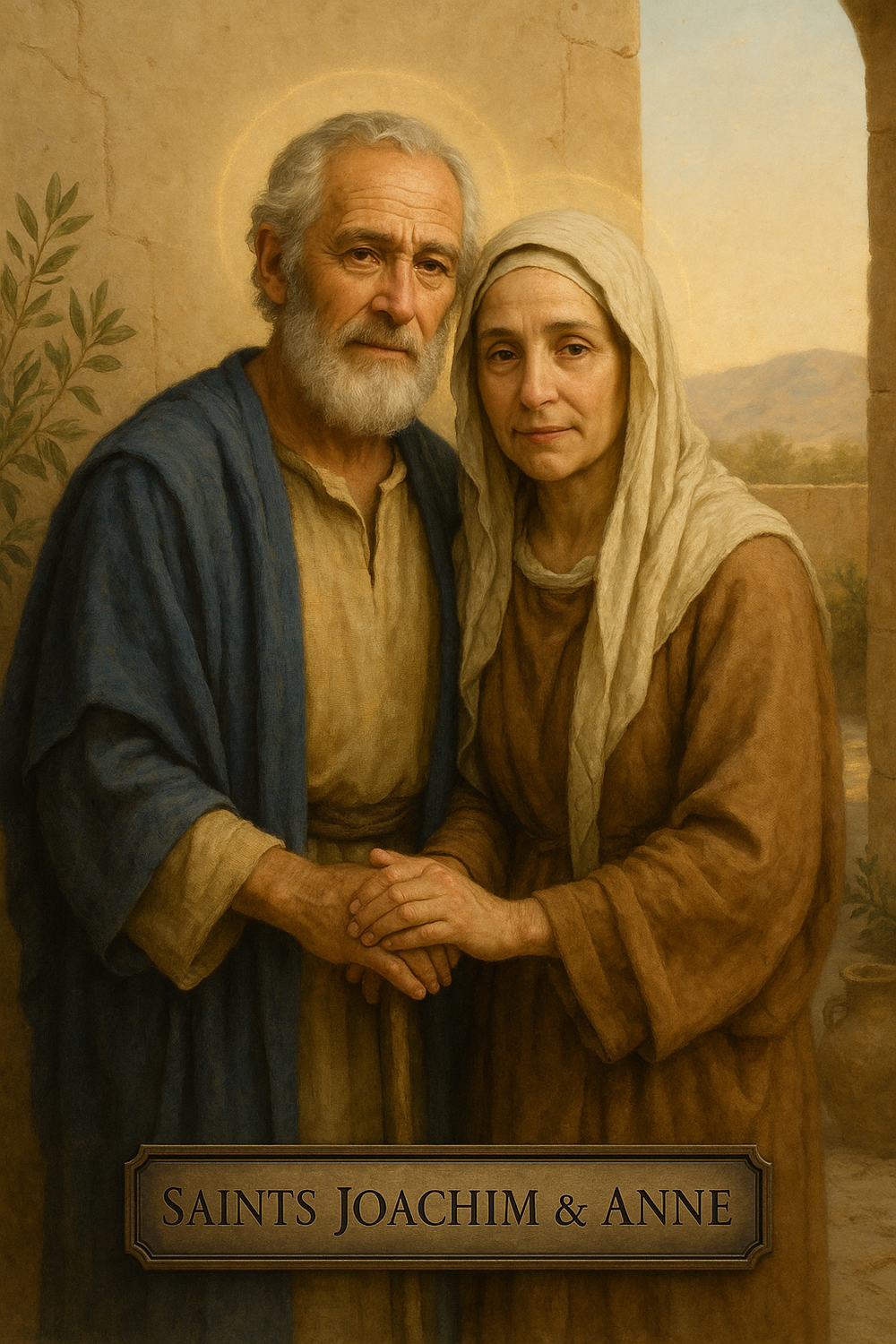
Saints Joachim and Anna
Joachim and Anna are the parents of the Virgin Mary — not named in the canonical Gospels but present in the Protoevangelium of James and venerated across both Eastern and Western Christianity for two millennia. Their story is one of long waiting: they were a devout couple who could not conceive, who bore the social shame of childlessness in their culture for decades, who prayed faithfully without apparent answer — and who, in old age, received the child who would become the Mother of God.
In the Eastern tradition, their feast day on September 9 — the day after the Nativity of Mary — is a major liturgical celebration. They are depicted in iconography as a couple, frequently shown in embrace or flanking the young Mary, and they are the preeminent Eastern model of faithful marriage: two people who maintained their covenant with each other and with God through a long season of apparent divine silence, and who became, in the end, the grandparents of the Incarnate Word.
Card Four
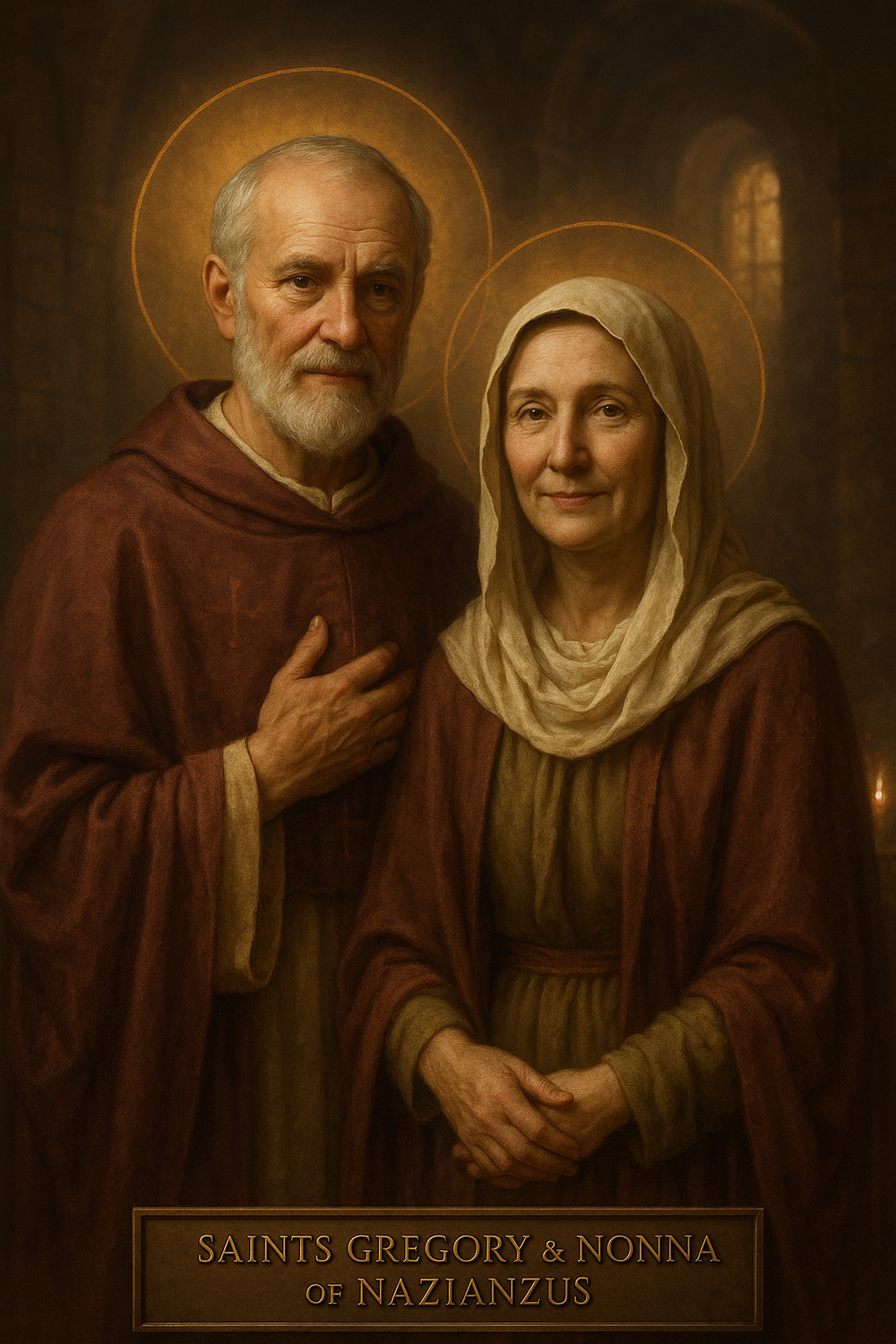
Saints Gregory and Nonna
Nonna was a devout Christian woman who married Gregory of Nazianzus the Elder — a man who belonged to a syncretic religious sect called the Hypsistarians, who combined elements of paganism and Judaism. Through the consistency of her prayer, the integrity of her life, and what her son Gregory the Theologian describes as patient, loving persistence, she brought her husband to Christian faith. He was baptized and eventually ordained a bishop, serving the diocese of Nazianzus for forty-five years. He died a bishop. She died a saint.
Together they raised three children who are all venerated in the Orthodox calendar: Gregory the Theologian (one of the Three Holy Hierarchs and one of the greatest theologians in Christian history), Caesarius the Physician, and Gorgonia. Their marriage is one of the most remarkable in the Christian tradition — not because it was easy or free of difficulty, but because the holiness of one spouse gradually drew the other into the fullness of faith, and the resulting family became one of the most spiritually fruitful in the history of the Eastern church.
Card Five
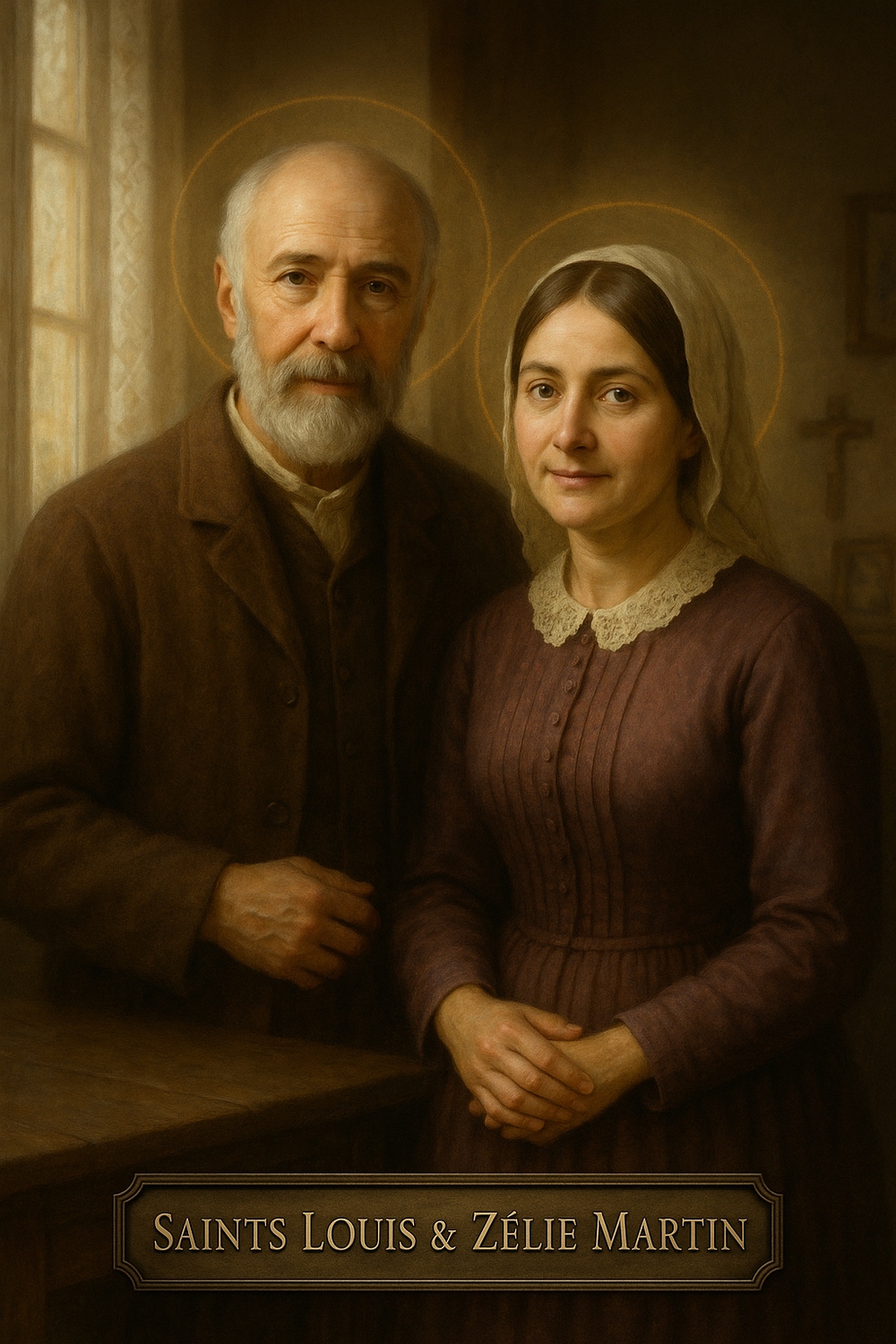
Saints Louis and Zélie Martin
Louis Martin was a watchmaker and jeweler. Zélie Guérin was a lacemaker. They met in 1858, married three months later, and had nine children — four of whom died in infancy. All five who survived to adulthood entered religious life; the youngest was Thérèse, who became Saint Thérèse of Lisieux and one of only four women named a Doctor of the Church. Louis and Zélie corresponded extensively during the periods Louis traveled for business, and their letters survive — hundreds of pages of ordinary married correspondence that are extraordinary precisely because of what they reveal: a marriage in which both people were actively pursuing holiness together, supporting each other’s prayer life, discussing the faith, grieving their dead children, and raising the living ones with deliberate attention to their spiritual formation.
Pope Francis canonized them together on October 18, 2015 — the first married couple canonized simultaneously as a couple in modern Catholic history. Their canonization was the Church’s formal declaration of something the tradition has always held but rarely demonstrated so explicitly: that ordinary married life, lived with extraordinary faithfulness, is itself a complete path to sainthood.
Every previous married saint was canonized individually — for their personal holiness, with the marriage as context but not subject. Louis and Zélie were canonized together, as a couple, for their holiness as a married couple. The marriage itself is what was declared holy.
This is a theological statement of considerable weight. It means the Church has formally recognized that the ordinary life of a faithful Christian marriage — the daily decisions, the correspondence, the grief over lost children, the support of each other’s prayer, the raising of children in the faith — constitutes heroic virtue. Not despite being ordinary. Because of it.
Card Six
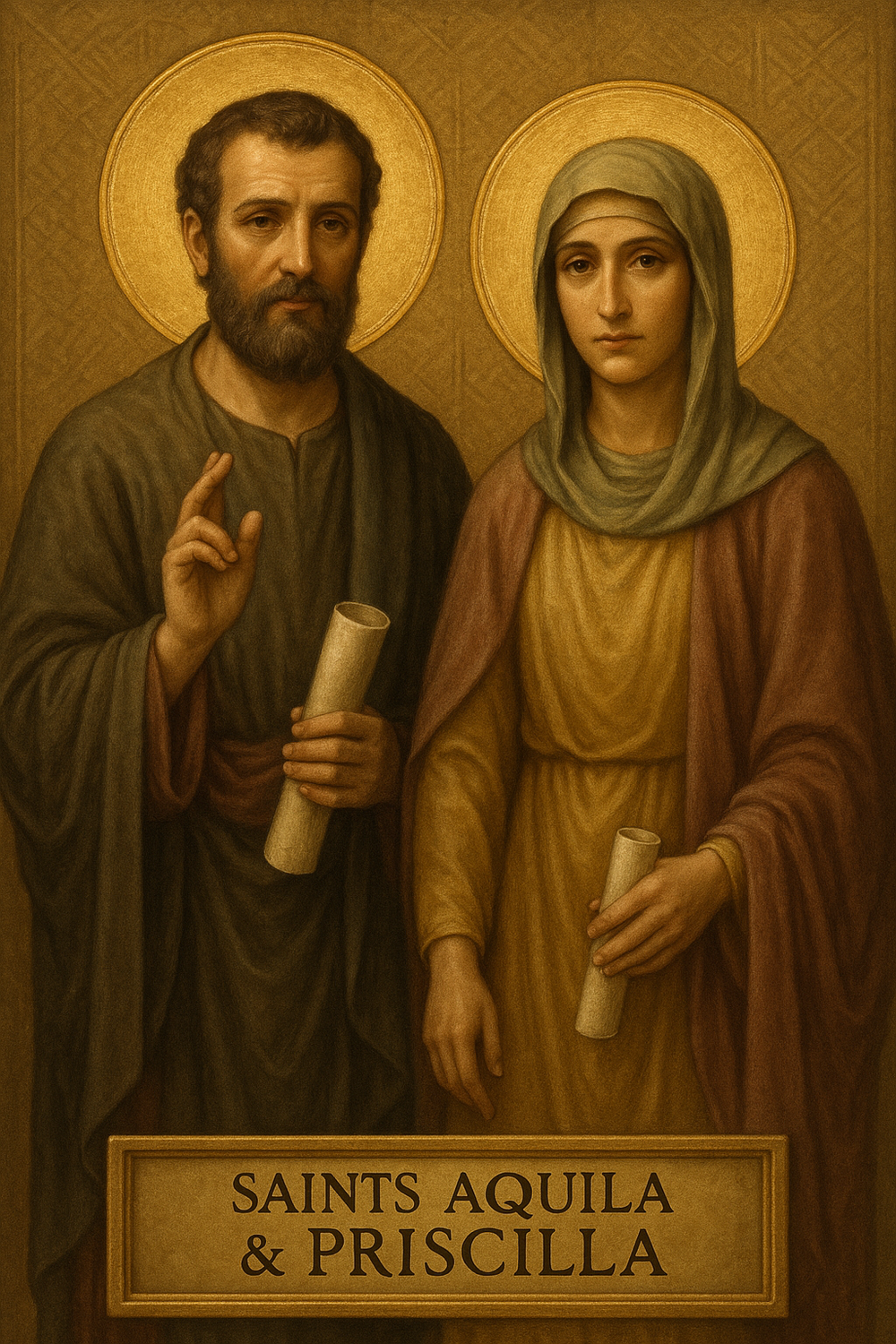
Saints Aquila and Priscilla
Aquila and Priscilla appear in the New Testament more than any other married couple apart from Mary and Joseph. They are mentioned in Romans 16, Acts 18, 1 Corinthians 16, and 2 Timothy 4 — always together, always working. Paul calls them his fellow workers in Christ Jesus. They hosted a church in their home in Corinth, then Ephesus, then Rome. They took Apollos aside and explained the faith to him more accurately. They risked their necks for Paul’s life. They were Jews expelled from Rome under the Emperor Claudius who made their home and their marriage into a center of apostolic activity wherever they landed.
What the tradition has preserved in Aquila and Priscilla is the earliest model of the domestic church — the marriage that opens its home to the community, that does ministry together rather than separately, that makes the household itself a place of hospitality and prayer. They are the patron couple for every husband and wife who want their marriage to be something more than a private arrangement — who want their home to be, in the Eastern phrase, a little church.
Card Seven
Saint Rita of Cascia
Rita Lotti was born in 1381 near Cascia, Italy, and from an early age wanted to enter religious life. Her parents instead arranged her marriage to a man named Ferdinand Mancini — by most accounts a harsh and quick-tempered husband who treated Rita poorly throughout their marriage. She bore this without retaliation, prayed for her husband, and reportedly softened his character significantly over the years. He was killed in a vendetta after eighteen years of marriage, leaving Rita a widow with two sons. Both sons died young, and Rita entered the Augustinian convent at Cascia — eventually receiving the stigma of the crown of thorns. She died in 1457 and was canonized in 1900.
Her association with difficult and impossible situations in marriage comes from the specific texture of what she bore — a marriage she did not choose, to a man who was genuinely difficult, which she held in faith for eighteen years without bitterness. She is not the patron of happy marriages. She is the patron of the ones that are hardest, the ones that have been violent or unjust or simply very difficult, and of the person inside them who is trying to hold on to faith while bearing what they have been given.
Saint Rita is the card for the person whose marriage is not a source of joy right now — who is bearing something genuinely difficult, who is praying for a spouse who has caused real harm, or who is trying to find God inside a marriage that has been very hard. She has been there. She held on. She is the patron of impossible situations in marriage, which means she is also the patron of those for whom the situation may not be impossible — just very, very hard.

Card Eight
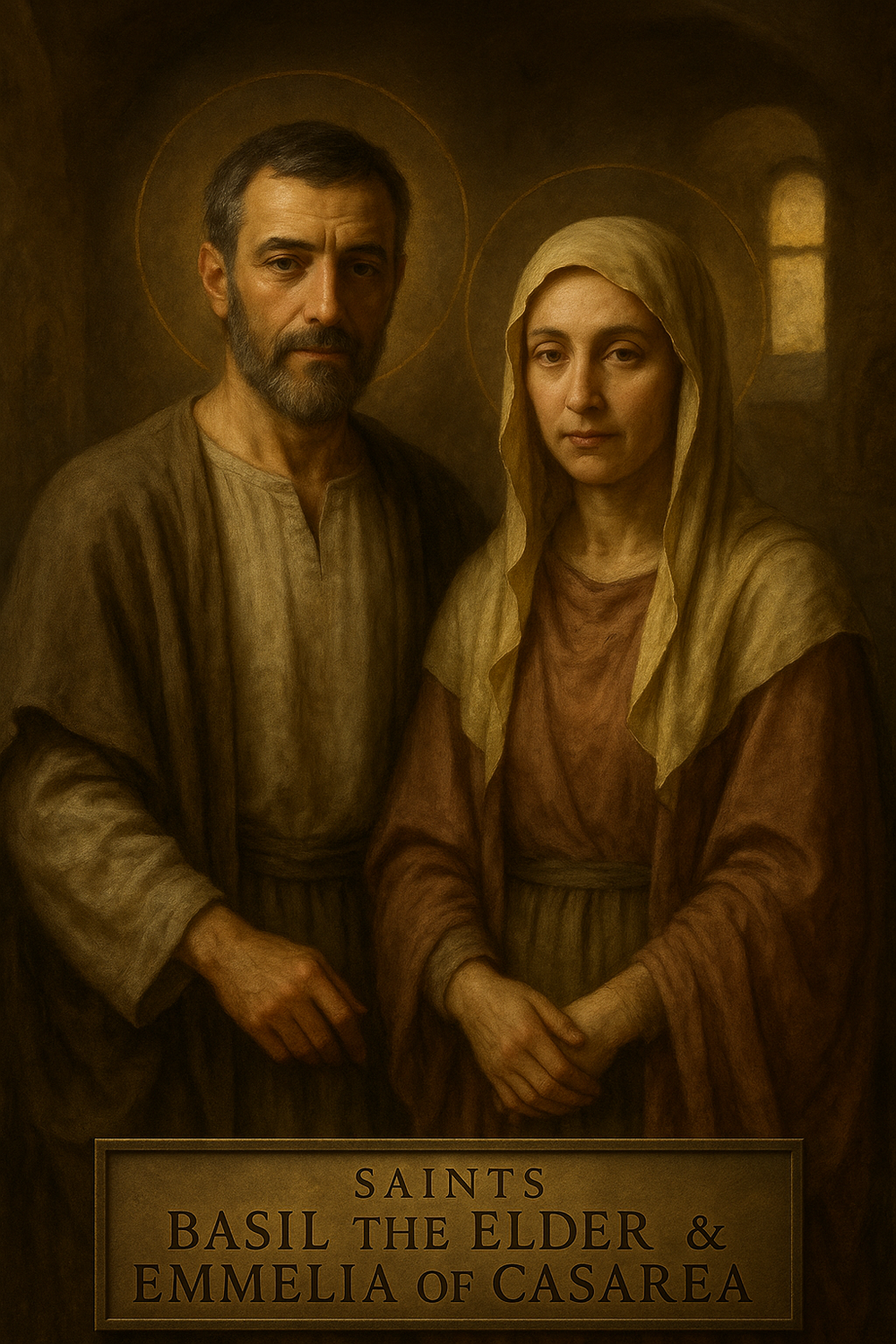
Saints Basil the Elder and Emmelia of Caesarea
Basil the Elder and Emmelia of Caesarea were a wealthy Christian couple in fourth-century Cappadocia who had ten children. Of those ten, four are venerated as saints in the Eastern Orthodox calendar: Basil the Great (one of the Three Holy Hierarchs and the most influential theologian of the fourth century), Gregory of Nyssa (a foundational figure in early Christian mysticism), Peter of Sebaste (a bishop and theologian), and Macrina the Younger (the eldest daughter and a foundational figure in Eastern monastic life). Their grandmother, Macrina the Elder, had been a disciple of Gregory the Wonderworker. The family had been Christian for three generations before Basil and Emmelia, and they produced saints for at least two generations after.
What they represent in the theology of marriage is specific and remarkable: a marriage whose primary fruit was not personal holiness — though that was present — but the formation of children who shaped the entire trajectory of Eastern Christianity. Their home was a school of faith in the most practical sense. Emmelia in particular is credited with the theological formation of the children; Gregory of Nyssa’s account of their eldest sister Macrina describes a household where Scripture and theology were the ordinary content of family life.
The Bundle
The Happy Marriage Saints Bundle — All Eight Cards
All eight prayer cards, handmade and shipped together. For the engaged couple, for the newlyweds, for the anniversary, for the couple in a hard season, for the parent who wants something to give that has real theological weight. Each card carries an icon on the front and a saint biography and marriage prayer on the back. Made by hand in Austin, Texas.
Get the Happy Marriage Saints Bundle
Eight handmade prayer cards covering every season of marriage — from the joy of new love to the patience of decades to the grace of holding together what is hard. For the wedding, the anniversary, the couple in a difficult season, or the family trying to build something that lasts.
Add to Cart →Frequently Asked Questions
Saints for Marriage — Common Questions
Every Marriage Needs a Cloud of Witnesses.
Louis and Zélie wrote letters to each other about God. Aquila and Priscilla opened their home to an entire church. Nonna prayed her husband into faith. Monica outlasted a difficult marriage through prayer alone. Joachim and Anna waited thirty years for the child they were promised. These are not idealized figures. They are people who did the actual work of marriage, in actual circumstances, with actual difficulty — and who are now in a position to bring yours before God.
Get the Bundle →