What Is the Jesus Prayer? The Eastern Christian Path to Contemplative Prayer
Christian Mysticism · Contemplative Prayer · Eastern Tradition
What Is the Jesus Prayer? The Eastern Christian Path to Contemplative Prayer
Seventeen words that have carried millions of souls toward God for sixteen centuries—and can carry you, too.
"Lord Jesus Christ, Son of God,
have mercy on me, a sinner."
Κύριε Ἰησοῦ Χριστέ, Υἱέ τοῦ Θεοῦ, ἐλέησόν με τὸν ἁμαρτωλόν — The Jesus Prayer in Greek
There is a prayer so ancient, so simple, and so complete that an entire mystical tradition—spanning sixteen centuries, two continents, and hundreds of saints—was built around it. It contains seventeen words in English, fewer in Greek. It can be prayed in four seconds or allowed to unfold into an hour of silent communion. A monk on Mount Athos prays it ten thousand times a day. A mother prays it on the bus between school pickup and grocery shopping. A man dying in a hospital bed in Cleveland prays it as his last conscious act.
The prayer is this: Lord Jesus Christ, Son of God, have mercy on me, a sinner.
If you have ever wondered what contemplative prayer actually looks like in daily life—not in a monastery, not in a theology textbook, but in the real and ordinary hours of your day—the Jesus Prayer is the most complete answer the Eastern Christian tradition has ever given.
This guide covers everything: where the prayer came from, what every phrase means, how to pray it, how the prayer rope works, which saints perfected it and what their lives prove, whether Western Christians can use it, and what to do when it feels like nothing is happening. We will also point you, more than once, to a book that we believe is the single most practical companion available right now for beginning or deepening this kind of prayer life.
What Is the Jesus Prayer?
The Jesus Prayer is a short, scriptural invocation of the name and mercy of Christ, repeated slowly and attentively as a path toward continuous prayer and interior communion with God. Its full form—Lord Jesus Christ, Son of God, have mercy on me, a sinner—is the version most widely used in Eastern Christianity today, though shorter forms (Lord Jesus Christ, have mercy on me or simply Lord, have mercy) have always existed alongside it.
What makes the Jesus Prayer different from other repetitive prayers is its intent. It is not a formula for getting something from God. It is not a mantra in the Eastern religious sense—it does not aim at emptying the mind or achieving a state of consciousness. It is a repeated act of turning: turning the attention, the will, and eventually the whole being toward the person of Jesus Christ, asking for the one thing that makes all other things possible—His mercy.
The prayer is entirely scriptural in its components. "Lord" is the earliest Christian confession (Romans 10:9). "Jesus Christ, Son of God" echoes Peter's confession at Caesarea Philippi (Matthew 16:16) and the angel's words at the Annunciation (Luke 1:31–35). "Have mercy on me, a sinner" is the exact prayer of the publican in the parable Jesus himself commended above the prayer of the Pharisee (Luke 18:13). The two blind men beside the road cried, "Lord, have mercy on us, Son of David!" (Matthew 20:30). Bartimaeus cried it alone from the roadside (Mark 10:47). The ten lepers cried it from a distance (Luke 17:13). This prayer is not an invention of the monks. It is the cry of the desperate, the forgotten, and the honest—and Jesus answered every one of them.
The Eastern Church took these cries, wove them into a single sentence, and built a complete mystical tradition around the act of repeating them. That tradition is called hesychasm—from the Greek word hesychia, meaning inner stillness—and it is one of the most sophisticated accounts of contemplative prayer in the history of Christianity.

The Practical Companion for This Journey
Christian Mysticism for Everyday Life
This book dedicates full chapters to contemplative prayer and the Jesus Prayer as lived practices for ordinary people—not just monks. Drawing on the same Eastern and Western mystical traditions we explore in this article, it provides step-by-step guidance, scriptural grounding, and practical exercises for integrating this prayer into your daily life. If you are serious about beginning or deepening the Jesus Prayer, this is the book to have alongside you.
Get the Book on Amazon →Born in the Desert: Where the Jesus Prayer Came From
The Jesus Prayer was not handed down from heaven fully formed. It developed over centuries in the deserts of Egypt, Palestine, and Syria, as the earliest Christian monks wrestled with how to obey the Apostle Paul's command to "pray without ceasing" (1 Thessalonians 5:17). This command posed an obvious practical problem: how does a person who must eat, work, and sleep pray without stopping?
The Desert Fathers of the fourth and fifth centuries proposed a solution: a short, memorable phrase that could be repeated so consistently it eventually became semi-automatic—a heartbeat of prayer running beneath the surface of other activities. These short phrases, called monologistos (single-phrase prayers), were assigned by a spiritual father to his disciple and repeated throughout the day and night.
Evagrius Ponticus, the great fourth-century theorist of desert prayer, prescribed short scriptural phrases to counter specific passions. John Cassian, who carried the desert tradition to the West, recommended the verse "O God, come to my assistance; O Lord, make haste to help me" (Psalm 70:1)—the verse that still opens the Liturgy of the Hours today. But it was in the Eastern tradition that the name of Jesus emerged as the specific and irreplaceable center of the monologistos.
By the fifth century, texts like the Life of Abba Philimon record monks praying specifically with the name of Jesus. By the sixth and seventh centuries, figures like St. John Climacus—whose Ladder of Divine Ascent remains mandatory reading in Orthodox monasteries every Lent—describe the Jesus Prayer as a distinct practice: "Let the remembrance of Jesus be united with your every breath, and then you will know the value of hesychia." The prayer had found its form. The tradition that would carry it—hesychasm—was gathering its full force.
The Philokalia, the great fifth-century-to-fifteenth-century anthology of hesychast writing compiled by St. Nikodemos of the Holy Mountain and St. Makarios of Corinth in 1782, brought the full tradition together in one place. The Philokalia remains the foundational text of the Jesus Prayer tradition, and its volumes are still actively read in monasteries from Mount Athos to the monasteries of Egypt and Lebanon.
The Theology in Every Word
The Jesus Prayer is not arbitrary. Every phrase carries the full weight of Christian theology and invites the person praying it into a specific act of faith. Understanding what you are saying transforms the prayer from a formula into a living confession.
When these phrases are prayed together, slowly and repeatedly, something interesting happens over time: the theology stops being abstract and starts being inhabited. The person praying begins to feel—not merely think—that Jesus is Lord, that His name carries weight, that mercy is the shape of their relationship with God. This is precisely what the Eastern tradition intends: the movement of theological truth from the head to the heart.
Christian Mysticism for Everyday Life walks through exactly this movement—theology becoming experience—in its chapter on contemplative prayer. If the theology of the Jesus Prayer intrigues you and you want a guided path into actually living it, this is the book that bridges the two.
View on Amazon →Hesychasm: The Tradition That Carried the Prayer
Hesychasm is the Eastern Christian mystical tradition centered on hesychia—interior stillness, silence, and watchfulness—as the conditions necessary for direct encounter with God. The Jesus Prayer is its primary and indispensable practice. To understand the prayer fully, you need to understand the world it inhabits.
The Three Stages: Lips, Mind, Heart
The hesychast tradition describes the deepening of the Jesus Prayer in three stages. Most people reading this are at the first stage and should stay there for years without anxiety about the others.
Stage One — On the lips: The prayer is spoken aloud or whispered, repeated slowly and attentively. The mind wanders. The person gently returns. This is the beginning of the practice, and it is good and sufficient. Most laypeople pray the Jesus Prayer at this level throughout their entire lives, and the saints affirm this is entirely fruitful.
Stage Two — In the mind: Over time and with faithful practice, the prayer moves from the lips to the mind. It becomes interior, a constant mental hum beneath other activities. The person notices themselves returning to the prayer spontaneously—while driving, while waiting, in moments between tasks. Paul's "pray without ceasing" begins to seem less impossible.
Stage Three — In the heart: In the hesychast tradition, the "heart" is not merely the emotional center but the deepest core of the person—what St. Theophan the Recluse called the place where God dwells within us. When the prayer descends from the mind into the heart, it becomes what the tradition calls the "Prayer of the Heart"—a continuous, almost spontaneous movement of the soul toward God that requires no effort to sustain. This is the prayer of the heart that the hesychast Fathers describe in the Philokalia, and it is understood to be a pure gift of grace, not a technique anyone can manufacture.
Gregory Palamas and the Uncreated Light
In the fourteenth century, St. Gregory Palamas—monk of Mount Athos and Archbishop of Thessalonica—gave the hesychast tradition its definitive theological defense. The controversy was this: the hesychasts claimed that through disciplined prayer of the heart, monks could perceive the divine light—the same light that shone from Christ at the Transfiguration on Mount Tabor. A philosopher-monk named Barlaam accused them of claiming to see God's essence, which is impossible for any creature. Palamas responded with a crucial distinction: there is a difference between God's unknowable essence and His knowable energies—His grace, His life, His presence active in creation. The light the hesychasts perceive is not an illusion or a creature. It is God Himself, genuinely encountered through His energies. The person does not become God, but truly participates in God.
This theology was affirmed by a series of Church councils in Constantinople and remains the theological foundation of Eastern Catholic hesychasm as well as Orthodox practice. It is also what explains why the Eastern tradition takes the Jesus Prayer so seriously: it is not self-hypnosis. It is preparation for real encounter with the living God.
"To pray is to descend with the mind into the heart, and there to stand before the face of the Lord, ever-present, all-seeing, within you." — St. Theophan the Recluse
How to Actually Pray the Jesus Prayer
The hesychast tradition is specific about method, and for good reason: done carelessly, any intense contemplative practice can produce spiritual pride, self-absorption, or confusion. But the tradition is equally emphatic that the method exists to serve encounter—it is never an end in itself. Here is the plain, practical account of how to begin.
-
1
Find a position and a place Sit upright with your back relatively straight—not rigid, not slouched. You want alertness without tension. Many Eastern Christians sit in a chair with feet flat on the floor. Some prefer to stand, as is traditional in Eastern prayer. The location matters less than consistency: a dedicated prayer corner with an icon and a candle creates the physical cues that help the mind transition into prayer. Choose the same place and time each day if at all possible.
-
2
Begin with a few minutes of stillness Before the first repetition, pause. Take two or three slow, conscious breaths. Acknowledge that you are in the presence of God—not working yourself into a feeling of it, but simply stating it as a fact: God is here. I am before Him. This brief settling is what the tradition calls "placing the mind in the presence of God," and it matters more than the number of repetitions that follow.
-
3
Begin to pray the words Start with the full form: Lord Jesus Christ, Son of God, have mercy on me, a sinner. Say it slowly enough that each word registers. The pace should feel like a conversation, not a race. Many practitioners naturally align the prayer with breathing—inhaling on Lord Jesus Christ, Son of God and exhaling on have mercy on me, a sinner—but this is a help, not a requirement. Do not force the breathing. Let it find its own natural alignment over time.
-
4
When the mind wanders, return without judgment The mind will wander. This is not failure—it is the practice. Every return to the prayer is itself an act of will directed toward God, and over hundreds of repetitions those acts accumulate. The Fathers compare it to learning a musical instrument: the early sessions are full of mistakes and corrections, and this is exactly right. What kills the prayer is not wandering but the frustration and self-condemnation that can follow. When you notice the mind has drifted, simply return to the words. No drama. No self-scolding.
-
5
Establish a daily rule, then let the prayer spill over Begin with a dedicated session—ten to fifteen minutes in the morning or evening, or both. Use a prayer rule to anchor the practice: a fixed number of repetitions or a fixed duration, held consistently. As the prayer becomes more familiar, you will begin to notice it arising spontaneously in unguarded moments—at a stoplight, while washing dishes, while waiting. This is the prayer beginning to move from the lips toward the mind. Welcome it. Encourage it. Let it accompany you.
-
6
Seek a spiritual father if you go deeper The Philokalia is consistent and emphatic on this point: intense prayer of the heart practiced without guidance from an experienced spiritual father is dangerous. For most laypeople praying the Jesus Prayer at an introductory or intermediate level, this caution is not immediately pressing. But if you begin to experience unusual physical sensations, strong emotional upheaval, or anything that seems extraordinary, seek out a confessor or spiritual director who knows this tradition. The prayer is safe and fruitful at the beginner level. As it deepens, accompaniment matters.
Step-by-Step Guidance for the Practice
Christian Mysticism for Everyday Life
The chapter on contemplative prayer in this book does exactly what the tradition has always done for beginners: it takes these abstract principles and makes them concrete, accessible, and doable for someone with a real schedule and a noisy life. The five-minute breath prayer exercise alone is worth the price of the book for anyone who finds the hesychast texts too technical to enter directly. This is the practical bridge from theology to daily practice.
Get the Book on Amazon →The Prayer Rope: Your Physical Anchor
The prayer rope—called a komboskini (κομποσχοίνι) in Greek or a chotki (чётки) in Russian—is one of the oldest and most distinctive tools of Eastern Christian devotional life. It is not a rosary. There are no decades, no mysteries, no assigned meditations. It is simply a knotted cord, each knot tied during its own prayer, designed to count repetitions of the Jesus Prayer so that the mind does not have to.
The history of the prayer rope traces back to the Desert Fathers, who used pebbles or knotted strings to count prayers before the more standardized form developed. The traditional form uses wool or silk, knotted in a specific cross pattern that involves nine separate threads—itself a small act of prayer in the making. Monks on Mount Athos typically carry a 100-knot rope. Many laypeople use a 33-knot rope (corresponding to the years of Christ's earthly life) or a 50-knot rope.
The value of the prayer rope is practical and profound at once. Practically, it frees the attention from counting, allowing the mind to remain with the words rather than the number. Profoundly, it is a physical tether—something in the hand that signals to the whole person that prayer is happening. The body knows things the mind forgets. Holding the rope, moving through the knots, creates a tactile rhythm that supports and anchors the interior movement of prayer. Many practitioners find that reaching for the rope in a stressful moment—a difficult conversation, a moment of anxiety, a long wait—is enough to begin the return to prayer.

Prayer Rope from Mount Athos
A traditional komboskini handmade by Athonite monastics—the same tradition that has passed the Jesus Prayer down for sixteen centuries. Available in wool or silk, 33 or 50 knots. A fitting physical companion for beginning this practice.
View on Amazon →For a fuller guide to choosing and using a prayer rope, including the different traditions within Orthodox and Eastern Catholic practice, see our Jesus Prayer and prayer rope beginner's guide and our roundup of the best prayer ropes for beginners.
The Saints Who Show Us What This Prayer Produces
Doctrine tells us what the Jesus Prayer is. The saints show us what it does. These are not theoretical figures. They are recent—most of them canonized within living memory—and their lives are documented accounts of what happens when a human soul makes the Jesus Prayer its central practice over decades.
St. Seraphim of Sarov — "Acquire a Peaceful Spirit"
Born in 1754, St. Seraphim of Sarov spent twenty-five years in solitary prayer in a forest hermitage near the Sarov Monastery in Russia, much of that time in near-constant practice of the Jesus Prayer. When he emerged to receive the streams of pilgrims who found their way to his little cell, something extraordinary was immediately apparent: his face shone. Witnesses described an unearthly luminosity, especially during prayer—an experience that recalled to them the Transfiguration, and which Palamas had called the Uncreated Light. One of the most documented accounts in modern Orthodox hagiography is his conversation with Nicholas Motovilov, in which Seraphim explained the aim of the Christian life as "the acquisition of the Holy Spirit"—and then demonstrated it by transfiguring before Motovilov's eyes.
But Seraphim was not remote or frightening. He greeted every pilgrim—regardless of who they were—with "Christ is risen, my joy!" even outside Pascha season. He wept for those who were suffering. His decades of solitary Jesus Prayer had not made him abstract or otherworldly. They had made him more human—more present, more gentle, more full of precisely the mercy he had been asking for.
"Acquire a peaceful spirit, and around you thousands will be saved." — St. Seraphim of Sarov
St. Silouan the Athonite — Praying for the Whole World
St. Silouan the Athonite arrived on Mount Athos as a young Russian peasant in 1892 and spent the rest of his life there, working in the monastery mill and praying the Jesus Prayer for decades. His inner life was a battlefield—intense demonic attacks, long periods of spiritual darkness, the famous counsel from Christ: "Keep thy mind in hell and despair not." Through it all, the Jesus Prayer was his anchor.
What the prayer produced in Silouan over time was not a private spiritual experience but a capacity for universal love. He wept for all of humanity. He prayed for his enemies with genuine compassion. He wrote that "whoever will not love his enemies cannot know the Lord and the sweetness of the Holy Spirit." This is the fruit the tradition consistently produces: not spiritual self-improvement but an expanding circle of love that begins to look increasingly like Christ. The Jesus Prayer, prayed faithfully for decades, made Silouan pray the way God prays—for everyone, without exception.
St. Paisios of Mount Athos — Joy as Proof
St. Paisios the Athonite, canonized in 2015, is perhaps the most widely known modern hesychast—partly because the thousands of pilgrims who came to his small hut in the forest left written accounts of their encounters. What they describe is a man of inexhaustible joy. He was often found smiling. He made visitors laugh. He had a gift for dissolving spiritual anxiety with a single simple sentence that managed to be simultaneously humble and luminously wise.
Paisios slept only a few hours each night. The rest of the time was prayer—primarily the Jesus Prayer. His counsel on it was characteristically practical: "Pray simply, like a child with his father. Too much analyzing hinders God's grace." He consistently warned against both mechanical prayer (mindless repetition) and over-intellectualized prayer (so self-conscious it never actually addresses God). The middle way—attentive, humble, trusting, childlike—is what the Jesus Prayer demands and what Paisios embodied.
The saints above are documented in detail in the Eastern mystical tradition, and Christian Mysticism for Everyday Life draws on exactly their witness—St. Seraphim, the hesychast tradition, the Desert Fathers—to show what their practices look like when translated into ordinary life. These are not abstract figures in this book. They are the guides.
Get the Book on Amazon →From the Store
Carry These Saints With You
These are the hesychast masters—the men whose lives the Jesus Prayer most visibly transformed. Keep their intercession near as you begin your own practice.
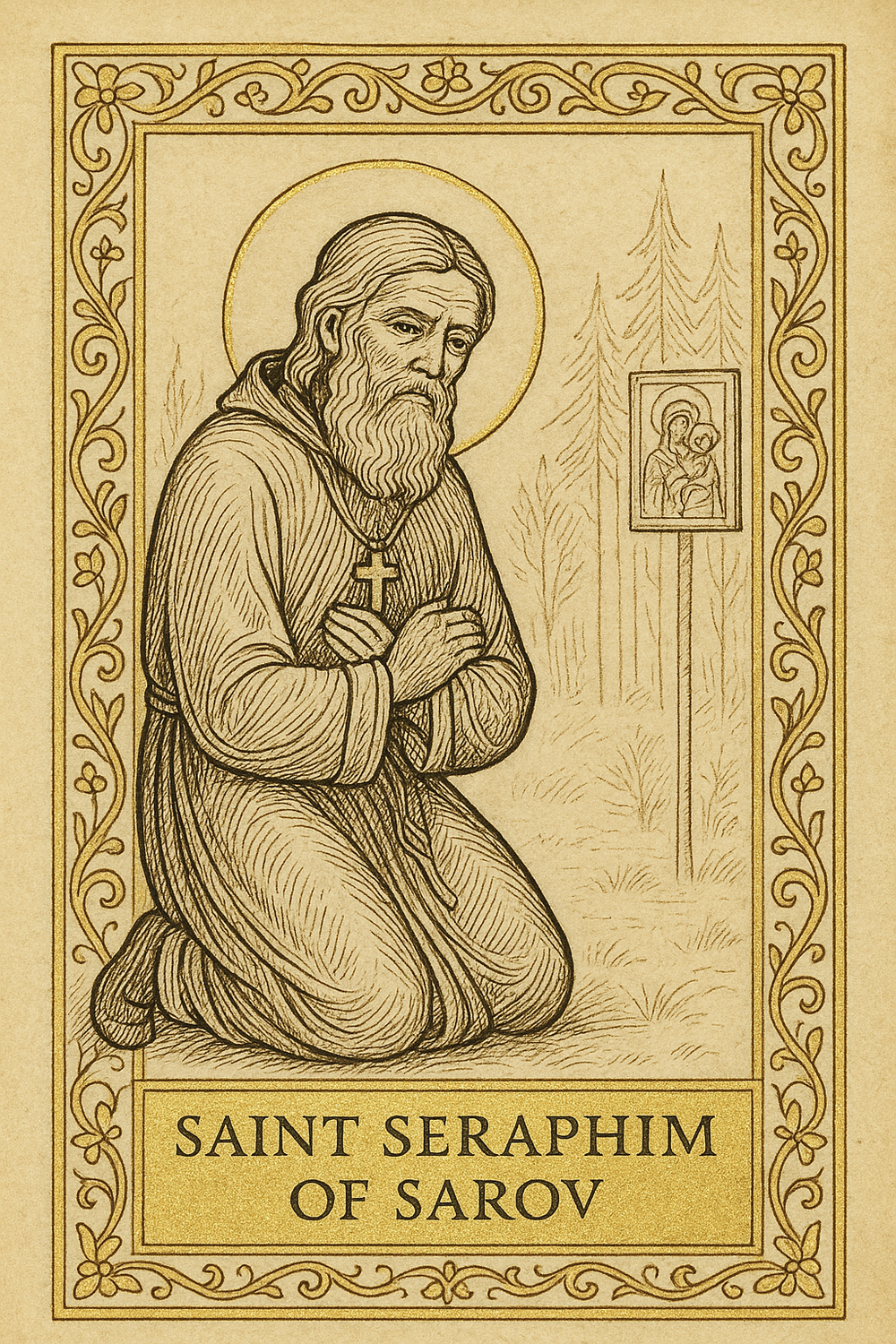
St. Seraphim of Sarov
The radiant Russian hesychast who greeted every pilgrim with "Christ is risen, my joy!"—proof of what decades of the Jesus Prayer produces in a human soul.
View Prayer Card →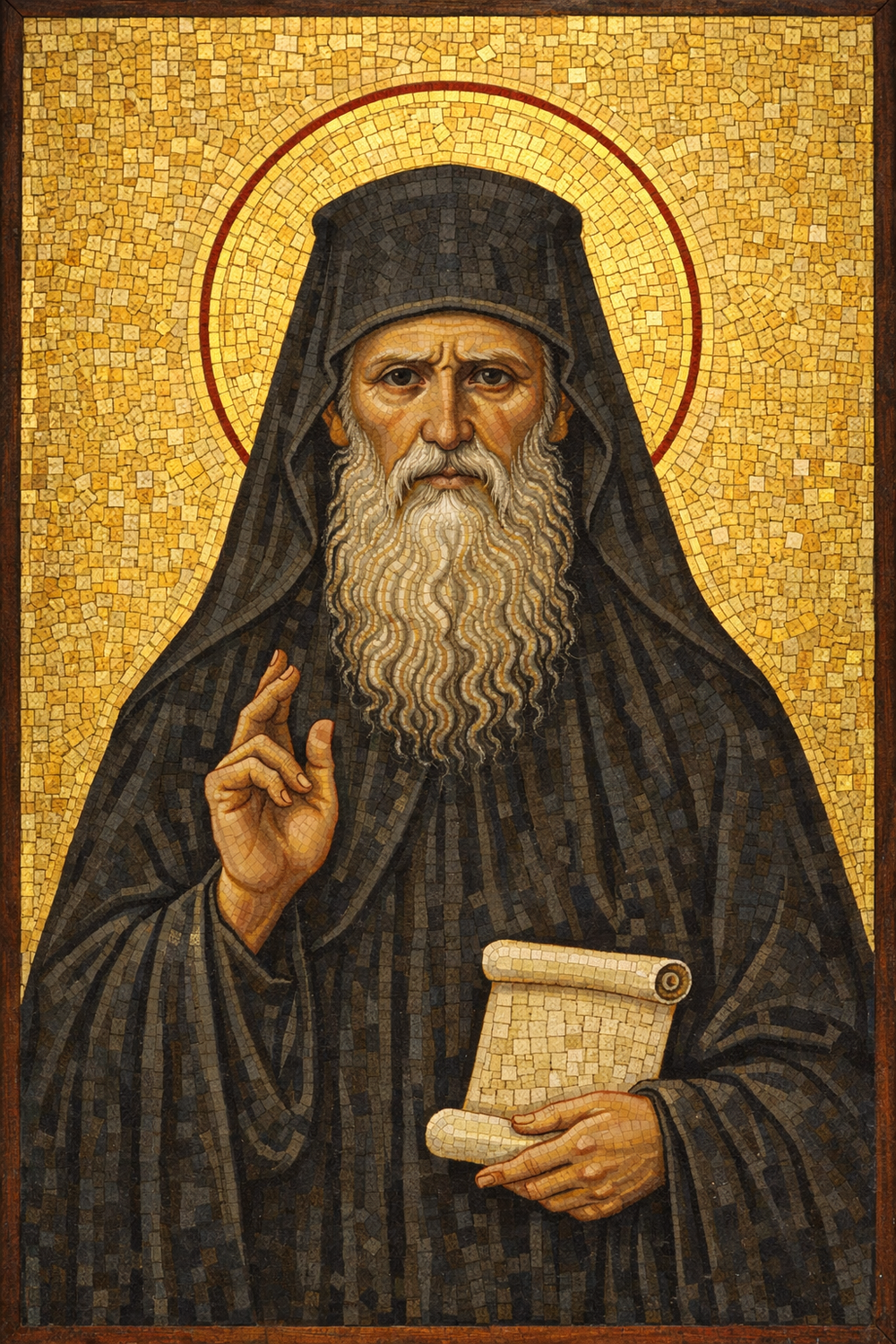
St. Silouan the Athonite
The Athonite monk who prayed for the whole world with tears—whose decades of the Jesus Prayer produced a love so vast it encompassed even his enemies.
View Prayer Card →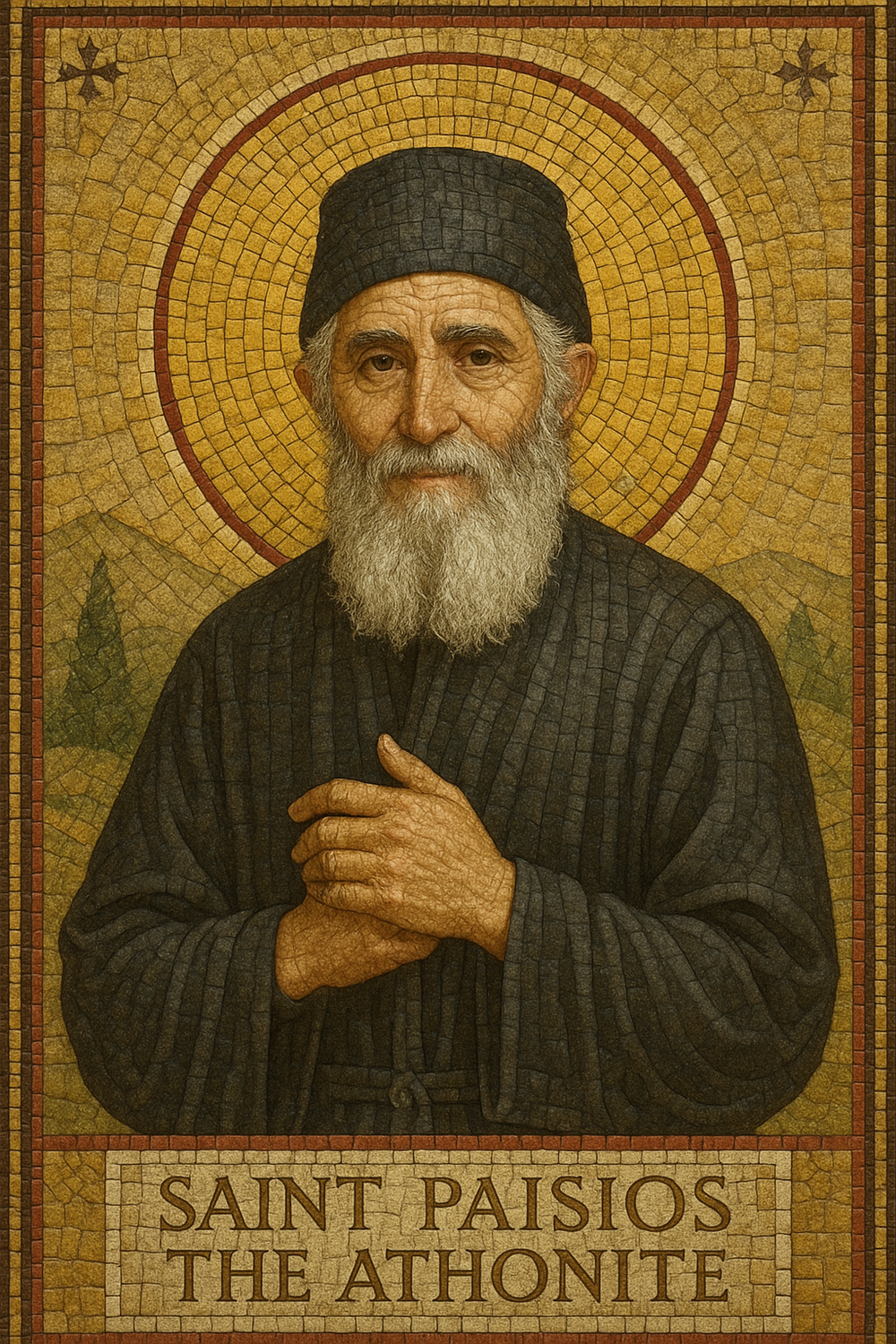
St. Paisios of Mount Athos
The joyful modern elder whose simple, trusting approach to the Jesus Prayer made him a light for thousands—canonized in 2015, beloved across the world.
View Prayer Card →Praying It Now
How to Begin the Jesus Prayer Today
"Lord Jesus Christ, Son of God,
have mercy on me, a sinner."
Try this right now. Set aside three minutes. Sit quietly.
Breathe In
"Lord Jesus Christ,
Son of God"
Breathe Out
"have mercy on me,
a sinner"
Repeat slowly. When a thought arises, notice it without judgment and return to the words. You are not performing. You are not achieving. You are simply turning toward the one Person whose mercy is actually infinite—and asking for it. That is all. That is enough. The saints who prayed this prayer for decades began exactly here, exactly like this.
If you lose the words, pick them back up. If you pray ten repetitions and feel nothing, that is ten acts of faith offered to God. If you pray one hundred and feel the faintest warmth of His nearness, receive it gratefully. If you feel absolutely nothing for weeks, keep going. The tradition is unanimous: this prayer works in the silence beneath feeling, at a depth the emotions cannot always reach.
The Jesus Prayer for Roman Catholics and Western Christians
One of the most common questions this prayer generates is: Do I have to be Orthodox to pray it? The answer is an unambiguous no.
The Jesus Prayer belongs to the whole Church. It is composed entirely of Scripture. It addresses the same Christ who is confessed in every Christian creed. Its content—acknowledgment of Christ's lordship, His divine Sonship, and our need for mercy—is not a distinctively Orthodox theological position. It is basic Christian faith rendered into a sentence.
Many Roman Catholics have discovered the Jesus Prayer through works like The Way of the Pilgrim—the anonymous nineteenth-century Russian account of a wandering peasant learning to pray the prayer without ceasing—and through the writings of modern Catholic contemplatives who have drawn from the Eastern hesychast tradition. Roman Catholics and Eastern spiritual practices have a long and fruitful relationship, and the Jesus Prayer is one of the most accessible entry points.
Eastern Catholics—Melkites, Maronites, Byzantines, Chaldeans, Copts, and others—already inhabit a tradition that includes the Jesus Prayer, and for them this practice is a recovery of something already theirs. Eastern Catholic hesychasm has its own rich development and is entirely continuous with what we have described in this article.
Protestant and Anglican readers who have found contemplative prayer through figures like Thomas Merton, Richard Foster, or the Taizé community will recognize the Jesus Prayer as a gateway into the deepest roots of the contemplative tradition they are already touching. It predates the Reformation by eleven centuries. It is not denominational property. It is ancient Christian prayer.
The one thing the tradition does recommend for all newcomers to the Jesus Prayer, regardless of denomination, is some form of accountability: a confessor, a spiritual director, or at minimum a trusted companion in faith who knows you are practicing it. Not because the prayer is dangerous for beginners—it is not—but because the spiritual life deepens better in relationship than in isolation. This is a counsel of the whole Christian tradition, East and West.
Common Questions and Obstacles
Isn't This Vain Repetition?
Jesus warned against battalogia—"vain repetition" or "babbling" (Matthew 6:7)—performed in the belief that God hears because of the sheer quantity of words. The Jesus Prayer is the opposite: it is prayed with attention and simplicity, not inattention and complexity. The repetition serves to quiet the busy mind and return it to God, not to impress God with volume. The Desert Fathers, who read this same Gospel passage, had no hesitation in prescribing short repeated prayers. The entire tradition understands that repetition done with care is not what Jesus condemned.
"I Feel Nothing"
Good. Or at least: this is normal, and it is not evidence that the prayer is failing. Spiritual dryness is part of every serious prayer life. The tradition consistently teaches that the fruit of the Jesus Prayer often appears not during the prayer but in the hours afterward—in unexpected moments of patience, in a calm that arrives unbidden in a tense situation, in a growing sense of God's reality that is more like quiet certainty than emotional warmth. Trust the practice and give it time. Give it months, not days.
My Mind Won't Stop
This is the universal experience of everyone who has ever tried to pray. St. John Climacus compared the wandering mind to a horse that needs a rider who keeps redirecting it without anger. Elder Theophan wrote that the very act of returning the attention to the prayer—each individual return—is itself a prayer, an act of will offered to God. The number of times you return matters more than the number of times you wander. Be patient with yourself. The tradition is patient with you.
How Many Times Should I Pray It?
Begin with a manageable number that you can sustain without strain—perhaps thirty or fifty repetitions in a dedicated session, morning and evening. The point is consistency, not volume. A steady ten minutes daily for a year is incomparably more valuable than an intense week followed by abandonment. As the prayer becomes more natural and your time and desire expand, the count can grow. Use a prayer rope to count without mental effort. For a more detailed approach to structuring this within a daily rule, see our beginner's guide to the Orthodox prayer rule.
What About Distractions During Prayer?
Distractions during the Jesus Prayer are not enemies to be defeated—they are the very material on which the practice works. Each distraction noticed and released is a small act of detachment. Each return to the words is a small act of love. Why silence matters for hearing God becomes clear over time: not because God refuses to speak in noise, but because we have trained ourselves to hear only noise, and the practice of returning from distraction to prayer gradually builds a capacity for the quieter registers of God's voice.
Your Guide for the Journey Ahead
Christian Mysticism for Everyday Life
Everything in this article—the theology of the Jesus Prayer, the practice of contemplative prayer, the wisdom of the hesychast saints, the practical steps for beginning—comes alive in this book. It covers not just the Jesus Prayer but the full landscape of Christian mystical practice: silence, Lectio Divina, the dark night of the soul, prayer in family life, prayer in the workplace. Written for ordinary people with ordinary lives, it takes the tradition seriously without making it inaccessible. If you have read this far and something in you is saying I want more of this—this book is where to go next.
Get the Book on Amazon →Available on Amazon · Affiliate link — supports The Eastern Church at no extra cost to you
Frequently Asked Questions
What is the Jesus Prayer?
The Jesus Prayer is an ancient Christian prayer that reads: "Lord Jesus Christ, Son of God, have mercy on me, a sinner." It originated among the Desert Fathers of Egypt and Syria in the fourth and fifth centuries and was systematized within the Eastern Christian hesychast tradition. It is prayed repeatedly, often in rhythm with the breath, as a path to continuous prayer and interior communion with God. Shorter forms—"Lord Jesus Christ, have mercy on me" or simply "Lord, have mercy"—have always existed alongside the full version.
Is the Jesus Prayer in the Bible?
Yes—the Jesus Prayer is a synthesis of several scriptural moments. "Lord Jesus Christ, Son of God" echoes Peter's confession (Matthew 16:16) and the angel's announcement (Luke 1:31–35). "Have mercy on me, a sinner" comes directly from the parable of the publican (Luke 18:13). The two blind men cried "Lord, have mercy on us, Son of David" (Matthew 20:30–31), and Bartimaeus cried it alone from the roadside (Mark 10:47). The prayer is entirely scriptural in its components, which is why Eastern Christianity has always regarded it as a form of continuous scriptural prayer.
How do you pray the Jesus Prayer?
The Jesus Prayer is prayed by repeating the words "Lord Jesus Christ, Son of God, have mercy on me, a sinner" slowly and attentively, ideally synchronized with the breath—inhaling on "Lord Jesus Christ, Son of God" and exhaling on "have mercy on me, a sinner." Many Eastern Christians use a prayer rope to count repetitions. The goal is not mechanical repetition but gradual internalization: over time the prayer descends from the lips to the mind to the heart, becoming a continuous, spontaneous movement of the soul toward God.
Is the Jesus Prayer vain repetition?
No. Jesus warned against "vain repetition" (Matthew 6:7)—repetition performed with the belief that God hears only because of the quantity of words. The Jesus Prayer is the opposite: it is prayed with attention, not inattention; with simplicity, not manipulation. The repetition serves to quiet the busy mind and return it to God. The Desert Fathers, who read this same Gospel passage, had no hesitation in prescribing short repeated prayers. The tradition distinguishes clearly between mechanical, mindless repetition and the slow, attentive invocation of the name of Jesus.
What is a prayer rope and how is it used with the Jesus Prayer?
A prayer rope (komboskini in Greek, chotki in Russian) is a knotted woolen or silk cord traditionally made by monastics, with each knot tied during its own prayer. It is used to count repetitions of the Jesus Prayer, freeing the mind from the mental effort of counting so that attention can rest on God. Prayer ropes typically come in lengths of 33, 50, or 100 knots. They are not a rosary—there are no mysteries or decades. The prayer is simply the same each time. See our guide to the best prayer ropes for beginners for more.
Can Roman Catholics and Western Christians pray the Jesus Prayer?
Yes. The Jesus Prayer requires no denomination and no special initiation. It is a prayer composed entirely of Scripture and addressed to Christ. Many Roman Catholics, Anglican, and Protestant Christians have adopted it as a contemplative practice. While it reaches its fullest expression within the Eastern hesychast tradition—which provides a complete theological and ascetic framework for it—the prayer itself is available to any Christian who desires to cultivate interior communion with Christ.
What is hesychasm?
Hesychasm is the Eastern Christian mystical tradition centered on the practice of hesychia—inner stillness and silence—as the path to direct encounter with God. Hesychasm developed among the Desert Fathers and was systematized on Mount Athos, particularly through the writings of St. Gregory Palamas in the fourteenth century. The Jesus Prayer is the primary practice of the hesychast tradition. Hesychasm teaches that through disciplined, attentive prayer of the heart, the soul can experience the Uncreated Light—the divine energies of God—even in this life. Learn more in our complete guide to hesychasm.