Saint Paisios of Mount Athos — Life, Miracles & Teachings
Eastern Orthodox Saint • Mount Athos • July 25, 1924 – July 12, 1994 • Feast Day: July 12
Saint Paisios of Mount Athos — The Complete Life, Family, Miracles, Teachings & Legacy of the Saint for Our Anxious Age
He was born the ninth of nine children to a village mayor in Cappadocia, baptized by a saint who died naming him his successor, and carried out of Asia Minor five weeks later on a four hundred mile refugee march. He fixed a deer's broken leg. He lived peacefully among snakes. He asked God for cancer as a consolation to the suffering. And in a cell with no address, no phone, and no comfort, he told hundreds of thousands of ordinary people exactly what was wrong with their souls before they said a word.
Most saints reach us across centuries, filtered through translation, legend, and the slow accumulation of tradition. Saint Paisios of Mount Athos reaches us across a single generation. He died in 1994. The nurses who cared for him in his final illness are alive. The nuns who recorded his sayings are alive. The pilgrims who stood at the wooden fence of his hermitage cell and watched him name their hidden sins before they had confessed them are alive, and many of them have written down, in their own words, exactly what happened.
This is the fullest account of his life available in English in one place: his family and childhood in Cappadocia and Konitsa, his military service, every stage of his monastic formation from Esphigmenou to Philotheou to Sinai to Stavronikita to Panagouda, his illnesses, his teachings on anxiety and the whole of the spiritual life, the founding of the monastery that now holds his relics, his miracle record from the deer with the broken leg to modern testimonies still being reported today, his canonization, and the prayers the faithful bring to him now. Nothing here is invented. Where the record is uncertain or contested, that is said plainly. If you are carrying anxiety, grief, or the specific exhaustion of the modern world, this is the saint who mapped that exhaustion more precisely than almost anyone before or since, and who is still, by every account, receiving people at the fence.
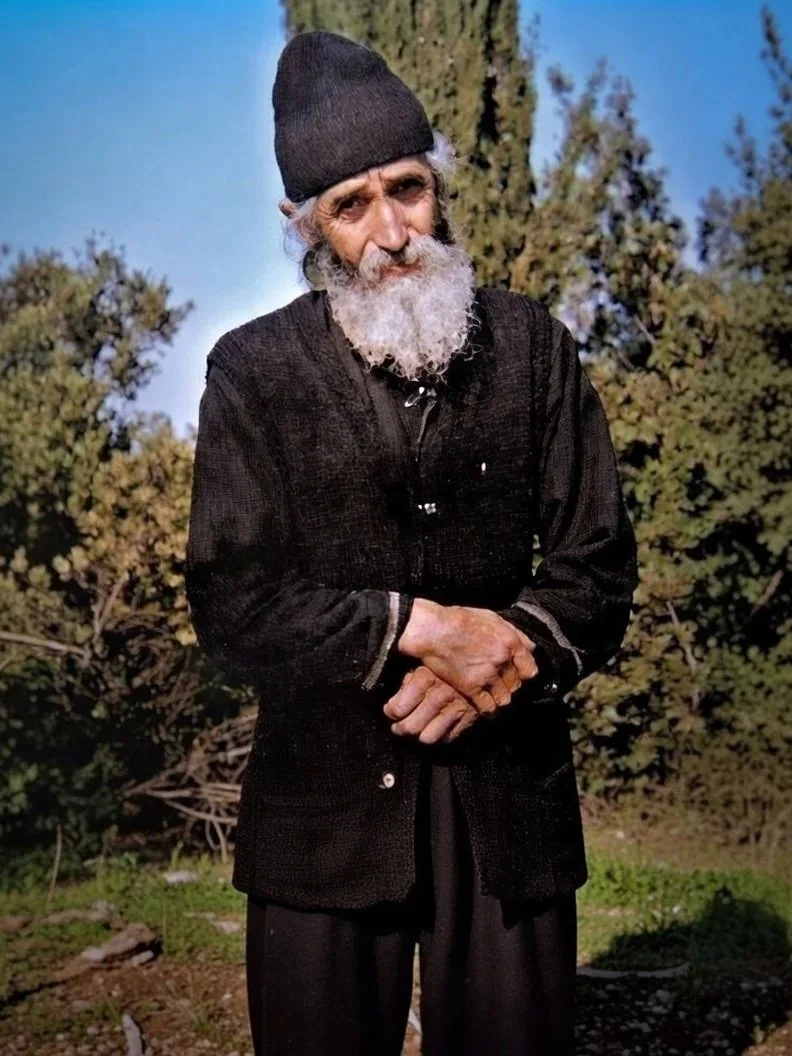
Paisios understood modern anxiety better than almost anyone in the 20th century. He sat with hundreds of thousands of people who carried it, and he knew exactly what it was and what to do about it. Carry his card as a daily reminder of what he knew and what he now intercedes for you.
$3.00 — Hand-finished and prayed over in Austin, Texas Get This Prayer Card →Saint Paisios of Mount Athos, Quick Facts
Born: July 25, 1924 (Old Style; August 7, New Style), in Pharasa (Farasa, modern Çamlıca), Cappadocia, Asia Minor. Birth name: Arsenios Eznepidis.
Parents: Prodromos Eznepidis, president (mayor) of Pharasa, and Evlampia Eznepidis. Arsenios was the ninth of the couple's children.
Died: July 12, 1994, Monastery of St. John the Theologian, Souroti, near Thessaloniki, Greece. Cause: cancer, after a lung operation in 1966 and years of chronic illness.
Monastic names: Tonsured Rassophore monk Averkios in 1954; given the Small Schema and the name Paisios in 1957, in honor of Metropolitan Paisios II of Caesarea; received the Great Schema in 1966 under Elder Tikhon.
Order: Eastern Orthodox monk. A simple monk, never ordained priest or bishop.
Primary cell: Panagouda hermitage, belonging to Koutloumousiou Monastery, Mount Athos, from 1979 to 1993.
Canonized: January 13, 2015, by the Holy Synod of the Ecumenical Patriarchate of Constantinople; added to the Russian Orthodox Church calendar on May 5, 2015.
Feast Day: July 12 (New Style) / June 29 (Old Style).
Patronage: Invoked for anxiety and mental illness, cancer, spiritual warfare, and family difficulty; formally proclaimed patron of the Greek military communications corps in 2017 and Protector of Australia in 2023.
Known for: Reading of souls, healing, prophecy, humor, extraordinary compassion, gentleness with wild animals, and his six-volume teaching series Words.
Authoritative biography: "Elder Paisios of Mount Athos" by Hieromonk Isaac, a monk of Koutloumousiou who knew him personally, translated into English by Hieromonk Alexis Trader and Fr. Peter Heers. Widely regarded in Orthodox circles as the definitive account of his life.
Family & Birth in Cappadocia
Arsenios Eznepidis was born on July 25, 1924, by the Old Church calendar, which corresponds to August 7 on the New Style calendar most Western readers use today. His birthplace was Pharasa, known in Turkish as Çamlıca, a mountain village in Cappadocia, the ancient heartland of Eastern Christianity in what is now central Turkey. His father, Prodromos Eznepidis, served as president of the village, roughly equivalent to mayor. His mother, Evlampia, kept the household. Arsenios was their ninth child, born into a large family in a community that had prayed and farmed that same Cappadocian ground for centuries.
He was born into a world that was ending as he took his first breath. The Greco-Turkish War had concluded two years earlier, and the population exchange that followed it, one of the largest forced migrations of the twentieth century, meant the Greek Christian communities of Anatolia, rooted in Cappadocia since the earliest days of the faith, were being uprooted entirely. Pharasa's parish had one week left before its people would leave the village for good.
In that final week, the infant Arsenios was brought to be baptized by the parish priest, a monk named Arsenios who was already regarded by the community as a man of remarkable holiness and who is now himself formally canonized as Saint Arsenios of Cappadocia. The elder Arsenios baptized the child with his own name and told the family plainly why: so that he could leave behind a monk to take his place. It was not a vague blessing. It was a stated intention, spoken at the font, that this particular infant would one day enter the monastic life the elder himself was about to leave behind through death.
This detail matters theologically as much as biographically. From his first moment in the Christian life, the future Saint Paisios was bound to a specific spiritual lineage: he was, in the most direct sense available in Orthodox practice, the spiritual heir of Saint Arsenios the Cappadocian. The ancient hesychastic tradition of Cappadocia, the same soil that had produced the Cappadocian Fathers of the fourth century, passed to him at the font before he could understand what was being given.
The Exodus & the Konitsa Childhood
Five weeks after baptizing the infant Arsenios, Saint Arsenios the Cappadocian led his entire flock out of Pharasa on a trek of roughly four hundred miles toward Greece, part of the mass displacement mandated by the Treaty of Lausanne. He personally guided the community the whole distance. Exactly forty days after the exiled community finally settled on Greek soil, arriving at St. George in Piraeus on September 14, 1924, the elder Arsenios reposed, precisely as he had foretold, leaving the forty-day-old infant Arsenios as, in the words of the tradition, his spiritual heir.
The Eznepidis family eventually settled in Konitsa, a mountain town in the Epirus region of northwestern Greece. Life there was hard. Refugee families from Asia Minor were regarded warily by some of the established locals, and the Eznepidis children grew up in poverty and manual labor. But prayer was constant in the household. Arsenios attended the local school through the intermediate grades and then apprenticed as a carpenter, a trade that would stay with him his entire life and later produce, quite literally, the wooden crosses and prayer ropes he made with his own hands for pilgrims.
From his earliest years, those who knew him describe a child already living an interior life of unusual intensity. He read the lives of the saints obsessively and tried, with what those close to him called uncompromising zeal, to imitate what he read. He kept the fasts of the Church as a boy long before he was required to. He withdrew alone into the woods around Konitsa to pray for hours, often in tears, and returned to defend the faith against older boys who mocked it, arguing his case with a clarity that surprised the adults who overheard him. He was, by every account that survives, already forming the habits of a monk years before he had any legal right to become one.
Military Service — Volunteering for the Front Line
In 1945, Arsenios was conscripted into the Hellenic Army during the Greek Civil War, the brutal internal conflict that followed the Second World War, pitting the Greek government against Communist insurgents. He served as a radio operator, a role that would later give him one of his most enduring teaching images: the monk as God's radio operator, maintaining the signal between earth and heaven the way he once maintained it between military units.
What distinguishes his service is a specific act of self-sacrifice that appears in every account of this period of his life. When his unit needed volunteers for the most dangerous positions at the front line, Arsenios stepped forward ahead of the men who had wives and children. His reasoning was simple and entirely characteristic of the man he would become: those men had families who depended on them and who would be devastated by their loss. He had neither wife nor children. It made more sense, he said, for him to accept the risk that a family man should be spared.
He survived his service and was discharged in 1949. He did not go to Mount Athos immediately. He first returned to Konitsa to see to the practical needs of his unmarried sisters, making sure they were provided for before he allowed himself to pursue what he had wanted since childhood. Only once that responsibility was settled, with what his biographers describe as a clean conscience, did he set out for the Holy Mountain in 1950.
Entering Mount Athos — Formation, Names & Obedience
Mount Athos, the Holy Mountain, is a peninsula in northeastern Greece inhabited by monks since the ninth century, governed as a self-administered monastic republic under the spiritual authority of the Ecumenical Patriarchate. Twenty ruling monasteries and countless smaller cells, sketes, and hermitages cover its steep terrain. In Orthodox understanding it is the earthly domain of the Theotokos, the Mother of God, considered the protectress of the Mountain, and women are not permitted to enter.
Arsenios arrived at Athos in 1950. He went first to Father Kyril, later abbot of Koutloumousiou Monastery, and then to Esphigmenou Monastery, where he spent four years as a novice, the period of testing and formation that precedes formal monastic profession. On March 27, 1954, he was tonsured a Rassophore monk, the first degree of monastic profession, and given the name Averkios. He then moved to the Philotheou brotherhood, where his uncle was already a monk, and placed himself in obedience under Elder Symeon.
On March 12, 1957, Elder Symeon tonsured Averkios to the Small Schema, the intermediate degree of Orthodox monastic profession, giving him a new name: Paisios, in honor of Metropolitan Paisios II of Caesarea, whose native village was Pharasa, the very village of Arsenios's birth. The name reconnected the new monk to his homeland at the exact moment he was formally leaving the world behind.
Those who lived alongside him at Philotheou describe a monk consumed by a very particular form of self-accusation. He dwelt continually on the thought that his own spiritual failures, his own shortage of love, were the true cause of his neighbor's faults and of the world's troubles generally, and he pushed himself toward greater self-denial and more fervent prayer as a result. He also cultivated a specific habit that his biographers single out: whenever he heard someone speak scandalously of another monk's strange behavior, he trained himself to search for the charitable explanation before accepting the uncharitable one, a discipline meant to guard him permanently against judging others.
Defending Orthodoxy in Konitsa
In 1958, Paisios was sent by his superiors back to the region of Konitsa, the very town of his childhood, to support the local faithful against an active campaign of Protestant proselytism that was drawing wavering Orthodox Christians away from the Church. Missionaries were working the region aggressively, and the Church wanted someone with both local credibility and genuine spiritual fire to counter them.
Paisios threw himself into the work. Accounts describe sustained preaching, personal conversation, and pastoral attention that reignited faith in people who had begun to drift. This episode is important because it corrects a common misunderstanding of who Paisios was. He was not only a solitary mystic. In this period of his life he was also, deliberately and effectively, a missionary and a public defender of Orthodox tradition in the world, willing to argue the case for the faith of his childhood in the same streets where he had once defended it as a boy.
Sinai & the Bedouins
In 1962, Paisios left Greece for Saint Catherine's Monastery at the foot of Mount Sinai, the ancient monastic community continuously inhabited since the sixth century, on the site where Moses is said to have received the Law. He remained there roughly two years, and returned again briefly in 1982.
What is remembered most from this period is not the location but what he did there. A skilled carpenter, Paisios sold his own carved woodwork and used the proceeds to buy food for the Bedouin nomads of the surrounding desert. The Bedouins, who had no obvious reason to care about a Greek Orthodox monk, came to genuinely love him, and the accounts describe him walking barefoot among them in emulation of Moses, calling himself, in his own self-deprecating way, "a tramp of God." His holiness was not confined to the monastery. It reached a non-Christian desert community that had nothing to gain by liking him, and they chose to receive him anyway.
Illness, the Founding of Souroti & the Hermitage of the Holy Cross
On his return to Athos in 1964, Paisios took up residence briefly at the Skete of Iviron before moving to Katounakia, at the wild southern tip of the peninsula, for a short stay in even deeper solitude. His health, already fragile, may have forced his departure from that austerity. In 1966 he underwent lung surgery that removed a significant portion of one lung; the operation required a large quantity of blood, and a group of young women who were drawn to the monastic life, and who would soon become the founding sisterhood of a new convent, donated the blood that saved him.
Paisios considered himself permanently in their debt. He would later say he wanted to repay their kindness the way a man wants to remove a hair shirt: urgently, and completely. In gratitude, he helped this small group of women find a place to live out the monastic vocation properly, and in doing so he became, in effect, the founder and enduring spiritual father of what is today the Monastery of Saint John the Theologian in Souroti, near Thessaloniki, the very convent where he would later be cared for in his final illness, and where his relics rest today. He continued to guide the sisterhood in person and by letter for the rest of his life. It was, as those close to the community put it, an exchange of gifts: they gave him blood, and he gave them the spirit.
On January 11, 1966, Paisios received the Great and Angelic Schema, the highest degree of Orthodox monastic profession, from Elder Tikhon at the Hermitage of the Holy Cross, belonging to Stavronikita Monastery. He remained at Tikhon's side as his devoted disciple until the elder's death on September 10, 1968, after which Paisios stayed on in the same hermitage in accordance with Tikhon's wishes, and later assisted in the spiritual and material renewal of Stavronikita Monastery itself. He remained there until 1979.
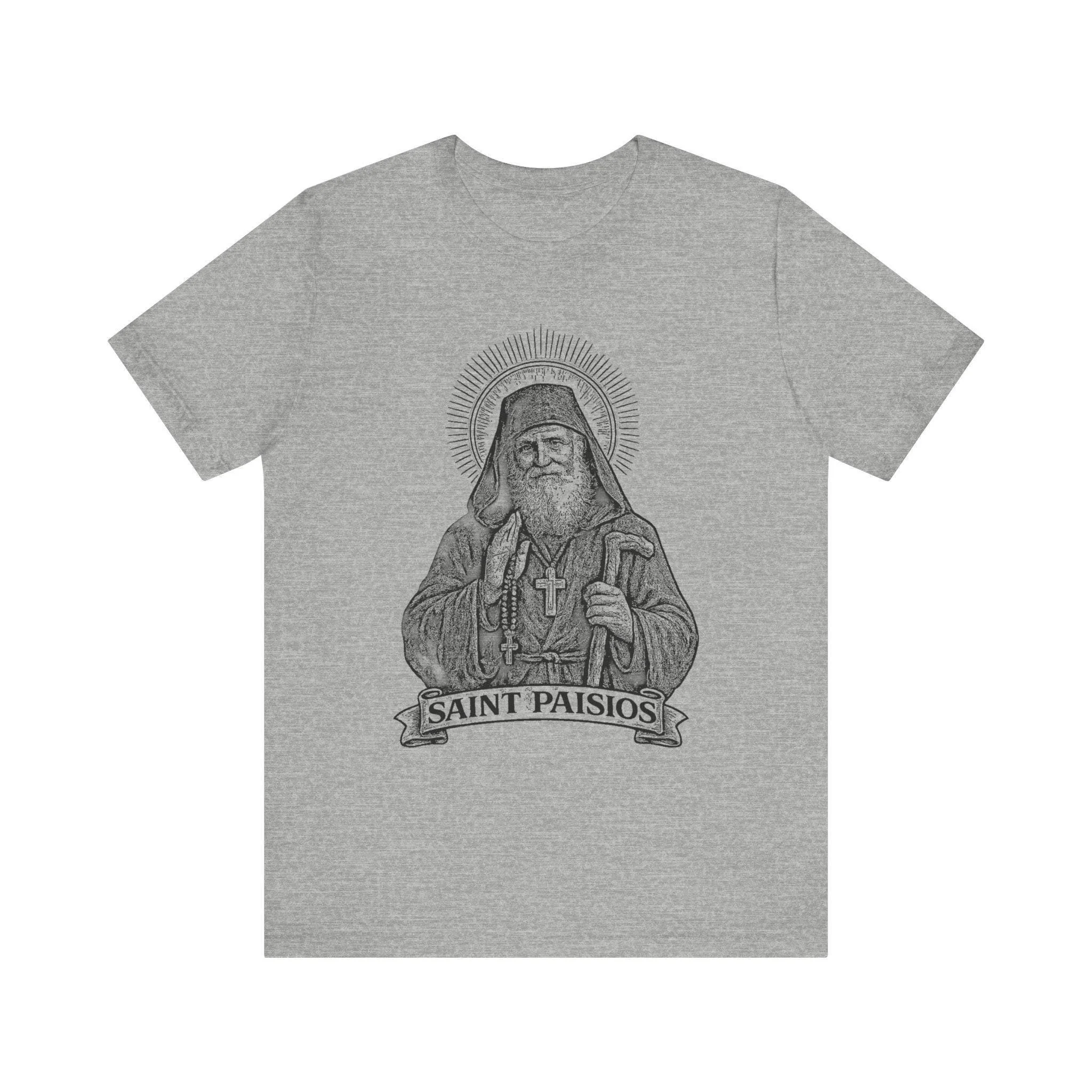
A soft, comfortable tee carrying the icon of the elder who called himself God's radio operator and a tramp of God. Wear it as a quiet, everyday witness to the saint most associated with anxiety, humility, and the ordinary sanctity of a life spent entirely for others.
Unisex fit • See sizes and colors on site Shop This Shirt →Panagouda — Where the World Came to Him
In May 1979, Paisios took up residence at Panagouda, a small hermitage cell belonging to Koutloumousiou Monastery. It offered no comfort and no amenities, only a modest wooden fence and a small garden set into the mountainside. It was exactly what a hesychast monk would want. And for the next fourteen years, the world came looking for him there.
The scale of it is almost impossible to credit without the weight of witness behind it. Contemporaries said that if a hundred pilgrims made the journey to Mount Athos, ninety of them were coming specifically for Paisios. They came by boat, walked the mountain paths, and waited at his fence: bishops, scholars, politicians, ordinary parents, people who had flown across an ocean on instinct without knowing exactly what they were looking for. Paisios greeted each one with the same phrase, so consistently that it became his signature: "my joy." He rested only two or three hours a night, giving his days entirely to people and his nights entirely to God, and he answered the dozens of letters that arrived every week from those who could not travel to him in person.
What People Found at the Fence
Those who visited Panagouda describe a consistent pattern: Paisios already knew what they had come to ask before they said a word. He would name the specific grief someone was carrying, the specific sin someone had been too afraid to confess for years, the specific decision someone was too paralyzed to make, and address it directly and by name. This gift of reading souls, attested throughout Orthodox hagiography but possessed by Paisios with unusual precision, was the primary reason people traveled across the world to stand at the fence of a small hermitage cell.
But witnesses insist there was something beyond the clairvoyance. He had genuine humor. He teased people affectionately. He had a quality of total attention that made whoever stood before him feel, for that moment, like the only person in the world who mattered. He was not performing holiness. He was simply, completely present, and people left changed less by what he said than by what it had felt like to be truly seen by him.
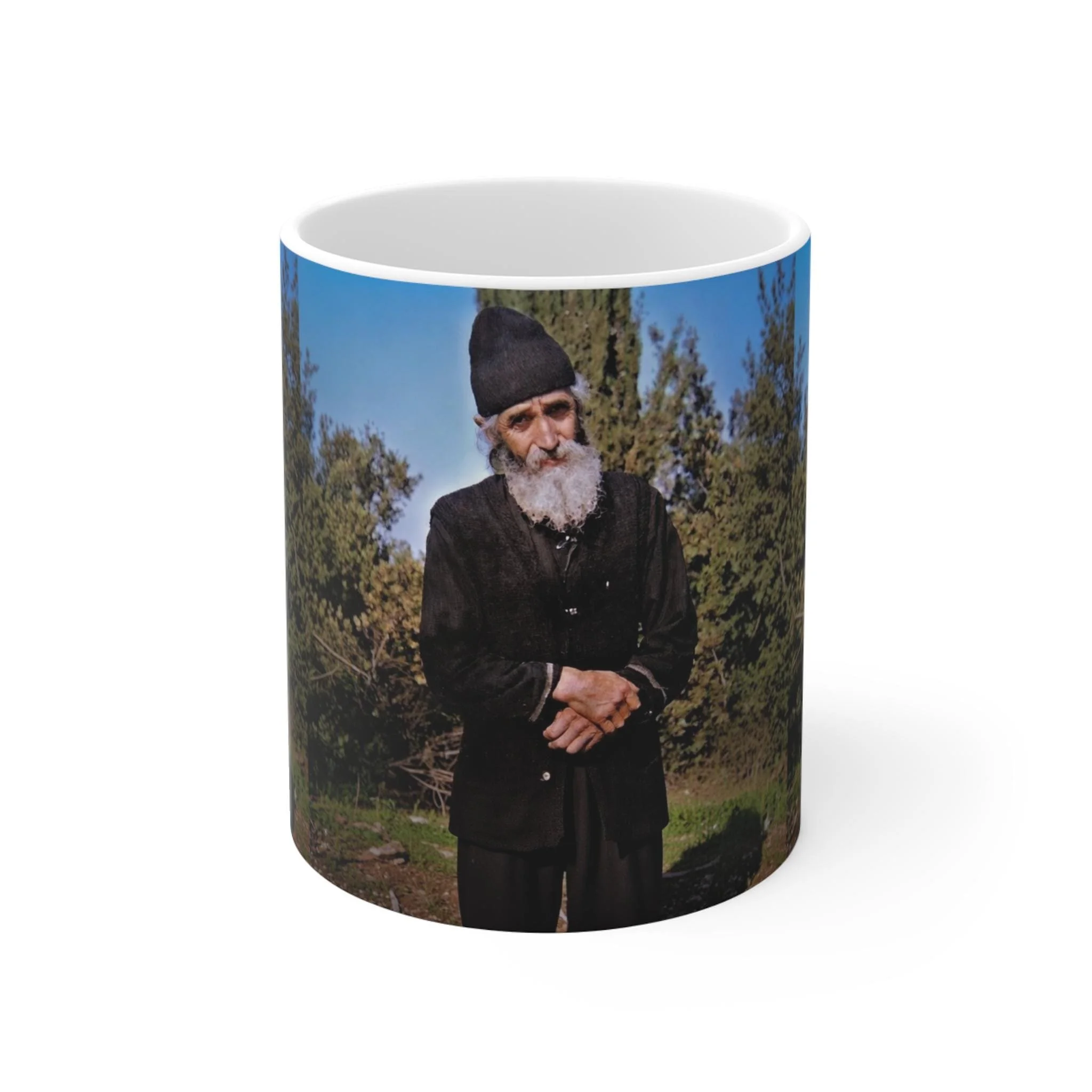
Start the day with the elder who taught that anxiety loosens its grip the moment Christ is truly present in the soul. A simple ceramic mug for your morning prayer rule, your desk, or as a thoughtful gift for anyone drawn to the Athonite fathers.
Ceramic • See sizes on site Shop This Mug →Taking the World's Suffering Upon Himself
Beginning with the 1966 lung surgery, Paisios lived with serious physical illness for the rest of his life. Asthma followed the lung operation. Later came a hernia, colon complications, and finally the cancer that killed him. He spent nearly three decades in chronic pain while continuing to receive pilgrims, answer letters, and pray through the night.
Witnesses describe something more than ordinary compassion in how he carried other people's suffering. In the course of a single conversation with someone in real distress, he would visibly age, his face drawing tight and exhausted, as though the weight of what he had absorbed had cost him something physically real. This was not treated as metaphor by those who saw it happen. It was treated as a form of vicarious bearing of suffering, the same pattern the tradition traces back through the lives of the saints to Christ himself.
The Cancer Request
One of the most striking episodes in his biography concerns a specific prayer he made before his cancer diagnosis. He told a fellow monk that in his time, people suffered above all from three things: cancer, mental illness, and divorce, and that his weekly letters were full of exactly these three problems. He himself, he noted, had no serious mental illness and no marriage to suffer over. So he asked, as he put it, to at least be allowed to suffer from cancer, as a consolation to the people in distress who wrote to him, since it did not look right for everyone in the world to be in pain while he alone had nothing to bear.
He developed cancer not long after. The tradition presents the timing not as coincidence but as a form of voluntary, vicarious suffering accepted on behalf of others. When the diagnosis came, Paisios did not seek to avoid it. He received it as the very thing he had asked for and continued his work in its presence until his body could no longer sustain the pace.

Teachings on Anxiety & Mental Health
Paisios lived at the intersection of the ancient monastic tradition and the specific pressures of modern life. He received people from cities, hospitals, psychiatric wards, broken marriages, and careers that had consumed them. He did not generalize their suffering away. He named it precisely and offered specific responses.
Anxiety Is Spiritually Diagnosed
Paisios's central teaching begins with a spiritual diagnosis rather than a psychological one: anxiety is a symptom of the soul's distance from God, not primarily a clinical condition to be managed on its own terms. His most quoted formulation holds that those without Christ present in them are full of anxiety, but that once a person grasps the deepest meaning of life, the anxiety departs and a divine consolation takes its place, healing what remains, so that even the people nearby find rest in that person's presence.
This is a complete theory of anxiety compressed into a few sentences: the problem is distance from God, the remedy is grasping life's deepest meaning, and the result is not merely personal peace but a kind of radiance that calms everyone nearby.
He taught his visitors plainly not to worry about anything, insisting that anxiety is the devil's own work, and that whenever anxiety appears it is a sign we have drifted out of the space where God is moving, since God is no tyrant seeking to drown us in fear.
The Mechanism He Identified
Beyond the spiritual diagnosis, Paisios identified a concrete mechanism: people grow anxious in direct proportion to how much they attempt to control what cannot be controlled. He taught that the further people move from a natural, simple life and toward luxury, the more anxiety takes hold, because distance from God leaves nothing in which to find rest. This is not moral condemnation of comfort. It is an observation about the relationship between the number of variables a person is trying to manage and their capacity for interior peace. Fewer variables, whether through poverty, monastic simplicity, or deliberate limitation, tend to produce lower anxiety.
His Prescription: The Jesus Prayer
For anxiety specifically, Paisios prescribed the Jesus Prayer, "Lord Jesus Christ, Son of God, have mercy on me, a sinner," prayed slowly and repeatedly with a prayer rope. He handed out prayer ropes he had tied himself, calling them his handguns, tools for quieting an anxious mind by giving it something simple, repetitive, and God-directed to do instead of spiraling. He paired this with humility, the posture of refusing to place oneself at the center of the universe, describing it as the specific frequency on which God can be reached, a metaphor drawn straight from his years as a military radio operator.
What He Said to the Depressed and Despairing
Accounts of his encounters with the severely anxious and depressed are among the most moving in his biography. He never offered false comfort, and he never told anyone their suffering was not real. He received each person's specific pain, acknowledged it fully, and then offered prayer, presence, and a word addressed to the exact mechanism generating their suffering. He also made a striking observation about psychiatry itself: he suggested that if someone brought the writings of Saint Isaac the Syrian into a psychiatric hospital and read them to believing patients, those patients would recover, because they would finally grasp the deeper meaning of their lives. This was not an attack on medicine. It was a claim about what the tradition offers that medicine alone cannot reach.
His teaching on anxiety is on the back of this card. His face is on the front. Carry it in your pocket, especially on the days when the anxiety is loudest. He understood exactly what modern anxiety is, and he is praying for you from a place where anxiety does not exist.
$3.00 — Hand-finished and prayed over in Austin, Texas Get This Prayer Card →Broader Teachings on Love, Judgment & the Modern World
Anxiety was only one theme among many that Paisios addressed with the same precision. He taught that self-accusation, taking responsibility for one's own failures rather than blaming others, was the surest path out of both judgment and despair, a discipline he had practiced on himself since his earliest years as a monk. He taught, famously, that a person should always search for the good reason behind another's troubling behavior before assuming the worst, a habit meant to protect the soul from the corrosive effect of judging others.
He spoke often about love as something that must be tested by real cost, not merely felt as sentiment, and he modeled this in the smallest details of his own life, from volunteering for the front line as a young soldier to giving away food he had earned by his own carpentry to people who had no claim on his generosity. On family life, the subject of the fourth volume of Words, he taught that the home is itself a small church, and that the spiritual condition of parents shapes children more thoroughly than any explicit instruction ever could.
He was also unusually direct, for a monk of his generation, about the psychological costs of modern technology and the pace of contemporary life, teaching that the more complicated and comfort-driven life becomes, the further the soul tends to drift from the stillness in which prayer, and therefore peace, becomes possible. This is not a rejection of the modern world so much as a diagnosis of its specific temptation: more inputs, more variables, and less capacity to be still enough to notice God's presence.

The exact words Paisios prayed on his prayer rope through the night while pilgrims slept. A simple, faith-forward tee for anyone whose day runs on the same short prayer, one knot, one breath, at a time.
Unisex fit • See sizes and colors on site Shop This Shirt →Prophecy & Disputed Sayings
Paisios was widely reported by those who knew him to have made specific predictions, some of which appear to have been fulfilled and others of which remain unfulfilled or contested. Hieromonk Makarios of Mount Athos published a collection of sayings attributed to Paisios during the elder's own lifetime, and further geopolitical prophecies have circulated since his death, including predictions about regional conflict and the political future of Constantinople.
Readers should approach this category of material carefully. Unlike the biographical record, which rests on eyewitness testimony gathered close to the events described, prophetic sayings of this kind were often recorded secondhand, sometimes years after the fact, and sometimes by people with their own interpretive agenda. Some Orthodox clergy and scholars accept these sayings as genuine and significant. Others urge caution, noting that prophecy attributed to a beloved elder after his death is especially easy to shape to fit later events. This article presents the fact that such prophecies are widely reported and discussed within Orthodoxy without endorsing any specific claim as verified history, and readers interested in this material are encouraged to consult primary Orthodox sources directly rather than secondhand summaries.
Miracles — The Complete Record
Reading of Souls and Consciences
The most consistently attested gift of Paisios's ministry was his ability to know, unprompted, the specific interior situation of the person standing before him. Multiple named witnesses describe arriving at Panagouda and being greeted by name before any introduction was made, or having a private engagement, family circumstance, or hidden sin described back to them in detail before they had spoken a word. One theologian recalled being welcomed by his own name on his very first visit, though Paisios had never met him. Another visitor was told, unprompted, the exact reason a cousin's fiance was unsuited for marriage, a private matter Paisios had no natural way of knowing, and the prediction of that relationship's failure was later confirmed.
Healing of Physical Illness
A well-documented account describes a man who arrived at Mount Athos with a severe abdominal illness and recovered completely within two or three days of meeting Paisios. When the man later mentioned the healing to a senior clergyman, he was told plainly that it was not his diet that had cured him, that Paisios had deliberately let it look like a dietary matter so pilgrims would not flood the Mountain seeking miracle cures, and that the healing belonged to Paisios alone. This account, recorded by a named witness, is one of dozens of physical healing testimonies submitted during the canonization process, including cases of paralysis, infertility, and serious disease that resolved after contact with the elder.
Gentleness With Wild Creatures
Multiple testimonies describe Paisios living peacefully among snakes, birds, and other wild animals that approached him without fear, a state the tradition compares to the harmony Adam is said to have shared with creation before the Fall. He is remembered teaching that even a snake sunning itself deserves no violence, and witnesses describe snakes retreating gently at his word rather than striking.
The Deer With the Broken Leg
One of the most beloved miracles in his biography concerns a deer that appeared at the fence of Panagouda while Father Christodoulos, abbot of Koutloumousiou, was visiting. Paisios scolded the animal affectionately for wandering in daylight where hunters might find it, then noticed its leg was broken. He fetched wood and gauze, set the leg himself, joking that he was acting as an orthopedic veterinarian, and told the deer to return in exactly twenty-five days to have the cast removed. Father Christodoulos marked the date. Twenty-five days later, the deer appeared again at the fence; Paisios removed the cast, examined the leg, found it perfectly healed, and sent the animal on its way with instructions to travel only by night from then on.
Prophecy Within Individual Lives
Beyond the larger, disputed geopolitical prophecies discussed above, Paisios's record includes many smaller, well-attested predictions concerning individuals: warnings against specific risky behavior that were later borne out exactly as he described, foreknowledge of family circumstances he had no natural means of learning, and accurate anticipation of how particular decisions would resolve. A frequently retold account describes him warning a young rock climber, through the boy's mother, to give up a dangerous habit, then later informing the mother, before any news had reached her, that the boy had fallen exactly as he had warned he would.
Encounters With the Devil
Paisios spoke directly, and without embarrassment, about encounters with demonic presences. When a woman preparing to become a nun asked whether he had ever seen the devil, he told her that he had, that the devil could appear strikingly handsome, and that only the depth of God's love kept ordinary people from seeing him, since without that mercy humanity would die of fear. He described the devil as capable of appearing in tangible form, whether as a man or an animal, and said that prayer binds him instantly: once recognized and confronted through prayer, the presence disappears at once. His biographers do not treat these accounts as symptoms of illness or imagination. They present them as spiritual warfare of the kind the hesychast tradition has described and prepared its practitioners to face for fifteen centuries.
A bold, understated cross tee in the spirit of the ascetic fathers of Athos. A good match for anyone drawn to the hesychast tradition Paisios represented, spiritual warfare and all, worn with the quiet confidence of a settled faith.
Unisex fit • See sizes and colors on site Shop This Shirt →
Modern & Reported Miracles
The Orthodox tradition holds that a saint's intercession does not end with death, and the reported miracles connected to Paisios have continued steadily since 1994, both at his tomb and far beyond Greece. One widely circulated account describes a young American man who suffered a severe brain injury in a car accident in 2013. As his family kept vigil, they were introduced to Paisios's intercession through a friend in Greece, placed his image in the hospital room, and prayed for his recovery using oil sent from the Souroti monastery. Doctors had given the family a grim prognosis. The young man survived, recovered far beyond what his medical team expected, and was, within the year, back to ordinary life.
More recent reports have come from far outside the traditional Orthodox heartlands. A priest serving a parish in the Democratic Republic of Congo reported two cases in his own congregation, a child recovering from serious poisoning and a woman healed of severe pain, in which both individuals separately described a dream of an unfamiliar holy figure whom they later identified, from an icon shown to them afterward, as Saint Paisios, a man neither had heard of before their healing. Testimonies of this kind continue to be collected and published by Orthodox clergy and lay writers who track the saint's ongoing intercession, a body of evidence the tradition regards as consistent with how sainthood is understood to function after death: not as a closed biographical record, but as an active, continuing relationship between the saint and those who ask for help.
For the modern struggles he understood so precisely: anxiety, illness, family strain, and spiritual exhaustion. Keep it in your wallet, your car, or your prayer corner as a direct line to an elder still, by every account, actively interceding.
$3.00 — Hand-finished and prayed over in Austin, Texas Get This Prayer Card →His Death & Burial at Souroti
On October 5, 1993, Paisios left Mount Athos for medical attention, expecting to be away only a few days. He was instead diagnosed with cancer requiring immediate surgery. After the operation, he was transferred to the Monastery of Saint John the Theologian in Souroti, the very community he had helped establish decades earlier, where the sisters cared for him as their founding spiritual father. He had hoped to return to Athos to die. His body would not allow it.
He died on July 12, 1994, at Souroti, having received Holy Communion the day before, at sixty-nine years old. Those with him in his final hours reported that he continued praying, blessing, and giving thanks even as death approached, and some of his spiritual children described seeing light on his face at the moment of his repose. He was buried at Souroti beside the church dedicated to Saint Arsenios the Cappadocian, the saint who had baptized him seventy years earlier and named him his spiritual heir.
The Tomb at Souroti
Pilgrims began arriving within hours of his burial and have not stopped since. Approximately 300,000 people visit his tomb on his feast day alone, one of the largest annual Orthodox pilgrimage gatherings in the modern world, and the monastery receives a steady stream of pilgrims year-round. Many report healing, physical and spiritual, at the grave itself, and the fragrance of myrrh has been reported there on multiple occasions, a phenomenon the Orthodox tradition associates with holiness in the remains of the saints.
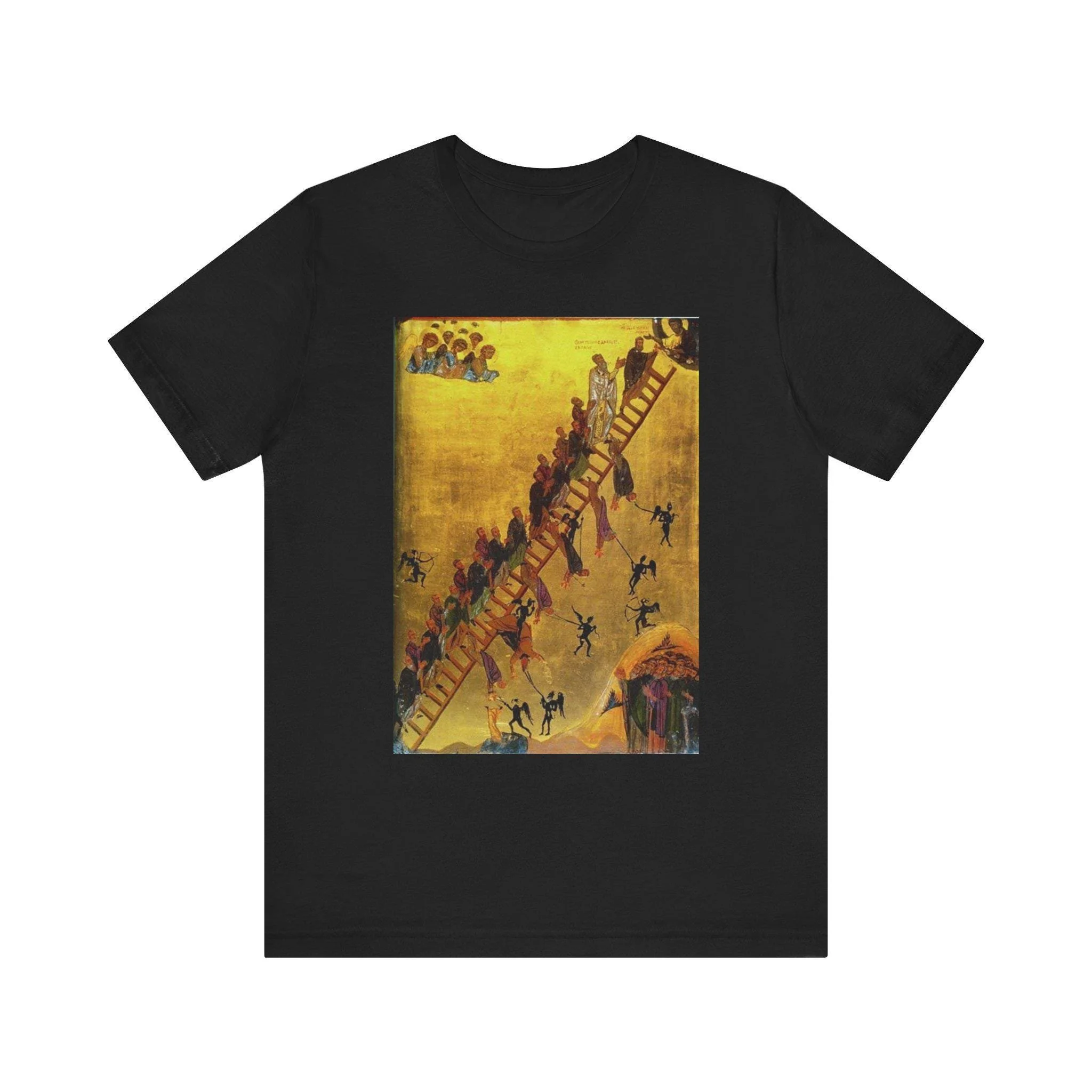
Paisios told a hospital could be healed if patients simply had the writings of Saint Isaac the Syrian read to them; his own reading list, and the hesychast tradition he stood in, runs straight back through Saint John Climacus and the Ladder. A meaningful tee for anyone drawn to that same ascetic lineage.
Unisex fit • See sizes and colors on site Shop This Shirt →Canonization & Worldwide Veneration
On January 13, 2015, twenty-one years after his death, the Holy Synod of the Ecumenical Patriarchate of Constantinople formally canonized Paisios as a saint of the Orthodox Church, entering his name into the Synaxarion. The speed of the canonization, unusually fast by Orthodox standards, reflects both the strength of the miracle record and the breadth of popular devotion to him worldwide. His feast day was set as July 12, the anniversary of his repose.
Later that same year, on May 5, 2015, the Holy Synod of the Russian Orthodox Church added Paisios to its own calendar, a significant step given how carefully the Russian Church weighs the canonization of saints from other jurisdictions. In 2017, the Holy Synod of the Church of Greece proclaimed him patron of the Greek military communications corps, the very corps in which he had served as a young radio operator, a fitting close to the circle he had once described himself: the man who once carried a military radio signal became, decades later, the patron of everyone who carries one.
Veneration has spread rapidly and concretely since. On January 25, 2015, the first church in the world dedicated to Saint Paisios was consecrated in Limassol, Cyprus. A church in Greece followed within months, in Nea Efesos, Pieria. On October 2, 2023, he was formally declared Protector of Australia and patron of the Greek Orthodox Archdiocese of Australia. Icons of him now hang in churches and homes across the Orthodox world and increasingly among Catholic and Anglican Christians drawn to his writing, and his authoritative biography by Hieromonk Isaac has been translated and reprinted in numerous languages.
The Six Volumes of Words
The six-volume series Words (Logoi in Greek) was compiled by the nuns of the Monastery of Saint John the Theologian in Souroti from decades of recorded conversations with Paisios. Translated into Russian, English, Romanian, Serbian, and many other languages, it is widely regarded as among the most practically useful Orthodox spiritual writing of the modern era.
Volume 1, With Pain and Love for Contemporary Man: human suffering, the challenges of modernity, and the transformative power of love and prayer. His most direct engagement with the specific forms of modern pain.
Volume 2, Spiritual Awakening: the soul's movement toward God and the foundations of interior life.
Volume 3, Spiritual Struggle: the passions, temptation, and the practice of virtue under real pressure.
Volume 4, Family Life: marriage, children, and the spiritual dimensions of ordinary domestic existence.
Volume 5, Passions and Virtues: the precise interior work of transforming the passions into virtues.
Volume 6, On Prayer: his most concentrated teaching on the interior life of prayer, the Jesus Prayer, and hesychasm.

Ceramic mug carrying the full text of the Jesus Prayer, the same prayer Paisios prescribed above all else for anxiety and spiritual unrest. A steady, quiet reminder over morning coffee to turn the mind toward the same short, repeated prayer.
Ceramic, 11oz or 15oz • See options on site Shop This Mug →How to Pray to Saint Paisios, for Anxiety, Suffering & Inner Peace
O Holy Father Paisios, God-bearer and radio operator between earth and heaven, you who sat with thousands of anxious people at the fence of Panagouda and received their fear without flinching, intercede for me now in my anxiety.
You taught that anxiety is the absence of God's presence in the soul. Help me find that presence. You taught that the Jesus Prayer is the handgun against the enemy. Help me pray it. You taught that humility is the frequency on which God operates. Help me find that frequency.
I am carrying what modern people carry: a thousand variables I cannot control, a mind that will not stop, a fear that has no clear object. You understood this. You named it. You knew the mechanism and you knew the remedy. Intercede for me. Ask Christ to send the peace you found in that small cell to find me here, in a life that looks nothing like Panagouda but needs the same thing Panagouda offered: the presence of God, close enough to touch.
Saint Paisios of Mount Athos, pray for me. Amen.
O Saint Paisios, you who said that cancer, mental illness, and divorce are what everyone suffers from in our time, and who asked God to let you carry the cancer so you would share something in common with those who came to you, look upon those suffering from mental illness now with that same compassion.
You did not turn away from the mentally ill. You did not treat them as spiritually deficient or too difficult for your patience. You sat with them. You received them. You prayed for them with the same quality of attention you gave to everyone.
Intercede for those carrying what they did not choose: anxiety that will not quiet, depression that will not lift, intrusive thoughts, fear, fragmentation. Ask God to send healing to the places medicine has not reached, and help those who love people with mental illness to love them with the same patience you showed at Panagouda. Amen.
Saint Paisios, you taught that the home is itself a small church and that the peace or unrest of parents shapes their children more than any words ever could. Watch over my household. Where there is strain between us, soften it. Where there is silence that should be conversation, open it. Help me become, in my own small home, the kind of quiet presence you were at Panagouda: patient, attentive, and unwilling to give up on anyone God has placed in my care. Amen.
Lord Jesus Christ, Son of God, have mercy on me, a sinner.
Prayed slowly, with a prayer rope, one knot at a time. Not as performance, but as the steady turning of the soul toward God. Paisios said this is the frequency. Stay on it.
Free Eastern Christian Marriage & Family Resources
Paisios spoke directly and at length about marriage, family, and the spiritual life of the home; his fourth volume of Words is devoted entirely to it. If you are navigating marriage, parenting, or family difficulty, we have compiled free Eastern Christian resources on these themes, available to download now.
Access Free Marriage Resources →
A simple, versatile mug carrying classic Christian iconography, a good everyday companion for morning prayer alongside your Saint Paisios devotions or as a gift for a household that mixes Eastern and Western Christian practice.
Ceramic, 11oz • See colors on site Shop This Mug →
A second look at the same tee for anyone reading this far: a quiet, everyday way to carry an elder who is, by the testimony of thousands, still receiving people at the fence today, just as he did at Panagouda.
Unisex fit • See sizes and colors on site Shop This Shirt →Questions About Saint Paisios of Mount Athos
He Was the Radio Operator Between Earth and Heaven. He Is Still Transmitting.
He was born the ninth child of a village mayor in a Cappadocian town erased from the map within weeks of his birth. He volunteered for a front line so other men's children would keep their fathers. He fixed a deer's broken leg and told it to come back in twenty-five days. He helped found a monastery out of gratitude for the blood that saved his life. He sat with hundreds of thousands of people at the fence of a small cell on a Greek mountain and turned none of them away. He asked God for cancer so he would share something in common with those who suffered from it. He said anxiety is what happens when Christ is not present in the soul, and that the remedy is the Jesus Prayer and humility, because he had watched it work thousands of times.
He died in 1994. Three hundred thousand people visit his grave every year on the anniversary of his death, and reports of his help keep arriving from places as far from Athos as Texas and the Congo. The signal he maintained between earth and heaven did not go down when he died. It is still operating, still receiving the anxious, the broken, and the modern, still turning them toward the frequency where God is found.
Carry his card. Wear his name. Pray his prayer. Turn the dial.
Get Saint Paisios's Prayer Card →