Saint Gerard Majella — Life, Miracles & Patron of Mothers
Roman Catholic Saint • Redemptorist • April 6, 1726 – October 16, 1755 • Feast Day: October 16
Saint Gerard Majella — Complete Life, Miracles & Why He Became the Patron of Expectant Mothers
He died at twenty-nine. He lived as a lay brother, not a priest. He was falsely accused of the worst thing imaginable and stayed silent. He walked on water. He raised a dead child. He predicted the hour of his own death. And a single handkerchief — dropped, returned, kept — made him the saint that mothers all over the world have carried into labor for three hundred years.
There are saints who became patrons of their causes through long devotion and obvious connection. And there are saints like Gerard Majella, whose patronage is almost theologically impossible to explain — a young, unmarried lay brother, dead at twenty-nine after barely six years of religious life, who became the patron saint of expectant mothers through a combination of miracles so precise and so numerous that the Church had no choice but to recognize what the mothers of Italy had already discovered on their own: something in Gerard's intercession reaches into pregnancy and delivery in a way that almost nothing else does.
This article is the most complete account of Gerard Majella available online. It covers his full life — the poverty, the failed attempts to enter religious life, the years of service, the mystical gifts, the false accusation, the silence, the vindication. It covers every miracle attributed to him during his lifetime and the posthumous miracles that brought about his canonization. It covers the specific story of the handkerchief — the one miracle that made him "il santo dei felice parti," the saint of happy childbirths. And it covers the prayers you can pray with him and how to carry his intercession into your own life.
If you are expecting, trying to conceive, or praying for any dimension of fertility, pregnancy, or childbirth — this is the saint you have been looking for. And this is everything you need to know about him.
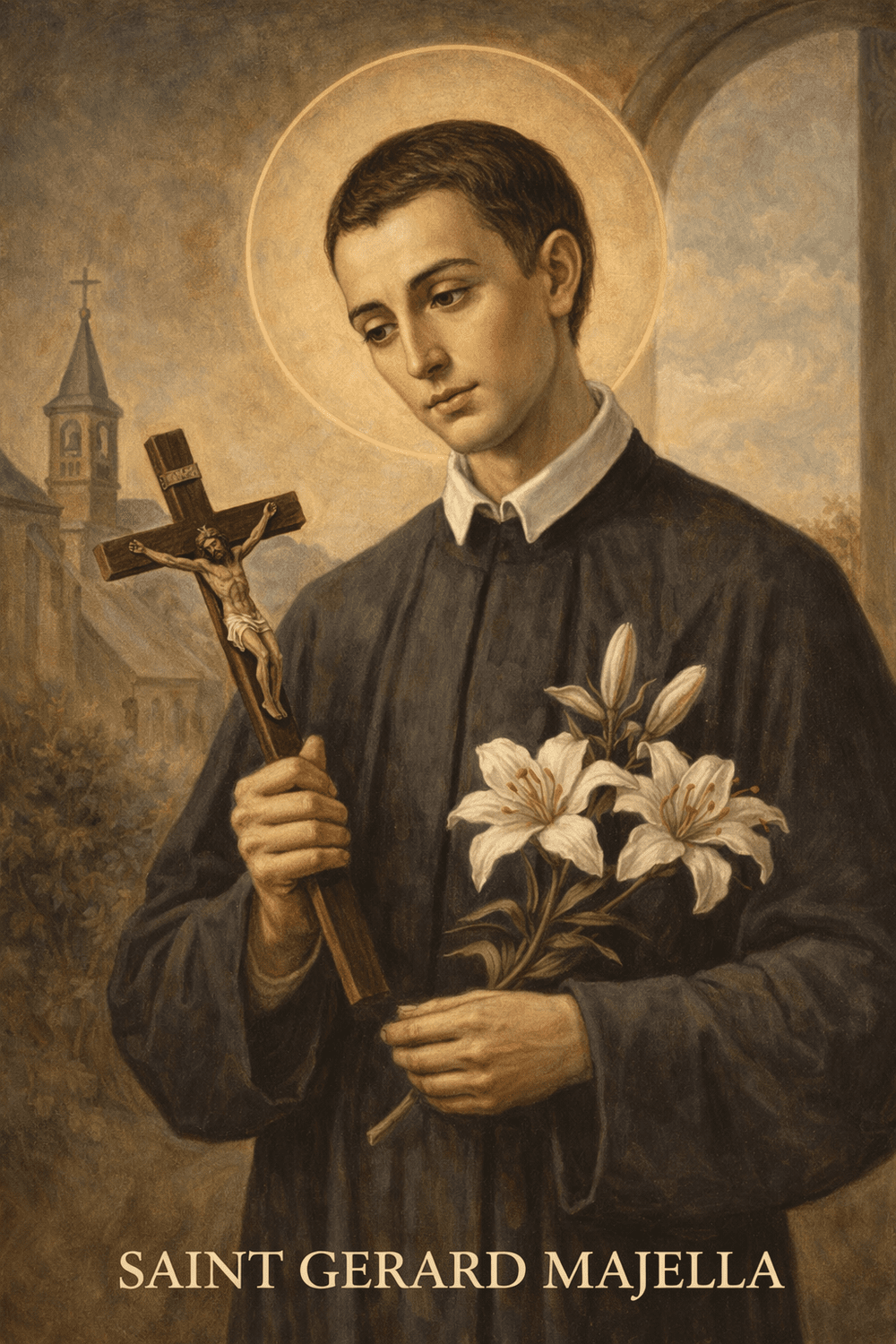
Gerard's card is for the entire journey of pregnancy — from the desire to conceive through the moment of delivery. Thousands of women carry it throughout their pregnancies. Many hold it in their hands during labor itself. This is the card the mothers of Italy have carried for three centuries.
$3.00 — Hand-finished and prayed over in Austin, Texas Get This Prayer Card →Saint Gerard Majella — Quick Facts
Born: April 6, 1726, Muro Lucano, Basilicata, Italy
Died: October 16, 1755, Caposele, Campania, Italy. Age 29. Cause: Tuberculosis.
Religious order: Congregation of the Most Holy Redeemer (Redemptorists). Role: Lay brother.
Professed by: Saint Alphonsus Maria de Liguori, founder of the Redemptorists.
Beatified: January 29, 1893, by Pope Leo XIII.
Canonized: December 11, 1904, by Pope Saint Pius X.
Feast Day: October 16.
Patronage: Expectant mothers, pregnant women, childbirth, children, unborn children, motherhood, the pro-life movement, the falsely accused, good confessions, lay brothers, Muro Lucano (Italy).
Known for: Bilocation, levitation, prophecy, reading of souls, multiplying food, raising the dead, walking on water, the handkerchief miracle, silence under false accusation.
Italian title: "Il santo dei felice parti" — the saint of happy childbirths.
Early Life — Poverty, Loss & the First Signs of Something Extraordinary
Gerard Majella was born on April 6, 1726, in Muro Lucano, a small hill town about fifty miles south of Naples in what is now the Basilicata region of southern Italy. He was the fourth and youngest child of Domenico Maiella, a tailor, and Benedetta Galella, a woman of deep and practical piety. From the beginning, Gerard was physically fragile. His parents had him baptized on the day of his birth — a common practice in that era not out of theological urgency alone, but out of the very real fear that an infant who appeared sickly might not survive the week.
From his earliest years, something in Gerard's interior life was different. The stories that survive from his childhood carry the characteristic marks of the saints — an intensity of devotion, an unusual relationship with the sacred, a quality of interiority that the people around him noticed without being able to name. At age five, he is reported to have regularly received bread from the hands of a young boy who disappeared immediately after each visit. When his mother asked who had given him the bread, Gerard told her it was a beautiful boy who came to him regularly — later identified in the tradition as the Christ Child. Whether this is literal or legendary, it establishes the character of what follows: a child whose interior life was already operating at a level unusual for his age.
The First Communion from Saint Michael
At age eight, Gerard attempted to receive his First Communion at the local church. The priest refused him — he was simply too young. That night, by the account that survived through the canonization process, the boy woke to find Saint Michael the Archangel standing in his room, who offered him the Eucharist he had been denied. This account cannot be verified with the kind of evidence that modern history demands. What can be verified is that the story was told, repeated, and submitted as testimony during the formal investigation of Gerard's holiness — which means those who knew him believed it to be true.
The Death of His Father & the Loss of Childhood
When Gerard was twelve, his father Domenico died suddenly. The family was already poor; the death of the family's primary earner made them immediately destitute. Gerard's mother sent him to live with his uncle, who apprenticed him to a local tailor named Martino Pannuto. The other apprentices at the workshop treated Gerard with cruelty — regular blows, verbal persecution, the kind of sustained petty violence that adult workers sometimes inflict on the most vulnerable among them. Gerard bore it silently. He is described in the accounts as having absorbed the mistreatment without complaint, which his biographers read as early formation in the suffering-without-retaliation that would become his defining spiritual posture.
The Hay Barn Fire
During his time at the workshop, a hay barn on the property caught fire at night, with Gerard and the tailor's young child inside. Accounts say that Gerard crossed himself, muttered a prayer, and the flames ceased immediately. The child was unhurt. This is the first miracle in his record with any claim to historical attestation — reported by witnesses who were alive at the time of the canonization investigation.
The Bishop's Household
After his tailor apprenticeship, Gerard entered the service of the Bishop of Lacedonia, Monsignor Claudio Albini — a man described consistently in the sources as harsh, severe, and given to irrational punishments. Gerard spent three years in this service, absorbing punishment and humiliation that the accounts say he received with the same equanimity he had shown in the workshop. What the bishop's household gave Gerard was something unexpected: proximity to serious religious culture, even if the bishop himself was difficult. It was in this period that his sense of religious vocation sharpened into certainty.
The First Attempt at Religious Life — The Capuchins Refuse Him
When Bishop Albini died in 1745 and Gerard returned home, he began pursuing what had become the clear direction of his life: formal religious vocation. He approached the Capuchin Franciscans in Muro Lucano and asked to be received. They refused him. The reason was his health. He was physically thin, appeared chronically unwell, and the Capuchins did not believe he could survive the rigors of their community. Gerard was devastated. He tried again. They refused again. He attempted to climb over the convent wall. He was removed. He returned home and fell into a sustained period of spiritual darkness — the kind that appears repeatedly in the lives of the saints, where the call is clear but every path to answering it is blocked.
During this period at home, he divided his wages as a journeyman tailor three ways: a portion to his mother, a portion to the poor, and a portion as offerings for the souls in purgatory. This practice — sustained throughout his early adult life before he entered religious life — is one of the clearest windows into his character. He was not waiting for the right moment to become generous. He was already living as he intended to live, in whatever circumstances he was given.
Religious Life — The Redemptorists, St. Alphonsus & Six Years That Changed Everything
In 1748, a group of Redemptorist priests arrived in Muro Lucano to preach a mission. The Congregation of the Most Holy Redeemer had been founded by Alphonsus Liguori only a few years earlier, in 1732. It was a new order, still forming its identity, built around preaching missions to the rural poor of southern Italy — precisely the world Gerard had grown up in. When Gerard encountered the Redemptorists, something in him recognized them. He asked to join. The priests were hesitant — he appeared too ill — but his persistence eventually won through, and he was received as a lay brother. He was twenty-three years old.
What a Lay Brother Was
The distinction between a lay brother and a priest is important for understanding Gerard. A lay brother in a religious order was not ordained. He could not celebrate Mass, hear confession, or preach. His role was everything else: cooking, cleaning, gardening, carpentry, tailoring, caring for the sick, managing the physical life of the community. Gerard served as tailor, sacristan, gardener, porter, and infirmarian at various times during his six years in the order. He was professed — formally received into the community — in 1752, by Alphonsus Liguori himself.
What makes Gerard remarkable within this role is how completely he inhabited it. The accounts describe him approaching the most menial tasks with a quality of attention and joy that the other brothers found striking. He would, when no one was watching, prostrate himself before the Blessed Sacrament in the chapel for hours. He fasted with an intensity that alarmed his superiors. He slept little. He prayed constantly. The external life of a simple lay brother contained, in his case, an interior life of extraordinary depth.
His Reputation Spreads
Despite his lay status, Gerard's spiritual reputation spread rapidly. People came to the Redemptorist community specifically to seek his counsel. Communities of nuns asked for his direction. Because of his extraordinary wisdom and his gift of reading consciences, his superiors gave him the unusual permission — for a lay brother — to counsel religious women and give spiritual conferences. Clergy sought his advice. Great scholars at Naples requested to speak with him. What they encountered was not a formally educated man but one whose knowledge of the interior life seemed to come from a source other than study.
His Mystical Gifts — Bilocation, Levitation, Reading Souls & Infused Knowledge
The Catholic Church's canonization process requires rigorous investigation of miracle claims. The records submitted for Gerard Majella's beatification and canonization represent one of the most extensive miracle portfolios in modern hagiographic history. The following mystical gifts are recorded in those documents — not as popular legend, but as witnessed and investigated testimony.
Bilocation — Being in Two Places at Once
The record of Gerard's bilocations is among the most attested in the Church's modern canonization files. Bilocation — the simultaneous presence of a person in two distinct locations — is one of the rarest mystical phenomena in the tradition, and it appears in Gerard's record repeatedly. The documented accounts describe him being seen and spoken to in one location while witnesses in a different location, sometimes miles away, also saw and spoke to him at the same time. One account has him appearing suddenly before St. Alphonsus Liguori in the refectory at Pagani in response to a mental summons from the superior — while Gerard was physically located elsewhere. Alphonsus, who was cautious about extraordinary phenomena and would not have recorded such an event lightly, confirmed what had happened.
Levitation During Ecstasy
Multiple witnesses testified that during periods of deep prayer and meditation, particularly during Mass or when contemplating the Eucharist, Gerard's body was observed rising several feet above the ground. These episodes of levitation accompanied states of ecstasy — altered states of consciousness where his awareness of the physical world appeared entirely suspended and his attention was entirely absorbed in God. These states were involuntary, not performed, and sometimes Gerard's brothers had to physically bring him back to ordinary consciousness. His biographers note that he was embarrassed by these episodes rather than proud of them.
Reading Souls and Consciences
The gift that most profoundly affected the people who encountered Gerard was his ability to read souls. Repeatedly, he would approach someone — a stranger, a traveler, a person who had never met him — and tell them of specific sins they had been carrying in secret, sins they had been too ashamed or too afraid to confess. This was not general spiritual observation. It was specific. One documented account describes him telling a man the precise nature and circumstances of a sin the man had committed years before in another town, with details no one in the room could have known. In every case, the response was the same: the person wept, confessed, and received absolution. Gerard's gift of reading consciences was, in practical terms, a ministry of reconciliation — people were returned to God through encounters they had not sought and could not explain.
Prophecy and Infused Knowledge
Gerard predicted specific events with enough accuracy that his community took his prophecies seriously. He predicted the outcomes of elections and appointments in the Church. He predicted the deaths of specific individuals with precision that impressed even the skeptical. He predicted the time and circumstances of his own death weeks in advance, accurately identifying the date and hour. His infused knowledge — direct knowledge of things he had no natural means of knowing — extended to people's personal situations, their hidden struggles, and the spiritual state of those he had never met.
Power Over Nature
Several accounts describe Gerard exercising what the tradition calls "power over nature" — events where the ordinary behavior of the physical world was suspended in response to his prayer. The most dramatic of these is the walking on water: during a violent storm at sea, when a boatload of fishermen was in genuine danger of drowning, Gerard walked across the water to reach their boat, calmed the storm, and led them to shore. This account was submitted with multiple witnesses during the canonization process. He also stopped fires, protected crops from pests through a simple blessing, and caused the multiplication of grain and bread.
Miracles During His Lifetime — The Complete Record
Raising a Child from the Dead
The most dramatic miracle attributed to Gerard during his lifetime is the restoration of a boy who had fallen from a high cliff. The boy was found dead at the base of the cliff — no vital signs, no response. Gerard was brought to the scene, knelt, prayed, and the boy revived. This miracle was attested by witnesses and submitted in the canonization process. It establishes the range of Gerard's miraculous power at the extreme end — not the healing of illness, but the reversal of death itself.
The Lost Key and the Infant Jesus Statue
While working in the household of the Bishop of Lacedonia, Gerard accidentally dropped the house key into a deep well. Faced with an insoluble practical problem, he lowered a small statue of the Infant Jesus into the well on a string. When he raised the statue, the key was held in its hands. This miracle was witnessed by others in the household and reported in the sources as one of the early signs that something extraordinary was at work in this young servant's life.
Multiplying Bread and Wheat
Multiple accounts describe Gerard blessing a poor family's inadequate supply of wheat — a supply that should have lasted weeks — and finding that it continued until the next harvest, feeding the family through an entire season. Separately, he multiplied bread on several occasions while distributing food to the poor, continuing to give from a supply that by ordinary reckoning should have been exhausted long before it was. These accounts echo the Gospel's feeding miracles explicitly, and the parallelism is not accidental in how the tradition presents them.
Walking on Water
During a severe storm at sea, a group of fishermen faced drowning when their boat was overwhelmed by waves. Gerard, on shore, walked across the water to reach them. He boarded the boat, the storm ceased, and he led them safely to land. Multiple witnesses on shore observed this. The miracle was investigated and submitted in the canonization process.
Removing a Mouse Infestation
A poor farmer's crops were being destroyed by a severe infestation of mice. Gerard blessed the farm. The mice disappeared. The crops survived. This is one of the smaller miracles in the record but one of the most often cited — because it demonstrates that Gerard's miraculous attention was not reserved for dramatic moments but extended to the ordinary material suffering of poor people whose livelihoods depended on a harvest.
Conversions Through Reading of Consciences
Perhaps the most consistently attested of all his gifts was the reading of consciences — telling people of specific sins they had been carrying in secret. The accounts number in the dozens, spanning his entire religious life. The effect was uniform: the person confronted with knowledge of their own soul that no natural means could explain was brought to immediate, complete confession and reconciliation. Gerard's spiritual direction was, in practice, a ministry of returning people to God through the gift of being seen completely and being invited to honesty.
The False Accusation — His Greatest Trial & His Most Complete Silence
In 1754, Gerard faced the worst thing that could happen to a celibate religious man in 18th-century Catholic Italy. He was accused, by a young woman named Neria Caggiano, of sins of impurity — sexual misconduct with a young woman from a family with whom he frequently stayed during his missionary journeys.
The Origin of the Accusation
Neria Caggiano was a young woman from Lacedonia whom Gerard had helped to enter the convent of San Salvatore in Foggia. She lacked the required dowry; Gerard went to considerable effort to arrange for friends to provide it. After three weeks in the convent, Neria left — she found the life too demanding. To justify her departure and protect her reputation, she began spreading stories about the nuns that the people of Lacedonia refused to believe. When her stories found no audience, she escalated: she sent a letter directly to St. Alphonsus Liguori accusing Gerard of impurity with the daughter of the Cappucci family, a prominent family in Lacedonia with whom Gerard had stayed for a full month earlier that year.
The Silence
When St. Alphonsus summoned Gerard and confronted him with the accusation, Gerard said nothing. Not a denial. Not an explanation. Not a defense. Nothing. Alphonsus pressed him. He remained silent. He was given, by all accounts, every opportunity to clear his name, and he declined every one of them. His biographers explain his silence as a deliberate imitation of Christ before Pilate — the decision that the will of God, operating through the judgment of his superior, was to be trusted more than his own self-preservation.
The Punishment
Faced with a silent accused and an accuser who maintained her charges, Alphonsus had no choice but to act on the accusation. Gerard was placed under severe penance. He was denied Holy Communion — the worst possible deprivation for a man whose interior life was organized entirely around the Eucharist. He was forbidden from all contact with outsiders. He was, in effect, treated as guilty while the investigation continued.
What the sources record about Gerard's interior state during this period is remarkable. He was not depressed. He was not bitter. He was not outwardly disturbed. He continued his ordinary work — his tailoring, his duties in the community — with the same equanimity he had shown in every previous period of difficulty. When asked by a fellow brother how he could bear being denied Communion, he is reported to have said that the will of God was sufficient, and that the will of God was being done whether he received Communion or not.
This response is theologically significant. It represents the highest possible form of the surrender to divine providence — not merely accepting suffering, but receiving it as the specific form in which God was currently acting in his life. The same quality of total surrender that appears in Gerard's miracle record appears here in his suffering. They are two expressions of the same interior posture.
The Vindication
Sometime later — the sources do not give an exact timeframe — Neria Caggiano fell dangerously ill. In the face of what she believed was her approaching death, she wrote a letter to St. Alphonsus confessing that every charge she had brought against Gerard was a fabrication. The accusation had been entirely invented. Alphonsus received the letter and immediately lifted all restrictions from Gerard. He was restored to full standing in the community, including the reception of Holy Communion.
"I thought such patience was required in the face of unjust accusation — that defending myself was not what God was asking of me in that moment, and that the truth would surface in its own time."
What is perhaps most striking about the account is the description of Gerard's reaction to his vindication. He was, by the accounts, not unduly elated. He did not express relief or triumph. He received the news of his innocence with the same equanimity he had received the accusation. As his biographers note: in both cases, he felt that the will of God had been fulfilled, and that was sufficient. This is the man whose intercession the Church invokes for the falsely accused.

The Handkerchief Miracle — How a Dropped Cloth Made Him the Mothers' Saint
A few months before his death, Gerard visited the Pirofalo family in Oliveto Citra. He was there for health reasons — his tuberculosis was advancing, and the mountain air was thought to help. As he was leaving the family home, he accidentally dropped his handkerchief on the threshold. One of the daughters of the house — her name is not given in most accounts — spotted it moments after he had gone and ran after him to return it.
Gerard looked at the handkerchief. Then he looked at the girl. He told her to keep it. She might need it someday.
At the time, this was an odd thing to say. A handkerchief is a handkerchief. The girl kept it, presumably puzzled.
Years Later
The girl grew up. She married. Some years after Gerard's death in 1755, she became pregnant and went into labor. The labor was dangerous — the kind of complication that, in 18th-century Italy, killed women regularly. She was on the verge of dying. In that extremity, she remembered the handkerchief and remembered what Gerard had told her. She asked for it to be brought to her. The women attending her applied it to her. Her pain immediately ceased. She gave birth to a healthy child.
What happened next was not orchestrated. Word spread — the way word spreads in small communities when something impossible has happened and everyone knows the family and the child and the woman who had nearly died. Other pregnant women began asking for the handkerchief. Then began praying to Gerard. Then began reporting their own miracles. The handkerchief passed from hand to hand across the region, and with each pregnancy it accompanied, the devotion grew.
What the Witness Testified at His Beatification
At the formal investigation conducted for Gerard's beatification in 1893, one witness testified that in the years after his death, Gerard had already become known throughout the region by a specific Italian phrase: il santo dei felice parti — the saint of happy childbirths. This was not a title assigned by the Church or by theologians. It was a title given by ordinary women who had prayed to him and who had experienced what they could only call a miracle in the most terrifying threshold moment of their lives.
The Church did not create this patronage. The mothers of Italy did. The Church simply recognized what had already been happening for decades.
The handkerchief passed hand to hand through Italy for decades. A prayer card is the modern equivalent — something small and physical that you carry, that you hold, that connects your prayer to the saint's intercession. Gerard's card belongs in your pocket from the moment you decide to conceive until the moment you hold your baby.
$3.00 — Hand-finished and prayed over in Austin, Texas Get This Prayer Card →His Death — The Last Note on the Door & the Bell That Rang the Wrong Way
By the summer of 1755, Gerard's tuberculosis was beyond recovery. He was moved to the house at Materdomini in Caposele, where the Redemptorists had a community beside a chapel dedicated to the Virgin Mary. The mountain climate was thought to be beneficial for his lungs, and his superiors hoped it might prolong his life. It did not.
As he grew weaker and the end became clear, Gerard asked that a small note be placed on the door of his cell. The note read: "Here the will of God is done, as God wills, and as long as God wills." He had written it in Italian. He had it fixed to the door not as a statement to others but as a prayer — a declaration of the posture that had organized his entire life and that he intended to maintain into death.
One account survives of a moment during his final illness when a well-meaning superior told him that the will of God was for him to recover and become well. Gerard obeyed. Almost immediately he felt better. His fever broke. He seemed to be recovering. His brothers were amazed. This lasted approximately a month — before the tuberculosis returned with greater force and the decline resumed.
The Prediction
Weeks before he died, Gerard told those around him the date and hour of his approaching death. He was specific. When the day came — October 16, 1755 — it arrived exactly as he had described it. He died in the early hours of the morning, quietly, after receiving the last sacraments. He was twenty-nine years and six months old.
The Bell That Rang Wrong
When Gerard died, the Brother sacristan was charged with ringing the death bell — the slow, tolling toll that announced a death in the community. In his emotional state, he rang the wrong pattern. He rang the bell as if announcing a feast — the rapid, joyful pealing of celebration. Those who heard it came running, expecting good news. What they found was Gerard's body. The accounts preserve this detail not as an error but as an accidental truth: the community's first response to his death was not grief but celebration. They knew immediately that they had been living alongside a saint.
Thousands came to view the body. People who had been healed by his intercession, who had been returned to God through his reading of their consciences, who had survived pregnancies through his prayers — they came to find a last relic, a last tangible connection to the one who had helped them. The accounts say that pieces of his habit and personal effects were taken as relics in such quantities that his superiors had difficulty controlling the crowds.
Posthumous Miracles & the Road to Canonization
After Gerard's death, reports of miracles attributed to his intercession began arriving from across Italy. These were not isolated incidents but a continuous stream, documented and submitted through proper ecclesiastical channels over the following decades. The breadth and variety of the reported miracles — healing of serious illness, resolution of dangerous pregnancies, conversion of sinners, protection from accidents, restoration of sight and hearing — persuaded the Church to open formal proceedings.
The proceedings for beatification — the first step toward canonization — required the Church to investigate the miracle claims with rigorous scrutiny. Multiple witnesses had to attest to each miracle. Medical opinion was sought where physical healing was claimed. The standard was, and remains, extremely high. The number of miracles that survived this scrutiny and were submitted for Gerard's cause was exceptional. His biographers note that of few saints in the modern period had so many verified miracles been submitted for canonization.
Beatification — 1893
On January 29, 1893 — 138 years after Gerard's death — Pope Leo XIII beatified him at a ceremony in Rome. The beatification process had included thorough investigation of his life, his virtues, and specific miracles attributed to his intercession. The title "Blessed" was formally conferred. For the devotion that had been building in southern Italy and spreading to Catholic communities worldwide, the beatification was a recognition of what ordinary Catholics had already known through their own experience of his intercession.
Canonization — 1904
Less than twelve years later, on December 11, 1904, Pope Saint Pius X canonized Gerard Majella at St. Peter's Basilica in Rome. The speed of the move from beatification to canonization — unusual even for modern saints — reflects the strength and breadth of the miracle record. Gerard was formally declared a saint of the universal Catholic Church. His feast day was established as October 16, the anniversary of his death. The Basilica of San Gerardo Maiella at Materdomini, where he had died and been buried, became his official shrine.
The Shrine and the Bows
At the Sanctuary of Materdomini in Caposele, one of the most distinctive features of the devotion is the colorful bows that cover the walls and votive alcoves of the basilica. These bows — pink and blue — are left by mothers who have delivered healthy children through Gerard's intercession. Thousands of them cover the sanctuary. They are not a folk tradition grafted onto the devotion; they are the devotion's most visible expression. Each bow represents a pregnancy that was dangerous, a woman who prayed, and a baby who survived. The sanctuary is a three-dimensional record of the handkerchief miracle, repeated across centuries.

His Full Patronage Explained — Why This Specific Saint for These Specific Causes
Expectant Mothers, Pregnant Women & Childbirth
The patronage is not primarily theological — it is experiential. The mothers of Italy discovered through prayer that Gerard's intercession was specifically effective for pregnancy and delivery. The handkerchief miracle was the catalyst, but it was not the whole story. Multiple pregnancy miracles were attested during his lifetime and submitted in the canonization process. One specific account describes a pregnant mother who feared she would lose her baby, who asked Gerard to pray for her and bless her, and who gave birth to a healthy child after he did. When roughly one third of pregnancies in 18th-century Italy resulted in live births, Gerard's intercession for mothers represented access to something that medicine alone could not provide.
His patronage of unborn children and the pro-life movement follows naturally from his general patronage of pregnancy. He stands between the pregnant woman and all that threatens her and her child — not only medical complications but the cultural and circumstantial forces that make pregnancy feel unsafe or unwanted. He is the saint for the pregnancy that everyone around the mother is afraid of, and for the child whose survival is uncertain.
The Falsely Accused
His patronage of the falsely accused is the most directly biographical patronage in his portfolio. He lived the falsely accused person's experience with complete fidelity. He was accused of something that, in his context, would have destroyed his life and his community. He had every means of defending himself and chose none of them. He was punished as guilty and bore the punishment without complaint. And his innocence was eventually vindicated — not by his own action but by the conscience of his accuser. For those carrying false accusations in their own lives, his patronage offers not a promise of quick vindication but the testimony of someone who bore unjust accusation with grace and trusted that the truth would surface in God's time.
Good Confessions
His patronage of good confessions connects to his gift of reading souls. Many people came to confession before or after encountering Gerard because what he told them about their own interior state made it impossible to continue in dishonesty. His gift of reading consciences was, in practice, a preparation for confession — he named what was hidden, and the naming made confession possible. For those who struggle with making a thorough and honest confession, his intercession is for the courage to say what needs to be said.
Lay Brothers
Gerard is the patron saint of lay brothers — the non-ordained members of religious communities who do the physical work that keeps communities functioning. His patronage here is a statement about the dignity of work done without public recognition, without the status of ordination, without the visibility of priestly ministry. Gerard accomplished everything he accomplished as someone who cooked and cleaned and sewed and gardened. His canonization is the Church's most emphatic statement that holiness is available in every state of life, without exception.
The Shrine at Materdomini — The Living Heart of His Devotion
The Sanctuary of Materdomini at Caposele in Campania is where Gerard died, where he is buried, and where the living heart of his devotion has been beating for nearly three centuries. The basilica is co-dedicated to Maria Santissima Mater Domini — the Most Holy Mary, Mother of the Lord — and to Gerard himself, a pairing that makes theological sense: the patron of expectant mothers is venerated beside the most exalted mother in the tradition.
Pilgrims come to Materdomini from across Italy and from Catholic communities worldwide. The basilica is decorated with the ex-votos — the thank-offerings — of those who have experienced healing through Gerard's intercession. The most distinctive of these are the bows: thousands of pink and blue bows covering the walls and side chapels, left by mothers who have delivered healthy children through his intercession. Some bows are decades old. Some were left last month. Together they constitute one of the most visually striking records of popular devotion in southern Italian Catholicism.
There is also a national shrine in North America: the Chapel of St. Gerard at St. Lucy's Church in Newark, New Jersey, dedicated in 1977. The Newark shrine is the center of Gerard's devotion in the United States and hosts annual feast day celebrations, a street procession, and a devotional community that draws people from across the region.
The Prayers — How to Pray to Saint Gerard Majella
O Great Saint Gerard, beloved servant of Jesus Christ, perfect imitator of your meek and humble Savior, and devoted child of the Mother of God — enkindle within my heart one spark of that heavenly fire of charity which glowed in your heart and made you an angel of love.
O glorious Saint Gerard, because when falsely accused of crime you did bear, like your Divine Master, without murmur or complaint, the calumnies of wicked men, you have been raised up by God as the patron and protector of expectant mothers. Preserve me from danger and from the excessive pains accompanying childbirth, and shield the child which I now carry, that it may see the light of day and receive the purifying and life-giving waters of baptism through Jesus Christ our Lord.
Amen.
O Saint Gerard, you who interceded for so many women who longed for a child and could not conceive — look upon me now in my own longing. I want to be a mother. I want to carry a child. I want to hold in my arms what I have been praying toward.
You know what it is to want something deeply and to be refused, at first, every conventional path toward it. You tried to enter religious life and were turned away. You persisted. And God honored that persistence. Intercede for me in my own persistence. Let my longing not become bitterness. Let my prayer not become demand. And let the child I long for come — in God's time, through God's means, protected by your prayers.
Amen.
O Saint Gerard, I am in labor now. I am afraid. The pain is real and the stakes are real and I do not know how this ends.
You were born by Caesarean section after your mother died. You came into the world in the most dangerous way possible and survived. You spent your life standing between vulnerable people and the forces that would destroy them. Stand between me and my child and all that threatens this birth.
Give my medical team wisdom. Give me strength. Steady the labor. Bring my baby safely into the world. I trust you. I trust the intercession that has been working through your prayers since the mothers of Italy first discovered that you heard them. Hear me now.
Amen.
O Saint Gerard, you who stood before your superior and chose silence when you could have defended yourself — who bore months of punishment for something you did not do, and who did not break under it — intercede for me in my own false accusation.
I am carrying the weight of being believed guilty of something I did not do. The people who should believe me do not believe me. The evidence is not cooperating with the truth. And I am learning what you learned: that vindication comes in God's time, not in the time that feels urgent to me.
Help me bear this with the same equanimity you bore yours. Help me trust that the will of God is being fulfilled even in this. And help me not become bitter while I wait for the truth to surface.
Amen.
Free Eastern Christian Marriage & Family Resources
Pregnancy changes marriages profoundly. If you are expecting, preparing to become parents, or navigating the intersection of faith and family life, we have created free Eastern Christian resources on marriage, intimacy, and the spiritual dimensions of parenthood. Available to download now.
Access Free Marriage Resources →Questions About Saint Gerard Majella
He Died at Twenty-Nine. His Intercession Has Been Working Ever Since.
He was born by Caesarean section after his mother died in labor. He spent his entire life reaching toward the poor, the imprisoned, the falsely accused, and the vulnerable. He bore unjust accusation without a single word of self-defense. He raised a dead child. He walked on water. He predicted his own death. He left a handkerchief with a little girl and told her she might need it someday.
She needed it. And so have millions of women since, who have carried his prayer card into hospital rooms and delivery wards and ultrasound appointments and the long, quiet months of trying and waiting and hoping. The mothers of Italy took him as their saint before the Church formally recognized what he was. They knew from their own experience what his intercession could do in the threshold moment when a life is at stake.
He is still interceding. Carry him.
Get Saint Gerard's Prayer Card →