Eastern Orthodox Saints • Hagiography • Wildest Stories • Coolest Saints
5 Wildest Orthodox Saints You've Never Heard Of — And Why Their Stories Are Wilder Than Anything Called "Cool"
A secret prison operative who stayed anonymous for decades. A young woman who defeated a professional sorcerer in direct spiritual combat. Two aristocrats who disguised themselves as male monks for years without being found out. And a courtesan who burned her fortune in a single afternoon and disappeared into a desert cave. These are the five wildest Orthodox saints in the Eastern Christian tradition — and almost no one knows their names.
People who search for the "coolest Orthodox saints" are usually looking for the same thing: stories that don't read like devotional literature. Stories that have drama, reversals, disguises, confrontations, and transformations so complete they seem impossible. The Eastern Orthodox tradition has those stories in abundance — but they tend to stay inside the walls of the tradition, known to monastics and hagiographers and quietly passed down, rather than reaching the wider audience they deserve.
These five saints are not the famous ones. They are not Nicholas, not Seraphim, not Anthony the Great — not the saints whose icons appear in every Orthodox home and whose feast days fill the church calendar with familiar weight. These are saints from the margins of the tradition's attention: a 6th-century monk who moonlighted as an anonymous prison liberator; a 3rd-century girl who took on a hired sorcerer and won; an emperor's daughter who spent years as an undetectable male monk; a wealthy man's only child who vanished into a monastery and counseled her grieving father for decades without him knowing who she was; and Antioch's most famous actress, who walked away from everything in a single afternoon and never came back.
Each of them has a prayer card. Each of them is still interceding. And each of them has a story that earns the word "wild" — not because they were reckless, but because they were so completely surrendered to something larger than self-preservation that what they did stopped making conventional sense entirely.
What Makes a Saint "Wild" — And Why the Orthodox Tradition Has More of Them Than You Think
The Orthodox hagiographic tradition has always made room for saints who don't fit the standard template of quiet, prayerful holiness. The category of "Fool for Christ" — the holy fools who wandered cities naked, acted insane in public, and deliberately invited mockery as a form of radical humility — is the most well-known of these. But the tradition's wildness runs deeper than the fools. It runs through the desert fathers who discovered that radical interiority sometimes requires radical exterior strangeness. It runs through the martyrs who refused every rational exit from their suffering. And it runs especially through the women saints of the early Byzantine period — saints whose stories involve disguise, disappearance, and long years of hidden identity — who found a way to pursue the fullest possible ascetic life in a world that had not built that life for them.
What makes a saint "wild" in the most useful sense is not shock value but the degree of total commitment their stories demonstrate. The saints in this article are not performing for an audience. They are doing something so completely, for so long, in the face of so much potential consequence, that the story reads as almost impossible — except that the tradition insists on its truth and has preserved these accounts through fifteen centuries because something in them strikes the transmission-chain of monastics and priests and ordinary believers as real.
These are also five of the saints most likely to resonate with people who are skeptical of conventional piety. They are not virtuous in a soft way. They are relentless in a hard way. That is a different kind of "cool" — and it is the kind this tradition has been quietly producing for two thousand years.
Saint Vitalis of Gaza — The Secret Operative for Christ
The hagiography of Vitalis of Gaza is unlike almost any other in the Eastern Christian tradition — because for nearly the entire length of the story, he appears to be doing the wrong thing. He starts as a monk in the monastery of Abbot Seridus near Gaza, a man of obvious spiritual depth living in obvious spiritual community. And then, at some point in his monastic life, he receives a vision or a calling that sends him to Alexandria — and what he does there is so strange that it nearly destroyed his reputation while he was alive.
Vitalis arrived in Alexandria and set himself up as a day laborer, working whatever jobs were available to earn wages. At the end of each day, he took his earnings and walked into the city — and at night, he visited the condemned: people imprisoned for debt, people awaiting execution, people whose situations had reached the point where no ordinary help could reach them. He paid for the release of those who could be released. He sat with those who could not. He prayed with them. He offered them whatever a single person, arriving without credentials or reputation, could offer.
He maintained complete anonymity throughout. He allowed himself to be seen in disreputable parts of the city at night, which generated exactly the rumors you would expect. He never defended himself. He never explained. He accumulated a reputation as someone not to be trusted — and continued his work under that reputation, apparently calculating that the cover it provided was worth more than the respect he was forfeiting. The hagiographic tradition records that he did this for years before his death, and that it was only after he died that those he had helped — some of them now free, some of them still in prison but changed — came forward and explained what he had actually been doing in the dark. The reversal at the end of his story, when the truth surfaces, is theologically deliberate: the saint who is most misunderstood while alive is often the one whose story is most clarifying after death.
Saint Vitalis of Gaza is commemorated on April 22 in the Eastern Orthodox calendar. He is venerated as a patron for those engaged in hidden works of mercy, for those who serve the condemned and imprisoned, and for those who have allowed themselves to be misunderstood in service of something they cannot publicly explain. His story is one of the most complete accounts in the tradition of voluntary hidden ministry — the deliberate choice to serve without acknowledgment, not as a temporary sacrifice but as the fundamental structure of the work itself.
The deeper theological dimension of his story is the question of what anonymity costs and what it produces. Vitalis's reputation was his offering — the thing he gave up so that the work could continue. The tradition preserves his name precisely because he was willing for his name to mean nothing during his lifetime. That paradox — the saint who becomes famous for having chosen obscurity — is one the Eastern tradition returns to repeatedly, especially in the lives of the desert fathers.
O Saint Vitalis, monk of Gaza and servant of the condemned — you who gave away your reputation as willingly as your wages, who walked into the darkness of Alexandria's prisons night after night without a credential to your name and without a single person who knew the truth of what you were doing — intercede for me now in the hidden work I carry.
Pray for those who serve without acknowledgment, who do their best work in secret, who have chosen to be misunderstood rather than compromise the work. Pray for those who are imprisoned — by walls, by debt, by circumstances that no single act of help could fully reach. You know what it is to stand at the limit of what can be done for another person and to do it anyway.
Pray for me that I would love the work more than the credit. And pray for all those in prison — that someone will find them there, as you found the condemned of Alexandria, and that what they receive will be more than what any ordinary person could offer.
Amen.
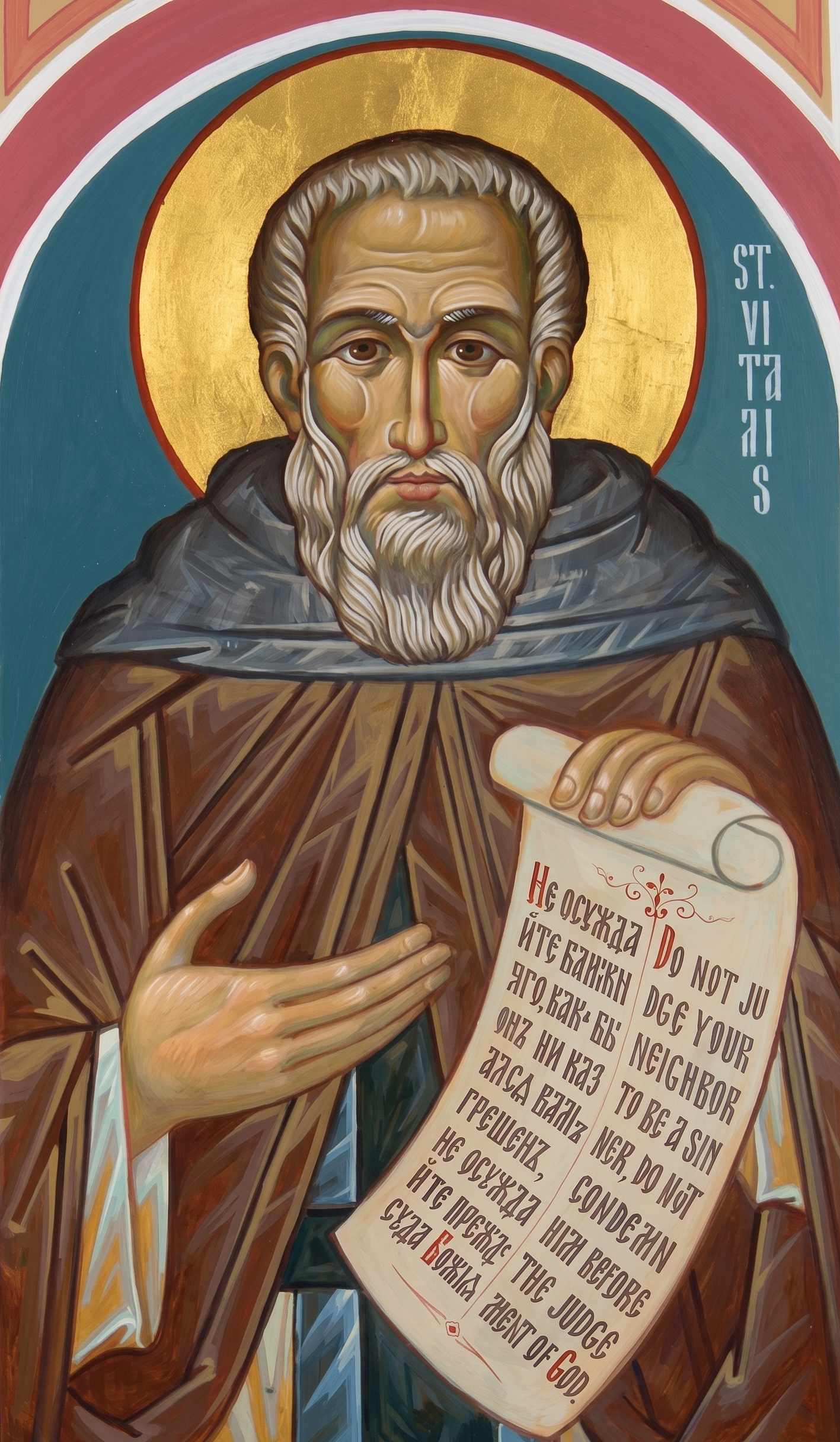
Vitalis's card belongs in the wallet or pocket of anyone who does their most important work without an audience — volunteers, caregivers, those who serve in prisons, hospitals, or shelters. He is a patron of the anonymous act, and his story is a reminder that the most complete kind of giving is the kind that cannot be tracked back to you.
$3.00 — Hand-finished and prayed over in Austin, Texas Get This Prayer Card →
Saint Justina of Antioch — The Virgin Who Defeated a Professional Sorcerer
The story of Justina of Antioch begins with a man hiring a professional sorcerer to solve a romantic problem — and ends with that sorcerer becoming a Christian martyr. What happens in between is one of the most kinetic and theologically dense hagiographic accounts in the Eastern Christian tradition.
Justina was a young Christian woman in Antioch — beautiful, devout, committed to a life of virginity. A young pagan man named Agladius became obsessed with her and, when his direct approaches failed, hired the sorcerer Cyprian of Antioch to compel her affection through magical means. Cyprian was the real thing: the account makes clear that he was an accomplished practitioner whose arts had produced real effects on real people. He was not a fraud. He was a man who had spent years cultivating access to powers that the tradition identifies as demonic, and who was hired to direct those powers at a specific young woman.
The vita describes three escalating attacks. The first: a demon sent to infiltrate Justina's thoughts and inflame her passions. She recognized what was happening, made the sign of the cross, prayed with particular intensity, and the demon departed, reporting back to Cyprian that he had been repelled "by a power that burns." The second: a more powerful demon sent with more specific instruction. The same result. The third: an attack at the level of the city itself — an attempt to create widespread disease that would build pressure on Justina's entire community. She began praying for the city. The epidemic stopped.
At this point, Cyprian broke. He understood that whatever Justina was connected to was categorically more powerful than what he had access to. He converted — fully, radically, not hedging — and eventually became a bishop. Both he and Justina were martyred together during the Diocletian persecution, beheaded on the same day. The story ends with the sorcerer who was sent to destroy her dying alongside her as her co-martyr. It is one of the tradition's most complete accounts of spiritual combat: direct, escalating, and resolved not by the victim's cleverness but by the quality of her actual prayer life.
"The demon said to Cyprian: 'I sent all my power against her, and she made the sign of the cross, and I melted like wax before fire, and could do nothing.' And Cyprian understood for the first time what kind of power the Christians had — and what kind he did not."
Saints Cyprian and Justina are commemorated together on October 2 in the Eastern Orthodox Church — a feast that is itself theologically significant, since it insists on holding both figures together: the attacker and the defender, the sorcerer and the martyr, as a single story whose ending belongs to both of them. Justina is venerated as a patron for those experiencing spiritual attacks, occult oppression, and demonic harassment — and more broadly, for anyone who needs the kind of prayer that holds its ground under direct pressure.
The details of her vita matter theologically because they do not present prayer as passive or resigned. Justina's prayer was active, specific, and powerful. She prayed into the attack rather than away from it. The tradition holds this as an example of what the fullness of Christian prayer looks like when it is tested against something real — and what it is capable of producing when it holds.
O Saint Justina, virgin and martyr, who stood against the full weight of the occult with nothing but prayer and the sign of the cross — intercede for me now against whatever is pressing against my peace, my mind, my spirit. I am not always sure what I am fighting. You were. Teach me the quality of attention you brought to your prayer. Teach me to hold my ground without understanding the mechanism by which the ground is held.
Pray for all those who are experiencing spiritual attacks they cannot name, who feel a darkness that does not belong to ordinary sadness, who sense that something is working against them in a way they cannot argue with or reason out of. You defeated a professional. You know what is actually possible.
And pray for all those who, like Cyprian, have been on the wrong side of this and need a way back in. He found one through watching your prayer. May they find it too.
Amen.
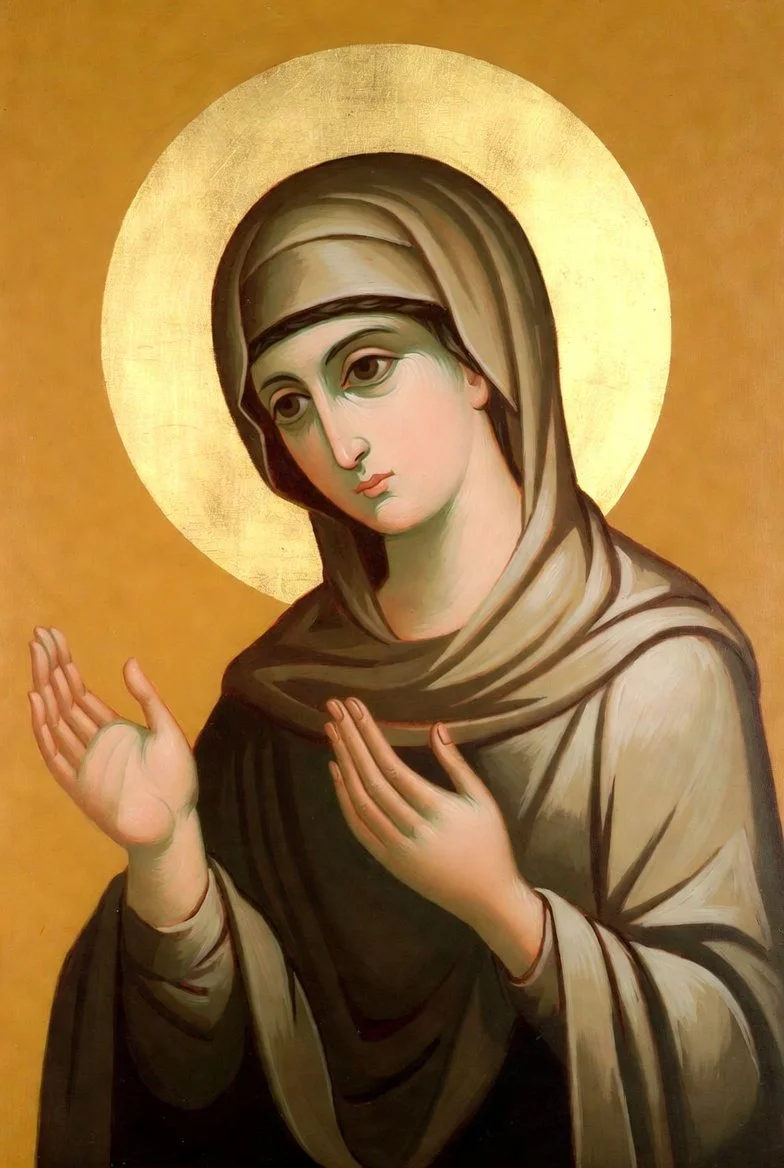
Justina's card is for those who need the kind of intercession that has already been tested against something real. She did not survive her story through luck or good timing — she survived it through the sustained quality of her prayer. Carry her card when the pressure feels spiritual rather than circumstantial.
$3.00 — Hand-finished and prayed over in Austin, Texas Get This Prayer Card →
Saint Hilaria — The Emperor's Daughter Who Vanished Into a Male Monastery
Hilaria was the eldest daughter of Zeno, Emperor of the Byzantine Empire from 474 to 491. She was not a woman who needed to find a way out of an ordinary life — she was at the top of the most powerful structure in the known world. And she left it entirely, in one of the most decisive acts of voluntary disappearance in Byzantine history.
The account states that Hilaria, deeply devout and committed to a life of ascetic prayer that the imperial court could not accommodate, dressed herself in male clothing, left Constantinople, and made her way to Egypt — to the great monastic desert tradition that had been producing its most serious practitioners for over a century by the time she arrived. She entered a male monastery as a monk. She was not discovered. She lived in the community, followed the rule, received the same formation as the other monks, and became — by the account's testimony — a figure of genuine spiritual depth who earned the respect of her community over years without a single person learning her origin or her sex.
The turning point in her story — the moment the tradition finds most theologically charged — came when her younger sister was brought to the desert for healing. The sister was suffering from what the sources describe as spiritual illness, and the family sent her to the desert monastics in hope of help. Hilaria was assigned to pray over her sister. She healed her. And then — in a moment the vita preserves with remarkable psychological complexity — her sister recognized her. Not immediately, but through the healing: something in the way Hilaria prayed, or looked at her, or held her hands broke through the disguise. The sister kept the secret. Hilaria continued her monastic life until her death, at which point her true identity was revealed to the community. The tradition does not record confusion or scandal. It records veneration.
The tradition of women saints who disguised themselves as male monks is large enough that scholars have identified it as a distinct hagiographic genre in early Byzantine Christianity. What the tradition was preserving in these accounts was not primarily a statement about gender — it was a statement about the radicalism of the monastic vocation and about the women who pursued it so seriously that no institutional barrier was going to stop them. The disguise is not the point. The depth is the point. The disguise is what the depth required of them in the world they inhabited.
The Eastern Church carries prayer cards for several of these saints: Hilaria, Euphrosyne of Alexandria, Pelagia the Penitent, Matrona of Perge, Apollinaria the Virgin, and others. Their stories are not embarrassments the tradition has had to explain — they are among the most read and loved of the female hagiographies.
O Saint Hilaria, daughter of an emperor and servant of a monastery — you who gave up the highest position the world of your time could offer in order to pursue the only position that mattered to you — intercede for me in the calling I am trying to follow.
Pray for all those who feel called to something that the people around them cannot easily understand or affirm. Pray for those who have given up visible status or security to pursue interior life. Pray for those who feel the strange loneliness of carrying a vocation that cannot be fully explained to the people who love them. You carried yours in secret for decades. You know the weight of it and the grace inside the weight.
Pray that I would follow what I am called toward with the same quiet, complete, entirely undefended commitment. Amen.
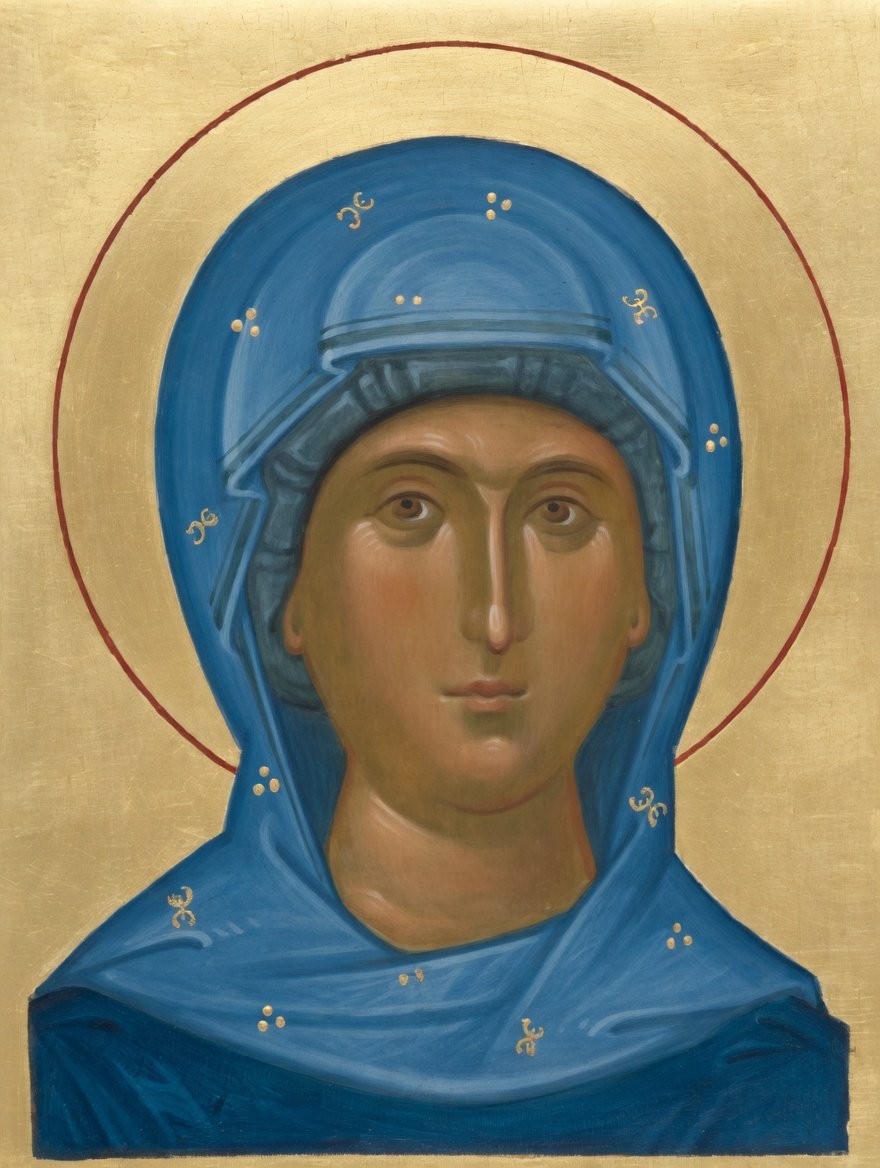
Hilaria's card is for those in the middle of a vocation that cost more than they expected and that they are still following anyway. She gave up an empire. Whatever you've given up is held in the same hands that held her offering. Carry her card as a reminder of what complete commitment actually looks like — not dramatic, not announced, just continuous.
$3.00 — Hand-finished and prayed over in Austin, Texas Get This Prayer Card →Saint Euphrosyne of Alexandria — She Counseled Her Grieving Father for Decades Without Him Knowing Who She Was
The hagiography of Euphrosyne of Alexandria is, at its core, a story about a father and a daughter — two people who loved each other deeply, were separated by her radical choice, and spent decades in the same space without the father knowing it. The reunion at the end of the story, when Euphrosyne was dying and finally revealed herself, is one of the most affecting moments in Eastern hagiography. It has been read in monasteries and homes for fifteen hundred years. It does not age.
Euphrosyne was the only child of Paphnutius, a wealthy Alexandrian merchant who had spent years praying for a child before she was born. She was, in the way of only children of devoted parents, the center of his world. When she reached marriageable age, he arranged a betrothal for her. She had other plans. She wanted the desert — the full ascetic formation that the great Egyptian monasteries were producing. She had no way to enter one as a woman. So she did what a number of her era's most serious female ascetics did: she disguised herself as a man, took the name Smaragdus, and entered a male monastery in Alexandria.
She was not discovered. She thrived. Over the decades, she became known in the monastery for the depth of her spiritual counsel — a monk of genuine discernment whom other monks and laypeople sought out for direction. And among those who came seeking that counsel was her father, Paphnutius, who had spent years in anguish over her disappearance and who had eventually turned to the desert monastic tradition for consolation. He became a regular visitor to the monastery. He and Smaragdus developed a spiritual relationship that deepened over years. He received counsel from his daughter — specific, knowing, tender counsel — without the smallest awareness of who Smaragdus was.
Only when Euphrosyne was dying did she reveal herself. The reunion is brief in the vita — she was near death, the reveal was quiet, Paphnutius received it in silence. After her death, he remained at the monastery for years, eventually dying in the same cell where she had lived. The tradition holds this together without softening it: the separation was real, the grief was real, the reunion was real, and all three were contained within a single vocation that was, in its depth, larger than any of them.
Saint Euphrosyne of Alexandria is commemorated on September 25 in the Eastern Orthodox Church. She is venerated as a patron for those making radical discernment decisions, for those estranged from family by vocation or calling, and for those whose acts of love are not recognizable as such to those receiving them. Her story is also read as an account of how spiritual formation can happen without the recipient understanding its source — Paphnutius was genuinely formed by his years of counsel with Smaragdus, and that formation was real regardless of who Smaragdus actually was.
O Saint Euphrosyne, who loved your father more completely than he knew and served him more deeply than he understood — intercede for those of us whose deepest acts of love are invisible to those we love most. Intercede for those who are estranged from family by calling, by circumstance, by choices that could not be fully explained and that cost both sides something irreplaceable.
Pray for grieving parents who do not know where their children are, and for the children who have gone somewhere their parents cannot follow. Pray that the love that crosses that distance — imperfect, hidden, expressed in forms that cannot be received directly — would still do its work. You know that it can. You did it for decades.
Pray for me in the loves I cannot fully show, and in the grief I carry for the people I cannot fully reach. Amen.
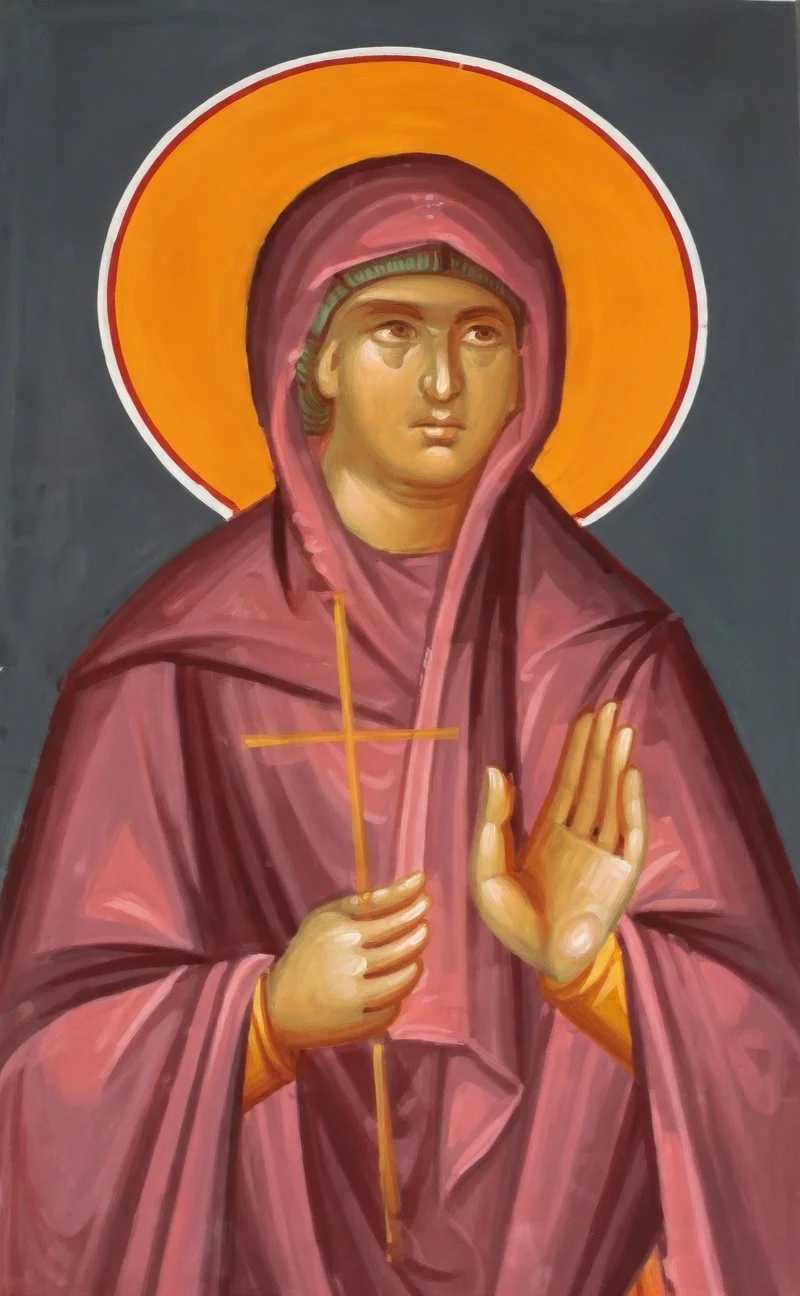
Euphrosyne's card is for those who love someone they cannot reach, who serve someone who does not know they are being served, or who carry the grief of a separation that was necessary and that still hurts. She held all three of those things for four decades and came out of it in a way that left her father — finally, briefly, in full knowledge — deeply at peace.
$3.00 — Hand-finished and prayed over in Austin, Texas Get This Prayer Card →
Free Eastern Christian Marriage Resources
Euphrosyne's story — a father who loved his daughter, and a daughter who loved her father, and the complicated grief of deep family bonds broken and restored — is not far from the territory covered in our free Eastern Christian marriage and family books. If you're navigating something difficult in your closest relationships, these books are available free online.
Browse Free Marriage Books →Saint Pelagia the Penitent — Antioch's Most Famous Courtesan, the Desert's Most Anonymous Hermit
The account of Pelagia the Penitent is the sharpest before-and-after transformation in the Eastern Christian hagiographic tradition — sharper than Augustine, sharper than Mary of Egypt, sharper even than Moses the Black — because of the speed of it. Everything that made her who she was, was gone within a single afternoon. And everything that replaced it lasted the rest of her life without a single reversal.
Pelagia was the most celebrated actress and entertainer in Antioch — in the 5th-century sense, which means she was also a courtesan, and famous for it. The vita describes her arriving in the city on horseback during the council of bishops that had gathered there, dressed in extravagance, surrounded by attendants, the object of every eye. The bishops looked away. One of them, Nonnus of Edessa, stared at her — not with lust but with a kind of fierce attention, and then turned to the bishops and asked them: have we given our souls the same care she has given her appearance? His question is the theological hinge of the story. He saw in her not a fallen woman but a mirror for his own spiritual inadequacy.
The next day, Pelagia came to hear Nonnus preach. Something in the sermon broke her open. The vita does not specify which words — only that what landed in her was total and irresistible. She sought out Nonnus after the service, confessed at extraordinary length, and asked for baptism. He initially refused — not out of disapproval but out of hesitation about his own worthiness to receive her confession. She persisted. He baptized her. Within days, she had gathered every possession she owned — jewelry, clothing, wealth accumulated over years of her profession — and distributed it to the poor in a single public act. Then she shaved her head, put on monastic clothing, and left Antioch.
She made her way to Jerusalem and to the Mount of Olives, where she took up residence in a small cell under the name Pelagius — a male name, a male hermit's identity, a male ascetic's reputation that grew over years among the pilgrims who came to the holy city and sometimes sought out the hermit Pelagius for counsel. Only when she died, and those who came to prepare her body discovered the truth, did Antioch's most visible woman become Jerusalem's most hidden saint. The deacon James, who tells the story, was one of those who discovered the truth — and his account is the source of what we know. He had come to Jerusalem expecting to find a male monk. He found Pelagia. He was stunned. The tradition has been reading his stunned account ever since.
"He looked at her for a long time, and then he turned to the other bishops and said: 'Has not this woman's diligence put us to shame? She adorns herself with such care for the pleasure of men — and we adorn our souls with so little care for the pleasure of God. What will we say on the day of judgment?'"
Saint Pelagia the Penitent is commemorated on October 8 in the Eastern Orthodox Church. She is venerated as a patron for those experiencing radical conversion, for those who carry the weight of a past they cannot undo, for those in the entertainment industry seeking a way toward God, and for those who need the kind of intercession that comes from someone who has been in the furthest possible place from where they want to be and made it all the way back.
What the tradition holds about Pelagia's story that is most theologically dense is the symmetry between her visibility and her hiddenness. She was, in Antioch, the most seen person in the city — the one everyone looked at, everyone talked about, everyone recognized. She chose, after her conversion, to become the least seen person in Jerusalem — a hermit no one could find, whose name was not her own, whose history was known to no one. The tradition reads this not as self-punishment but as the specific form her transformation took: she had been entirely given over to being seen, and she chose to give herself entirely to being hidden. Same completeness. Different direction.
O Saint Pelagia — actress, courtesan, penitent, hermit, and saint — you who made the sharpest turn in the history of the Eastern tradition in a single afternoon and never looked back — intercede for me in the places in my life where I need a turn that sharp and have been unable to make it.
You did not ease into conversion. You did not manage it gradually or protect what you were giving up by giving it up slowly. You burned it in a day and walked away. Pray that whatever in me is keeping me from that kind of completeness would soften enough to let me move. Pray for those who carry the weight of a past that feels too heavy to carry and too complicated to put down.
You went from the most visible person in Antioch to the most hidden person in Jerusalem, and in both places you were entirely yourself. Pray that I would find that — the place where I am entirely myself, and it is enough, and it is given completely to God.
Amen.
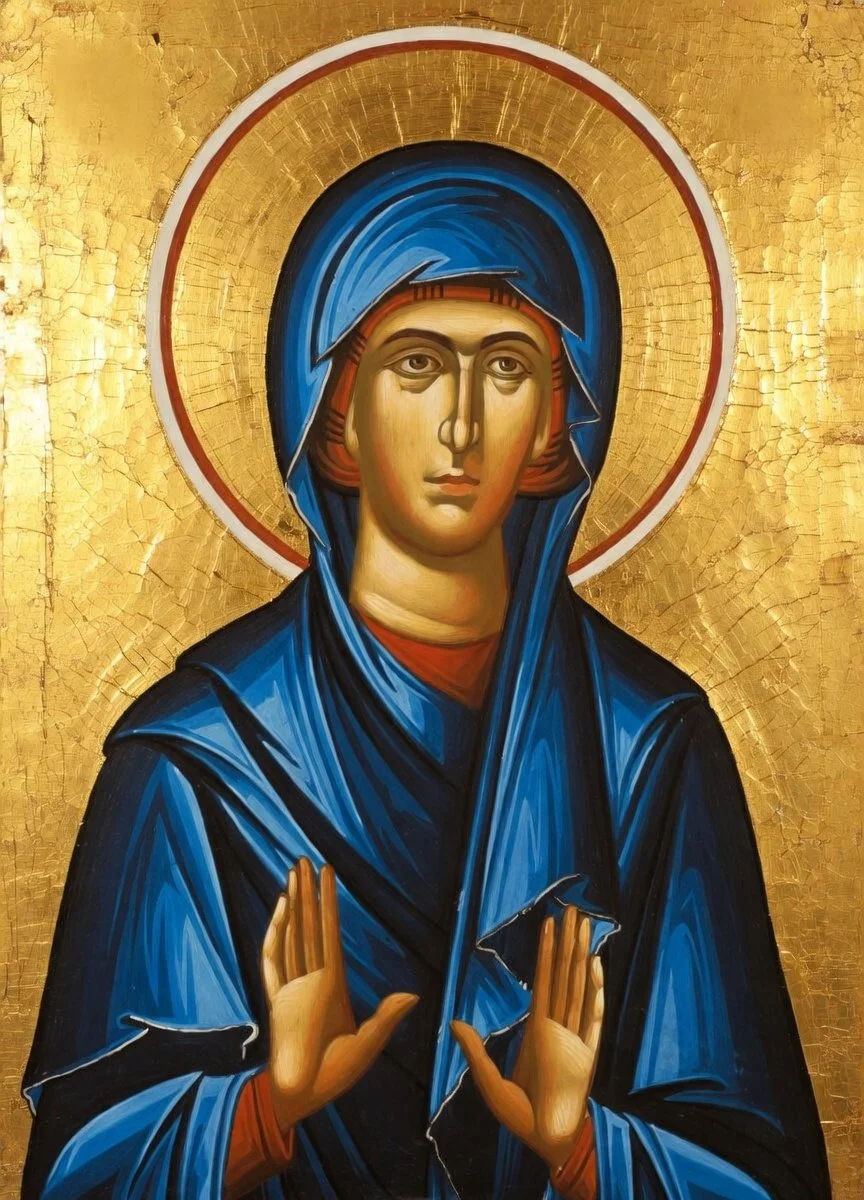
Pelagia's card is for those who know what they need to walk away from and have not yet found the moment to do it. She found hers in a single sermon. You may find yours somewhere entirely different. But she is interceding for the moment to arrive — for the thing that lands in you completely and changes the direction — and for the strength to follow it all the way.
$3.00 — Hand-finished and prayed over in Austin, Texas Get This Prayer Card →
Eastern Christian Gifts & Icons
Explore handcrafted icons, devotional gifts, and sacred art from the Eastern Christian tradition — gifts for the people in your life who take the interior life as seriously as the saints in this article did.
Browse Eastern Christian Gifts & Icons →Questions About the Wildest and Coolest Orthodox Saints
The Eastern Tradition Has Always Made Room for the Ones Who Went All the Way
Vitalis gave away the only currency that actually mattered to him — his reputation — so the work could continue. Justina held her ground against something designed by a professional to destroy it, and turned the professional into a martyr. Hilaria and Euphrosyne built lives so complete in their hiddenness that the people who loved them most could not see them. Pelagia burned everything she was in an afternoon and spent the rest of her life becoming something nobody expected.
These are not gentle saints. They are the ones who went all the way — who found the point at which ordinary self-protection would have said "far enough" and walked past it. They are interceding now. They are not waiting for you to have your life together before they receive your prayer. They have been receiving prayers from people in worse situations than yours for fifteen hundred years.
Carry one of them. In your wallet. In your pocket. In the console of your car. You don't need the right words when you reach for the card. You just need to reach.
Browse All Orthodox Prayer Cards →