The Women Saints Who Disguised Themselves as Male Monks
Early Church • 3rd–6th Century • The Complete Guide
Women Saints Who Disguised Themselves as Monks: The Complete Guide
Nine women. Nine extraordinary lives. Each one left everything behind, entered a monastery in disguise, and was discovered only in death. Here is the full history of one of the most remarkable patterns in all of Christian hagiography.
At a Glance
- Saints Covered
- 9 — Pelagia, Theodora, Euphrosyne, Apollinaria, Anastasia, Matrona, Eugenia, Hilaria, Marina
- Era
- 3rd through 6th century AD
- Traditions
- Eastern Orthodox, Byzantine Catholic, Roman Catholic (Eugenia)
- Primary Locations
- Antioch, Alexandria, Constantinople, Egypt, Rome, Perge
- Common Pattern
- Noble or sinful woman leaves worldly life, enters male monastery in disguise, identity revealed only after death
- Theological Theme
- Hidden holiness, repentance, total surrender, enduring injustice
- Why They Disguised Themselves
- Access to male monasteries, protection, escape from worldly obligations, complete renunciation of former identity
- Who Prays to Them
- Those seeking repentance, enduring false accusation, discerning vocation, escaping harmful situations
There is a pattern in early Christian hagiography that appears nowhere else in the history of world religion: women — noblewomen, sinners, wives, daughters of emperors — who vanished from their known lives, dressed as men, entered male monasteries, lived for decades among the monks without detection, and were discovered to be women only when their bodies were prepared for burial.
This is not a rare curiosity. At least nine saints in the Eastern Christian tradition followed this pattern. Some entered monasteries to flee from unwanted marriages or political danger. Others were driven by repentance so radical that they wanted to erase every trace of the life they had lived. Others simply desired God with an intensity that made no room for the limits placed on women in their world.
They are called, collectively, the transvestite saints — a term that is clinical and modern and fails entirely to capture what their lives actually were. They were not making a statement about gender. They were making a statement about God. They wanted nothing less than complete surrender, and in their era, complete surrender meant entering the place where complete surrender was most available: the monastery. And monasteries were male.
So they dressed as monks. And they became monks. And most of them remained monks forever — even after death.
This article covers all nine. Each one gets the full story: who she was, what she left behind, what she endured, and why the Church has preserved her memory for fourteen to seventeen centuries. These are not peripheral figures. They are among the most powerful witnesses in all of Christian history.
Your Marriage Can Be an Act of Worship
The women on this page gave their lives entirely to God. But radical devotion is not only for monks and hermits. The Eastern Christian tradition teaches that marriage itself — rightly lived — is a path of holiness as demanding and as beautiful as any monastery. Discover that tradition for free.
Explore Free Marriage Resources →
Why Did Women Saints Disguise Themselves as Monks?
Before meeting the nine saints individually, it is worth understanding why this pattern existed at all. It is not self-explanatory. Why would a woman seeking God need to disguise herself as a man? Why not simply enter a convent, or live as a desert anchoress in her own cell?
The answer is more complex than it first appears, and it varies by saint. But several recurring motivations emerge across all nine stories.
Access: Male Monasteries Were the Centers of Spiritual Life
In the early Christian world — particularly in Egypt, Syria, and Asia Minor during the 4th through 6th centuries — the great desert monasteries were male. The Desert Fathers were the theological giants of the age. Abbots like Pachomius, Shenoute, and John of Lycopolis were the figures you went to for spiritual guidance. Convents existed, but they were fewer, smaller, and often less rigorous. A woman who wanted the fullest possible ascetic formation often faced a practical problem: the best monasteries did not accept women.
Several of these saints were not disguising themselves primarily to hide an identity. They were disguising themselves in order to gain access to the kind of formation they could not receive any other way.
Protection: Escaping Danger Without Explanation
Several of these women — Anastasia the Patrician in particular — faced genuine physical danger. Anastasia fled the unwanted attentions of Emperor Justinian himself. A woman traveling alone in the ancient world was vulnerable. A man dressed as a monk traveling to a desert monastery was not. The disguise was protection as much as it was theological statement.
Total Renunciation: The Complete Death of the Former Self
For some of these saints — Pelagia the Penitent most dramatically — the disguise represented something deeper than access or protection. It was a symbolic annihilation of the former self. Pelagia had been famous. People knew her face. By becoming a monk named Pelagius, she did not just change her life. She erased herself and started over. This is repentance taken to its most radical possible expression.
Escaping Worldly Obligation: Marriage, Family, Status
Euphrosyne, Apollinaria, and Hilaria all faced the same pressure: wealthy families with arranged marriages waiting for them. Their options in the ancient world were limited. A woman who announced she wanted to become a nun could still be compelled by family. A woman who disappeared and became a man with a new name could not. The disguise was, in these cases, a kind of irreversible commitment — a way of closing a door behind them so permanently that no one could force it back open.
Why the Church Preserved These Stories
The Eastern Church did not simply record these stories as curiosities. It preserved them as theological statements. Each story illustrates something the Church wants to say: that God sees what the world cannot see. That the interior life matters infinitely more than external appearances. That holiness can live completely hidden. That God receives the soul that turns to Him, regardless of how strange, how extreme, or how costly that turning appears to others.
These women were not considered heroes for their disguise. They were considered saints for what happened under it.

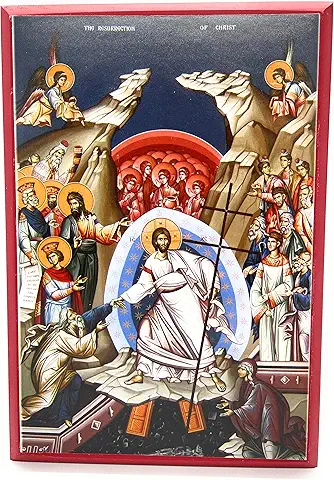

Saint I of IX
Saint Pelagia the Penitent
There is a moment in the life of Pelagia of Antioch that has been retold for sixteen centuries, and it has not lost its force: a woman at the height of her beauty and fame, surrounded by admirers, processing through the streets of one of the ancient world's greatest cities — and a bishop seeing her pass and beginning to weep. Not because she was sinful. Because she was lost. And because he could see in her something she could not yet see in herself: the capacity for absolute transformation.
Pelagia lived in Antioch, the third city of the Roman Empire, a place known for its wealth, its intellectual culture, and its moral complexity. She was famous — described in sources as an actress or courtesan, which in the ancient world often meant the same thing: a woman of public life, visible beauty, and scandalous reputation. She had wealth. She had influence. She had everything the world could offer a woman of that era, and she wore it all with extraordinary confidence.
Her life changed during a gathering of bishops. The bishop Nonnus of Edessa was preaching, and Pelagia passed by outside. The sermon was not directed at her. It may not have even been audible to her at first. But something reached her — what the Greek tradition would call the movement of the Holy Spirit, the finger of God touching a soul at the precise moment of its readiness.
She could not sleep that night. The sources say she sat with what she had heard and felt it the way a person feels the diagnosis that names what has been wrong for years — devastating and clarifying at once. She saw her life not through the world's eyes, which admired her, but through the eyes of something larger. And what she saw was not acceptable to her.
The Conversion: Immediate and Total
Pelagia did not delay. She did not spend weeks or months in gradual reformation. She went directly to Nonnus, confessed everything, and asked for baptism. Nonnus, it is recorded, had already spoken of her to his brother bishops the day before — not with contempt but with challenge: this woman, he told them, takes more care with her beauty than we do with our souls. He recognized in her, before she recognized it in herself, the material of sanctity.
She was baptized. She gave away her wealth with the totality of someone who does not want it back. She freed her servants. She walked away from the life she had built, and she did not look back.
But Pelagia did not simply become a reformed woman living quietly in Antioch. She understood, in the logic of her conversion, that she could not remain where she was known. The old life had a face, and that face was hers. She had to disappear completely.
The Hidden Life: Monk Pelagius on the Mount of Olives
She traveled to Jerusalem and climbed to the Mount of Olives, the place where Christ had prayed before His passion. There, she made her cell. She took the name Pelagius and the appearance of a male monk, and she lived in complete silence, complete solitude, complete fasting, and complete prayer for the rest of her life.
For years, no one knew who she was. Monks from the area knew of the holy hermit on the Mount of Olives — thin, ravaged by asceticism, radiating something that people recognized as the presence of God. They did not know the hermit had once been the most famous woman in Antioch.
She lived entirely for God. Not partially. Not with a portion of herself still attached to what she had been. The conversion that began with a sermon and a sleepless night had completed itself in total self-obliteration. She had become, in the truest sense, a new creation.
Only when she died did the monks who came to prepare her body discover the truth. The hermit Pelagius was Pelagia. The woman they found was so wasted by decades of fasting that she was barely recognizable as the person the old stories described. But she was recognized. And the Church understood immediately what it had witnessed: one of the most complete acts of repentance in the history of Christianity.
Who Prays to Saint Pelagia
She is prayed to by anyone who has ever felt that they have gone too far to return — that the weight of the past is too heavy, the damage too permanent, the distance from God too great. Pelagia answers that prayer with her life. She did not reform. She did not improve. She was transformed, completely and immediately, by a grace she did not earn and could not have anticipated.
She is especially sought by those in seasons of deep repentance, by people returning to faith after long absences, and by anyone who needs to believe that radical change is still possible.
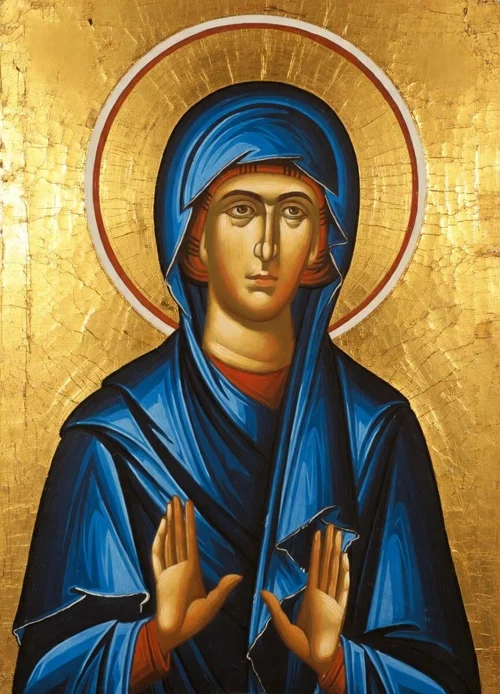
Saint II of IX
Saint Theodora of Alexandria
If Pelagia's story is about the drama of conversion, Theodora's story is about something quieter and in some ways more demanding: the willingness to carry a burden that is not yours, to accept blame that belongs to someone else, and to do so in complete silence without ever once demanding that the truth be known.
Theodora lived in Alexandria, a married woman of respectable standing. The sources treat her fall with unusual care: she was led into adultery not through hardness of heart but through deception and persistent pressure — a seduction she eventually yielded to and then immediately, completely regretted. There was no ambiguity in her conscience about what had happened. She had sinned. The guilt was hers to carry.
What followed is extraordinary. Theodora did not confess to her husband. She did not perform public penance. She did not seek absolution through conventional means. She did something far more radical: she decided that the person who had committed this sin could not be allowed to continue existing.
The Disappearance: Becoming Brother Theodore
She left her home, her husband, and her life in Alexandria without explanation. She dressed as a man, presented herself at a desert monastery as a monk named Theodore seeking admission, and was accepted. She had begun her burial of the self she had been.
The monastic life Theodora embraced was not gentle. The Egyptian desert monasteries of the 4th and 5th centuries were among the most demanding human environments ever constructed. The regimen of fasting, vigil, labor, and prayer was designed to break the self down entirely so that God could fill the space that remained. Theodora threw herself into it with the desperation of someone who genuinely did not want to survive as the person she had been.
She rose in the estimation of the community not because she sought recognition but because genuine holiness is hard to hide entirely. Brother Theodore became known as a monk of unusual discipline and unusual kindness — someone who carried more than their share, who fasted harder than required, who prayed when others slept.
The False Accusation: The Test That Defines Her
Then came the test that would define her memory for sixteen centuries. A young woman in the area became pregnant. For reasons that the sources do not fully explain — whether out of malice, confusion, or the desire to protect another — she accused Brother Theodore of being responsible for her condition.
Theodora knew the accusation was impossible. She was a woman. She could have proven her innocence in the most direct possible way.
She did not.
She accepted the accusation. She accepted the expulsion from the monastery. She accepted the child. She lived outside the monastery gates in poverty, raising an infant that was not hers, begging for food, enduring the contempt of everyone who had once respected Brother Theodore. She did this for years. She had already decided that she was willing to carry the consequences of the sin she had actually committed — and she was equally willing to carry the consequences of a sin she had not committed. In her understanding, the suffering was not unjust. It was simply continuation of the same act of repentance she had begun years earlier.
Eventually she was permitted to return to the monastery, still without revealing her identity. She lived out the remainder of her life there, in the community that had expelled her and received her back without ever knowing who she really was.
Discovery and Legacy
Only at her death was the truth discovered. The community that had judged her, expelled her, and received her back realized what they had been living alongside. A woman. A penitent. A saint whose humility had been so perfect that she had allowed every one of them to believe a lie about her rather than defend herself.
Theodora is especially prayed to by those carrying false accusations — people in professional, legal, or personal situations where the truth is known to God and not yet to anyone else. She is also sought by those whose guilt from the past has not been fully resolved, who need a path forward that does not depend on the world's understanding or approval.
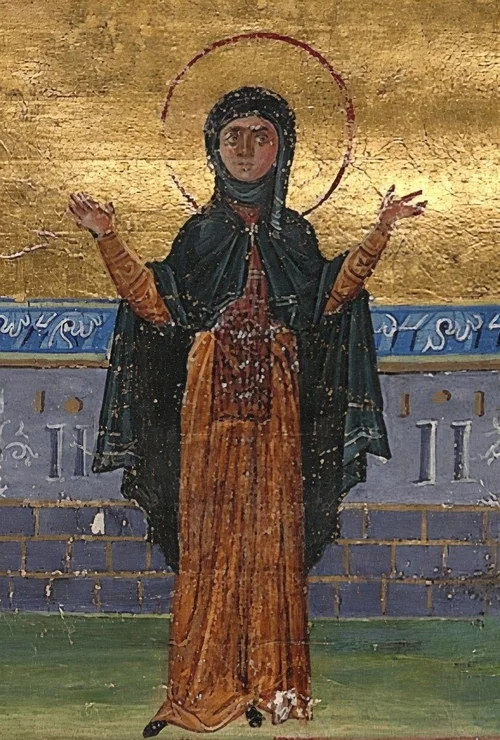
Saint III of IX
Saint Euphrosyne of Alexandria
If Theodora's story is about bearing injustice and Pelagia's is about radical conversion, Euphrosyne's story is about something rarer still: a woman whose hidden holiness became the instrument of her own father's salvation — without him ever knowing, for thirty-eight years, that the monk guiding his soul was his own daughter.
Euphrosyne was born in Alexandria into a wealthy Christian family. Her father, Paphnutius, was himself a devout man — one of those 5th-century Christians for whom faith was not nominal but genuinely formative. He had prayed for a child for years, and Euphrosyne was the answer. He loved her with the particular intensity of a man who had waited a long time for something and knew it as gift.
He had also arranged her marriage.
Euphrosyne felt the pull toward monastic life from early childhood — the sources describe it as a desire for God that had no corresponding desire for anything else the world was offering. The marriage arrangement created a crisis. She could not obey her father without betraying the call she heard more clearly than any human voice. She could not follow the call without devastating a father she genuinely loved.
The Solution: Disappear Into the One Place He Would Never Look
She chose the call. But she chose it with extraordinary cunning: she dressed as a man, presented herself at the monastery of Paphnutius — her father's own monastery, the place he frequented for spiritual guidance — and was admitted as a monk named Smaragdus.
This is the detail that the tradition has always found most astonishing. She did not simply flee. She hid in plain sight, in the very place her father went for consolation. She became the monk he sought out when he was grieving her disappearance. She listened to him describe his sorrow over his missing daughter. She guided him spiritually. She helped him come to terms with her loss. And she never told him who she was.
This is not cruelty, though it can appear that way. The sources — and the theological tradition that preserved and honored her — understood it differently. Euphrosyne had given herself to God completely. The life of "Smaragdus" was not a performance. It was reality. The woman Paphnutius had known no longer existed in the way he was looking for her. Euphrosyne had died to herself. What remained was entirely God's.
Thirty-Eight Years: The Long Hiddenness
She lived in the monastery for thirty-eight years. Paphnutius visited regularly. He sought out the holy monk Smaragdus for counsel. He had no idea. The sources do not sentimentalize this — they present it as part of the radical nature of her renunciation. She had left everything. Including, in a real sense, the relationship that would have been most natural to maintain.
At the end of her life, she called her father to her deathbed. She revealed who she was. The sources describe Paphnutius's response as complete collapse — the grief of thirty-eight years of loss and the joy of discovery simultaneous and overwhelming. He had found his daughter. He had found her in the last moments of her life, which had been spent entirely in prayer for him.
He stayed. After her death, he remained in her cell and lived the rest of his life as a monk in the place where she had died. He was buried alongside her. Father and daughter, who had lived so close and so far apart for nearly four decades, spent eternity in the same ground.
What Euphrosyne Teaches
Her story is not primarily about vocation, though it is that. It is about the cost of total surrender — the things that are genuinely given up, the relationships genuinely severed, and the mysterious way in which God uses even that severance to draw the beloved toward Himself. Paphnutius was brought to deeper holiness by the very loss he could not understand. The daughter who vanished became the instrument of the father's salvation.
She is especially meaningful for those who sense a calling that conflicts with family expectation, those discerning between love of family and love of God, and those who need permission to believe that God can use even painful absences for good.
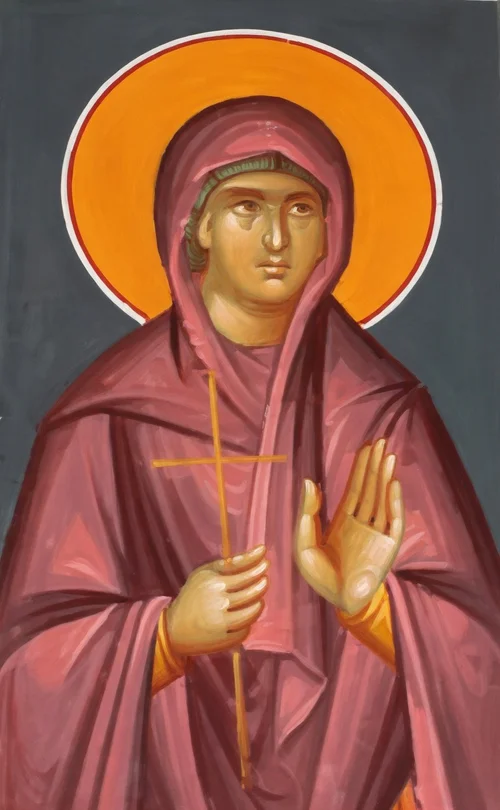
Saint IV of IX
Saint Apollinaria the Virgin
Apollinaria's story contains one of the most extraordinary scenes in all of early Christian hagiography: a woman living as a desert monk, who is brought her own sister — afflicted, and brought for healing — and who heals her without the sister recognizing who she is. The miracle is real. The identity is hidden. The saint who cured her was the sister she believed she would never see again.
Apollinaria was born into one of the highest families of Constantinople, traditionally identified as connected to the imperial court. Her upbringing was privileged in every possible way — education, beauty, social position, and all the futures that came with them. She was expected to marry well and be a credit to her family. She was destined for a public life.
She wanted none of it.
The desire for God that she carried from childhood was not compatible with the life being arranged around her. The sources do not describe her rejection of marriage as reluctance or timidity. It reads as clarity — the same kind of clarity that drove Euphrosyne and Hilaria, the understanding that nothing else would do. She was made for something that the world around her could not accommodate.
The Journey to Egypt: Becoming the Monk Dorotheus
When the pressure of marriage arrangements became acute, Apollinaria left. She traveled to Egypt — the great center of desert monasticism — and entered a monastery under the name Dorotheus. The sources do not describe any elaborate strategy. She simply arrived, presented herself as a monk seeking admission, and began her new life.
She practiced the standard Egyptian monastic disciplines with the intensity that characterized all these women: extreme fasting, vigil prayer, manual labor, radical obedience. She became known as a monk of unusual spiritual depth. Dorotheus had a reputation. The abbot valued the community's newest member.
Then her sister was brought to the monastery.
The Healing: Miracle at a Distance From Identity
The sources describe her sister as afflicted in a way that was interpreted spiritually — a condition that had not responded to ordinary treatment. Her family sent her to the desert, believing that holy men might succeed where physicians had not. They sent her, with no irony intended, to the very monastery where Apollinaria was living under her assumed name.
Apollinaria was brought to tend to her. She prayed over her sister. The sister was healed.
But the story continues. The sister returned home healed, and then — this is the part that strains the modern imagination but that the ancient sources treat as simple fact — she became pregnant, or appeared to. Her family, searching for an explanation, concluded that somehow the monk Dorotheus was responsible. They returned to the monastery with an accusation.
Apollinaria accepted it. She did not defend herself. She withdrew into even greater solitude, carrying the accusation in silence, just as Theodora had done. The parallel is not coincidence — it reflects a theological conviction shared across these stories: that the soul fully surrendered to God is willing to carry any shame, because its standing before God is the only standing that ultimately matters.
The truth emerged, as it always does in these stories, at death. The monk Dorotheus was found to be a woman. The family that had accused her realized who she was. The sister whose healing had led to the accusation understood, finally, the full dimensions of who had healed her.
Why Apollinaria Matters for Discernment
She is especially meaningful for anyone navigating the tension between a spiritual calling and powerful family expectations. Her story does not minimize how much she gave up — the account of her sister suggests how close the two were, and how much the disguise cost. But it holds that cost alongside the grace it enabled. She gave up the relationship to follow God, and then God used her, hidden and unnamed, to give her sister's life back.
Saint V of IX
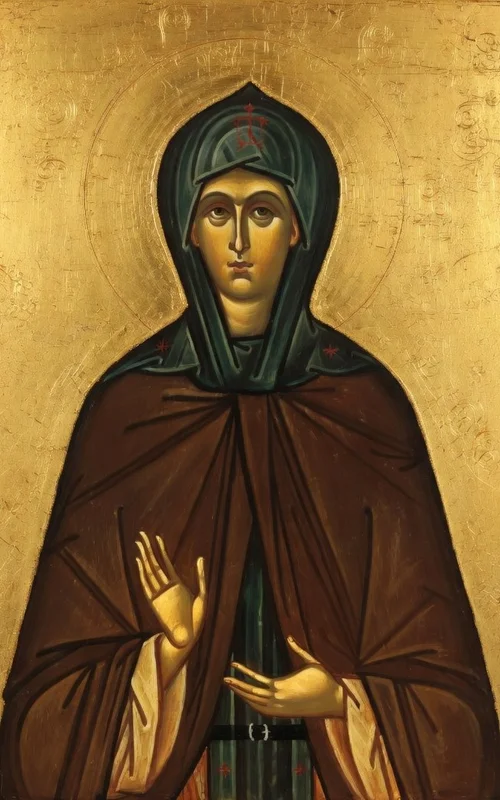
Saint Anastasia the Patrician
Anastasia's story is different from the others in one important way: she did not flee a marriage arrangement or seek radical repentance. She fled a man with an empire at his command. Her disguise was not primarily about calling. It was about survival — physical, spiritual, and psychological.
She was a patrician woman of the court of Constantinople in the 6th century, living during the reign of Emperor Justinian I. Her status was high. Her position was secure. Her life, by the standards of the era, was enviable. Then Empress Theodora — Justinian's powerful wife — died in 548, and everything changed.
Tradition holds that after Theodora's death, Justinian's attention turned to Anastasia. The nature of that attention — whether romantic fixation, political manipulation, or something else — is not spelled out in the sources, but the danger was real enough that Anastasia recognized it immediately. She was a woman of faith and she understood what was being asked of her, implicitly or explicitly. She also understood that she had no good options that remained within the normal channels available to a woman of her time.
The Flight: Into the Desert Under Another Name
She fled Constantinople and traveled to Egypt. There she placed herself under the guidance of Abba Daniel of Sketis — one of the great desert fathers of the 6th century, a figure whose own sayings appear in the monastic literature of the era. She was not simply hiding. She was seeking genuine spiritual formation under genuine spiritual authority.
With Daniel's guidance, she entered solitary monastic life dressed as a man, taking a new name, and living in a cell in the desert. For twenty-eight years she remained there. The emperor's men searched for her. They never found her. In the desert, dressed as a eunuch monk, she was invisible to a world that was only looking for a patrician woman.
But the desert was not simply refuge. In those twenty-eight years, Anastasia became something the court of Constantinople could not have produced: a genuine contemplative. The solitude that had begun as escape became her vocation. She had entered the desert to survive and she remained in it because she had discovered God there in a way she had not found in any other life she had lived.
The Witness of Abba Daniel
The relationship with Daniel of Sketis is theologically important. He knew who she was. He provided her with the Eucharist and spiritual direction throughout her hidden years. He is the source through which the tradition came to know her story at all — she would not have told it herself, and indeed she did not. Daniel recorded it, as something worth recording: a woman of imperial courts who had chosen a desert cell and had not looked back for nearly three decades.
She died in her cell. Daniel buried her. He told her story afterward as a witness to the power of total renunciation and the particular grace available to those who are willing to lose everything in order to find God.
What Anastasia Teaches
She speaks most directly to those in situations of danger — people in unhealthy environments, controlling relationships, or circumstances where remaining means compromising something essential. Her story teaches that leaving is sometimes the holiest possible response. Not as failure or retreat, but as the preservation of something God needs to protect.
She also speaks to those who have arrived at solitude or stillness through circumstances they did not choose — who found God in what felt like exile. Anastasia did not plan to become a desert contemplative. She planned to survive. But God met her in the desert she had fled to, and turned her hiding place into her sanctuary.


Saint VI of IX
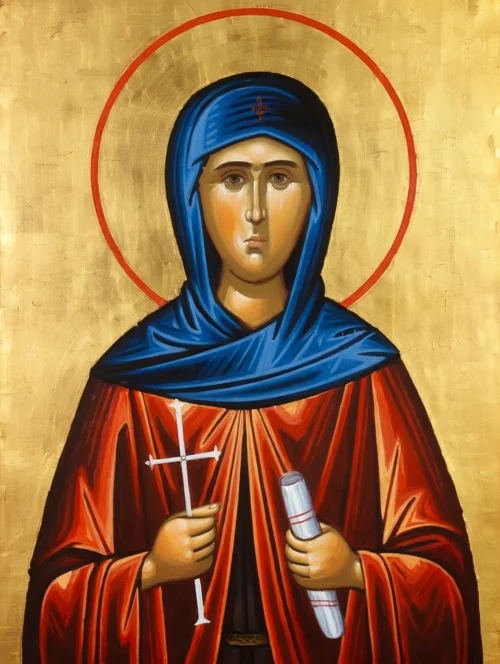
Saint Matrona of Perge
Most of the women in this group made a single dramatic decision and lived it out. Matrona of Perge's story is different in an important way: she was discovered, expelled, survived, and then continued forward anyway. Her holiness was not formed in one spectacular act of renunciation. It was formed by persistence — by refusing to stop seeking God no matter how many times circumstances forced her to start over.
She was born in Perge, a city in the region of Pamphylia in what is now southern Turkey. She married, as was expected of her, and entered a life that was outwardly respectable. But her interior life was pulling her in a different direction. Her husband, described in the sources as a man who did not share her spiritual intensity, opposed her desire for prayer, fasting, and religious practice. He did not understand it. He may have felt threatened by it. The conflict was genuine and ongoing.
Matrona's situation was different from that of the women who left before marriage. She had made vows. She had a household. She had an obligation. And yet the call she heard was not quieted by obligation — it grew louder.
The First Monastery: Babylas in Constantinople
She made her decision gradually, and when she acted, she acted carefully. She traveled to Constantinople — not randomly, but with a specific monastery in mind. She presented herself as a man named Babylas and was admitted. She began the life she had been unable to live in Perge: sustained prayer, fasting, the full monastic regimen, without a husband's opposition and without the endless friction of a life lived at cross-purposes to her calling.
For a period, the life worked. She was accepted. She was valued. But monasteries are small communities, and small communities eventually notice things. Her identity was discovered. She was required to leave.
A lesser woman might have returned to Perge. Matrona did not. She continued forward.
Persecution and Persistence: The Pattern of Her Life
What followed was a series of setbacks that would have defeated most people's spiritual ambition. Her husband discovered her location at one point and pursued her. She had to flee. She sought refuge with bishops and abbesses who protected her, moving from place to place, always maintaining the practice she had committed to even when the external form of that practice had to change.
Eventually she entered a women's monastic community — openly, as herself — and there her life settled into the pattern it would follow for decades. She grew in spiritual authority. She eventually led the community. The woman who had been expelled from a monastery for her hidden identity became the head of a monastery where her identity was fully known.
Her life is long — the sources place her death in advanced old age, possibly in her late eighties or nineties. The arc from young wife in Perge to revered abbess in Constantinople covers five to six decades. Every obstacle in that arc was real. None of them stopped her.
What Matrona Teaches
Matrona speaks to people in difficult marriages where faith and vocation create genuine tension. She speaks to people who have been forced to start over, who have been expelled or excluded from something they were pursuing faithfully. She speaks to anyone whose holiness is being formed not through one dramatic gesture but through years of patient, persistent movement toward God despite repeated interference.
Her story does not offer a clean resolution to the tension between marriage and calling — her path involved leaving the marriage, which is a fact the tradition preserves without commentary. What it does offer is the testimony that God does not abandon the soul that refuses to give up, even when every external circumstance seems determined to make it do so.
Saint VII of IX
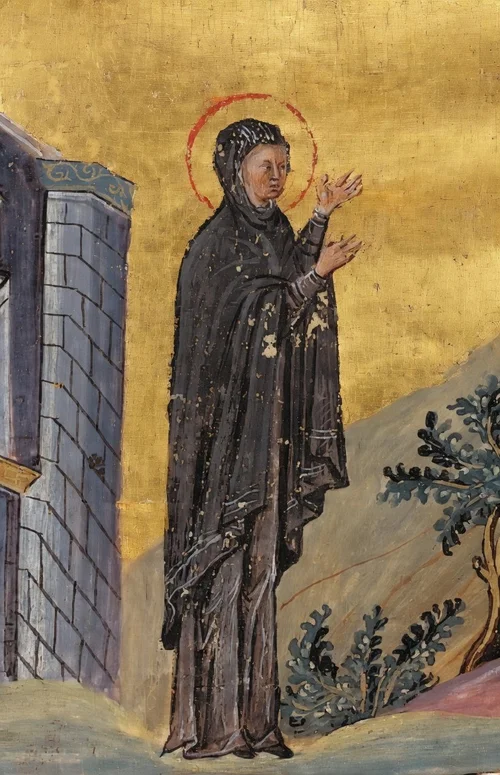
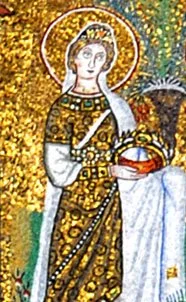
Saint Eugenia of Rome
Eugenia of Rome is the oldest saint in this group — her story is set in the 3rd century, during the years of Roman persecution of Christians, which gives it a dimension the later saints do not share: her story ends not with death in a desert cell but with martyrdom. She is not only a saint who disguised herself as a monk. She is a saint who disguised herself as a monk and then died for Christ.
She was born into one of the most powerful families in the Roman Empire. Her father, Philip, served as governor of Egypt — a position that made him one of the most significant Roman officials in the eastern provinces. The family was pagan. Eugenia grew up in a world of classical education, Roman religion, and imperial administration.
She encountered Christianity the way many educated Romans encountered it in the early centuries: through texts. She was reading — the sources often mention her literacy, which was notable for women of even wealthy families in that era — and she came across Christian writings that did not let her go. The arguments were more compelling than anything she had encountered in her philosophical education. The story of Christ was more coherent, and more disturbing, than any myth she had been raised on.
She did not convert quietly. Eugenia moved toward Christianity with the same intensity with which she apparently moved toward everything — fully, intellectually, personally. She became a catechumen. She was baptized.
The Entry into Monastic Life: Eugenius in Egypt
She dressed as a man, took the name Eugenius, and presented herself at a monastery in Egypt. The sources note that her father, as governor, was in Egypt at the time — there is a parallel with Euphrosyne's story, though the details differ. She was admitted to the monastery and lived the monastic life with the intensity of someone who had arrived at it through genuine intellectual conviction, not only emotional experience.
She was so respected by the community that she was eventually made abbot. This is remarkable: a woman, disguised as a man, leading a male monastery in Roman Egypt in the 3rd century. The sources treat this as straightforward — she was chosen because she was the most spiritually qualified person available, which is exactly the theological point the tradition wants to make.
The False Accusation and the Revelation
Like Theodora and Apollinaria, Eugenia faced a false accusation. A woman named Melanthia accused her of wrongdoing. Unlike Theodora, Eugenia did eventually defend herself — but she did so by revealing her identity publicly, stripping away the disguise in front of the authorities who were adjudicating the case. The revelation vindicated her completely and, according to the sources, led several of those present — including the judge — to convert to Christianity on the spot.
The truth had been a more powerful witness than silence. Both are present in this tradition: Theodora's silent endurance and Eugenia's sudden revelation, both honored, both effective, both serving the same God in different ways.
Return to Rome and Martyrdom
Her father Philip, who had converted to Christianity after his daughter's revelation, was eventually killed for his faith. The family returned to Rome, where Eugenia continued her Christian life and ministry. She converted many people, including members of the Roman nobility.
During the Valerian persecution — one of the most severe persecutions of the 3rd century — she was arrested. She survived an initial execution attempt that the sources describe as miraculous. She was ultimately beheaded on what tradition records as Christmas Day, making her feast one of the strangest coincidences in the liturgical calendar: the birth of Christ and the martyrdom of Eugenia on the same day.
She is unique among the nine women of this article because she belongs to both the Eastern and Western traditions with equal strength — on the Orthodox calendar on December 24, on the Roman calendar on December 25. She crossed the traditions in life, in theology, and in the calendar of the Church.
Saint VIII of IX
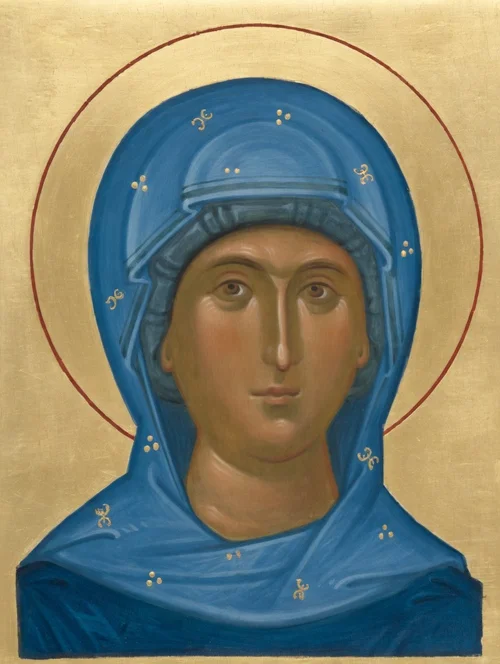
Saint Hilaria
Hilaria shares her feast day with Apollinaria — January 5 — and she shares a remarkable parallel with Euphrosyne: she was the daughter of an emperor, she fled into the desert, she hid her identity from her own family, and she was the instrument of healing for a sibling who came to the monastery not knowing who was there. These are not coincidences of the storytelling tradition. They are theological constants: the pattern of radical renunciation leading to healing that flows outward to the very people most injured by the renunciation.
Hilaria is traditionally identified as the daughter of Emperor Zeno — the Eastern Roman Emperor who reigned from 474 to 491 AD. If this identification is correct, she was born into absolute worldly power. The court of Constantinople in the 5th century was one of the most opulent environments on earth. She had everything.
She left it completely.
The Desert: Life Among the Monks Under an Assumed Name
Like Euphrosyne, she dressed as a man and entered a desert monastery in Egypt. She took a new name — the sources give it as that of a male monk — and lived the life of an ascetic with the thoroughness of someone who has genuinely decided that the former self is finished.
The Egyptian desert in the 5th century was still populated by significant numbers of monastics and hermits living in the tradition of the Desert Fathers of the previous century. Hilaria would have entered a world of profound spiritual seriousness — a world where the question of God was treated as the only question, where the disciplines of prayer and fasting were not supplementary but central, where silence was valued over all speech except necessary speech about God.
She thrived in it. The sources note her spiritual depth without dwelling on the paradox of her origin. She was no longer Hilaria, daughter of Zeno. She was a monk, and the monk's life had become her actual life, not a performance of one.
The Sister: Healing Across a Hidden Identity
The turning point in her story — the moment the tradition finds most theologically charged — came when her sister was brought to the desert for spiritual care. Like Apollinaria's sister, she was afflicted in a way that had not responded to ordinary treatment. Like Euphrosyne's father, she came to the monastery that held the person she had lost, without knowing who was there.
Hilaria was brought to minister to her. Through prayer and care, healing came. Her sister was restored. And like all the others in this pattern, Hilaria did not reveal herself. She allowed her sister to be healed and to leave, never knowing who had done it.
The tradition preserves this not as tragedy but as testimony. Hilaria's love for her sister had not diminished. Her capacity to heal her had been formed by the very renunciation that had taken her away. What she gave her sister in the desert, she could only have given because she had spent years in the desert giving everything to God first.
What Hilaria Teaches
She speaks most directly to those who feel called to something that the world — even the people who love them — cannot understand. She also speaks to those who are seeking healing for someone they love, particularly healing of a spiritual or psychological nature. Her story suggests that the most powerful intercession sometimes comes from the person you least expect to find doing it.
She is also a saint for people who carry a background they do not speak about — who have come from wealth or power or privilege and have set it aside for something they cannot fully explain to others. Hilaria did not apologize for where she had come from. She simply left it behind. Completely.
Saint IX of IX
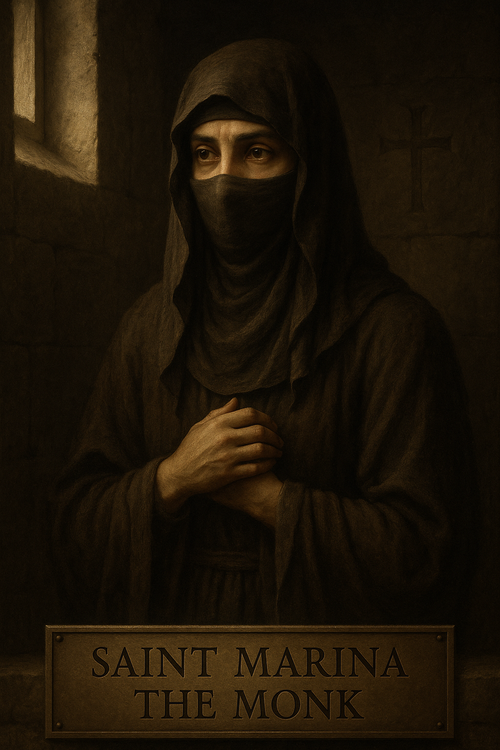
Saint Marina the Monk
Marina the Monk is the saint in this group whose story has perhaps the most concentrated emotional power. Every story here involves some degree of injustice endured — but Marina's story places that injustice at the center of her sanctity in a way that makes it almost unbearable to read and impossible to forget. She did not merely accept a false accusation. She accepted its fullest possible consequences: expulsion, poverty, the raising of a child who was not hers, years of public disgrace — and she did all of this in complete silence, without once using the simplest possible word to end it.
She could have said: I am a woman. The accusation is impossible.
She did not say it.
Marina was born into a devout family somewhere in the Levant — Lebanon, Syria, or the surrounding area. She lost her mother early. When her father felt the call to monastic life, she faced a choice: be left behind, or find a way to go with him. She found a way. She dressed as a boy, took the name Marinos, and followed her father into the monastery. The monks knew nothing. She was Brother Marinos, a young monk who had joined the community with his father.
Her Father's Death and the Life That Followed
Her father died within the monastery. She remained. Now she was not following her father — she was simply living the life they had chosen together, continuing it alone, because it was the right life and because turning back would have meant abandoning everything they had built together in God.
She was known as a good monk. Obedient, disciplined, reliable. The community valued her without knowing her. She was Marinos — a young man who fasted hard and prayed hard and asked for nothing that was not already given to monks by the rule.
Then the accusation arrived. A young woman from outside the monastery became pregnant. She identified Brother Marinos as the father. The sources do not speculate about why she made this claim — whether from malice, genuine confusion, or pressure from somewhere else. What matters is the claim, and what Marina did with it.
The Most Costly Silence in Christian Hagiography
She said nothing.
She accepted the accusation. She accepted expulsion from the monastery. She was put outside the gates with the infant she was told to raise. She lived in the space between the monastery wall and the ordinary world — close enough to the place she belonged to be reminded constantly of what she had lost, far enough to be treated as an outcast by those inside.
She begged. She survived on whatever was given. She raised the child. Monks who passed in and out occasionally spoke to her or gave her food. She did not ask for reconsideration. She did not explain herself. She did not ask to be heard.
Years passed. The child grew. Marina remained in her place of humiliation with a patience that the tradition does not attempt to rationalize — it simply records it, because some things cannot be explained, only witnessed.
Readmission and Death
Eventually, after years of this, she was permitted to return to the monastery as a penitent — still believed to be a man who had fathered a child and been appropriately punished. She accepted this framing too. She made no corrections. She returned to the monastic life in the lowest possible position, having been stripped of every status she had earned.
She died shortly after her readmission. When her body was prepared for burial, the truth was discovered.
The abbot's response is recorded in the sources with striking emotional force. He was devastated — not because he had been wrong about her sin (he had been) but because of the nature of what he had been living alongside without understanding it. He had expelled a holy woman, a woman who had carried an impossible burden for years in complete silence, who had returned to the monastery in humility and died there without ever once demanding to be understood.
The woman who had accused her came and confessed the truth publicly. The child Marina had raised acknowledged what had happened. The record was corrected. Her holiness was recognized.
Who Prays to Saint Marina the Monk
She is prayed to by anyone enduring false accusations — in the workplace, in families, in legal situations, in the court of public opinion. She is sought by people whose reputation has been damaged by lies they cannot quickly disprove, who are learning to trust God with their vindication while carrying the weight of injustice in the present.
She is also prayed to by those who are spiritually exhausted — not because they have done wrong but because they have been required to carry something too long and too heavy. Marina knows that exhaustion. She lived inside it for years. And she did not let it become bitterness. That is her most remarkable gift to those who seek her intercession: not a promise that the accusation will be quickly lifted, but the testimony that it is possible to carry it with God and survive it intact.
What the Church Teaches Through These Stories
Nine women. Spanning three centuries and five countries. None of them coordinating with any other. Yet their stories follow recognizable patterns with theological consistency — patterns the Church recognized, preserved, and canonized, which means the Church believed these patterns were saying something important that needed to be kept.
The Theology of Hidden Holiness
The most consistent theological theme across all nine stories is the complete irrelevance of human recognition to the reality of sanctity. Every one of these women was a saint while no one knew it. Their holiness was real, complete, and active — healing the sick, converting the lost, guiding the grief-stricken — while the people closest to them had no accurate picture of who they were. God knew. And in the economy of these stories, that was enough.
The Eastern tradition has a specific theological category for this: hidden holiness, or the holiness of those whose sanctity is concealed from the world. It is connected to the theology of the fools for Christ — those who appear mad or foolish while being inwardly aligned with God — but it is distinct. The fools for Christ are publicly visible in their apparent foolishness. The women of this article were invisible. They did not perform strangeness. They performed ordinariness so completely that no one looked twice.
The Theology of False Accusation
At least five of the nine women in this article were falsely accused of sexual sin: Theodora, Apollinaria, Eugenia, Marina, and (in some versions) Matrona. The pattern is too consistent to be coincidence. It is a theological statement about the nature of the test that hidden holiness invites.
The accusation of sexual sin is, in the moral world of late antiquity and early Christianity, the accusation most completely incompatible with the accused's actual identity. A woman living as a celibate male monk accused of fathering a child is being accused of two impossibilities at once. The tradition seems to find in this extreme form of injustice the extreme form of the spiritual test: can the soul remain attached to God when the world has constructed the most completely false possible picture of it?
Every woman who accepted the false accusation in silence was answering yes. The standing that matters is not human standing. The story that matters is not the world's story. God sees. That is enough.
The Theology of Deferred Vindication
In every case, the truth is revealed at death. Not before. Not in time for the vindicated person to benefit from the correction. The vindication belongs to the dead, and the living receive it as a gift they cannot return to its rightful owner.
This is not an accident of storytelling. It is a theological statement about where justice ultimately lives. The Eastern tradition does not promise quick vindication. It promises final vindication. It promises that God does not forget what the world misread. And it promises this in the most costly possible way: by showing, in story after story, women who waited for that vindication their entire lives and received it only in death — and who, by all evidence, found that acceptable.
The Theology of Gender and Identity
Modern readers inevitably ask what these stories mean for questions of gender and identity. The tradition offers a careful answer: the women in these stories did not claim to be men. They dressed as men for reasons that were practical, protective, or expressive of radical renunciation, but the tradition consistently preserves their female identity as the truth that the disguise concealed. The moment of revelation at death is always treated as the moment of full restoration — when the true self, which had been hidden, is finally seen.
The theological claim is not that gender is irrelevant. It is that gender, like everything else human and exterior, is subordinate to the soul's relationship with God. What God sees in Theodora or Marina or Euphrosyne is not a monk or a woman. It is a soul of extraordinary purity and courage. The rest is detail.
Radical Devotion Is Not Only for Monks
Every woman on this page gave herself entirely to God. But the Eastern Christian tradition has always taught that the same totality of gift is possible — and demanded — in marriage. The vocation of marriage, rightly understood, is not a lesser path. It is a different monastery. Discover what the saints and the Eastern tradition teach about marriage as worship, for free.
Free Marriage Resources: Marriage as a Path to God →Frequently Asked Questions
Complete Collection: All Nine Prayer Cards
Nine Lives. One Pattern. One God.
These women came from different centuries, different cities, different circumstances. Some were repenting. Some were escaping. Some were answering a call so clear it left no room for anything else. What united them was not their disguise but what they found under it: a life given entirely to God, with nothing held back, witnessed by no one but the One whose witness is the only one that finally matters.
Their prayer cards exist so that this witness can accompany you — in whatever season you are living, whatever you are carrying, whatever you are trying to find the courage to do next.
Browse All Prayer Cards →As an Amazon Associate, The Eastern Church earns from qualifying purchases.