Why Silence Is Essential for Hearing God
The Forgotten Christian Practice of Sacred Silence
In the modern world, silence is almost impossible to find. Phones buzz, music plays in the background, podcasts fill empty moments, and the mind itself rarely stops moving. Many people live their entire lives surrounded by noise and constant stimulation, and yet at the same time they often ask a deeply spiritual question: “Why can’t I hear God?”
For most Christians today, the idea that silence itself could be a form of prayer is unfamiliar. Prayer is often taught as something we say—words spoken to God, petitions offered, or Scriptures recited. These practices are beautiful and important, but they are only part of the ancient Christian tradition.
From the earliest centuries of the Church, believers understood that silence is not the absence of prayer but one of its deepest forms. In silence, the soul becomes attentive. The heart slows down. The inner noise settles. When that happens, a person begins to perceive what was always present but previously unnoticed: the quiet presence of God.
Christian mystics, desert monks, and saints across the centuries consistently taught that God often speaks in stillness rather than noise. Learning to enter silence is therefore not merely a spiritual exercise. It is a way of becoming aware of God's presence.
This article explores why silence has always been central to Christian spirituality, how the earliest monks used it to encounter God, why constant noise makes spiritual awareness difficult, and how anyone today can begin practicing a simple form of silent prayer.
The reflections in this article draw inspiration from the chapter “The Power of Silence” in the book Becoming a Christian Mystic, which explores how silence opens the heart to deeper communion with God.

Silence in the Bible: Where God Speaks
Silence is not a modern spiritual idea borrowed from other traditions. It is deeply rooted in Scripture itself.
Throughout the Bible, the people of God repeatedly encounter Him not in noise or spectacle but in quiet moments of stillness.
One of the most famous examples comes from the prophet Elijah.
Elijah and the Whisper of God
In 1 Kings 19, Elijah is fleeing for his life and hiding on Mount Horeb. God tells him that He will pass by. Elijah witnesses dramatic signs of power:
A mighty wind that shatters rocks
An earthquake
A fire
Yet Scripture says that God was not in any of those things.
Then comes something unexpected.
“And after the fire a still small voice.”
— 1 Kings 19:12
Some translations render this phrase as “a gentle whisper” or “the sound of sheer silence.”
It is in this quiet moment that Elijah recognizes the presence of God.
The lesson is profound. God certainly can reveal Himself through dramatic events, but very often He chooses to reveal Himself through stillness.
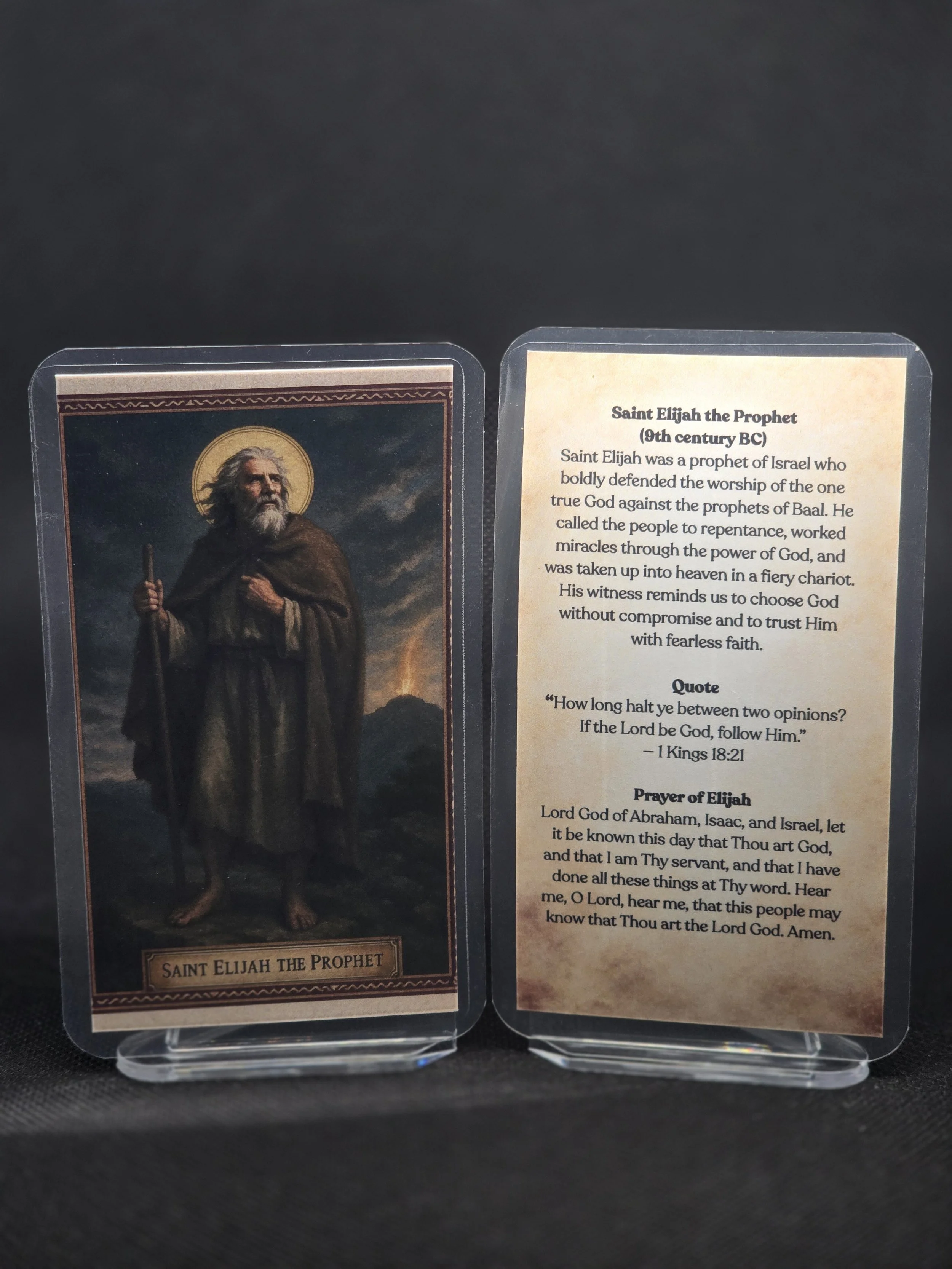
Saint Elijah the Prophet stands in Scripture as one of the most powerful and mysterious figures in salvation history. Honored across Eastern Orthodox, Eastern Catholic, and Roman Catholic tradition, Elijah was not a quiet teacher or gentle mystic. He was a warrior-prophet, a man of fire and silence, miracles and despair, confrontation and collapse. His feast is celebrated on July 20 in the Eastern Churches and also observed on the same date in the Western calendar.
People come to Saint Elijah when spiritual warfare feels real. They come after emotional burnout, when they have poured everything out for God and suddenly find themselves empty. They come when they feel isolated for standing up for truth, when depression follows spiritual victory, and when they need courage to keep going even though they feel alone.
Elijah understands this pattern of strength followed by exhaustion.
He confronted kings.
He called down fire from heaven.
He raised the dead.
He challenged false religion publicly.
And then, after one of the greatest victories recorded in Scripture, he collapsed emotionally and asked God to let him die.
Elijah knows what it feels like to fight hard for God and then fall apart inside.
He knows what it feels like to be bold in public and broken in private. He knows what it feels like to hear God powerfully one day and feel abandoned the next. His life speaks directly to anyone walking through spiritual battles, emotional crashes, or seasons where prayer feels quiet and courage feels thin.
Today, Saint Elijah is prayed to by those battling depression after burnout, believers facing spiritual opposition, people standing alone for truth, and anyone desperate to hear God again after long silence. He is especially sought by those navigating intense spiritual seasons followed by emotional fatigue.
This prayer card honors the prophet who teaches that even God’s strongest servants still need rest, renewal, and gentle mercy.
Each card is handmade in Austin and created to order. We do not keep stock, because every prayer card is treated as a unique devotional offering. They are printed on museum-quality photo paper, not cardstock, and each one is made during prayer. The saints are venerated throughout the entire process, and prayers are intentionally offered for the person who will receive the card. These are not mass-produced items. They are created slowly, reverently, and with spiritual intention, because every soul and every prayer matters.
“Be Still and Know That I Am God”
Another foundational verse about silence appears in the Psalms.
“Be still, and know that I am God.”
— Psalm 46:10
Notice that the verse does not say do more, speak more, or think harder. Instead, it commands stillness.
Stillness creates the conditions in which knowledge of God becomes possible. Without stillness, the human heart remains distracted and restless.
Jesus and the Silence of Prayer
Even Jesus Himself regularly withdrew into silence.
The Gospels repeatedly describe Him leaving crowds behind in order to pray alone.
“Very early in the morning, while it was still dark, Jesus got up, left the house and went off to a solitary place, where he prayed.”
— Mark 1:35
These moments were not public prayers or teaching sessions. They were quiet encounters between the Son and the Father.
If Christ Himself sought silence in order to commune with God, it should not surprise us that the saints throughout history followed the same path.

The Desert Fathers and the Discovery of Sacred Silence
Around the third and fourth centuries, thousands of Christians began leaving the cities of the Roman Empire and moving into the deserts of Egypt, Syria, and Palestine.
These men and women became known as the Desert Fathers and Mothers. Their goal was simple but radical: they wanted to remove every distraction that prevented them from focusing on God.
The desert offered what cities could not—silence.
Without crowds, entertainment, or constant activity, these monks discovered that silence revealed the true state of the heart.
One desert saying explains it clearly:
“Sit in your cell, and your cell will teach you everything.”
The meaning of this teaching was not merely physical isolation. The monks believed that when a person sits quietly long enough, they begin to notice the thoughts, fears, and distractions that normally remain hidden.
Silence exposes the inner world.
Only when a person becomes aware of that inner chaos can true prayer begin.
Why the Desert Monks Guarded Silence
The early monks treated silence as something sacred that must be protected.
Many monasteries developed rules limiting unnecessary speech. This was not because conversation was sinful, but because the monks believed words could easily scatter the mind and weaken attention to God.
One of the most famous sayings from the desert tradition teaches:
“If you love silence, you will become a light.”
Silence was seen as a teacher, a purifier, and a gateway to spiritual awareness.
Over time, these practices would deeply influence Christian spirituality across both the Eastern and Western Churches.
Hesychasm: The Spiritual Tradition of Inner Stillness
Within Eastern Christianity, silence eventually became the foundation of a spiritual tradition known as Hesychasm.
The word hesychia in Greek means stillness, quiet, or inner peace.
Hesychasm developed particularly within the monasteries of Mount Athos and other centers of Eastern monasticism. The goal of this tradition was not simply external quiet but inner stillness of the heart.
Practitioners sought to quiet their thoughts and focus their attention entirely on God.
The central prayer used in this practice is known as the Jesus Prayer.
“Lord Jesus Christ, Son of God, have mercy on me, a sinner.”
This short prayer is repeated slowly and attentively, often synchronized with breathing. Over time, the prayer moves from the lips to the mind and eventually into the heart.
When this happens, the prayer becomes almost continuous, fulfilling the biblical instruction to “pray without ceasing” (1 Thessalonians 5:17).
Silence is essential in this process because constant noise makes deep attention impossible.


Why Modern Life Makes Hearing God Difficult
If silence is so important for spiritual awareness, it becomes clear why many modern believers struggle to feel connected to God.
The problem is not necessarily a lack of faith. Often the real issue is a lack of quiet.
Modern life creates an environment that constantly fragments attention.
Consider how frequently the mind is interrupted today:
Phone notifications
Social media scrolling
Streaming entertainment
Background music or podcasts
Endless news cycles
Even moments that once belonged to quiet reflection—such as walking, driving, or waiting—are now filled with digital noise.
The human mind rarely experiences true stillness.
Without stillness, spiritual awareness becomes extremely difficult.
Noise Prevents Interior Awareness
Silence reveals the inner world, but noise hides it.
When a person is constantly stimulated, they never notice their deeper thoughts or spiritual hunger. Noise becomes a kind of distraction from the soul.
The desert monks understood this long before smartphones existed.
They taught that external noise creates internal noise, and internal noise makes prayer difficult.
Silence, on the other hand, gradually clears the mind. As the mind becomes calmer, the heart becomes more attentive to God.


Silence Is Not Empty
One misunderstanding about silence is that it feels empty or unproductive.
In reality, silence is not empty at all.
Silence is space.
It is the space where a person becomes aware of what is already present.
God does not appear only when noise disappears. Rather, silence simply removes the distractions that prevented us from noticing Him.
The saints consistently described this experience as becoming aware of the quiet presence of God.
A Simple Five-Minute Silence Practice
The idea of silent prayer may sound intimidating, but it does not need to be complicated. Anyone can begin practicing silence with just a few minutes each day.
Here is a simple exercise inspired by the traditions of Christian mysticism.
Step 1: Find a Quiet Place
Choose a location where you will not be interrupted. This could be a quiet room, a corner of a church, or even a peaceful outdoor space.
Sit comfortably with your back straight.
Step 2: Slow Your Breathing
Take slow, steady breaths. Allow your body to relax.
This physical calmness helps quiet the mind.
Step 3: Focus on the Presence of God
Instead of trying to force thoughts away, gently bring your attention to God.
You might imagine yourself sitting before Christ or resting in God's presence.
Step 4: Use the Jesus Prayer
If your mind becomes distracted, quietly repeat the Jesus Prayer.
“Lord Jesus Christ, Son of God, have mercy on me, a sinner.”
Let the prayer bring your attention back to God.

"Lord Jesus Christ, Son of God, have mercy on me, a sinner."
The Jesus Prayer is central to Orthodox Christianity and a profound expression of faith, humility, and devotion. This shirt is designed to be bold yet simple, making it a meaningful way to carry your faith into daily life.
✔ Features the full Jesus Prayer in a clean, powerful design
✔ Comfortable, high-quality fabric for all-day wear
✔ Perfect for church, prayer groups, retreats, or everyday style
✔ Makes a thoughtful gift for Orthodox Christians and people of faith
✔ Minimalist, masculine, and reverent design
Pray without ceasing. Wear the prayer. Live the devotion.
Product features
- Constructed with durable side seams for long-lasting shape retention.
- Features a ribbed knit collar that maintains its elasticity over time.
- Stabilized shoulder seams with twill tape prevent stretching.
- Utilizes advanced printing techniques for vibrant and detailed designs.
- Made from 100% Airlume combed and ring-spun cotton for soft, breathable comfort.
Care instructions
- Machine wash: cold (max 30C or 90F)
- Non-chlorine: bleach as needed
- Tumble dry: low heat
- Iron, steam or dry: medium heat
- Do not dryclean
EU representative: HONSON VENTURES LIMITED, gpsr@honsonventures.com, 3, Gnaftis House flat 102, Limassol, Mesa Geitonia, 4003, CY
Product information: Bella+Canvas 3001, 2 year warranty in EU and Northern Ireland as per Directive 1999/44/EC
Warnings, Hazard: For adults, Blank product sourced from Honduras
Care instructions: Machine wash: cold (max 30C or 90F), Non-chlorine: bleach as needed, Tumble dry: low heat, Iron, steam or dry: medium heat, Do not dryclean
Step 5: Remain in Silence
Spend five minutes simply resting in stillness.
Do not worry about doing it perfectly. The goal is simply to become attentive.
Over time, this short practice can gradually deepen your awareness of God's presence.
Silence as a Path to Transformation
The saints did not pursue silence merely for relaxation or mental clarity. They believed silence transformed the heart.
In silence, a person begins to see themselves honestly. Hidden fears, attachments, and habits become visible.
This process can be uncomfortable, but it is also deeply healing.
As distractions fall away, a person becomes more aware of God's mercy, grace, and love.
Silence allows the soul to be shaped by God's presence rather than the noise of the world.

Learning the Ancient Practice Again
Many Christians today feel spiritually exhausted. They want a deeper relationship with God but often do not know where to begin.
The rediscovery of sacred silence offers a powerful starting point.
For nearly two thousand years, Christians across different cultures have used silence as a doorway into deeper prayer. Monks, saints, mystics, and ordinary believers alike discovered that stillness allows the heart to hear God more clearly.
Silence is not reserved for monasteries. It is available to anyone willing to pause and become attentive.
Even a few minutes each day can begin to change how a person experiences prayer.


Continuing the Journey
The reflections in this article are inspired by the chapter “The Power of Silence” in the book Becoming a Christian Mystic. That chapter explores in greater depth how silence opens the heart to God's presence and how believers can cultivate a life of prayer rooted in stillness.
If this topic resonates with you, the book offers further insights into the ancient Christian path of contemplation, prayer, and spiritual transformation.
You can learn more about it here:
Becoming a Christian Mystic by Hank Freeman
Silence may feel unfamiliar at first in a world filled with noise. Yet for centuries Christians understood that stillness is not the absence of prayer but its beginning.
When the noise fades, the heart becomes attentive.
And in that quiet place, many believers discover that God was speaking all along.