Saint Charbel Makhlouf: The Definitive Biography – The Complete Documented Life
May 8, 1828 – December 24, 1898 • Bkaakafra, Lebanon • The Complete Documented Life
Saint Charbel Makhlouf: The Definitive Biography
The complete documented life, radical asceticism, incorrupt body, 33,000+ verified miracles, and enduring global legacy of Lebanon’s miraculous Maronite hermit saint.
At a Glance
- Born
- May 8, 1828, Bkaakafra, Lebanon (1,560 m elevation)
- Died
- December 24, 1898 (Christmas Eve), Hermitage of Saints Peter and Paul, Annaya
- Birth Name
- Youssef Antoun Makhlouf
- Religious Order
- Lebanese Maronite Order
- Ordained
- July 23, 1859, by Patriarch Paul Peter Massad at Bkerke
- Years in Hermitage
- 23 years (1875–1898)
- Beatified
- December 5, 1965, by Pope Saint Paul VI (final day of Vatican II)
- Canonized
- October 9, 1977, by Pope Saint Paul VI
- Feast Day
- July 24 (universal); Third Sunday of July (Maronite)
- Known For
- 67 years of bodily incorruptibility, healing fluid, 33,000+ verified miracles; first Maronite monk canonized
- Patron
- Lebanon; physical healing; paralysis; cancer; the sick of every faith
- Miracles in 2026
- Two new prominent miracles officially authenticated at Annaya in early 2026; hundreds more under investigation
In the majestic cedar-clad mountains of northern Lebanon, within the ancient and unbroken tradition of the Maronite Church — the only Eastern Catholic community that has never once broken communion with the See of Rome — Saint Charbel Makhlouf shines as the brightest modern star of Eastern monastic holiness. Born Youssef Antoun Makhlouf on May 8, 1828, in the remote village of Bkaakafra and called home to God on Christmas Eve 1898, this humble priest, monk, and hermit of the Lebanese Maronite Order lived seventy years in deliberate obscurity and radical self-denial.
Yet after death, divine providence transformed his silent witness into one of the most astonishing phenomena in the entire history of the Church: a body that remained perfectly incorrupt, flexible, and warm to the touch for sixty-seven years while continuously exuding a fragrant, healing oily fluid that soaked through multiple coffins and tombs. The Monastery of Saint Maron at Annaya has officially registered more than 33,000 medically verified healings attributed to his intercession — with hundreds of new, fully documented cases added every year, including two prominent new miracles reported and authenticated in the first months of 2026 alone.
Pope Saint Paul VI, who both beatified and canonized him, described him as "an admirable flower of sanctity blooming on the stem of the ancient monastic traditions of the East." This article gathers every verifiable fact from primary monastery records, Vatican documentation, and medical commissions to create the definitive educational resource on Lebanon's miraculous hermit.


The Unique Maronite Heritage That Formed Him
To truly understand Saint Charbel, one must first grasp the extraordinary spiritual soil in which he grew. The Maronite Church traces its roots directly to Saint Maron, a fourth-century Syrian monk whose disciples fled to the Lebanese mountains during the Islamic conquests of the seventh century. Unlike other Eastern Churches, the Maronites preserved full communion with Rome even through centuries of isolation, persecution, and the Crusades. Their liturgy remains in Syriac-Aramaic — the language Jesus Himself spoke — and their monastic tradition emphasizes the same radical poverty, ceaseless prayer, and manual labor practiced by the Egyptian and Syrian desert fathers of the fourth and fifth centuries.
By the nineteenth century, when Charbel was born, Lebanon was under harsh Ottoman Turkish rule. Christians faced heavy taxation, forced labor, and periodic massacres — most notably the 1860 events that killed thousands. In this crucible of suffering, Maronite monasteries became fortresses of faith, learning, and agriculture. The Lebanese Maronite Order, founded in 1695, deliberately revived the strictest eremitical life modeled on Saint Anthony the Great and Saint Pachomius. Young Youssef Makhlouf would absorb this entire 1,600-year tradition and carry it to its most perfect modern expression.

Birth and Childhood in the Highest Village of Lebanon
Youssef Antoun Makhlouf entered the world on May 8, 1828, in Bkaakafra, the highest permanently inhabited village in Lebanon at approximately 1,560 meters (5,118 feet) above sea level. The family lived in a simple one-room stone house typical of mountain peasants. He was the youngest of five children born to Antoun Zaarour Makhlouf, a hardworking mule driver, and Brigitta Elias Chidiac, a woman of exceptional piety who wove silk while praying the Rosary daily and fasting rigorously.
Tragedy struck early. On August 8, 1831, when Youssef was only three, his father died of a high fever contracted during Ottoman forced labor. His mother later remarried Deacon Lahoud, who eventually became a priest. Youssef was raised under the guardianship of his uncle Tanious. From the age of five he tended the family's small herd of cows and sheep on the rocky slopes overlooking the sacred Qadisha Valley — a place the Bible calls the "Valley of the Saints" because of its countless ancient monasteries carved into cliffs.
Even as a small boy, Youssef showed no interest in ordinary childhood games. He would lead the animals to pasture and then slip away to a nearby grotto he had transformed into his first private chapel — placing a small icon of the Blessed Virgin Mary on a rock, decorating it with wildflowers and olive-oil lamps, and spending hours in silent prayer. Villagers soon began calling the quiet child "the little saint of Bkaakafra." Two maternal uncles, Fathers Augustin and Daniel Chidiac, lived as hermits at the ancient Monastery of Saint Anthony of Kozhaya in the Qadisha Valley, and young Youssef frequently walked the four-hour mountain path to visit them.
The Call to Monastic Life and the Long Journey of Formation
By age twenty-three, in 1851, the inner call had become irresistible. Despite tears and strong opposition from his family — his mother wept, his uncle threatened disinheritance — Youssef left home forever with only a small bundle and presented himself at the historic Monastery of Our Lady of Mayfouq, the former patriarchal seat of the Maronite Church. The Order accepted him and gave him the religious name Sharbel (or Charbel) in honor of a second-century Antiochene martyr.
After a demanding first year of novitiate at Mayfouq, he transferred in 1852 to the larger Monastery of Saint Maron at Annaya for his second year of formation. On November 1, 1853, he pronounced his solemn vows of poverty, chastity, and obedience before the superior and community. He received the full monastic habit: the black robe symbolizing death to the world, the angelic cowl for purity, the leather belt of fidelity, the tassel recalling Christ's scourging, a cross, and a candle carried in solemn procession.
From 1853 until 1859 he pursued philosophy and theology at the Order's seminary at Kfifan. One of his professors and spiritual directors was the holy monk Nimatullah Kassab al-Hardini — later canonized by Pope Saint John Paul II in 2004 — who instilled in him a burning love for the Eucharist and the Syriac liturgical tradition. Fellow students and professors described Sharbel as the most obedient, silent, recollected, and humble seminarian they had ever encountered. On July 23, 1859, he was ordained to the priesthood at Bkerke, the current patriarchal see, by Patriarch Paul Peter Massad.
Sixteen Years of Hidden Obedience and the Pivotal Miracle of the Lamp
During his community years at Annaya, Father Charbel became legendary for perfect, almost angelic obedience. He willingly took the most menial and exhausting tasks — carrying manure to the fields, plowing rocky terraces, harvesting olives and grapes — without the slightest complaint. The Maronite tradition views such agricultural work as a mystical continuation of the Eucharistic sacrifice: wheat becomes bread, grapes become wine, offered back to God.
His personal regime was already extreme: one meal daily of leftover vegetables and bread soaked in oil, never more than four or five hours of sleep on a straw mat with a wooden pillow, constant wearing of a hair shirt, and regular self-flagellation. He observed absolute silence except when superiors addressed him and never left the monastery enclosure without explicit permission. Monks and villagers alike felt his silent presence radiate peace, drawing Christians, Muslims, and Druze alike to respect him even amid regional tensions.
The Miracle of the Lamp
A decisive sign occurred one evening when Father Charbel asked a sleepy worker to refill his small oil lamp for night prayer. The worker accidentally filled it with water instead of oil. To everyone's astonishment the lamp burned brilliantly through the entire night. The superior himself witnessed this miracle and recognized it as God's clear confirmation that Father Charbel's vocation was moving toward the solitude of the hermitage. After sixteen flawless years in community, the Order granted his request.

Twenty-Three Years of Total Solitude at the Hermitage of Saints Peter and Paul
On February 15, 1875, at the age of forty-seven, Father Charbel moved just 500 meters uphill to the tiny hermitage of Saints Peter and Paul — a simple chapel with two small cells and a garden plot. He would remain there, following the strictest rule of the Order, for the final twenty-three years of his earthly life.
Reconstructed from eyewitness accounts of the monks who served him, his daily schedule embodied the ancient Eastern ideal of hesychasm — inner stillness and ceaseless prayer of the heart.
2:00 a.m. — Rose for Matins and long periods of mental prayer.
4:00 a.m. — Spent two to three hours preparing to celebrate the Divine Liturgy, then offered the Holy Sacrifice with such devotion that witnesses sometimes saw him levitate or surrounded by supernatural light.
After Liturgy — Remained in thanksgiving before the Blessed Sacrament for another two to three hours, often motionless on his knees.
Rest of the day — Divided between cultivating his small garden and vineyard, reading Sacred Scripture, reciting the Divine Office, and profound interior prayer.
Midday — One simple meal: no meat, no wine, only vegetables — and even less during Lent.
Night — Nightly disciplines; sometimes chained himself to the wall for part of the night; slept on a plank.
He lived with two other hermits but maintained radical solitude. Visitors were received only with the superior's permission. Witnesses described him as "inebriated with God." He healed the sick who came to him, cast out demons, and once simply blessed the fields to make an entire plague of locusts disappear. His superiors repeatedly described his obedience as "not human but angelic."
The Holy Death on Christmas Eve 1898
On December 16, 1898, while celebrating the Divine Liturgy at the hermitage altar, Father Charbel suffered a cerebral hemorrhage exactly at the moment of consecration. He collapsed while whispering the words, "Father of truth, behold Your Son, the sacrifice in whom You are well pleased…" Monks carried him gently to his cell. He received the last sacraments and endured eight days of intense suffering in perfect peace and silence, repeatedly whispering the holy names of Jesus, Mary, Joseph, and Saints Peter and Paul.
He breathed his last on Christmas Eve, December 24, 1898, at approximately 3:00 p.m. The monastery superior recorded in the official death register: "On the 24th day of the month of December 1898, Father Sharbel, the hermit of Bkaakafra, died after suffering a stroke and receiving the Sacraments of the dying… What God will perform after his death will be sufficient proof of his exemplary behavior in the observance of his vows, to a degree such that we can say that his obedience was angelic, not human."
He was buried the next day, Christmas 1898, in the common monastery cemetery during a heavy snowfall. Only a few monks and villagers attended. The body was placed without a coffin in a shallow grave covered simply by his habit, hood, and a cross, then sealed with stone and concrete.
The Astonishing Phenomenon of the Incorrupt Body and the Healing Fluid
Almost immediately after burial, a brilliant light began emanating from the grave every night — visible for miles and witnessed by Christians and Muslims alike. Four months later, on April 15, 1899, with patriarchal permission, the tomb was opened. The body was found completely incorrupt, flexible as if still alive, and exuding a mysterious reddish oily fluid that smelled sweetly and soaked through clothing and coffins.
Medical and ecclesiastical commissions examined the body repeatedly over the decades — notably in 1927, 1950, 1952, 1955, and 1965. Doctors, including non-Christian Lebanese government physicians, repeatedly declared there was no natural explanation. The body remained supple, warm, and lifelike despite the damp, muddy grave. The fluid — scientifically analyzed as resembling blood serum mixed with olive oil — continued flowing unabated for sixty-seven years and possessed documented healing properties.
Duration: 67 years of continuous bodily incorruptibility (1899–c. 1966). By 1976, only the skeleton remained — as though the miraculous sign had fulfilled its divine purpose.
The fluid: Continuously exuded from the body. Scientifically analyzed as resembling blood serum mixed with olive oil. Documented healing properties. Soaked through multiple coffins and layers of stone.
Commissions: Multiple international medical commissions over six decades. Non-Christian Lebanese government physicians. All concluded: no natural explanation.
Theological meaning: Understood as a sign of the Resurrection already begun in the saint's mortal flesh — a living testimony that the body offered totally to God in life remains a vessel of grace after death.
Uniqueness: This continuous exudation for nearly seven decades is unique even among other famous incorrupt saints and remains one of the most thoroughly documented phenomena in Church history.
The Most Complete Account of His Documented Miracles
Contemporary witnesses recorded that during his lifetime Father Charbel healed the sick who sought him, restored fertility to at least one barren woman, exorcised demons on multiple occasions, exercised mysterious influence over animals, and brought about spiritual conversions through his mere presence. After his death, the miracles did not stop — they multiplied beyond all precedent.
The Three Officially Approved Miracles for Beatification and Canonization
A thirty-year-old nun suffering from advanced gastric ulcers, multiple failed surgeries, paralysis, osteoporosis, loss of teeth, and multi-organ failure. After being carried to the tomb in 1950, she touched it, felt an electric shock, stood up unassisted, and was instantly and permanently cured. Medical boards confirmed the miracle.
A blacksmith blinded and in agony for twenty-five years after workplace injuries. After dreaming of Saint Charbel and making a pilgrimage, he regained perfect vision immediately after prayer at the tomb.
Suffering terminal spreading cancer after three major surgeries. She vowed to visit the shrine if healed; the next morning every cancerous growth had completely vanished.
The Famous 1993 Miracle That Created the 22nd-of-the-Month Pilgrimage Tradition
Nohad El Shami, a fifty-five-year-old mother of twelve, suffered left-side hemiplegia — paralysis of leg, arm, and mouth. On January 9, 1993, she dreamed of two Maronite monks. One — Saint Charbel — operated on her neck while the other held a pillow. She awoke with two fresh surgical wounds on her neck and was completely healed. The following night Saint Charbel appeared again and instructed her: "I cut you by the Power of God so they could see you… Whoever needs anything from me, I, Father Sharbel, am always present in the hermitage. I ask you to visit the hermitage on the 22nd of each month and attend the Divine Liturgy, as long as you live." The custom of monthly pilgrimage on the 22nd continues to this day and draws pilgrims from around the world.
A Selection From the 33,000+ Archived at Annaya
Complete cure of Arnold-Chiari malformation causing seventeen years of blindness, seizures, and pain in Dafne Gutierrez, after venerating a relic.
Survival and full recovery of newborn Côme de Cacqueray with a fatal bladder/kidney malformation, after his parents used the holy oil in a novena.
Healing of aggressive brain cancer in a Muslim girl, Rahaf Al Halabawi, through intercession at the shrine.
Recovery of a Druze man, Nehmen BouMujahid, declared brain-dead after a car accident.
Two new prominent miracles were officially reported and authenticated at Annaya in the first months of 2026 alone: one involving the sudden and complete healing of a chronic, incurable condition in a woman in the United States, and another in Lebanon involving a life-threatening illness declared hopeless by physicians. Hundreds more are currently under investigation.
The Path to Official Recognition and the Papal Homilies
The cause for canonization opened in 1929. Heroic virtues were declared in 1954. On December 5, 1965 — the very last day of the Second Vatican Council — Pope Saint Paul VI beatified Charbel before the assembled bishops of the universal Church, calling him a model for the entire Christian world. On October 9, 1977, the same pope canonized him in Saint Peter's Basilica, making him the first Maronite monk so honored in the universal Church.
In his homily Pope Paul VI spoke movingly of Lebanon as a meeting place of East and West and expressed profound sympathy for the country's civil war sufferings, while holding up Saint Charbel as proof that "the only true values are those that do not pass away." The beatification on the final day of Vatican II was itself understood as providential: a sign that the ancient monastic East had something vital to offer the Church's renewal.
His Profound Spirituality and Attributed Teachings
Although Saint Charbel wrote nothing, his life and the locutions reported by those who experienced his intercession reveal a spirituality of breathtaking depth. He lived the Maronite ideal of total immersion in the Eucharist, ceaseless hesychastic prayer, and perfect detachment. He is the direct spiritual heir of Saint Anthony the Great, Saint Pachomius, and the entire desert tradition — living their charism in the modern age.
"The interior life is infinitely more important than exterior events."
"Begin nothing on earth unless its end is in heaven."
"Every human being is a flame created by the Lord to enlighten the world."
"Obedience is angelic, not merely human."
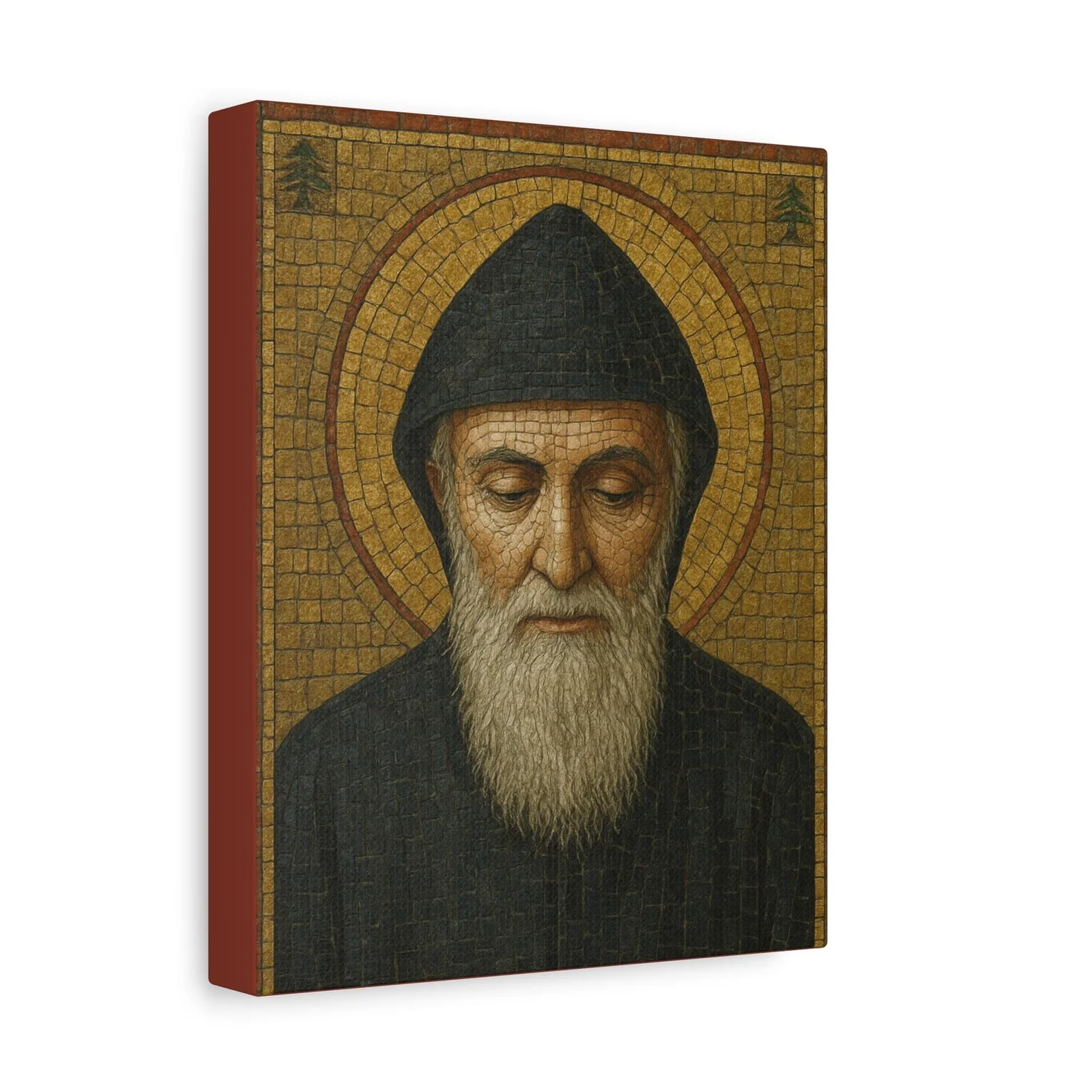
His iconography traditionally portrays him in black monastic habit, holding a cross and skull (memento mori), often with rays of light around the hermitage — a perfect visual summary of his theology: death to self, radiance of God.
His universal feast is July 24; the Maronite Church celebrates it on the third Sunday of July. Millions visit Annaya annually. Shrines and relics tour every continent. Devotion unites Eastern and Western Catholics, Orthodox Christians, and people of all faiths seeking healing of body and soul. In the first months of 2026, the miracle register at Annaya continues to grow — with two prominent new cases already authenticated and hundreds more under formal investigation.
Complete Timeline of His Life
O God, who called Saint Charbel to the monastic life and filled him with the spirit of prayer and penance, grant through his intercession that we too may live in perfect obedience, profound silence, and total love of the Eucharist.
Through his powerful intercession, heal us in body and soul, and draw us ever closer to Your Son, Jesus Christ. Amen.
Saint Charbel Makhlouf, hermit of Lebanon and miracle-worker of the modern age — pray for us!
Frequently Asked Questions
The Hermit Whose Silence Still Speaks
Saint Charbel Makhlouf sought nothing but God — no recognition, no followers, no legacy. He asked only to be left alone to pray, to fast, and to offer the Divine Liturgy in a tiny hermitage on a Lebanese mountain. In response, God gave him the largest miraculous legacy of any modern saint: a body that shone with light for decades, a stream of healing that has not stopped in over a century, and a name known on every continent.
The lesson is not difficult to read. Begin nothing on earth unless its end is in heaven. Pray as you live. Live as you pray. Let God do the rest.
Shop Saint Charbel Devotional Items →As an Amazon Associate, The Eastern Church earns from qualifying purchases.