Saint Joan of Arc: The Illiterate Peasant Girl Who Crowned a King, Was Burned as a Heretic, and Was Vindicated by the Church That Killed Her
Saint Joan of Arc: The Illiterate Peasant Girl Who Crowned a King, Was Burned as a Heretic, and Was Vindicated by the Church That Killed Her
She could not read or write, had never held a sword, and was nineteen years old when three saints' voices sent her to save a collapsing kingdom. She lifted a siege, crowned a king, and was burned at the stake by the same Church that would later name her a saint.
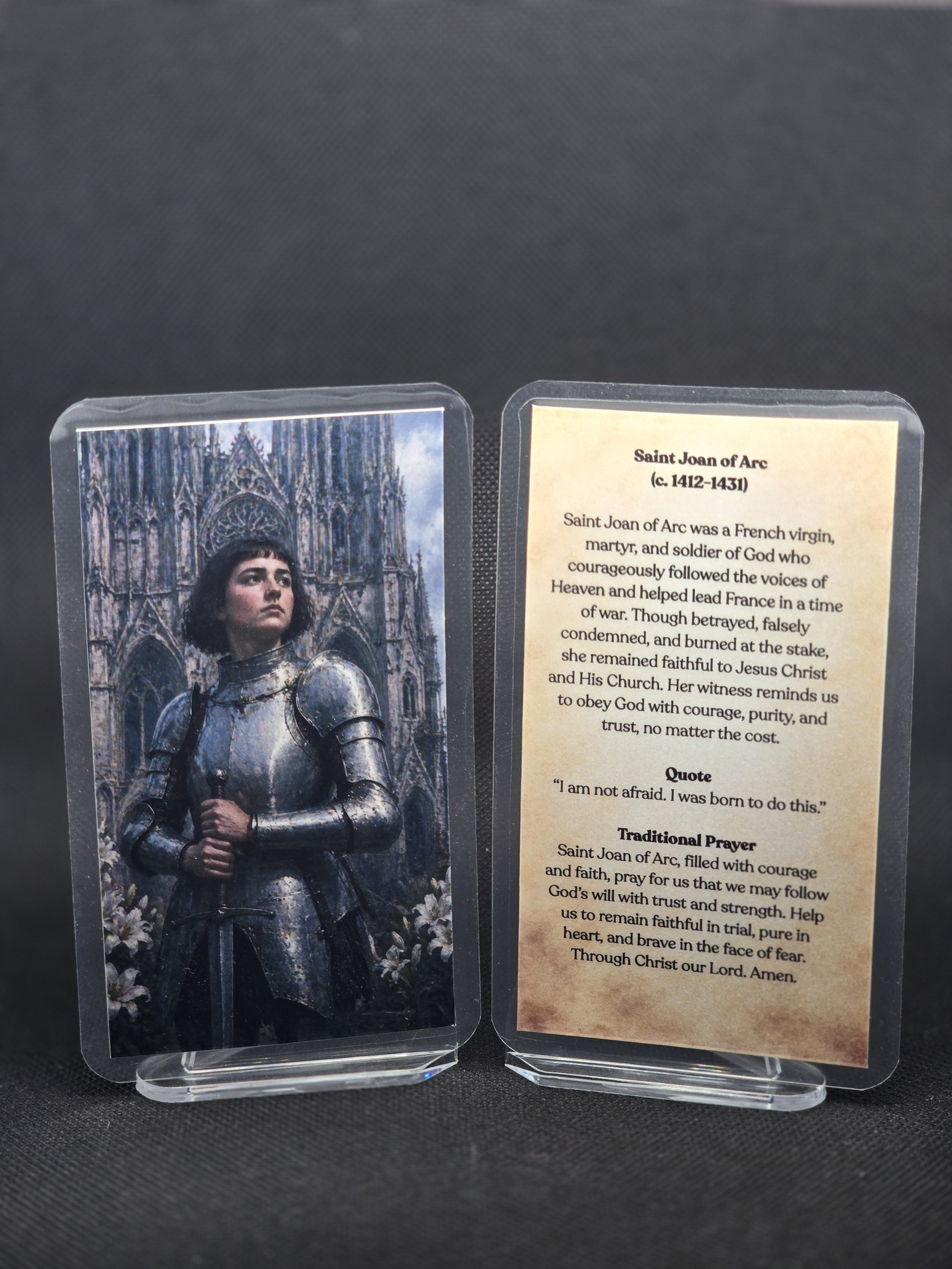
Saint Joan of Arc at a Glance
- Born
- c. January 6, 1412, Domremy, Duchy of Bar, France
- Died
- May 30, 1431 (age 19), burned at the stake at Rouen, Normandy
- Venerated In
- The Roman Catholic Church and the Anglican Communion
- Beatified
- April 18, 1909, by Pope Pius X
- Canonized
- May 16, 1920, by Pope Benedict XV
- Feast Day
- May 30
- Title
- Virgin; the Maid of Orleans; secondary Patroness of France (declared 1922)
- Guided By
- Voices she identified as Saint Michael the Archangel, Saint Catherine of Alexandria, and Saint Margaret of Antioch
- Known For
- Lifting the Siege of Orleans (1429) and securing the coronation of Charles VII at Reims
- Relics
- None survive; her ashes were cast into the Seine River
- I. A Peasant Childhood at Domremy
- II. The Voices Begin, Age Thirteen
- III. Vaucouleurs: Two Attempts to Be Taken Seriously
- IV. Chinon: Recognizing a Disguised King
- V. Examined by the Theologians of Poitiers
- VI. The Buried Sword and the Standard
- VII. The Siege of Orleans Lifted
- VIII. Patay, Troyes, and the Coronation at Reims
- IX. The Failed Assault on Paris
- X. Captured at Compiegne
- XI. The Trial at Rouen
- XII. Execution, May 30, 1431
- XIII. No Confirmed Relics, and a Forgery Exposed in 2007
- XIV. The Rehabilitation Trial, 1456
- XV. Beatification and Canonization
- XVI. Her Voices and Companions: Connections to Other Saints
- XVII. On Her Letters, Dictated by an Illiterate Peasant Girl
- XVIII. Shrines and Churches, With Links
- XIX. Legacy: The Maid Who Would Not Recant
- Prayer for the Intercession of Saint Joan of Arc
- Frequently Asked Questions
A Peasant Childhood at Domremy
Joan was born around January 6, 1412, in Domremy, a small village on the border of the Duchy of Bar, in a region caught between the French crown loyal to the Armagnac party and the Burgundian territories allied with England. Her father, Jacques d'Arc, was a modest peasant farmer, poor but not destitute; Joan was the youngest of five children. She never learned to read or write, but was skilled in sewing and spinning. The popular image of her spending a solitary childhood herding sheep alone in the pastures is not supported by the testimony gathered at her later rehabilitation trial.
Witnesses who knew her as a child described a girl of unusual and grave piety, often found kneeling in church absorbed in prayer, and tender toward the poor. At her later trial, her accusers tried hard to connect her to supposed superstitious rituals performed around a local landmark known as the Fairy Tree, l'Arbre des Dames. Joan's own honest answers undercut the accusation: she admitted she had sung and danced there with the other village children and had woven wreaths for a statue of Our Lady, but explained that she had held herself apart from such childhood diversions from around the age of twelve onward.
Part II
The Voices Begin, Age Thirteen
In the summer of 1425, at thirteen and a half years old, Joan first became aware of what she would later call her voices or her counsel. At first it was simply a voice speaking close beside her, accompanied by a blaze of light; over time she came to discern the appearance of those speaking to her and identified them individually as Saint Michael the Archangel, accompanied by other angels, Saint Catherine of Alexandria, and Saint Margaret of Antioch. Joan was consistently reluctant to describe her voices in detail, telling neither her confessor nor, later, her judges much about their appearance, though under direct questioning at her trial she stated plainly, "I saw them with these very eyes, as well as I see you."
The call the voices communicated to her did not arrive all at once but grew clearer gradually. By May 1428, Joan no longer doubted that she was being sent to help the king, and the voices grew insistent, even threatening, as she resisted them, protesting, "I am a poor girl; I do not know how to ride or fight." The voices answered simply: "It is God who commands it."
Part III
Vaucouleurs: Two Attempts to Be Taken Seriously
Joan first traveled to Vaucouleurs, the nearest garrison town still loyal to the French crown, in May 1428, to ask its captain, Robert de Baudricourt, for permission and escort to reach the dauphin, Charles VII. Baudricourt, a rough and skeptical soldier, dismissed her outright, telling the cousin who had accompanied her to take the sixteen-year-old home and give her a good whipping. Joan returned to Domremy.
By January 1429, with Orleans under siege and the royal cause growing desperate, Joan's voices had become urgent again, and she made her way back to Vaucouleurs a second time. Baudricourt remained doubtful, but her quiet persistence over the following weeks gradually wore down his resistance. On February 17, Joan announced, before any confirmation had reached the town, that a significant French defeat had just occurred outside Orleans, an event that became known as the Battle of the Herrings. When the report was officially confirmed days later, her credibility, and her cause, gained real ground for the first time.
Part IV
Chinon: Recognizing a Disguised King
Baudricourt finally permitted Joan to travel to the dauphin's court at Chinon, and she arrived, dressed in male clothing at her own request, with a slender escort of three men-at-arms, on March 6, 1429. Two days later she was granted an audience. Charles, testing her, had disguised himself and mingled anonymously among his attendants; Joan walked directly to him without hesitation and saluted him as king. A strong faction at court, led by the royal favorite La Tremoille, dismissed her immediately as a deluded visionary, but a private sign Joan communicated to Charles, the exact content of which she never revealed publicly, persuaded the king, somewhat cautiously, to believe in her mission. Most historians now believe this "secret of the king" concerned a private doubt Charles harbored about the legitimacy of his own birth, a doubt Joan's message was understood to resolve.
Part V
Examined by the Theologians of Poitiers
Before Joan could be entrusted with any military role, Charles's advisors sent her to Poitiers to be formally examined by a substantial committee of bishops and learned doctors of theology. The minutes of this searching, formal examination have since been lost, to the great regret of historians and, indeed, of Joan herself, who repeatedly appealed to its findings during her own later trial. What survives is the outcome: the theologians found nothing heretical in her claims to supernatural guidance and, without formally pronouncing on the reality of her mission, concluded she could safely be employed and tested further in the field.
Part VI
The Buried Sword and the Standard
Returning to Chinon to prepare for the campaign, Joan declined the sword the king offered her and instead asked that a search be made for an ancient sword she said was buried behind the altar of the chapel of Sainte-Catherine-de-Fierbois. It was found in precisely the spot her voices had indicated. A standard was made for her at the same time, bearing the words Jesus, Maria alongside an image of God the Father and kneeling angels presenting a fleur-de-lis, the symbol of the French crown.
Part VII
The Siege of Orleans Lifted
Before beginning her campaign, Joan formally summoned the King of England to withdraw his troops from French soil, a demand that reportedly enraged the English commanders. She entered the besieged city of Orleans on April 30, 1429, and her presence produced an almost immediate change in momentum. By May 8, every English fort encircling the city had been captured and the siege lifted entirely, though on May 7, in the fighting for one of the key forts, Joan was struck in the chest by an arrow. She continued directing the assault despite the wound.
Part VIII
Patay, Troyes, and the Coronation at Reims
At Joan's urging, a short campaign along the Loire followed the relief of Orleans, culminating on June 18, 1429, in a decisive French victory at Patay, where English reinforcements under Sir John Fastolf, sent from Paris, were routed. With the road to Reims now largely open, Joan had to press hard to persuade the army's commanders not to bypass Troyes, which initially closed its gates against them; the town was taken, and the army moved on, still reluctantly, toward Reims.
On Sunday, July 17, 1429, Charles VII was solemnly crowned King of France in Reims Cathedral, with Joan standing beside him holding her standard, which, as she explained afterward, had earned the right to share in the victory since it had shared in the toil. The central purpose of her mission, entrusted to her by the voices years earlier, had been accomplished.
Part IX
The Failed Assault on Paris
An attempt on Paris at the end of August 1429 stalled badly. Saint-Denis was occupied without resistance, but the assault launched on the city itself on September 8 received only half-hearted support from the army's commanders. Joan, heroically urging her men forward while helping fill the defensive moat, was shot through the thigh by a crossbow bolt; the Duc d'Alencon had her removed almost by force, and the attack was abandoned. Not long afterward, as Charles's political advisors negotiated a truce with the Duke of Burgundy, Joan, her military momentum broken, sadly laid her weapons upon the altar of the Basilica of Saint-Denis. On December 29, 1429, in what may have been intended partly as consolation, Charles ennobled Joan and her entire family, who thereafter bore the surname Du Lis in honor of the lilies added to their coat of arms.
Part X
Captured at Compiegne
Joan's voices had already warned her, at Melun in April 1430, that she would be taken prisoner before Midsummer Day, a prophecy fulfilled with unhappy speed. She had thrown herself into Compiegne on May 23 to help defend the town against a Burgundian attack, and that evening led a sortie that encountered a far superior enemy force. As her troops fell back under pressure, the drawbridge into the town was raised, by mistake or panic on the part of the garrison's commander Guillaume de Flavy, while many of the sortie party, Joan among them, remained outside the walls. She was pulled from her horse and taken prisoner by a follower of John of Luxembourg.
King Charles and his court made no meaningful effort to secure her release, either militarily or by prisoner exchange, despite holding English captives of high enough rank to have made such an exchange possible. John of Luxembourg instead sold Joan to the English for a substantial sum, equivalent to several hundred thousand dollars in modern terms. The English, driven partly by superstitious dread of their famous prisoner and partly by shame at that same dread, were determined to see her put to death, a goal they could not achieve simply for having defeated them militarily, but could pursue by having her condemned as a witch and a heretic instead.
Part XI
The Trial at Rouen
The English found a ready instrument in Pierre Cauchon, Bishop of Beauvais, an ambitious cleric closely tied to the Burgundian faction. Since Compiegne, where Joan had been captured, technically fell within his diocese, Cauchon claimed jurisdiction, though the trial itself was held at Rouen because Beauvais remained in French hands. Joan was denied an advocate and, though tried before an ecclesiastical court, was illegally confined throughout in the secular Castle of Rouen, guarded by English soldiers rather than held in an ecclesiastical prison with female attendants as she repeatedly requested, a circumstance that made her persistent refusal to abandon male clothing, worn largely to protect her modesty under such conditions, a central and manufactured point against her.
Preliminary sessions began in January 1431, and Joan first appeared before her judges on February 21. Throughout weeks of intense questioning, the surviving trial record shows her answers as consistently marked by simplicity, piety, and sound common sense, even as her judges pressed hard to trap her into damaging admissions about her visions. On March 1, she stated boldly that within seven years the English would forfeit a prize greater than Orleans, a statement historians have connected to the loss of Paris to the French in November 1437, six years and eight months later.
On May 24, 1431, worn down by months of confinement and public pressure at a formal ceremony held in the cemetery of Saint-Ouen, Joan signed some form of retraction, though the precise wording she actually agreed to remains disputed; witnesses at her later rehabilitation trial testified the document read aloud to her was only a few lines long, far shorter than the extensive, humiliating retraction later inserted into the official trial record. Even so, Joan reportedly qualified her submission, stating she retracted only insofar as it was God's will. This retraction spared her from immediate execution. Within days, however, she resumed wearing male clothing, an act her judges declared proof of relapse into heresy, and which some accounts suggest was engineered by jailers who left the clothing deliberately within her reach. On May 29, a court of thirty-seven judges unanimously declared her a relapsed heretic, to be handed over to secular authority for execution.
Part XII
Execution, May 30, 1431
Joan was permitted to make her confession and receive Communion before her execution. She was burned at the stake in the marketplace of Rouen on May 30, 1431, at approximately nineteen years old. Witnesses, including some of her bitter enemies, described her demeanor at the stake as moving many present to tears. She asked for a cross, embraced it, and it was held before her while she continuously called on the name of Jesus. Jean Manchon, the trial's official recorder, later testified, "Until the last, she declared that her voices came from God and had not deceived her." After her death, her remains were burned a further two times to ensure nothing survived, and her ashes were then gathered and cast into the Seine River, specifically to prevent any possibility of her remains being venerated as relics.
Part XIII
No Confirmed Relics, and a Forgery Exposed in 2007
This is one of the clearest cases in the entire Christian calendar of a saint with genuinely no surviving relics, and the record deserves to be stated plainly rather than softened. Joan's remains were deliberately cast into the Seine after her execution specifically to prevent veneration, and no bodily relics of her are documented as having survived that act.
In 1867, a jar was discovered in the attic of a Paris pharmacy, labeled "remains found under the stake of Joan of Arc, Virgin of Orleans," containing a charred human rib, a cat femur, fragments of burned wood, and a scrap of linen. The jar was eventually entrusted to a museum in Chinon, under the oversight of the Archdiocese of Tours, and in 1909, the year of Joan's beatification, scientists of the time judged it highly probable that the remains were genuinely hers. In 2007, a team of twenty forensic scientists, led by Dr. Philippe Charlier, subjected the jar's contents to modern forensic analysis, including carbon dating, DNA testing, and chemical and microscopic examination. The results were unambiguous: the human rib and cat bone dated to somewhere between the sixth and third centuries BC, more than a thousand years before Joan's birth, and were consistent with mummia, ground Egyptian mummy remains once sold across Europe for supposed medicinal use. The relics were confirmed as an elaborate forgery, most likely assembled in the nineteenth century, possibly to bolster the momentum of Joan's beatification cause.
Readers researching Joan of Arc relics should know clearly, and without ambiguity, that no authentic bodily relics of Saint Joan of Arc are known to exist anywhere. The Chinon jar, once treated as a probable relic, was conclusively identified by peer-reviewed forensic science in 2007 as containing Egyptian mummy remains and animal bone, not Joan's own body. This article states this plainly rather than perpetuating a claim the science itself has already settled.

Part XIV
The Rehabilitation Trial, 1456
Twenty-four years after her execution, a formal revision of Joan's trial, the proces de rehabilitation, opened in Paris with the consent of the Holy See. Popular sentiment had shifted dramatically by this point, and nearly every witness called was eager to testify to the Maid's virtue and the genuineness of her mission. An appellate court, constituted by papal authority and acting after lengthy inquiry, formally reversed and annulled the original 1431 sentence on July 7, 1456, finding that the original trial had been conducted illegally and in defiance of Joan's own appeal to the pope, which her original judges had simply ignored. The reversal implicitly acknowledged serious fault on the part of both the French crown and elements of the Church itself, since so grave an injustice had gone unaddressed for a full generation.
Part XV
Beatification and Canonization
Despite her rehabilitation in 1456, formal recognition of Joan's sanctity did not begin in earnest until Monsignor Dupanloup, Bishop of Orleans, petitioned the Holy See in 1869 to open her cause for beatification. The cause proceeded through its required stages, including the confirmation of the necessary miracles, and Pope Pius X issued the decree of beatification on April 11, 1909, with the formal beatification ceremony following on April 18, 1909. Eleven years later, on May 16, 1920, Pope Benedict XV canonized her a saint of the Catholic Church. In 1922, Pope Pius XI proclaimed her a secondary patroness of France.
Part XVI
Her Voices and Companions: Connections to Other Saints
Three specific saints are woven directly into Joan's own testimony as the voices that shaped and guided her entire mission:
Saint Michael the Archangel
The first and most frequent of her three voices, described as arriving accompanied by other angels, and the one Joan credited with first announcing her mission to save France.
Saint Catherine of Alexandria
One of the two female voices Joan named alongside Saint Margaret, drawn from the popular devotion to virgin-martyr saints widespread in fifteenth-century French piety.
Saint Margaret of Antioch
The third of Joan's named voices, another virgin-martyr whose cult was especially strong in the region of Lorraine where Joan grew up.
Beyond her voices, Joan's earthly life connected her directly to King Charles VII, whom she personally escorted to coronation at Reims, and to the Duc d'Alencon, who fought alongside her and later testified passionately on her behalf at the rehabilitation trial. Her chief adversary, Bishop Pierre Cauchon, remains one of the most infamous ecclesiastical figures in French history precisely because of his role in her unjust condemnation, a judgment the Church itself later reversed.
Part XVII
On Her Letters, Dictated by an Illiterate Peasant Girl
Joan of Arc never learned to read or write in the conventional sense, a fact repeatedly confirmed by witnesses at both her original and rehabilitation trials. She nonetheless dictated a number of letters over the course of her brief public career, most famously a formal summons sent to the King of England and his commanders before the relief of Orleans, demanding their withdrawal from French soil in uncompromising terms. Later in her captivity she did learn to form a simple signature of her own name, which appears on several surviving documents from her final months, though the extensive, damaging retraction inserted into the official trial record was, by the testimony of witnesses who were present, considerably longer and more elaborate than whatever brief statement she actually signed.
Part XVIII
Shrines and Churches, With Links
Two sites in France stand at the two ends of Joan's story, her birth and her death, and both remain active pilgrimage and memorial destinations today:
Basilique du Bois-Chenu, Domremy-la-Pucelle, France
The national basilica built between 1881 and 1934 on the wooded hillside above Joan's home village, at the very spot tradition holds she first heard her voices, and consecrated to her memory following her beatification. maisonjeannedarc.vosges.fr
Church of Saint Joan of Arc, Rouen, France
A striking modern church, consecrated in 1979, built directly on the Place du Vieux-Marche where Joan was executed, serving both as a place of Catholic worship and as France's civil memorial to her. rouen.fr/eglise-sainte-jeanne-darc
Part XIX
Legacy: The Maid Who Would Not Recant
Few saints anywhere in the Christian calendar carry a story as sharply double-edged as Joan of Arc's: she was tried, condemned, and executed as a heretic by an ecclesiastical court, and was later exonerated, beatified, and canonized by that very same institution, a full circle that took nearly five hundred years to close. Her courage rested on almost nothing the world of her time considered legitimate authority: she was young, female, illiterate, and a peasant, claiming direct communication with heaven in an age deeply suspicious of exactly that claim in exactly that kind of person. And yet a formal Church examination at Poitiers found nothing heretical in her, a king was crowned on her word, and an English-occupied France was, within years of her death, decisively pushed back.
What remains most striking, even now, is the plain consistency of her own account under the worst possible pressure: threatened, imprisoned, interrogated for months by trained theologians determined to trap her, she never significantly altered what she said her voices had told her, and by the testimony of the men who watched her die, she held to that account with her very last words.
Holy Trinity, Father, Son, and Holy Spirit, to You be glory, honor, and blessing, for having given to Your holy Church Saint Joan of Arc, virgin and martyr, as a model of courage under unjust accusation and unwavering fidelity to Your voice.
We ask You humbly: just as You gave her the strength to hold fast to the truth before hostile judges and to lead a broken kingdom back to hope, be pleased to grant us, through her intercession, courage to stand firm under pressure, clarity to discern Your will, and the grace we now ask with confidence.
Through Christ our Lord. Amen.
An original English-language devotional prayer composed for use with the Saint Joan of Arc prayer card, drawing on the traditional themes of her veneration in the Catholic Church.
More From Our Store, In Honor of Saint Joan of Arc



FAQ
Frequently Asked Questions About Saint Joan of Arc
She Never Held a Sword Before God Told Her To, and She Never Once Took Back Her Word.
Saint Joan of Arc was nineteen years old, illiterate, and a peasant when a Church court in Rouen declared her voices false and diabolical and handed her over to be burned. She was nineteen years old, illiterate, and a peasant when, three days before, in that same trial, she had told her judges, calmly and without hedging, that within seven years the English would forfeit something greater than Orleans, and she was proven right almost to the month. Twenty-five years later a different Church court, acting on the pope's own authority, reversed the sentence entirely. Five centuries after that, forensic scientists in white coats confirmed that the bones once venerated as her relics belonged to an Egyptian mummy, and the Church accepted the finding without protest, because by then the truth had never really been in question.
Ask her intercession. Say her prayer. Remember a peasant girl who crowned a king, was burned by the institution she died defending, and outlasted every single person who condemned her.
Get the Saint Joan of Arc Prayer Card →