Saint Augustine of Hippo: The Complete Life of the Restless Heart That Became a Doctor of the Church
Saint Augustine of Hippo: The Complete Life of the Restless Heart That Became a Doctor of the Church
Every documented detail of his birth, his mother's seventeen years of prayer, his years with the Manichees and his concubine, his conversion in a Milan garden, his episcopacy at Hippo, his writing of the Confessions and City of God, his death during the Vandal siege, and the extraordinary sixteen-century journey of his relics to Pavia.
At a Glance
- Born
- November 13, 354, Thagaste, Numidia (modern Souk Ahras, Algeria)
- Died
- August 28, 430, Hippo Regius, during the Vandal siege
- Parents
- Patricius (pagan, later baptized) and Saint Monica (devout Christian)
- Conversion
- 386, Milan, the "tolle lege" garden experience
- Baptized
- Easter, April 24 to 25, 387, by Bishop Ambrose of Milan
- Bishop of Hippo
- 395 or 396 until his death in 430
- Major Works
- Confessions, The City of God, On the Trinity, On Christian Doctrine
- Declared Doctor
- 1298, by Pope Boniface VIII
- Feast Day
- August 28
- Relics
- Basilica of San Pietro in Ciel d'Oro, Pavia, Italy
- Part I — Birth and Childhood in Thagaste
- Part II — Carthage, the Concubine, and Nine Years with the Manichees
- Part III — Rome, Milan, and the Preaching of Ambrose
- Part IV — The Garden in Milan: The Tolle Lege Conversion
- Part V — Baptism, Ostia, and the Death of Monica
- Part VI — Return to Africa, the Priesthood, and Becoming Bishop of Hippo
- Part VII — The Confessions and The City of God
- Part VIII — The Donatist and Pelagian Controversies
- Part IX — The Wider Body of Work
- Part X — The Vandal Siege and the Death of Augustine
- Part XI — The Extraordinary Journey of His Relics to Pavia
- Part XII — Doctor of the Church and Enduring Influence
- Part XIII — Feast Day, Patronage, and Devotion Today
- Frequently Asked Questions
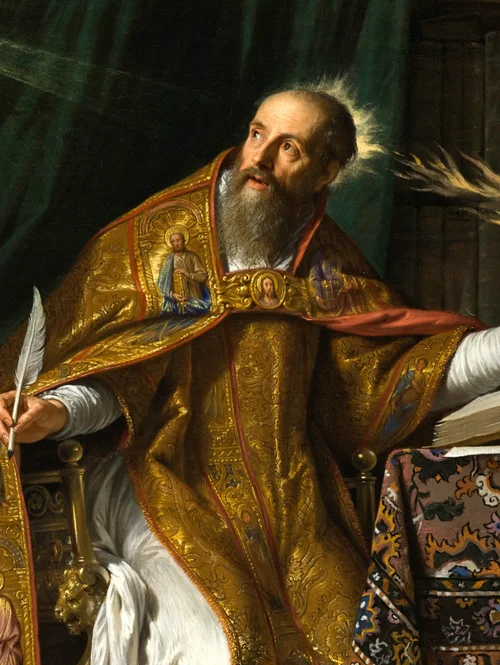
Birth and Childhood in Thagaste
Aurelius Augustinus, remembered by history as Saint Augustine of Hippo, was born on November 13, 354, in Thagaste, a modest provincial town in Roman Numidia, in what is today Souk Ahras, Algeria. His family were citizens of respectable but limited means. His father, Patricius, was a decurio, a minor Roman municipal official responsible for local administration and for covering any shortfall in the region's tax collection out of his own resources, a position that placed a chronic strain on the family's finances. Patricius was, by every account, a pagan and a hot-tempered man for most of his life, only converting to Christianity and receiving baptism shortly before his death, under the patient influence of his wife.
That wife was Monica, later venerated in her own right as Saint Monica, a woman of fervent and, by her son's own later account, remarkably persistent Christian faith. Some historians, drawing on the form of her name, suggest she may have been of Berber origin, though the family's status as honestiores, an upper tier of Roman provincial citizenship, meant Augustine's own first language and cultural formation were thoroughly Latin. Monica bore at least two other children besides Augustine: a son, Navigius, and a daughter, Perpetua, who later became abbess of a religious community for women that Augustine himself would go on to found.
Augustine's early education began in Thagaste and continued at age eleven at the nearby town of Madaurus, where he was immersed in Latin literature alongside a thorough exposure to pagan religious belief and practice. He was, by his own retrospective account in the Confessions, a gifted but undisciplined student, more inclined to games and mischief than to the Greek grammar he was set to learn, a subject he confessed he detested. The single incident from this period of his life that he chose to record at greatest length, and which has become the most famous anecdote of his childhood, was a seemingly trivial act of theft: as a teenager, Augustine and a group of friends stole pears from a neighbor's orchard, not out of hunger, since the pears were reportedly thrown to pigs rather than eaten, but for the thrill of the transgression itself. Augustine returned to this episode in the Confessions as a case study in the strange, self-devouring nature of sin committed for its own sake, without any object of desire beyond the act of wrongdoing.
Recognizing his son's intellectual gifts, Patricius scraped together the funds for a further, more advanced education, hoping to secure Augustine a prosperous career in the imperial bureaucracy through the study of rhetoric. A lack of money forced a delay, and Augustine spent a year at home in Thagaste before funds could be gathered to send him onward to Carthage, the great metropolitan center of Roman Africa, for his higher studies.
Part II
Carthage, the Concubine, and Nine Years with the Manichees
At around age seventeen, Augustine arrived in Carthage to study rhetoric, and found himself, in his own words, surrounded on every side by a cauldron of illicit loves. He threw himself into the pleasures of the city with an intensity that matched his intellectual ambition: he attended the coarse, sexually charged theater of the day, ran with a group of rowdy students who took pride in calling themselves the Eversores, or the Wreckers, and entered into a long-term relationship with a woman of lower social standing whose name Augustine, writing decades later as a bishop, chose never to record. Roman social convention of the period permitted marrying into a higher class but strongly discouraged marrying down, and this disparity in status appears to have been part of why the relationship, though evidently loving and monogamous on both sides for its duration, was never formalized as a marriage.
Around 372, this woman bore Augustine a son, whom he named Adeodatus, Latin for "gift of God." Despite the informality of the union in the eyes of Roman law, Augustine's relationship with Adeodatus's mother lasted approximately fifteen years, and his later writings reflect real tenderness for both her and their son, alongside considerable guilt over the disordered nature of the relationship itself and his failure to marry her.
It was also during his student days in Carthage that Augustine encountered the religious movement that would claim his intellectual allegiance for close to a decade: Manichaeism, a dualistic faith founded by the Persian prophet Mani, which taught a cosmic struggle between forces of light and darkness and offered an appealing answer to Augustine's search for the origin of evil, one that did not require attributing evil to human free will or personal responsibility. He was drawn in part by the sect's flexible tiered structure of membership, which permitted its rank-and-file "hearers," a category Augustine occupied, to avoid the strict asceticism required of the movement's elect. He remained formally attached to Manichaeism for roughly nine years, all the while continuing his studies and eventually beginning a career teaching rhetoric, first back in Thagaste and then in Carthage itself.
Part III
Rome, Milan, and the Preaching of Ambrose
By his late twenties, Augustine had grown disillusioned with the Manichees, whose answers to his mounting philosophical and scientific objections proved increasingly unsatisfying, and disillusioned as well with the rowdy, undisciplined students of Carthage. In 383 he left North Africa for Rome, and shortly afterward secured a prestigious appointment as professor of rhetoric at the imperial court in Milan, then a de facto capital of the Western Roman Empire. It was here, in Milan, that the two decisive influences of his final years before conversion converged: the Neoplatonist philosophy of Plotinus and Porphyry, newly available to him in Latin translation, which gave him for the first time an intellectually satisfying account of evil as a privation or absence of good rather than a positive force in its own right; and the towering figure of Ambrose, Bishop of Milan.
Augustine sought out Ambrose initially as a fellow master of rhetoric, curious to evaluate the older man's celebrated oratorical skill rather than out of any spiritual motive. He would later write of his growing attachment to Ambrose: "I began to love him, of course, not at the first as a teacher of the truth, for I had entirely despaired of finding that in thy Church, but as a friendly man." Ambrose, for his part, received Augustine warmly, and Augustine described the bishop's welcome in terms that suggest he recognized, even before his conversion, that he had found something like a father in him: "That man of God received me as a father would, and welcomed my coming as a good bishop should." Following the death of Augustine's own father years earlier, Ambrose in a real sense adopted Augustine as a spiritual son, and it was through sustained exposure to Ambrose's allegorical preaching, which resolved many of the intellectual objections to Scripture that had originally pushed Augustine toward Manichaeism, that the last major barrier to his conversion began to give way.
It was also in Milan that Augustine's mother, Monica, rejoined him, having followed her son from Africa first to Rome and now to Milan specifically to continue laboring for his conversion, a project she had by this point pursued for the better part of two decades. Monica arranged what she considered a respectable marriage prospect for her son, to a young woman still below the legal age for marriage, and Augustine, seeking to improve his social and professional standing, agreed to the match. This meant dismissing the mother of Adeodatus, the woman with whom he had lived faithfully for fifteen years, a separation Augustine later described as one that tore his heart, since it was, in his own words, joined to hers, and left a wound that bled. In the interval before the planned marriage could take place, and unable to live without a woman despite his professed resolve, Augustine took another concubine, a decision he would later look back on with even sharper self-reproach than on the earlier, longer relationship.
Part IV
The Garden in Milan: The Tolle Lege Conversion
By the summer of 386, Augustine had arrived at a state of profound inner division. Intellectually, he was already convinced of the truth of Christianity; Ambrose's preaching and the Neoplatonists had cleared away his major philosophical objections. What remained was a will divided against itself, unable to surrender what he still desired, namely the pleasures of the flesh, in exchange for a good he already recognized as greater. He captured this paralysis in the Confessions with a line that has become, alongside "restless heart," the second most quoted sentence he ever wrote, an unsparingly honest self-portrait of a man who wanted holiness on his own timetable: "Lord, give me chastity and continence, but not yet."
The resolution came in a garden attached to the house he shared in Milan. Augustine describes himself in a state of intense agitation, weeping, half-mad with the conviction of his own inner conflict, having withdrawn from his companion Alypius to be alone with his anguish. It was then, he recounts, that he heard what sounded like the voice of a child from a neighboring house, repeating in a sing-song chant a phrase he did not recognize as belonging to any children's game he knew: "Tolle lege, tolle lege," take up and read, take up and read. Unable to think of any game that used such words, Augustine took the sound as a divine command. He returned to where Alypius sat, picked up a codex of Saint Paul's epistles that lay nearby, and opened it at random. His eyes fell on Romans 13:13 to 14: "Not in rioting and drunkenness, not in chambering and impurities, not in contention and envy; but put ye on the Lord Jesus Christ, and make no provision for the flesh in its concupiscences."
He read no further. "Instantly," he writes, "as the sentence ended, there was infused in my heart something like the light of full certainty, and all the gloom of doubt vanished away." He closed the book, marking the place with his finger, and told Alypius what had happened. Alypius, who had been reading over Augustine's shoulder, then applied a further verse from the same passage of Scripture to his own life, and the two men went in together to tell Monica the news she had prayed for across nearly two decades. This event, traditionally dated to August 386, is the single most famous conversion narrative in Western Christian literature, and the phrase tolle lege has entered the devotional vocabulary of the Church as shorthand for the moment grace breaks through a divided will.
Part V
Baptism, Ostia, and the Death of Monica
Following his conversion, Augustine resigned his professorship of rhetoric and withdrew with a small circle of family and friends, including Monica, Adeodatus, and Alypius, to a borrowed country villa at Cassiciacum outside Milan, where he spent the following months in prayer, study, and philosophical dialogue, producing several early written works including Against the Academics, Soliloquies, and On the Happy Life. He then returned to Milan to be formally enrolled among the candidates for baptism.
On the night of Easter, April 24 to 25, 387, Augustine was baptized by Ambrose in the cathedral of Milan, together with his son Adeodatus and his friend Alypius, to the immense and long-awaited joy of Monica, whose most fervent wish this had been for the better part of her adult life. Not long afterward, the family set out to return to Africa. They traveled to the port city of Ostia, near Rome, to await passage, and it was there, in a scene Augustine renders with extraordinary tenderness in Book Nine of the Confessions, that he and his mother shared what became known as the vision at Ostia: standing together at a window overlooking a garden, the two of them were caught up in a shared contemplation of eternal wisdom that momentarily transcended, in Augustine's telling, all bodily and temporal things.
Shortly after this experience, Monica fell ill at Ostia and died, at around the age of fifty-five. Augustine devotes some of the most moving pages of the entire Confessions to her final days and to his own grief, a grief he initially fought to suppress out of a sense that Christian faith should not weep for a mother who had died in the peace of the Church, before finally allowing himself, alone, to weep freely. Monica's dying words to her sons, as Augustine records them, asked only that they remember her at the altar of the Lord wherever they might be, expressing no concern for where her body might be buried, since, she told them, nothing is far from God.

Part VI
Return to Africa, the Priesthood, and Becoming Bishop of Hippo
After Monica's death, Augustine spent roughly a year in Rome before finally securing passage back to Africa. He settled again at Thagaste, giving away the greater part of his family's property to the poor and to the local church, and founded a small quasi-monastic lay community with a handful of like-minded friends, living for nearly three years in prayer, fasting, study, and the common ownership of goods, deliberately withdrawn from worldly ambition.
In 391, Augustine traveled to the coastal city of Hippo Regius, roughly sixty miles from Thagaste, intending only to visit and possibly establish a monastery there, explicitly avoiding towns that lacked a bishop for fear of exactly what happened next: the Christian congregation of Hippo, recognizing his reputation, seized him during a church service and pressed him, against his own strong preference, into ordination to the priesthood under the elderly bishop Valerius. Four years later, in 395, recognizing his own advancing age and Augustine's evident gifts, Valerius had Augustine consecrated coadjutor bishop, an unusual and somewhat canonically irregular arrangement designed to secure Augustine's succession, and upon Valerius's death shortly afterward, Augustine became the full Bishop of Hippo, a see he would govern for the following thirty-four or thirty-five years, until his death in 430.
As bishop, Augustine lived an intensely disciplined and communal life alongside his clergy, adopting a rule of shared property and common life for the clergy of his household that would later be claimed as a foundational text by the Augustinian religious orders of the medieval and modern Church. He preached constantly, chose the Scripture readings for his congregation's worship himself, and understood his role explicitly as an authoritative interpreter of the biblical text for the people entrusted to him. Nearly one hundred of his sermons survive complete, filled, in the words of one modern account, with both charity and a burning insistence on truth.
Part VII
The Confessions and The City of God
Around 397 to 398, roughly a decade into his episcopacy and about forty-three years old, Augustine wrote the Confessions, an extended prayer addressed directly to God recounting his own sinful youth, his intellectual wanderings, his mother's persistence, and his conversion, concluding with philosophical meditations on memory, time, and the opening chapters of Genesis. It is widely regarded as the first true autobiography in the Western literary tradition, remarkable not merely as a historical record but as a work of theological and psychological interiority that has no real precedent in ancient literature. Augustine stated his purpose plainly: he wrote, he said, for a people curious to know the lives of others but careless to amend their own, so that God's mercy, shown in the life of one sinner, might be made known, and so that no reader should ever be tempted to think better of him than he actually deserved.
Augustine's other towering achievement, The City of God, was composed over a much longer period, from roughly 413 to 426, prompted directly by the sack of Rome by the Visigothic king Alaric in 410, an event that shocked the Roman world and led many pagans to blame the abandonment of the old gods, and the rise of Christianity, for the empire's catastrophic humiliation. In response, Augustine constructed a sweeping theological vision of two overlapping cities, the earthly city, built on self-love carried to the point of contempt for God, and the City of God, built on the love of God carried to the point of contempt for self. Earthly empires, Augustine argued, rise and fall according to a logic entirely independent of any nation's fidelity to the true God; only the City of God, the pilgrim Church journeying through history toward its eternal home, could not ultimately be shaken by Rome's collapse. The City of God became, by a wide margin, the most extensively copied and read theological work of the entire medieval period.
Lord, You have made us for Yourself, and our hearts are restless until they rest in You.
Saint Augustine, who searched through every philosophy of your age and found rest in none of them until you surrendered fully to Christ, pray for every soul still searching, still divided, still saying in some corner of the heart, "not yet."
Obtain for us the grace your own mother begged seventeen years to see: not a sudden conquest of sin by our own strength, but a will finally, truly surrendered to the God who alone can heal it.
Traditionally prayed on August 28, the feast of Saint Augustine of Hippo.
Part VIII
The Donatist and Pelagian Controversies
Much of Augustine's episcopal energy was consumed defending Catholic doctrine against two major heresies of his era. The Donatists, a schismatic movement strong in North Africa, held that the sacraments administered by a priest who had lapsed under persecution, or who was otherwise morally compromised, were invalid. Augustine argued forcefully and, in the judgment of the wider Church, decisively against this position: the effectiveness of the sacraments derives from Christ and from God's own action, not from the personal holiness of the minister who administers them, a principle that remains foundational to Catholic sacramental theology to this day.
The second and, for Augustine's lasting theological legacy, more consequential controversy came from Pelagius, a British monk who taught that human beings, created without any inherited stain of original sin, retained the natural capacity to achieve moral perfection through the unaided exercise of free will, and indeed were obligated by God's command to do so. Augustine, drawing directly on his own experience of a will divided against itself and powerless to reform on its own strength, the very experience recorded at length in the Confessions, argued that Pelagius's position denied both the reality of original sin and the absolute necessity of divine grace for any good act whatsoever. Notably, Augustine's tone toward Pelagius personally remained charitable even as he opposed his teaching without compromise, writing at one point that Pelagius was, so far as he could tell, a holy man, well exercised in Christian virtue, even while working to have his doctrine formally condemned, which it was, at Carthage in 416 and in subsequent Church rulings. Augustine went on to write further works, including On the Predestination of the Saints and On the Gift of Perseverance, against a softened version of the same error known as semi-Pelagianism. More than any other single figure, Augustine is credited with securing the Church's enduring doctrine that human beings remain utterly dependent on God's grace for salvation, a legacy reflected in his traditional title, Doctor Gratiae, the Doctor of Grace.

Part IX
The Wider Body of Work
Beyond the Confessions and The City of God, Augustine left behind a catalogue of writing scarcely matched by any other figure of the ancient Church: by later count, some 113 separate books, 218 surviving letters, and, depending on the count used, between roughly 350 and 500 sermons. His other major theological works include On the Trinity, a lengthy exploration of Trinitarian doctrine and its analogies in the structure of the human mind, composed over two decades from 399 to 419; On Christian Doctrine, a foundational work of biblical hermeneutics and rhetoric written for the training of preachers; and the Retractations, an extraordinary late-life project in which the aging bishop, in his early seventies, reviewed his entire body of published work and corrected his own past errors of judgment with what one ancient biographer called candor and severity toward himself.
Augustine's doctrine of original sin and grace would go on to shape the Council of Carthage in 418, the Council of Orange in 529, the Council of Trent in the sixteenth century, and the Catechism of the Catholic Church in the present day. His framework of the two cities in The City of God shaped medieval political theology for a thousand years. He is also widely credited with laying the foundations of Western just war theory, articulating criteria under which the use of force could be morally justified. Centuries later, both Thomas Aquinas within the Catholic tradition and the Protestant Reformers Martin Luther and John Calvin would each claim Augustine as a decisive influence on their own theology of grace, even as they drew sharply different conclusions from his writing, a testament to the sheer density and reach of his thought.
Part X
The Vandal Siege and the Death of Augustine
In 429, the Vandal king Genseric, also rendered Gaiseric, led his people across from Spain into Roman Africa, beginning a devastating invasion that would, within a generation, extinguish Roman rule across the entire region. By 430, Vandal forces had advanced to besiege Hippo Regius itself, trapping Augustine, now in his mid-seventies, inside the city walls for what would become his final months. According to Possidius, Augustine's own disciple and first biographer, the elderly bishop spent his last days in a state of deliberate, deep penitence, ordering the seven Penitential Psalms copied out and posted on the walls of his sickroom so that he could read and pray them continually as he lay dying, seeking, to his final breath, the same mercy he had spent his entire converted life proclaiming to others. Possidius also records that a sick man was healed during the siege through Augustine's intercession, one of several miracles attributed to him in his final months.
Augustine died on August 28, 430, in the third month of the siege, at approximately seventy-five or seventy-six years of age, having governed the see of Hippo for roughly thirty-four to thirty-five years. Not long after his death, the Vandals lifted their siege of Hippo temporarily, only to return and, following a further defeat of Roman forces, take the now largely abandoned city and burn it. Remarkably, Augustine's cathedral and his personal library, containing the great bulk of his enormous written output, were spared from the destruction, preserving for the whole of subsequent Western civilization the writings that would shape Catholic, and eventually Protestant, theology for the next millennium and a half.
Part XI
The Extraordinary Journey of His Relics to Pavia
Augustine was initially buried in his own cathedral at Hippo, then known as the Basilica of Peace, or Saint Stephen's, into whose altar he had deposited a portion of the relics of the martyr Saint Stephen some years earlier. His tomb quickly became a site of local veneration. Decades later, as Vandal persecution of Catholic (as opposed to Arian) Christians in North Africa intensified under King Huneric, Catholic bishops driven into exile are recorded, by the tradition preserved in the writings of the Venerable Bede, as having carried Augustine's relics with them to the island of Sardinia for safekeeping, where they remained for roughly two centuries.
Around 720 to 723, as Muslim raiding in the western Mediterranean made Sardinia itself an increasingly precarious place to safeguard so precious a relic, Liutprand, the king of the Lombards, arranged, according to differing accounts, either the purchase or the outright acquisition of Augustine's remains, and had them transported in solemn procession to Pavia, then the capital of his Lombard kingdom in northern Italy. There they were enshrined in the church of San Pietro in Ciel d'Oro, Saint Peter in the Golden Sky, a church Liutprand had rebuilt specifically to receive them. Liutprand himself is buried in the same church today.
The precise location of the relics within the church was subsequently lost for centuries amid political upheaval, until they were rediscovered in the church's crypt in 1695. In 1327, Pope John XXII had formally appointed the Augustinian friars as permanent guardians of the tomb, and in 1362 the magnificent marble Arca di Sant'Agostino, an elaborately carved sarcophagus depicting scenes from Augustine's life, was commissioned, funded in part by the ruling Visconti family of Milan, and completed by 1365. Political and religious upheaval saw the Augustinian friars expelled from the church more than once over subsequent centuries, and the relics were briefly relocated to Pavia's cathedral, before the friars' return and the relics' restoration to San Pietro in Ciel d'Oro on October 7, 1900, an event commemorated in a poem written by Pope Leo XIII.
The story of Augustine's relics has, remarkably, remained a living thread of Church history into the present. In June 2026, Pope Leo XIV, born Robert Francis Prevost and himself a member of the Augustinian Order who had served for over a decade as its Prior General before his election to the papacy, traveled to Pavia specifically to pray at Augustine's tomb, describing the visit as a kind of homecoming and referring to himself as a son of Saint Augustine. The visit followed an earlier trip in the spring of 2026 to Annaba, Algeria, the modern city built on the site of ancient Hippo, where Pope Leo visited the ruins of the basilica where Augustine once preached, even though the saint's body itself has rested in Pavia for well over a thousand years.

Part XII
Doctor of the Church and Enduring Influence
Augustine was never canonized through the formal, centralized process the Church would later develop, since his veneration as a saint predates the modern canonization procedure and rests instead on the ancient practice of local and popular acclamation ratified over time by the universal Church. In 1298, Pope Boniface VIII formally recognized Augustine, alongside Ambrose, Jerome, and Pope Gregory the Great, as one of the four great Doctors of the Latin Church, a title designating those whose writing has been judged to possess both outstanding personal sanctity and a uniquely significant contribution to Christian doctrine. Among these four, and arguably among all the Doctors of the Church from any era, Augustine's influence on the subsequent development of Western theology has few rivals; one modern historian went so far as to state that apart from the biblical authors themselves, no other figure had a greater impact on Christian life and thought until at least the time of the Reformation, a movement whose principal figures, Luther and Calvin included, continued to wrestle directly with Augustine's legacy even as they broke from the Catholic Church that had canonized him.

Part XIII
Feast Day, Patronage, and Devotion Today
Augustine's feast is celebrated on August 28, the anniversary of his death, in the Roman Rite, and is likewise observed by the Eastern Orthodox Church and the Anglican Communion, a rare instance of a single feast day uniting veneration across the major branches of historic Christianity. He is traditionally invoked as the patron of theologians and of printers, reflecting the sheer scale of his written corpus, and, by long popular tradition rather than formal decree, as a patron of brewers, an association traceable to the recorded excesses of his pre-conversion youth. Pope Francis, addressing the crowds at a General Audience on Augustine's feast in 2016, called him a guide for our restless hearts, pointing us to Christ, a description that captures better than almost any other single phrase why Augustine's Confessions, written some sixteen centuries ago, continues to be read today by believers and skeptics alike as one of the most searingly honest accounts of the human search for God ever committed to paper.
FAQ
Frequently Asked Questions About Saint Augustine of Hippo
A Heart That Finally Found Its Rest
Augustine spent the first three decades of his life running from the very thing he most wanted, a peace that no philosophy, no relationship, and no ambition could give him. It took a mother's seventeen years of tears, a bishop's patient preaching, and a single overheard line of Scripture in a garden to bring him home. What followed was thirty-five years of relentless work defending the faith he had once mocked, and a written legacy that has shaped the Church for sixteen centuries since.
Carry his prayer card. Ask his intercession, not for an easy conversion, but for the same honest reckoning with your own restlessness that he offers to every reader of the Confessions, and for the grace to stop saying, as he once did, "but not yet."
Get the Saint Augustine of Hippo Prayer Card →