Saint Andries Wouters: The Complete Life of the Priest Who Called Himself a Fornicator and Died a Martyr
Saint Andries Wouters: The Complete Life of the Priest Who Called Himself a Fornicator and Died a Martyr
Every documented detail of his birth, his troubled priesthood, his arrest at Gorkum, his interrogation before Lumey, his execution at Brielle, and the four centuries of veneration that followed — the most complete account of Saint Andries Wouters available anywhere.
At a Glance
- Born
- 1542, Heinenoord (some sources give October 1, 1542), Hoeksche Waard, Holland
- Died
- Night of July 9, 1572, hanged in a turfshed near Brielle, Holland
- Status
- Secular (diocesan) priest, pastor of Heinenoord, Diocese of Haarlem
- Group
- Nineteenth and last-added of the Nineteen Martyrs of Gorkum
- Beatified
- November 14, 1675, by Pope Clement X
- Canonized
- June 29, 1867, by Pope Pius IX
- Feast Day
- July 9 (collectively with the Martyrs of Gorkum)
- Relics
- Church of Saint Nicholas, Brussels, Belgium
- Last Words
- “Fornicator I always was; heretic I never was.”
- Patronage
- Invoked (with the Gorkum Martyrs) against hernias; perseverance under pressure
- Part I — Birth and Early Life in Heinenoord
- Part II — A Troubled Priesthood
- Part III — The Dutch Revolt and the Rise of the Sea Beggars
- Part IV — The Fall of Gorkum and the First Arrests
- Part V — The Arrest of Andries Wouters
- Part VI — Imprisonment at Gorkum
- Part VII — The Journey to Brielle and the Disputation Before Lumey
- Part VIII — The Martyrdom of July 9, 1572
- Part IX — His Eighteen Companions, the Nineteen Martyrs of Gorkum
- Part X — Burial, Relics, and the Shrine in Brussels
- Part XI — Beatification, Canonization, and the Historical Record
- Part XII — Feast Day, Patronage, and Devotion Today
- Part XIII — Why Andries Wouters Matters: Sanctity Without Perfection
- Frequently Asked Questions
Birth and Early Life in Heinenoord
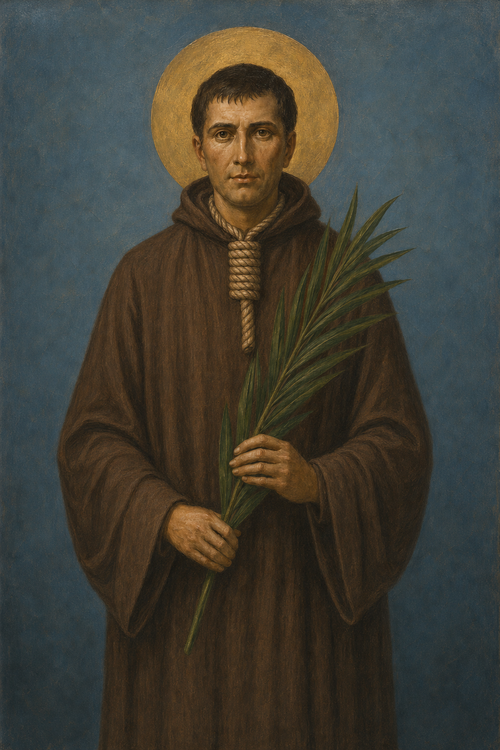
Andries Wouters, whose name appears in Latin martyrologies and older reference works as Andreas Wouters, and in English-language sources most often as Andrew Wouters, was born in the year 1542. One devotional source gives the specific date of October 1, 1542, though this level of precision does not appear in the earliest and most authoritative accounts, and should be treated as a later devotional addition rather than a documented fact. He was born in Heinenoord, a village in the Hoeksche Waard, a low-lying reclaimed polder region of islands in the province of South Holland, in what was then part of the Habsburg Netherlands under Spanish rule.
The Hoeksche Waard in the mid-sixteenth century was rural, agricultural, and thoroughly Catholic in its parish structure, falling under the ancient Diocese of Utrecht and, following the 1559 reorganization of the Dutch episcopal sees, the newly created Diocese of Haarlem. Almost nothing survives in the historical record about Wouters's parents, his family circumstances, or his childhood. This silence is typical of the Gorkum martyrs as a group: with the partial exception of a handful of the better-documented Franciscans, most of what is known about each man begins only when he enters the historical record as a cleric, and ends definitively in the summer of 1572. No surviving contemporary account describes Wouters's schooling, though his ordination to the secular (diocesan) priesthood implies some course of theological formation, most likely at a diocesan level rather than at a university, since none of the sources credit him with the kind of advanced Louvain education attributed to his fellow martyr and eventual spokesman, Leonard van Veghel.
What is certain is that Wouters was ordained a priest of the Diocese of Haarlem and was in due course appointed pastor, or parish priest, of his own home village and its surrounding area: Heinenoord, sometimes rendered in older sources as Heynoord or Heinot. This was not a grand or prestigious appointment. Heinenoord was a small rural parish in a marshy, agricultural corner of Holland, and Wouters's entire recorded ministry, prior to his arrest, took place within its bounds.
Part II
A Troubled Priesthood
No article claiming to be complete about Andries Wouters can pass over what every serious historical source about him records without exception: his priesthood, prior to his arrest in 1572, was marked by conduct that his own Church considered scandalous. This is not a modern reinterpretation or a softened hagiographical gloss. It is the plain description given by the Catholic Encyclopedia of 1909, which states that his conduct was not edifying up to the time of his arrest, and by nearly every subsequent Catholic reference source that has treated his case since.
The specific charges recorded against him are moral rather than doctrinal. Multiple independent sources describe him as a man who struggled publicly and repeatedly with chastity, who is reported to have fathered children outside of marriage, and who at points in his ministry is said to have kept women in a manner inconsistent with clerical celibacy. Some accounts add habitual drunkenness to the list of his failings. Several sources note that his conduct was serious enough that his bishop suspended him from the active exercise of his priestly faculties at some point prior to his arrest, though the precise dates and circumstances of any suspension are not preserved with the same clarity as the broader pattern of behavior.
It is worth being exact about what is not claimed. No source, ancient or modern, accuses Wouters of doctrinal error, of doubting the Catholic faith, or of any hesitation regarding the authority of the Pope or the doctrine of the Real Presence prior to his imprisonment. His failures were failures of the flesh and of clerical discipline, not failures of belief. This distinction mattered enormously to how his story was received by his contemporaries and by later generations: a priest who lived scandalously but died confessing the fullness of Catholic doctrine occupies a very particular and very human place in the communion of saints, one that later writers on his case have returned to again and again as the single most striking feature of who he was.
By the time Gorkum fell to Calvinist forces in the summer of 1572, Wouters appears to have had no active parish assignment, or at best a diminished one; several sources place him, in the weeks before his arrest, residing in or near the town of Gorkum itself rather than actively serving as pastor of Heinenoord. This detail is part of why he was swept up together with the clergy of Gorkum proper even though his own appointment had been to a different village.
Part III
The Dutch Revolt and the Rise of the Sea Beggars
To understand how a rural parish priest ended up hanged in a turfshed, it is necessary to understand the convulsion that had seized the Low Countries by 1572. The first half of the sixteenth century had seen Lutheranism and then, more decisively in the Netherlands, Calvinism spread rapidly through a region that had been solidly Catholic for centuries. The Habsburg rulers of the Netherlands, first Emperor Charles V and then his son King Philip II of Spain, responded with an increasingly harsh campaign of religious enforcement, backed by the machinery of the Inquisition, intended to root out the new confessions. That campaign generated not only religious backlash but a broader political resentment against Spanish rule that would fuse religious and nationalist grievance into a single revolutionary movement: the Dutch Revolt, which would eventually harden into the Eighty Years' War.
Within this revolt, a particular armed faction rose to prominence in 1572: the Watergeuzen, or Sea Beggars, sometimes rendered in French sources as the Gueux de mer. These were Calvinist privateers and rebel fighters who had been operating at sea against Spanish shipping, and who, in the spring of 1572, turned their attention to seizing coastal towns for the rebel cause. On April 1, 1572, the Sea Beggars captured the town of Brielle (also written Den Briel or Briel), followed shortly afterward by Vlissingen (Flushing) and a string of other towns across Holland and Zeeland. This wave of captures is generally reckoned by historians as the effective beginning of open, sustained revolt against Spanish authority in the northern Netherlands, and 1572 is remembered in Dutch national memory as the founding year of the future Dutch Republic.
The Sea Beggars were led at this stage by William de la Marck, Lord of Lumey, a nobleman whose hatred of the Catholic clergy was, by every account, personal as well as ideological, and who would go on to play the decisive role in ordering the deaths of Wouters and his companions. As the Sea Beggars expanded their control inland through June of 1572, the towns of Dordrecht and Gorkum fell into their hands. It was at Gorkum that the events leading directly to Wouters's martyrdom began.
Part IV
The Fall of Gorkum and the First Arrests
When Gorkum (Gorcum, modern Gorinchem) fell to the Watergeuzen in June 1572, the rebels moved immediately against the town's substantial Catholic clerical presence. Their first and largest target was the Franciscan friary of Gorkum, home to a community of Friars Minor under their guardian, Nicholas Pieck. Nine Franciscan priests were seized: Nicholas Pieck himself, the vicar Hieronymus (Jerome) of Weert, Theodorus van der Eem of Amersfoort, Nicasius Janssen of Heeze, Willehad of Denmark, Godefried of Mervel, Antonius of Weert, Antonius of Hoornaer, and Franciscus de Roye of Brussels. Alongside these nine priests, two Franciscan lay brothers from the same friary, Peter of Assche and Cornelius of Wijk bij Duurstede, were taken as well.
At almost the same time, the rebels arrested the secular parish clergy of Gorkum itself: Leonard van Veghel, a learned priest educated at Louvain who had served as pastor of Gorkum since 1566 and who would become the group's principal spokesman during their later interrogation, together with his assistant. Two further local clergy, Godfried van Duynsen, a priest native to Gorkum, and Jan van Oisterwijk, a Canon Regular who served as spiritual director to a community of Augustinian nuns in the town, were swept up in the same wave of arrests. This brought the initial number of prisoners to fifteen. All fifteen were held in the prison at Gorkum from June 26 to July 6, 1572, before being moved onward.
Part V
The Arrest of Andries Wouters
Andries Wouters was not among the first fifteen prisoners taken at Gorkum. He belonged instead to a second, smaller group of four additional clergy who were arrested somewhat later and added to the company of captives before the entire group was transferred onward together. His three companions in this second wave were Jan van Hoornaer, a Dominican friar and parish priest from the Cologne province who had rushed to Gorkum specifically to bring the sacraments to the imprisoned clergy once he learned of their arrest, and was seized himself for his trouble; Jacobus Lacops, a Norbertine (Premonstratensian) canon serving as curate in Monster, South Holland, who had by this point in his life turned away from an earlier period of laxity toward a renewed and serious practice of his vocation; and Adrian van Hilvarenbeek, another Premonstratensian, likewise a former parish priest of Monster, who was sent onward together with Lacops.
Wouters was the last of these four to be named, and the last name recorded on the list of nineteen in nearly every historical account: "lastly Andreas Wouters of Heynoord," as the Catholic Encyclopedia records it, with its immediate accompanying judgment that his conduct was not edifying up to the time of his arrest. The precise date of his individual arrest is not preserved with certainty in the sources reviewed for this article; what is certain is that he was gathered together with Hoornaer, Lacops, and Hilvarenbeek and brought into the company of the fifteen already held at Gorkum, bringing the total number of prisoners to the nineteen who would be martyred together at Brielle.

Part VI
Imprisonment at Gorkum
From June 26 to July 6, 1572, the assembled prisoners, Wouters now among them, were held at Gorkum. Multiple sources describe this period using the phrase much suffering and abuse, a deliberately restrained formula common to nineteenth-century hagiographical writing that likely understates conditions considerably: overcrowding, poor food, physical mistreatment by their captors, and the psychological pressure of repeated demands that they renounce their faith are all consistent with what is known of how Calvinist rebel forces treated captured Catholic clergy elsewhere during this same period of the revolt.
It was during this period of imprisonment at Gorkum, according to the fullest accounts, that the bonds between the nineteen men, drawn from wildly different backgrounds, ranging from Franciscan friars and a Dominican to Norbertine canons and ordinary secular parish priests, were forged into the shared communal witness for which they are remembered. Whatever divided them in religious observance, formation, or personal history, all nineteen faced the same demand and, over the following two weeks, gave the same answer.
Part VII
The Journey to Brielle and the Disputation Before Lumey
On July 6, 1572, the fifteen original prisoners were removed from Gorkum and transported toward Brielle, arriving there on July 8. Along the way, several sources record a particularly humiliating detail: the prisoners, reportedly stripped or half-naked, were exhibited for money to curious onlookers as they passed through Dordrecht, turned into a form of public spectacle for their captors' profit and the crowd's entertainment. The remaining four, including Wouters, arrived at Brielle to rejoin the group at roughly the same time, bringing the full company to nineteen.
Once assembled at Brielle, the prisoners were brought before William de la Marck, Lord of Lumey, commander of the Sea Beggars, who ordered a formal interrogation and what several sources describe as a kind of disputation, a staged theological confrontation in which the captured clergy were pressed, individually and collectively, to abandon two specific points of Catholic doctrine: belief in Transubstantiation, meaning the Real Presence of Christ's body and blood in the Blessed Sacrament, and belief in the supremacy of the Pope over the Church. Leonard van Veghel, the learned former pastor of Gorkum, appears to have served as the group's principal spokesman during this exchange, at one point declaring on behalf of the company, in a line still quoted in Catholic sources today, that they were ready to die for the Holy Catholic faith and for the authority of the successor of Saint Peter.
Every one of the nineteen, Wouters included, refused to recant. This is one of the most historically secure facts about the entire episode: it appears without variation across every source consulted, from the original nineteenth-century Catholic Encyclopedia account to modern academic and devotional treatments alike. Whatever moral failures had marked Wouters's priesthood before his arrest, his answer to Lumey's demand was identical to that of his more evidently virtuous companions: no.
It was at some point during this same window that a letter arrived from William the Silent, Prince of Orange, the political leader of the broader Dutch revolt, instructing all those in authority under his command to leave the captured priests and religious unmolested. The magistrates of Gorkum itself are recorded as having protested the arrests and the treatment of their former clergy. Lumey ignored both. He was, by every account, operating with an intensity of anti-Catholic animus that outpaced even the political goals of the wider revolt he nominally served, and he proceeded to order the executions regardless of instructions from his own nominal superior.
Part VIII
The Martyrdom of July 9, 1572
On the night of July 9, 1572, Lumey ordered all nineteen prisoners hanged. The execution took place not in the town of Brielle itself but at a deserted monastery nearby known as Ruggen, or in some renderings simply described as a turfshed, a rough outbuilding used for storing peat turves, which the sources describe interchangeably depending on translation and level of specificity. Several accounts add that the bodies of the martyrs were subjected to mutilation, whether before or immediately after death is not entirely clear from the surviving record, before being cast into a ditch near the site.
It is within this final scene, according to nearly every retelling of the episode, that Wouters's captors made a last attempt to break him, not by theological argument but by personal shame: they threw his own past, his years of publicly known moral failure, back in his face, apparently hoping that the humiliation of his sins would succeed where doctrinal pressure had failed. Wouters's reply has become the single most quoted line associated with the entire company of Gorkum martyrs, repeated in nearly every source consulted for this article, in slightly varying English translations but with identical substance:
The line is remarkable for what it does not do. Wouters does not deny his past. He does not minimize it, explain it away, or ask for a reputation he had not earned. He concedes the accusation entirely: yes, a fornicator, always. But he draws an absolute line at the one thing his captors were actually demanding of him in that moment, which was not a confession of general sinfulness but a formal renunciation of Catholic doctrine on the Eucharist and the papacy. That, he refused, unconditionally, to the point of death. Moments later, together with his eighteen companions, he was hanged.
A number of sources record that a shrub bearing nineteen white flowers is said to have sprung up at the site of the martyrdom shortly afterward, a legend that entered the devotional tradition surrounding the Gorkum martyrs early and has been repeated, generally with appropriate qualifying language such as "is said to have," in Catholic sources ever since. As with any reported prodigy of this kind, this account should be understood as part of the martyrs' devotional legend rather than as an independently verified historical event.
O God, who adorned with the laurel of immortality the glorious battle of Your blessed martyrs of Gorkum for the Faith, graciously grant that with them we may deserve to be crowned in heaven.
Holy Martyrs of Gorkum, faithful witnesses to the truth of the Catholic faith, pray for us. Strengthen our resolve to remain true to Christ and His Church, even when it is difficult or unpopular.
Saint Andries Wouters, who confessed your own sin without excuse and confessed the Real Presence of Christ without wavering in the same breath, pray for every soul who feels too broken to be forgiven and too weak to be faithful. Obtain for us the grace to hold fast to the truth even when we have not lived up to it.
Traditionally prayed on July 9, the shared feast of the Nineteen Martyrs of Gorkum.
His Eighteen Companions: The Nineteen Martyrs of Gorkum
Wouters is remembered, and was very likely canonized, as part of an indivisible company. Understanding who stood beside him at Brielle is essential to understanding his own story, since the group's shared refusal is the single most historically certain fact about all nineteen men. The following list draws on the Catholic Encyclopedia's account and cross-references other historical sources for names and identifying details.
Nicholas Pieck (born 1534), Guardian of the Franciscan friary of Gorkum, his native city, and a trained theologian. Hieronymus, called Jerome, of Weert (born 1522), vicar of the friary. Theodorus van der Eem of Amersfoort (born circa 1499 to 1502), chaplain to a nearby community of Franciscan Tertiary Sisters. Nicasius Janssen of Heeze (born 1522), friar, theologian, and priest. Willehad of Denmark, a Danish-born friar serving in the Gorkum community. Godefried of Mervel, vicar of Melveren near Sint-Truiden. Antonius of Weert. Antonius of Hoornaer. Franciscus de Roye of Brussels. Together with two Franciscan lay brothers, Peter of Assche (born 1530) and Cornelius of Wijk bij Duurstede (born 1548), these eleven men from a single friary made up the largest single block among the nineteen.
Leonard van Veghel (born 1527), Louvain-educated pastor of Gorkum since 1566 and spokesman for the group during their interrogation before Lumey. Nicholas Poppel, also recorded as Nicolaas Janssen surnamed Poppel, of Welde, Belgium (born 1532), assistant to Van Veghel. Godfried van Duynsen of Gorkum, a priest native to the city. Jan van Oisterwijk (born 1504), a Canon Regular serving as spiritual director for a community of Augustinian nuns in Gorkum.
Jan van Hoornaer, also called John of Cologne, a Dominican friar and parish priest who rushed to Gorkum to bring the sacraments to the imprisoned clergy and was seized for doing so. Jacobus Lacops of Oudenaarde, a Norbertine canon and curate in Monster, South Holland, who had turned from an earlier period of laxity to a renewed seriousness in his vocation before his arrest. Adrian van Hilvarenbeek (born 1528), a Premonstratensian canon and former parish priest of Monster. And finally Andries Wouters (born 1542) of Heinenoord, whose own conduct, as recorded repeatedly across the sources, had been the least edifying of the nineteen, and whose martyrdom was described by the earliest chroniclers as ample amends for that record.
Part X
Burial, Relics, and the Shrine in Brussels
In the immediate aftermath of the executions, the bodies of the nineteen martyrs were left in the ditch near the site of their hanging. Over subsequent decades, as the political and religious situation in the region shifted and as devotion to the martyrs grew within the Catholic communities of the southern, still-Catholic Netherlands and Belgium, efforts were made to recover and preserve what remained of their relics. The remains were eventually translated to the Franciscan church in Brussels in 1616, and over time a settled shrine developed at what is now the Church of Saint Nicholas in Brussels, where the relics of the Gorkum martyrs, including whatever could be identified and recovered of Wouters, are enshrined today.
The site of the original martyrdom near Brielle itself also became, and has remained for centuries, a place of pilgrimage and procession, particularly significant to Dutch Catholics for whom the Gorkum martyrs represent the defining witness of the faith's survival through the most violent years of the Reformation-era conflict in the Low Countries. Devotional literature attributes a substantial number of miraculous cures to the intercession of the nineteen martyrs collectively, with a notably specific and recurring tradition connecting their intercession to the healing of hernias, a devotional association that appears consistently enough across independent sources to represent a genuine and long-standing strand of popular piety rather than an isolated claim.
Part XI
Beatification, Canonization, and the Historical Record
Just over a century after their deaths, Andries Wouters and his eighteen companions were beatified by Pope Clement X on November 14, 1675, formally recognizing their martyrdom and opening the path to sainthood. Their canonization followed nearly two centuries later, on June 29, 1867, under Pope Pius IX. The date was not arbitrary: June 29 is the Feast of Saints Peter and Paul, and the canonization of the Gorkum martyrs formed part of a series of grand celebrations marking the 1,800th anniversary of the traditional date of the two apostles' martyrdom in Rome, an occasion Pius IX used to canonize several groups of saints simultaneously.
Readers researching this topic will encounter a genuine discrepancy in the sources. The original 1909 Catholic Encyclopedia entry, and a number of web reproductions and mirrors of that same public-domain text still circulating today, state the canonization year as 1865 rather than 1867. This appears in every case to be a transcription error carried forward from a single source rather than an independently attested alternative date, since the canonization is tied so specifically, in multiple other sources, to the 1867 Petrine anniversary celebrations, and since modern reference works including Wikipedia and Wikidata consistently give 1867. This article follows the 1867 date as the historically correct one, while noting the 1865 figure so that readers who encounter it elsewhere understand its likely origin rather than assuming a hidden second canonization event.
Part XII
Feast Day, Patronage, and Devotion Today
Andries Wouters is commemorated on July 9, the anniversary of the martyrdom, as recorded in the Roman Martyrology. The feast is kept collectively as that of the Nineteen Martyrs of Gorkum rather than as an individual feast day devoted solely to Wouters, reflecting the fact that the men were arrested, interrogated, executed, and ultimately canonized together as a single company rather than as separate individual causes. The feast remains optional on the universal liturgical calendar but is observed with particular solemnity in dioceses of the Netherlands and among Franciscan communities worldwide, given that the majority of the nineteen belonged to that order.
Devotion to the Gorkum martyrs as a group is longstanding and continues today through parish commemorations, pilgrimages to Brielle and to their shrine at Saint Nicholas in Brussels, and inclusion in devotional literature on the saints of the Reformation era. Wouters himself occupies a distinctive place within that shared devotion: he is regularly singled out, in ways his companions generally are not, as the martyr whose personal failings are discussed openly alongside his fidelity, precisely because his story offers something the more conventionally virtuous lives of his companions do not, namely a direct answer to the question of whether a life of real, documented, public moral failure can still end in authentic sanctity.
Part XIII
Why Andries Wouters Matters: Sanctity Without Perfection
Every canonized saint teaches something particular through the shape of an individual life, and the shape of Wouters's life is unusual precisely because the Church has never hidden or softened it. Other saints associated with sexual sin, Saint Augustine most famously, are remembered for a conversion that produced decades of subsequent holiness before death. Wouters had no such interval. His last recorded acts of ministry were, by his own Church's account, unedifying, and his final public statement was an admission, not a denial, of that record. What canonization affirms about him is not that his past ceased to matter, but that it was not, in the end, the decisive fact about him. The decisive fact was what he refused to say when a rope and a beam stood in front of him and an easy escape was on offer if he would only deny the Eucharist and the Pope.
This is, in a real sense, a harder kind of sanctity to sit with than the more conventional narrative of gradual conversion, because it refuses to resolve into a tidy redemption arc. Wouters does not appear to have spent his final weeks in visible, dramatic repentance; the sources are silent on any deathbed transformation of character beyond the singular fact of his refusal to apostatize. What the tradition asks us to receive is narrower and, in some ways, more demanding: that fidelity in the last extremity, even from an otherwise compromised life, is itself already a form of grace working, and that the God who judges hearts is not bound by the neatness that hagiography usually prefers.
For a reader today who feels that a lifetime of failure disqualifies them from any serious claim on holiness, Wouters's witness offers no easy comfort and no cheap grace. It offers instead a single, sharply defined data point: a man widely and publicly known to be exactly what he confessed himself to be, a fornicator, stood at the edge of his own death and discovered that the one thing he would not surrender, whatever else he had surrendered across an entire adult life, was the truth of the Eucharist and the authority of the Church that gave it to him. The Church has judged that this was enough. Not because his sins did not matter, but because in the moment that mattered most, he chose rightly, and died for that choice.
FAQ
Frequently Asked Questions About Saint Andries Wouters
A Fornicator Who Was Never a Heretic
Andries Wouters did not die because he had lived a good life. He died because, in the one moment that could not be undone, he refused to trade the truth of the Eucharist and the authority of the Church for his own safety, even though his captors had every reason, drawn from his own conduct, to expect him to break first. He did not break. His name stands today, four and a half centuries later, beside the names of Franciscan theologians and learned pastors, not despite his failures but alongside them, honestly remembered and never erased.
Carry his prayer card. Ask his intercession, not for a spotless life you may never achieve, but for the grace to hold the line when it matters most, whatever has come before.
Get the Saint Andries Wouters Prayer Card →