 Image 1 of 1
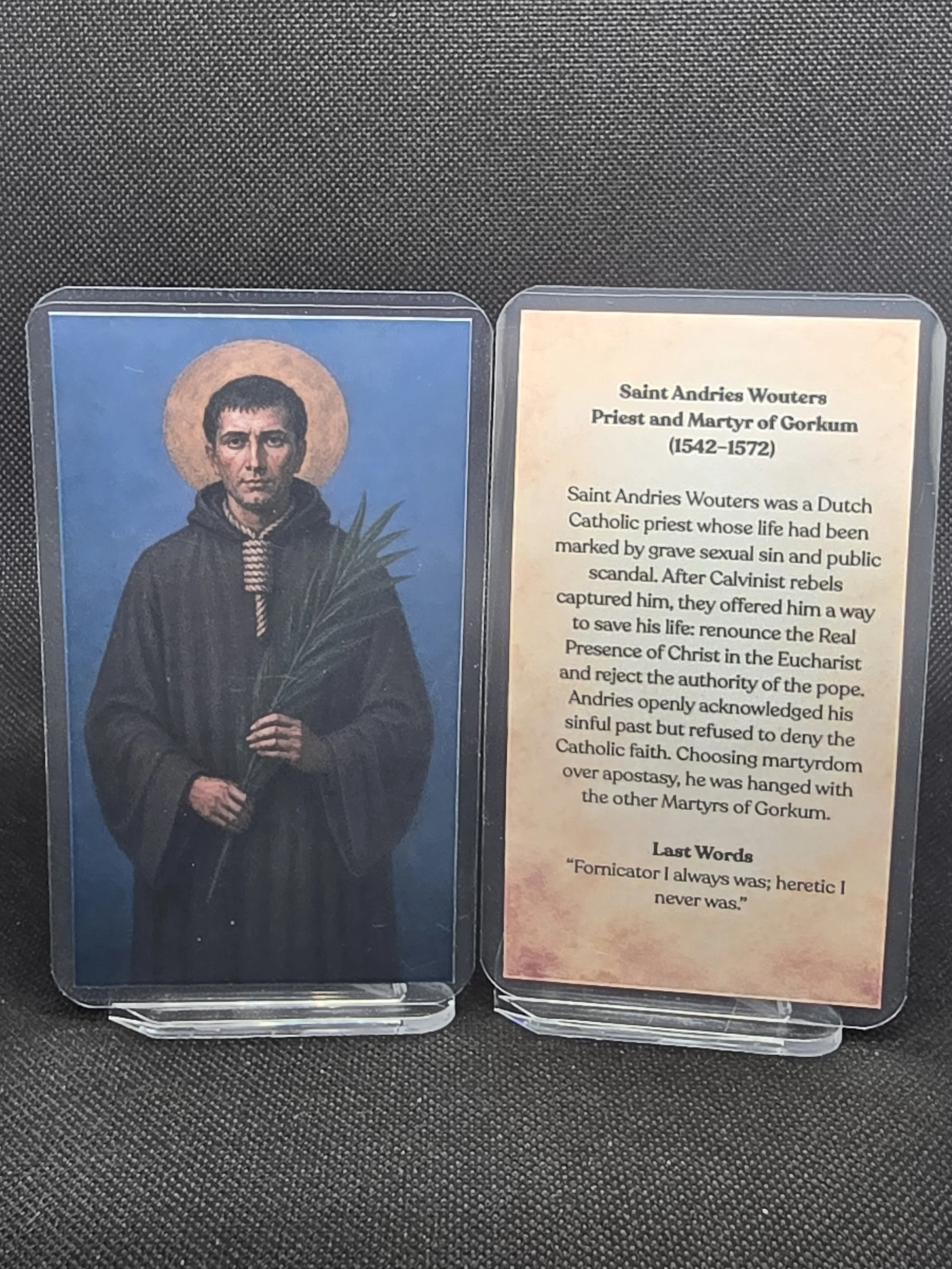
Saint Andries Wouters, also known as Saint Andrew Wouters, was a Dutch Catholic priest and one of the nineteen Martyrs of Gorkum. He is remembered not because his life was without serious sin, but because, when the final test came, he repented, held firmly to the Catholic faith, and chose death rather than deny the Real Presence of Christ in the Eucharist or the authority of the Church. His feast is celebrated on July 9.
Andries was not known as a holy priest.
His life had caused scandal.
Born in the Netherlands around 1542, Andries became a secular priest and served as pastor of Heinenoord. Yet his conduct did not reflect the dignity of his calling. Historical accounts remember him as a man who struggled with grave sexual sin and had brought shame upon his priesthood.
He had failed publicly.
But God had not abandoned him.
In 1572, during the religious violence of the Dutch Revolt, Catholic priests and religious were captured by militant Calvinist rebels. Andries was taken prisoner and joined eighteen other Catholic clergymen who would become known as the Martyrs of Gorkum.
Their captors demanded that they deny the authority of the pope and reject the Catholic teaching that Jesus Christ is truly present in the Holy Eucharist.
Andries was offered a way to save his life.
He refused.
The priest who had so often failed to live according to his faith would not deny that faith to escape death.
As the rope was placed around his neck, he is traditionally remembered as declaring:
“Fornicator I always was; heretic I never was.”
It was not a defense of his sins.
It was a confession of them.
And it was his final declaration that, despite everything he had done, he would not abandon Christ or His Church.
Andries and his companions were hanged at Brielle during the early morning of July 9, 1572. In that final act of fidelity, the scandalous priest became a martyr.
His past did not have the final word.
Christ did.
Today, Saint Andries Wouters is especially meaningful for those seeking:
Repentance after serious sin
Hope despite a shameful past
Freedom from despair and self-condemnation
Final perseverance in the Catholic faith
Strength to return to God
Courage to confess the truth
Trust in the mercy of Christ
Faith in the Real Presence of Jesus in the Eucharist
This prayer card honors a saint whose life proclaims that failure does not place a soul beyond the reach of God’s mercy.
Each card is handmade in Austin and created to order. We do not keep stock, because every prayer card is treated as a unique devotional offering. They are printed on museum-quality photo paper, not cardstock, and each one is made during prayer. The saints are venerated throughout the entire process, and prayers are intentionally offered for the person who will receive the card. These are not mass-produced items. They are created slowly, reverently, and with spiritual intention, because every soul and every prayer matters.
Saint Andries Wouters was born around 1542 in the Netherlands.
He was ordained a Catholic priest and became pastor of Heinenoord in the region of the Hoeksche Waard.
But his priesthood was deeply wounded by his behavior.
Andries became known for sexual immorality and scandal. His sins were not hidden, and his life appeared to be the opposite of what the Church expected from a priest.
Yet sainthood is not the story of human perfection.
It is the story of what grace can accomplish in a soul that finally surrenders to God.
During the Dutch Revolt, a militant Calvinist force known as the Sea Beggars captured a group of Catholic priests and religious. The prisoners were mocked, abused, and pressured to abandon two central Catholic teachings: the authority of the pope and the Real Presence of Christ in the Eucharist.
Andries was among four additional clergymen who joined the original prisoners.
Together, the nineteen were transported to Brielle.
Their captors promised freedom if they would renounce the Catholic faith.
None accepted.
Andries knew the truth about his past. He did not pretend that his life had been virtuous, nor did he excuse the scandal he had caused.
Instead, he chose fidelity when it mattered most.
On July 9, 1572, Andries and his companions were taken to an old turf shed near the former Rugge monastery. There they were hanged.
His traditionally recorded final declaration—“Fornicator I always was; heretic I never was”—has become one of the most striking statements associated with any Catholic martyr.
The words reveal a man who acknowledged his guilt but refused to surrender the truth.
He did not die claiming innocence.
He died trusting that God’s mercy was greater than his sins.
The Martyrs of Gorkum were beatified by Pope Clement X in 1675 and canonized by Pope Pius IX on June 29, 1867.
Saint Andries is remembered for repentance, final perseverance, and fidelity to the Catholic faith.
He represents hope for the fallen.
Repentant sinners
Those returning to the Catholic faith
People burdened by shame
Those struggling with sexual sin
Priests who have fallen or become discouraged
Those tempted to despair over their past
Those seeking final perseverance
Defenders of the Holy Eucharist
Catholics suffering persecution for their faith
Saint Andries died alongside the eighteen other Martyrs of Gorkum for refusing to deny papal authority and the Real Presence of Christ in the Eucharist.
Their place of martyrdom at Brielle became a destination for pilgrimages, and their relics have been venerated in the Church of Saint Nicholas in Brussels.
Today, many seek Saint Andries’ intercession for:
The grace of sincere repentance
Healing from shame and regret
Freedom from habitual sin
The return of fallen-away Catholics
Faithfulness at the hour of death
Courage to receive the Sacrament of Confession
Priests struggling with temptation
Deeper faith in the Holy Eucharist
His witness reminds us that a sinful past does not prevent a holy ending.
No soul is beyond redemption while that soul can still turn toward Christ.
O God, who adorned with the laurel of immortality the glorious battle of Your blessed Martyrs of Gorkum for the Faith, graciously grant that, with them, we may deserve to be crowned in heaven. Through Christ our Lord. Amen.
Saint Andries Wouters, repentant priest and faithful martyr, pray for me.
You knew the weight of serious sin.
You knew the shame of having failed God and scandalized others.
Yet when the final test came, you did not run from Christ.
Help me believe that my past does not have to determine my eternity.
When shame tells me that I am beyond forgiveness, remind me of the mercy of Jesus.
When the enemy accuses me, lead me to sincere repentance.
When I am afraid to confess my sins, give me courage.
When I fall, help me rise again.
Obtain for me a heart that does not excuse sin but never despairs of God’s mercy.
Strengthen my faith in the Real Presence of Jesus Christ in the Holy Eucharist.
Keep me faithful to Christ and His Church, especially when faithfulness carries a cost.
Pray for priests who have fallen, for those trapped in habitual sin, and for every soul that believes it is too late to return to God.
Saint Andries, help me finish my life better than I began it.
Pray that, at the hour of my death, I may remain faithful to Christ and place all my hope in His mercy.
Amen.
Q: What is Saint Andries Wouters known for?
He is known as a Catholic priest with a scandalous past who repented and became one of the nineteen Martyrs of Gorkum. He died rather than deny the Real Presence of Christ in the Eucharist or the authority of the pope.
Q: When is Saint Andries Wouters’ feast day?
His feast is celebrated with the Martyrs of Gorkum on July 9.
Q: Why do people pray to Saint Andries Wouters?
People seek his intercession for repentance, freedom from shame, perseverance after serious sin, fidelity to the Catholic faith, and hope that no repentant soul is beyond God’s mercy.
Q: What were Saint Andries Wouters’ final words?
He is traditionally remembered as saying, “Fornicator I always was; heretic I never was.” His words acknowledged his sinful past while declaring that he would not deny the Catholic faith.
Q: Why was Saint Andries Wouters killed?
He and the other Martyrs of Gorkum were executed after refusing to reject Catholic teaching concerning papal authority and the Real Presence of Christ in the Eucharist.
Q: Was Saint Andries Wouters officially canonized?
Yes. He and the other Martyrs of Gorkum were canonized by Pope Pius IX on June 29, 1867.
Saint Andries Wouters, also known as Saint Andrew Wouters, was a Dutch Catholic priest and one of the nineteen Martyrs of Gorkum. He is remembered not because his life was without serious sin, but because, when the final test came, he repented, held firmly to the Catholic faith, and chose death rather than deny the Real Presence of Christ in the Eucharist or the authority of the Church. His feast is celebrated on July 9.
Andries was not known as a holy priest.
His life had caused scandal.
Born in the Netherlands around 1542, Andries became a secular priest and served as pastor of Heinenoord. Yet his conduct did not reflect the dignity of his calling. Historical accounts remember him as a man who struggled with grave sexual sin and had brought shame upon his priesthood.
He had failed publicly.
But God had not abandoned him.
In 1572, during the religious violence of the Dutch Revolt, Catholic priests and religious were captured by militant Calvinist rebels. Andries was taken prisoner and joined eighteen other Catholic clergymen who would become known as the Martyrs of Gorkum.
Their captors demanded that they deny the authority of the pope and reject the Catholic teaching that Jesus Christ is truly present in the Holy Eucharist.
Andries was offered a way to save his life.
He refused.
The priest who had so often failed to live according to his faith would not deny that faith to escape death.
As the rope was placed around his neck, he is traditionally remembered as declaring:
“Fornicator I always was; heretic I never was.”
It was not a defense of his sins.
It was a confession of them.
And it was his final declaration that, despite everything he had done, he would not abandon Christ or His Church.
Andries and his companions were hanged at Brielle during the early morning of July 9, 1572. In that final act of fidelity, the scandalous priest became a martyr.
His past did not have the final word.
Christ did.
Today, Saint Andries Wouters is especially meaningful for those seeking:
Repentance after serious sin
Hope despite a shameful past
Freedom from despair and self-condemnation
Final perseverance in the Catholic faith
Strength to return to God
Courage to confess the truth
Trust in the mercy of Christ
Faith in the Real Presence of Jesus in the Eucharist
This prayer card honors a saint whose life proclaims that failure does not place a soul beyond the reach of God’s mercy.
Each card is handmade in Austin and created to order. We do not keep stock, because every prayer card is treated as a unique devotional offering. They are printed on museum-quality photo paper, not cardstock, and each one is made during prayer. The saints are venerated throughout the entire process, and prayers are intentionally offered for the person who will receive the card. These are not mass-produced items. They are created slowly, reverently, and with spiritual intention, because every soul and every prayer matters.
Saint Andries Wouters was born around 1542 in the Netherlands.
He was ordained a Catholic priest and became pastor of Heinenoord in the region of the Hoeksche Waard.
But his priesthood was deeply wounded by his behavior.
Andries became known for sexual immorality and scandal. His sins were not hidden, and his life appeared to be the opposite of what the Church expected from a priest.
Yet sainthood is not the story of human perfection.
It is the story of what grace can accomplish in a soul that finally surrenders to God.
During the Dutch Revolt, a militant Calvinist force known as the Sea Beggars captured a group of Catholic priests and religious. The prisoners were mocked, abused, and pressured to abandon two central Catholic teachings: the authority of the pope and the Real Presence of Christ in the Eucharist.
Andries was among four additional clergymen who joined the original prisoners.
Together, the nineteen were transported to Brielle.
Their captors promised freedom if they would renounce the Catholic faith.
None accepted.
Andries knew the truth about his past. He did not pretend that his life had been virtuous, nor did he excuse the scandal he had caused.
Instead, he chose fidelity when it mattered most.
On July 9, 1572, Andries and his companions were taken to an old turf shed near the former Rugge monastery. There they were hanged.
His traditionally recorded final declaration—“Fornicator I always was; heretic I never was”—has become one of the most striking statements associated with any Catholic martyr.
The words reveal a man who acknowledged his guilt but refused to surrender the truth.
He did not die claiming innocence.
He died trusting that God’s mercy was greater than his sins.
The Martyrs of Gorkum were beatified by Pope Clement X in 1675 and canonized by Pope Pius IX on June 29, 1867.
Saint Andries is remembered for repentance, final perseverance, and fidelity to the Catholic faith.
He represents hope for the fallen.
Repentant sinners
Those returning to the Catholic faith
People burdened by shame
Those struggling with sexual sin
Priests who have fallen or become discouraged
Those tempted to despair over their past
Those seeking final perseverance
Defenders of the Holy Eucharist
Catholics suffering persecution for their faith
Saint Andries died alongside the eighteen other Martyrs of Gorkum for refusing to deny papal authority and the Real Presence of Christ in the Eucharist.
Their place of martyrdom at Brielle became a destination for pilgrimages, and their relics have been venerated in the Church of Saint Nicholas in Brussels.
Today, many seek Saint Andries’ intercession for:
The grace of sincere repentance
Healing from shame and regret
Freedom from habitual sin
The return of fallen-away Catholics
Faithfulness at the hour of death
Courage to receive the Sacrament of Confession
Priests struggling with temptation
Deeper faith in the Holy Eucharist
His witness reminds us that a sinful past does not prevent a holy ending.
No soul is beyond redemption while that soul can still turn toward Christ.
O God, who adorned with the laurel of immortality the glorious battle of Your blessed Martyrs of Gorkum for the Faith, graciously grant that, with them, we may deserve to be crowned in heaven. Through Christ our Lord. Amen.
Saint Andries Wouters, repentant priest and faithful martyr, pray for me.
You knew the weight of serious sin.
You knew the shame of having failed God and scandalized others.
Yet when the final test came, you did not run from Christ.
Help me believe that my past does not have to determine my eternity.
When shame tells me that I am beyond forgiveness, remind me of the mercy of Jesus.
When the enemy accuses me, lead me to sincere repentance.
When I am afraid to confess my sins, give me courage.
When I fall, help me rise again.
Obtain for me a heart that does not excuse sin but never despairs of God’s mercy.
Strengthen my faith in the Real Presence of Jesus Christ in the Holy Eucharist.
Keep me faithful to Christ and His Church, especially when faithfulness carries a cost.
Pray for priests who have fallen, for those trapped in habitual sin, and for every soul that believes it is too late to return to God.
Saint Andries, help me finish my life better than I began it.
Pray that, at the hour of my death, I may remain faithful to Christ and place all my hope in His mercy.
Amen.
Q: What is Saint Andries Wouters known for?
He is known as a Catholic priest with a scandalous past who repented and became one of the nineteen Martyrs of Gorkum. He died rather than deny the Real Presence of Christ in the Eucharist or the authority of the pope.
Q: When is Saint Andries Wouters’ feast day?
His feast is celebrated with the Martyrs of Gorkum on July 9.
Q: Why do people pray to Saint Andries Wouters?
People seek his intercession for repentance, freedom from shame, perseverance after serious sin, fidelity to the Catholic faith, and hope that no repentant soul is beyond God’s mercy.
Q: What were Saint Andries Wouters’ final words?
He is traditionally remembered as saying, “Fornicator I always was; heretic I never was.” His words acknowledged his sinful past while declaring that he would not deny the Catholic faith.
Q: Why was Saint Andries Wouters killed?
He and the other Martyrs of Gorkum were executed after refusing to reject Catholic teaching concerning papal authority and the Real Presence of Christ in the Eucharist.
Q: Was Saint Andries Wouters officially canonized?
Yes. He and the other Martyrs of Gorkum were canonized by Pope Pius IX on June 29, 1867.