Saint Gregory the Theologian: Teacher of the Trinity and Bishop of Constantinople
A fourth-century orator, poet and bishop who defended the divinity of the Son and the Holy Spirit and then walked away from power for the sake of peace.
At a Glance
- Born
- About 329 or 330 AD, at Arianzus near Nazianzus in Cappadocia (the exact year is disputed)
- Died
- About 389 or 390 AD, probably at Arianzus (the exact year and day are disputed)
- Titles
- Theologian, Holy Hierarch, Cappadocian Father, Doctor of the Church
- Feast
- January 25 (Byzantine); January 30 (Three Holy Hierarchs); January 2 (Roman Catholic, with Basil the Great)
- Veneration
- Catholic Church and Eastern Orthodox Church; no formal canonization date, as his veneration is ancient
- Patronage
- No firm formal patronage; honored as a model of sacred learning
The Theologian
Saint Gregory of Nazianzus, known in the Christian East as Gregory the Theologian, was one of the great minds of the fourth century. A gifted speaker and poet, he served as a bishop in Cappadocia and, for a short and stormy time, in the imperial capital of Constantinople. With his friend Basil the Great and Basil's brother Gregory of Nyssa he belongs to the Cappadocian Fathers.
The Byzantine Church gives the title Theologian to very few people. Gregory earned it through a set of five sermons on the Holy Trinity, delivered in Constantinople around 380, which taught that the Son and the Holy Spirit share fully in the divine nature of the Father. These sermons shaped the language of the Council of Constantinople in 381 and still shape the Church's prayer.
He is also remembered as a man who disliked ecclesiastical politics and still found himself in the middle of it. He wanted a life of prayer and books, and he was repeatedly called into public service. This article follows him from a bishop's household in Cappadocia to the city of the emperors and back to a quiet country retreat, and it marks the points where dates and traditions are uncertain.
Family and Education
Gregory was born around 329 or 330 at Arianzus, a family estate near the town of Nazianzus in Cappadocia, in modern Turkey. The year is disputed. The Orthodox Church in America gives 329, Pope Benedict XVI spoke of about 330, and the older Catholic Encyclopedia suggested a date closer to 325. This article uses the cautious phrase about 329 or 330.
His father, also named Gregory, became bishop of Nazianzus. He had earlier belonged to a group known as the Hypsistarians, who worshipped the Most High God, and he came to the Christian faith through the influence of his wife Nonna, whom the Church remembers as a saint. Gregory had a brother, Caesarius, who became a physician, and a sister, Gorgonia, whom Gregory later praised in a funeral sermon. His own speeches about his parents are valuable sources, though they are tributes and not neutral biographies.
He received the best education available. He studied in Caesarea of Cappadocia, then in Alexandria, and finally in Athens, the great center of rhetoric and philosophy. In Athens he formed his famous friendship with Basil, and he also shared the city with the young Julian, who later became emperor and tried to restore the old pagan religion. Gregory's funeral speech for Basil, written years later, is the main source for their student days.
Reluctant Priest and Bishop
Although Gregory was raised in a Christian home, he was baptized as an adult, as was common at the time. A traditional story, based partly on his own recollections, tells of a violent storm at sea during which he feared dying unbaptized and promised himself to God. The storm itself is plausible, but its meaning as a miracle is a matter of faith and cannot be checked by history.
After his studies he spent time with Basil in Pontus in a life of prayer and reading of Scripture. Around 361 or 362 his father ordained him a priest, against his wishes, and Gregory fled. He soon returned and explained his reluctance in a speech known as On His Flight, which is one of the finest early reflections on the weight of pastoral office.
A second turning point came around 371 or 372, when Basil, by then bishop of Caesarea, made him bishop of Sasima, a poor post house town at the center of a jurisdictional quarrel. Gregory felt used and never took up the work. The episode strained a friendship that had been close, and it would later be used by his critics in Constantinople.
Preaching Orthodoxy in Constantinople
Around 379 Gregory was invited to Constantinople to lead the small community that held to the faith of the Council of Nicaea. The city was then dominated by groups that denied the full divinity of the Son. Gregory preached at first in a modest house church that he called Anastasia, meaning Resurrection, and the name of the church became a symbol of the revival of the Nicene faith.
His great achievement was the group of Five Theological Orations, numbered 27 to 31 in the collection of his sermons. In them he argued that theology is not an entertainment for debaters but a work that needs purity of life, humility and reverence. He taught that the Son is fully God, that the Holy Spirit is fully God, and that the three persons remain distinct while sharing one divine nature.
He also defended the full humanity of Christ against Apollinarianism, a view that said Christ lacked a human mind. In a letter written around 382 or 383 to a priest named Cledonius, Gregory argued that only what Christ truly took on could be healed. His pastoral work was not limited to doctrine. His sermon On the Love of the Poor urges Christians to care for those who suffer, and his funeral speeches preserve rich details of fourth-century family life.
Controversy and Resignation
Gregory's years in the capital were not peaceful. Orthodox hagiography describes an attack on his congregation during an Easter service in 379, though the details come from sources that are not independent of each other and should be read with caution. A rival named Maximus, who had been part of Gregory's circle, also tried to have himself consecrated bishop of the city, adding to the disorder.
The political situation changed when Emperor Theodosius I came to the throne and supported the Nicene faith. In 380 Gregory took possession of the main church of the city. The Second Ecumenical Council met in Constantinople in 381, confirmed Gregory as bishop, and for a time he presided after the death of Meletius of Antioch.
Then opposition arose. Some bishops argued that a bishop should not be moved from one see to another, and Gregory's earlier connection to Sasima was cited. Gregory chose to resign rather than become a cause of division. His farewell speech, known as Oration 42, shows a man who put peace in the Church above his own position, and the manner of his leaving is one of the most admired parts of his life.
Retirement and Final Years
After leaving Constantinople in 381 Gregory returned to Cappadocia. He helped the church of Nazianzus through a period without a settled bishop and eventually supported the appointment of Eulalius before withdrawing to Arianzus, the family estate where he had been born.
His last years were marked by illness and by memories of church conflict, which appear in his letters and poems. They were also productive. He wrote a large body of verse, which Pope Benedict XVI described as reaching about eighteen thousand lines, and a long autobiographical poem, On His Own Life, in which he looks back on his calling and disappointments.
Gregory died around 389 or 390, probably at Arianzus. The exact year and day are disputed, and a firm date should not be claimed. The Orthodox Church in America gives January 25, 389, and his principal feast follows that day, but other accounts prefer 390.
Relics and Feast Days
According to the Orthodox Church in America, Gregory's remains were brought to Constantinople in the tenth century, traditionally around 950, and placed in the Church of the Holy Apostles. Later accounts link the movement of relics to Rome with the Latin conquest of Constantinople in 1204, though the route and date of every relic cannot be reconstructed with certainty.
On November 27, 2004, Pope John Paul II formally returned relics of Gregory and John Chrysostom to Ecumenical Patriarch Bartholomew I as a sign of reconciliation between the Churches. The relics were received in Constantinople and placed in the Patriarchal Cathedral of Saint George on November 30, 2004.
His feasts differ by calendar. The Byzantine Churches keep January 25 for him alone and January 30 for the Three Holy Hierarchs, Basil, Gregory and John Chrysostom. In some Orthodox calendars January 19 marks the translation of his relics. The modern Roman Catholic calendar keeps January 2 for Basil and Gregory together. These are different customs, not disagreements about his holiness.
Traditions and Legends
Gregory's reputation rests more on his teaching and character than on a long list of miracles. The stories told about him are mostly marked as tradition. One tells of a would-be assassin who came to Gregory intending harm and instead repented. The historical details cannot be independently established.
A more famous tradition tells how the Three Holy Hierarchs appeared together to John Mauropous, bishop of Euchaita, to settle a dispute over which of them was greatest. The tradition places this in the reign of Alexios I Komnenos, and the Orthodox Church in America gives 1084. These dates belong to the story and do not prove that an apparition took place.
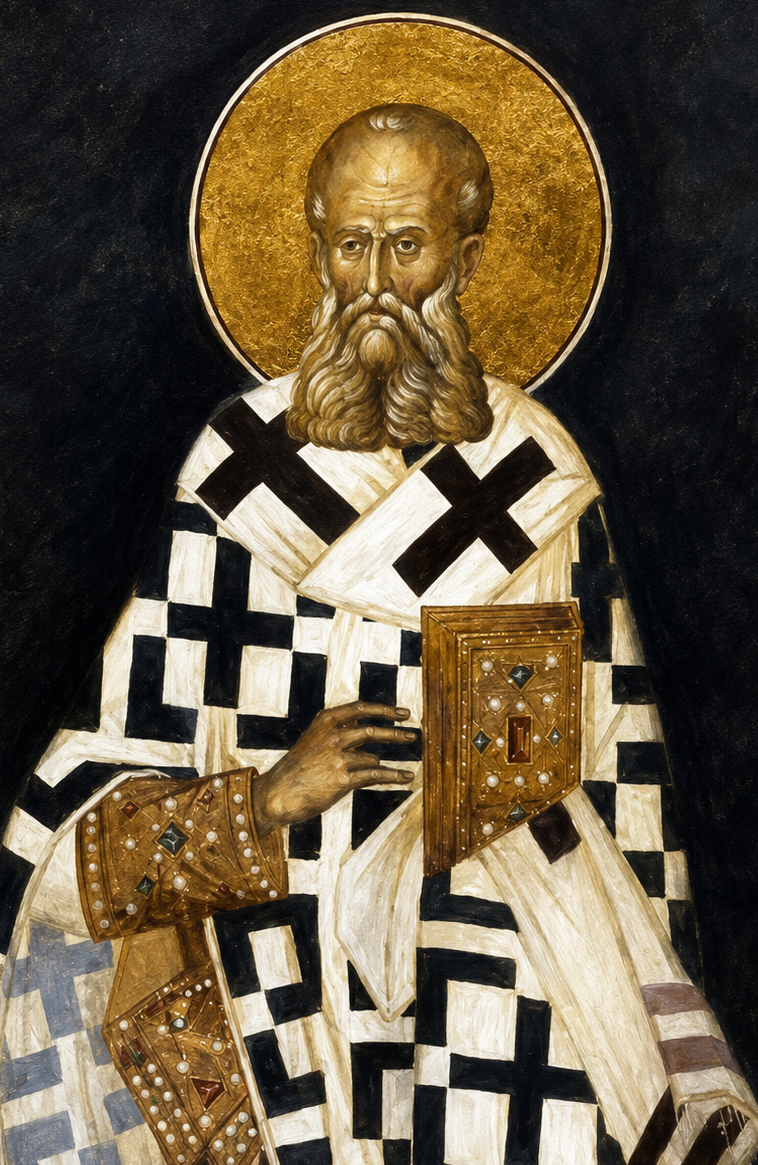
In iconography Gregory is shown as a bishop with a Gospel book or scroll, often in the company of Basil and Chrysostom. The common feast of the three is meant to teach that the Church's teachers are not rivals but one chorus. It is a gentle reminder from the tradition that holiness is shared and not competitive.
Writings and Scholarship
Gregory's own writings are the strongest foundation for his biography. His orations 2, 27 to 31, 42 and 43, along with his letters and poems, give a first-hand view of his life and thought. They are also rhetorical and theological works with purposes beyond recording events, so they are best read together with modern scholarship.
Among scholarly works, John McGuckin's intellectual biography of 2001 and Brian Daley's introduction and translations of 2006 are widely used. The older Catholic Encyclopedia remains useful but its chronology needs checking against later research. The two audiences of Pope Benedict XVI in August 2007 provide a clear Catholic summary of his life and teaching.
Readers should keep one point in mind. The title Archbishop of Constantinople is commonly used for Gregory, but Bishop of Constantinople is the more precise term for his own time, since the later rank of archbishop was applied backward. The same caution applies to the word canonization: his veneration is ancient, and no canonization date exists.
Holy Gregory, teacher of the faith and lover of peace, pray for us. Obtain for us a humble mind and a clean heart, that we may speak of God with reverence. Guard students, preachers and writers from pride, and give courage to those who must give up honor for the sake of unity. Help us to love the poor, to honor the Holy Trinity, and to seek the truth with patience. Amen.
This prayer is an original composition for devotion. It is not an official liturgical text and was not written by the saint.
Gregory in the Eastern Churches
Gregory holds a special place in the shared inheritance of Eastern Catholics and Orthodox. He lived centuries before the separation of East and West, and both traditions honor him. His teaching on the Trinity helped set the vocabulary of Byzantine theology, and his defense of the Holy Spirit's divinity is central to understanding the Council of 381.
For Eastern spirituality he is a witness that theology and holiness cannot be separated. His writings insist that speaking about God requires a purified heart as well as a trained mind. This idea runs through the Byzantine tradition and is one reason the title Theologian was given to him.
The return of his relics in 2004 gave this heritage a public face. Pope John Paul II and Patriarch Bartholomew described the act as a sign of the common patristic inheritance of their Churches. Pilgrims and students today still turn to Gregory as a patron of careful, prayerful study, even though no formal patronage can be firmly established from the major church sources.
Frequently Asked Questions
Ask His Prayers
Gregory loved the truth and loved peace. Keep his prayer card near your books or your prayer corner as a reminder to study with humility.
View Prayer Card