Blessed Hryhoriy Lakota: Bishop and Hieromartyr of the Ukrainian Greek Catholic Church
A village boy from Galicia who became a scholar, seminary rector and auxiliary bishop, and who died a prisoner in the Soviet camps of the far north.
At a Glance
- Born
- January 31, 1883, in Holodivka (now Zadnistryany), Galicia
- Died
- November 12, 1950, in the Abez labor camp, Komi region (the exact day is reported differently in some sources)
- Titles
- Blessed, Hieromartyr, Auxiliary Bishop of Przemysl
- Feast
- June 27 (July 10 on the Julian civil calendar); death anniversary November 12
- Veneration
- Ukrainian Greek Catholic Church; beatified June 27, 2001
- Patronage
- No formal patronage; honored by the Ukrainian Greek Catholic faithful as a witness of fidelity under persecution
- A Faithful Shepherd of Galicia
- Childhood and Schooling
- Priesthood and Study in Vienna
- Rector of the Przemysl Seminary
- Auxiliary Bishop of Przemysl
- The Soviet Assault on the Church
- Vorkuta and Abez
- Death and Burial at Abez
- Beatification and Veneration
- Place in the Eastern Churches
- Frequently Asked Questions
A Faithful Shepherd of Galicia
Blessed Hryhoriy Lakota, known in English as Gregory Lakota, was a bishop of the Ukrainian Greek Catholic Church in the western Ukrainian region of Galicia. He lived through the end of the Habsburg empire, two world wars, the Polish interwar state, German occupation and the arrival of Soviet power. In each of these changes he held the same post of service: teacher of priests, then pastor of a diocese.
He is remembered above all for how his life ended. When the Soviet state set out in the 1940s to destroy the Greek Catholic Church and fold its people into the Russian Orthodox structure, Lakota was among the bishops who refused to agree. He was arrested, sentenced, and sent to the camps of the Arctic north, where he died of illness in 1950.
The Catholic Church counts him among the blessed. Pope John Paul II beatified him in Lviv on June 27, 2001, together with Bishop Mykola Charnetsky and a large group of other Ukrainian Greek Catholic martyrs of the twentieth century. This article follows his life from a farming village to a seminary rectorship, a bishop's cross and a prisoner's grave, and it marks plainly where the sources disagree.
Childhood and Schooling
Hryhoriy Lakota was born on January 31, 1883, in the village of Holodivka in Galicia, a settlement now known as Zadnistryany. His parents, Ivan and Yevfrosyniya, were farmers, and Hryhoriy was the fourth of their children. Galicia then belonged to the Austro-Hungarian empire, and the Greek Catholic parish was the center of village life for Ukrainian families there.
He began his schooling at Komarno and in 1895 entered the Academic Gymnasium in Lviv, the city that was then the cultural capital of Ukrainian Galicia. A boy from a farming household who reached a gymnasium in the provincial capital had usually been noticed by his parish priest and teachers, and the path often led toward the priesthood.
After finishing school he entered seminary formation, studying in Lviv and later at Przemysl, the see that would shape the rest of his life. The seminary taught philosophy, theology, church history and law. These were the very subjects in which Lakota would later become a teacher and writer, so the years of his youth and the work of his maturity are closely joined.
Priesthood and Study in Vienna
Lakota was ordained a deacon on August 23, 1908, and a priest a week later, on August 30, 1908. The ordaining bishop was Konstantyn Chekhovych of Przemysl. His first parish assignment was at Trostianets, where he served as a young priest in the ordinary round of liturgy, confessions and village visits.
The bishop soon saw that the young priest had a gift for study and sent him to the Augustineum in Vienna in 1910, a house that trained gifted clergy from across the empire. His doctoral work dealt with the Sermon on the Mount. The sources do not agree on the date of the degree: the Ukrainian Greek Catholic biography places it in March 1911, while some encyclopedias give 1913, and this article treats the year as uncertain.
Returning to Galicia, he served in several parishes during the First World War, in places such as Husakiv, Bolekhovychi, Radokhiv and Myshliatychi, while the front lines moved across his homeland. From October 1916 he taught at the seminary, and the combination of pastoral experience and academic training prepared him for the leadership that was about to be offered to him.
Rector of the Przemysl Seminary
In 1918 Lakota became rector of the seminary in Przemysl and held the office until 1926. A rector is responsible for the spiritual life, discipline and studies of future priests, and the post was a heavy one in years when the region passed from Austrian rule into the new Polish state and the Ukrainian community faced uncertainty about its institutions.
He also taught church history and canon law, and he published. Among his early works was a study of matrimonial law from about 1921, and later he produced a history of the three synods of Przemysl, printed in 1939. His collected historical writings were published in 2003, and a volume of his pastoral letters and sermons followed in 2005, which allows modern readers to hear the voice of a man who was both an academic and a pastor.
His standing rose with the offices he was given. He was named a papal chamberlain in 1923, an honorary title from Rome, and he served as a protopresbyter and as vicar general of the eparchy. When Bishop Yosafat Kotsylovsky needed an assistant, the clergy and the bishop already knew Lakota as a steady, learned and approachable priest.
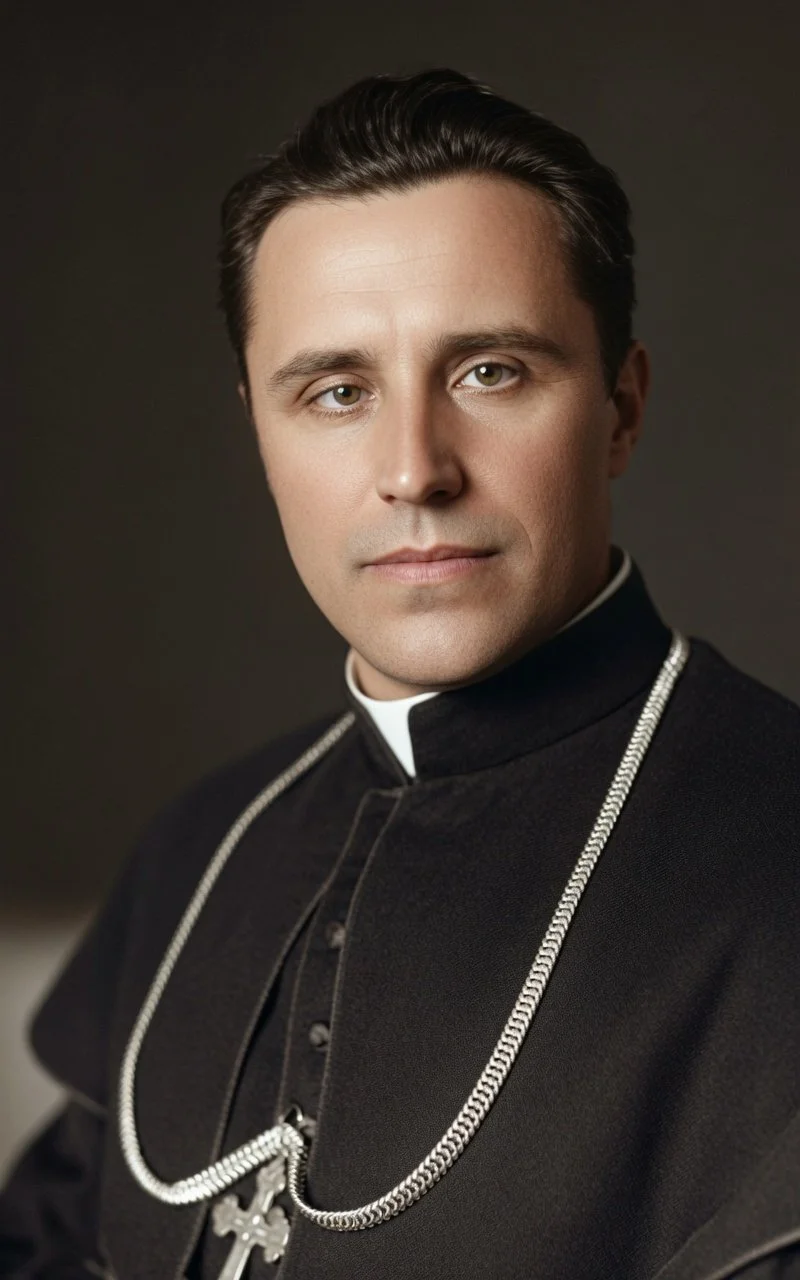
Auxiliary Bishop of Przemysl
Lakota was appointed auxiliary bishop of Przemysl, Sambir and Sanok on February 10, 1926, with the titular see of Daonium. He was consecrated on May 16, 1926, with Bishop Kotsylovsky as the principal consecrator. From then on he shared the pastoral work of a large eparchy with a bishop whom he deeply respected.
The next two decades were a time of quiet administration and teaching in a region that was far from stable. The interwar years brought political tension between Ukrainians and the Polish state. When the Second World War began and Germany occupied the territory, Lakota took responsibility for the western part of the eparchy and kept parishes supplied with priests and the sacraments as far as he could.
Those who knew him described a gentle and patient man, more inclined to a scholar's reserve than to public drama. That temperament matters for what followed, because when the crisis came it was not a combative personality that carried him through but a settled habit of fidelity to the Church he had served since youth.
The Soviet Assault on the Church
In April 1945 the Soviet authorities arrested Metropolitan Josyf Slipyj and the other Greek Catholic bishops of Lviv. In March 1946 a gathering in Lviv, later called the pseudo-synod because it was staged without the bishops and under state pressure, announced the dissolution of the union with Rome and the absorption of the Greek Catholic Church into the Russian Orthodox Church. The Catholic Church has never accepted that act as free or valid.
Lakota was arrested after the border had shifted and the territory was being brought under Soviet control. Sources give June 26, 1946, as the date of arrest by Polish authorities, one day after Bishop Kotsylovsky, and then he was handed over to Soviet custody. Exact dates and the order of transfers differ across accounts, so they are best held with caution.
In February 1947 he was sentenced. The length of the sentence is reported as eight years in some encyclopedias and ten years in the Ukrainian Greek Catholic biography. The charges combined anti-Soviet nationalism with alleged collaboration with the Germans. The Church's account is that the real reason was his refusal to join the Orthodox structure and to abandon his flock.
Vorkuta and Abez
He was sent to the camps of Vorkuta, in the Arctic north, one of the largest systems of forced labor in the Soviet Union. Prisoners mined coal in extreme cold on poor food. The bishop, then in his sixties, was assigned to hard labor at first, and later, as his strength failed, to lighter work, and eventually he was moved to the camp at Abez.
Fellow prisoners left testimony about him. A Jesuit priest, Pietro Leoni, wrote about him in 1959 after his own release and described a man of such gentleness and spiritual calm that others were drawn to him. Such recollections come from memory and from admirers, and they are treated as witness accounts, not as official findings, but they agree on the picture of a bishop who prayed, comforted others and did not complain.
A few of his letters survive from the camp years, including letters dated October 26, 1947, in 1948, on June 21, 1949, and on March 4, 1950, the last written from Abez. They show a man who was concerned for relatives and priests and who accepted his suffering without bitterness. The letters are among the most valuable sources for his inner life.
Death and Burial at Abez
Hryhoriy Lakota died on November 12, 1950, in the infirmary of the Abez camp. The cause given in the testimony of Father Alfonsas Svarinskas, a Lithuanian priest who was a fellow prisoner, was pulmonary tuberculosis. The date of death appears as the 12th in most accounts, though other days in early November have been suggested in some sources, and the point cannot be fully settled.
A prisoner physician, Dr. Serhiy Naklovych, and an Armenian cleric are named among those near him at the end. He was buried in the camp cemetery at Abez, in a grave later identified as D-14. The burial included his pectoral cross and panagia, which helped later searchers to identify his remains.
For decades the grave was unmarked and the family had no certain place to mourn him. In the summer of 1996 his burial site was found, and in 2001 the remains were brought back to Ukraine. This return of a bishop who had died in exile became a public act of memory in the years after the Soviet collapse.
Beatification and Veneration
The remains were first placed in the church complex of the Nativity of the Theotokos in Sykhiv, a district of Lviv. The year of the solemn transfer is reported unclearly in the available sources, so it is not stated here. Some Ukrainian Greek Catholic accounts describe his remains as incorrupt. That is a devotional claim of the faithful, not a finding of any forensic examination.
On June 27, 2001, in Lviv, Pope John Paul II beatified Lakota with Bishop Mykola Charnetsky and twenty-four companions. In his homily the pope spoke of an ecumenism of martyrs, saying that the sufferings of Christians of different traditions in the twentieth century formed a shared witness. His feast is kept on June 27, which falls on July 10 on the Julian civil calendar, and his death is remembered on November 12.
He has been beatified but not canonized. No miracle has been verified for him individually in the sources consulted, and there is no individual hymn. A collective troparion for the martyrs exists in the Edmonton eparchy, but it is not quoted here. In 2017 a memorial church and relic icon project was completed in his home village, and a church was blessed in Lviv on November 12 of that year.
Blessed Hryhoriy, shepherd who stayed with your people when it cost you everything, pray for us. Teach us to be faithful in small duties and in great trials. Strengthen priests and bishops who serve in hard places, console prisoners and the sick, and bring peace to families divided by war and fear. Ask Christ to keep us patient, honest and loyal to the truth. Amen.
This prayer is an original composition for devotion. It is not an official liturgical text and was not written by the saint.
Place in the Eastern Churches
Lakota belongs to the Ukrainian Greek Catholic Church, an Eastern Church in full communion with Rome that keeps the Byzantine rite. His life shows the painful position of such Churches under communism: they were Eastern in worship and Catholic in communion, and so were seen as hostile both by the state and by the Russian Orthodox leadership that benefited from the 1946 absorption.
The Orthodox Church has not glorified him as a saint, and he is not on Orthodox calendars. Within the Catholic Church he is a blessed, and his memory is cherished by Ukrainian Greek Catholics in Ukraine and the diaspora. His story is often told alongside those of Slipyj, Kotsylovsky and Charnetsky, bishops who faced the same demand and gave the same answer.
For readers of any tradition, Lakota offers a plain example of steadfastness without display. He wrote books, trained priests and governed a diocese, and when the decisive hour arrived he simply refused to leave his post. Many pilgrims today visit his grave and relics in Lviv to pray for families, priests and the suffering.
Frequently Asked Questions
Ask His Prayers
Blessed Hryhoriy gave his life in quiet fidelity. Keep his prayer card near you as a reminder to stay steady in your own duty.
View Prayer Card