Saint Luke of Crimea: Surgeon, Archbishop and Confessor
A professor of surgery who became a bishop, endured years of Soviet prison and exile, and kept treating the sick until he went blind.
At a Glance
- Born
- April 27, 1877 (April 14, Old Style), Kerch, Crimea
- Died
- June 11, 1961, Simferopol
- Titles
- Archbishop of Simferopol and Crimea, Confessor, Surgeon
- Feast
- June 11 (May 29, Old Style)
- Veneration
- Local glorification 1995; church-wide glorification 2000 (Russian Orthodox Church)
- Patronage
- Physicians, surgeons and patients (devotional, no formal decree)
Who Was Saint Luke of Crimea?
Saint Luke of Crimea was born Valentin Felixovich Voyno-Yasenetsky, a surgeon and professor of medicine who became a priest and then a bishop in the Russian Orthodox Church. He is remembered as Archbishop of Simferopol and Crimea, and as a confessor who endured years of Soviet prison and exile. The Orthodox Church keeps his feast on June 11, which is May 29 in the Julian calendar.
His story is unusually well documented. He left medical books, sermons and memoirs, and surgeons and historians have studied his career. Unlike ancient saints, we can read his own works and check many dates against professional records, though a few dates still disagree and are marked here as uncertain.
He did not give up medicine when he became a priest. For him the care of the body and the care of the soul belonged together. That unity, and the courage with which he held to it under an atheist state, is the heart of his witness.
Early Life and Family
Valentin was born in Kerch, a port city in eastern Crimea, on April 27, 1877, Gregorian calendar, which was April 14 Old Style. His family had Polish noble roots and had lost its money. His father, Felix Stanislavovich, was a Roman Catholic pharmacist, and his mother, Maria Dmitrievna, was Orthodox. He was the third of five surviving children, and the family moved to Kyiv in 1889.
Sources disagree on which parent shaped his faith more. The Orthodox Church in America stresses his mother's teaching, while a diocesan biography preserves a memoir that points to his father's influence. A firm judgment is not possible. He was raised in an Orthodox setting, and there was no conversion from Catholicism.
He had real talent for drawing and thought of becoming a painter, a gift that later helped him study anatomy. But he felt a duty to the poor and chose medicine. He entered the medical faculty at Kyiv University in 1898 and graduated in 1903, hoping to serve poor country people and not to seek a famous city post.
From Surgeon to Priest
During the Russo-Japanese War he served with a Red Cross surgical unit in Chita, where he met a nurse named Anna Vasilyevna Lanskaya. They married in 1904 and had four children. From 1905 to 1917 he worked in provincial and rural hospitals, where one surgeon had to handle every kind of emergency, and he treated rich and poor alike.
By 1917 he was in Tashkent, practicing surgery and later teaching as a professor at the new university. His wife died of tuberculosis in 1919, leaving him to raise the children, and he did not marry again. He took part openly in church life even as hostility to religion grew.
After hearing him speak at a church gathering, Bishop Innocent of Tashkent urged him to enter the priesthood. He took it as a call from God. He was ordained deacon and priest in February 1921 and kept on operating and teaching. In 1923 he was tonsured a monk with the name Luke, after the apostle and evangelist, and was consecrated bishop in the same year. He was arrested soon afterward.
Surgeon and Writer
His medical work was serious science. His chief fields were regional anesthesia, surgical anatomy, eye surgery and the treatment of purulent infections. His book on regional anesthesia appeared in 1915, and he defended a doctoral dissertation on it in 1916. His best known medical book, Essays on Purulent Surgery, first appeared in 1934, at a time before antibiotics were common, when the drainage of deep infections was crucial.
Another work, on late resections of infected gunshot wounds of the joints, came out in 1944 and grew from wartime experience. In 1946 he received the Stalin Prize, first class, for his medical research. The same state that persecuted him as a bishop thus honored his science, and the prize says nothing about any agreement with Soviet policy.
He also wrote on faith. His works include Spirit, Soul and Body, Science and Religion, collected sermons, and an autobiographical book on suffering, known in English as I Came to Love Suffering. Readers should check editions and translations before quoting him, and should avoid sayings attributed to him online without a source. His aim was to join scientific reason and traditional Christian teaching on the soul, prayer and providence.
Prison and Exile
After his consecration in 1923 he was arrested on political charges. He was held in Tashkent, moved through Moscow prisons, and exiled to the Yeniseisk region of Siberia. He kept treating patients and, where he could, celebrated services. He returned to Tashkent in early 1926.
He was arrested a second time and sent to Arkhangelsk. The medical-history account dates the arrest to May 6, 1930, while the Orthodox Church in America gives May 1931. This is UNCERTAIN, and it should be settled from archives. He kept up his research and, by one account, refused to lead a research institute when the offer required him to give up his clerical status.
In July 1937, during the Great Terror, he was arrested again and pressed to sign false accusations. Orthodox biographies say he refused and went on a hunger strike. He was exiled to the Krasnoyarsk region, and by 1940 he was working as a doctor in Bolshaya Murta. A diocesan biography estimates that he spent about eleven years in prison and exile in all, which is a traditional summary and not an audited count.
War, Crimea and Death
When Germany invaded in 1941, he asked to treat the wounded and returned to major hospital work in Krasnoyarsk, linked with evacuation hospital number 1515. In 1944 he became Archbishop of Tambov, and in May 1946 he was appointed Archbishop of Simferopol and Crimea, where he stayed until he died.
In his last years he lost his sight completely. The year is UNCERTAIN, since sources give 1955, 1956 or 1958. He kept taking part in the life of his diocese while blind. He died in Simferopol on June 11, 1961, at the age of eighty-four, and was buried in the city cemetery.
His opposition to the Renovationist movement and his loyalty to Patriarch Tikhon were among the reasons for his persecution. A full judgment of his dealings with church and security officials would need the archives and not only devotional biographies, and this article does not claim more than the sources show.
Relics and Devotion
Reports of healings at his grave and through his prayers began to spread after his death. These are TRADITION, and the sources used here give no clinical records that would show whether any recovery was medically unexplained. They are a form of religious testimony.
When his remains were moved in 1996, witnesses reportedly noticed a fragrance, and the Orthodox Church in America preserves an account that his heart was found incorrupt. These claims belong to the hagiographic tradition and are not the result of an independent forensic study.
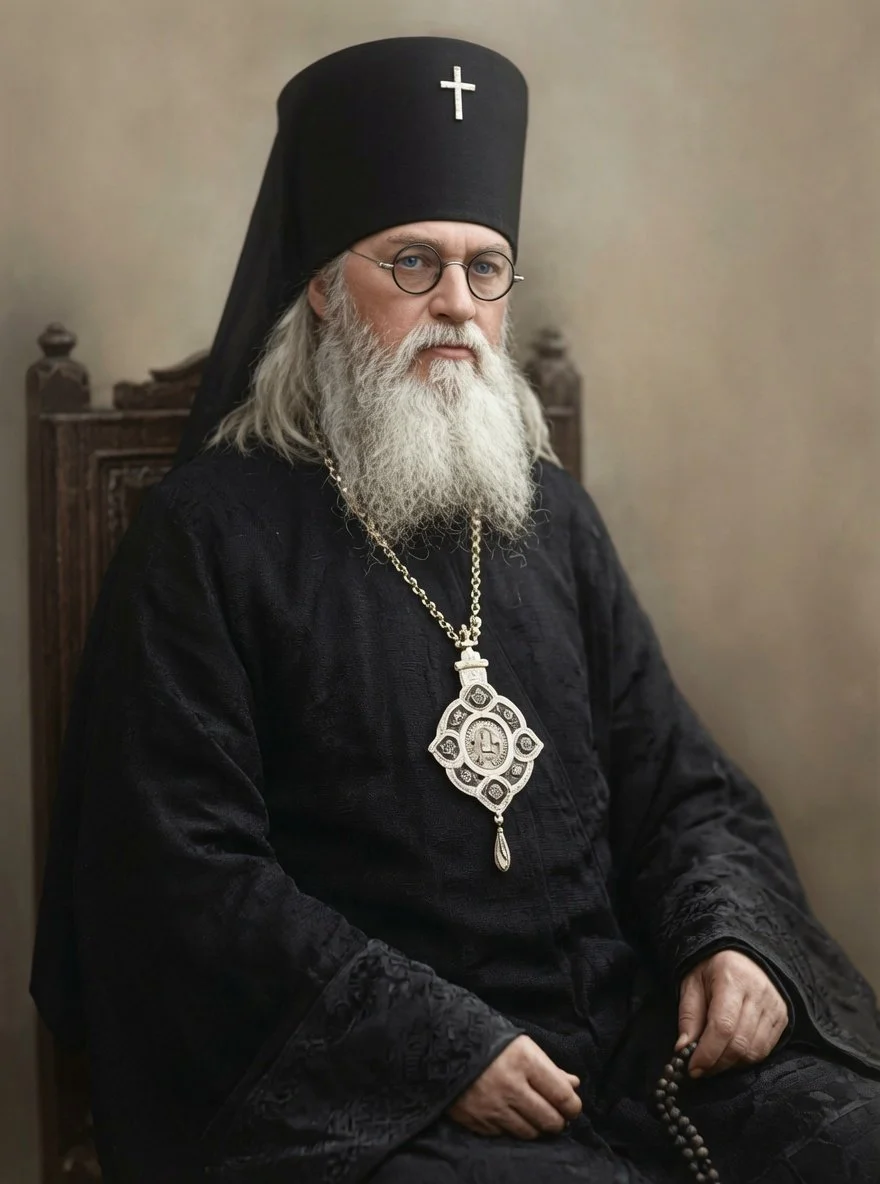
Devotion to him is strongest among doctors, nurses and patients, and many pray to him before surgery. Icons show him in a bishop's vestments with a Gospel book, and sometimes with a surgeon's instrument or a medical emblem. He is called a wonderworking physician, and that title of faith should be kept apart from his documented achievements in surgery.
Luke in Scholarship
Medical historians have written much on his career. Hercules Sakkas and Panagiota Spyropoulou wrote on his legacy to medical science in 2021, and A. A. Andreev and A. P. Ostroushko published biographical studies in 2017 and 2022 that give his professional chronology, arrests and publications.
Church biographies, such as that of the Orthodox Church in America and a diocesan life by Father Edward Pehanich, give the religious story. The two kinds of source mostly agree, but they differ on small points, such as the date of the second arrest and the year he went blind.
The editors of his writings in Russian maintain a catalog of his works online. The surgical books are well documented in the medical articles, though complete original editions were not checked for this article.
Glorification and Feast
On November 22, 1995, he was approved for local veneration in Crimea by the Ukrainian Orthodox Church within the Moscow Patriarchate. His relics were moved to Holy Trinity Cathedral in Simferopol on March 20, 1996, and public celebrations followed on May 24 and 25, 1996. In 2000 the Jubilee Council of Bishops of the Russian Orthodox Church approved church-wide veneration among the new martyrs and confessors.
His main relics rest in Holy Trinity Cathedral. Portions have been given to other churches and monasteries, including Sagmata Monastery in Greece, although the present place of every portion has not been verified.
His feast is June 11 on the civil calendar, May 29 in the Julian calendar. Some Orthodox calendars also keep March 5 Julian, or March 18 Gregorian, and these are not different saints. The Orthodox Church in America publishes a troparion and kontakion for him, which are received liturgical texts and not words of the saint.
Lord Jesus Christ, healer of body and soul, bless the hands of all who care for the sick. Through the prayers of Saint Luke of Crimea, give doctors wisdom and mercy, give patients peace and hope, and keep us faithful to you in every trial. Amen.
This prayer is an original composition for devotion. It is not an official liturgical text and was not written by the saint.
Why Luke Matters to the Eastern Churches
For Orthodox Christians Luke stands for faithfulness under persecution, service to the suffering, and the harmony of faith and learning. He is often compared with the older physician saints, such as Cosmas and Damian and Panteleimon.
For Eastern Catholics, his life is part of the shared Christian history of the Russian and Ukrainian lands. His father was a Roman Catholic and his mother Orthodox, which shows how families crossed lines of confession, though it does not make him a Catholic saint.
No Roman Catholic beatification or canonization has been found. His glorification belongs to the Orthodox Church, and Catholic readers can study and admire his life and writings while understanding that clearly.
Frequently Asked Questions
Ask His Prayers
Saint Luke of Crimea shows that skilled hands and a faithful heart can serve God together. Ask his prayers, and keep his prayer card where you will see it each day.
View Prayer Card