Saint Nicholas of Japan: Equal-to-the-Apostles and Enlightener of Japan
A Russian missionary who learned Japanese, translated the Scriptures and the liturgy, and built the Orthodox Church in Japan through the Meiji era and a war between his two homelands.
At a Glance
- Born
- August 13, 1836 (August 1, Old Style), Smolensk Province, Russia
- Died
- February 16, 1912 (February 3, Old Style), Tokyo
- Titles
- Equal-to-the-Apostles, Enlightener of Japan, Archbishop of Tokyo and All Japan
- Feast
- February 16 (February 3, Old Style)
- Veneration
- Glorified by the Moscow Patriarchate on April 10, 1970
- Patronage
- Associated with the Orthodox Church in Japan and with missionaries; no formal decree
Who Was Saint Nicholas of Japan?
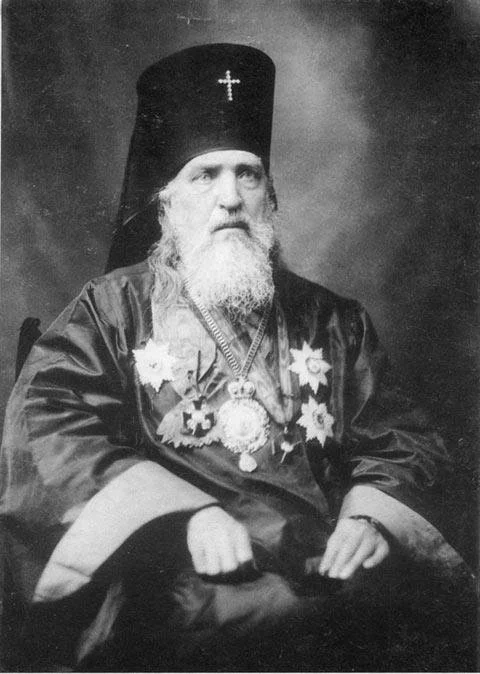
Saint Nicholas of Japan, born Ivan Dmitrievich Kasatkin, was a Russian Orthodox monk, missionary and archbishop who founded the Orthodox Church in Japan. He arrived in Hakodate in 1861, when Christianity was still forbidden in the country, and he died in Tokyo in 1912 as the head of a church of tens of thousands. The Orthodox Church honors him as Equal-to-the-Apostles and Enlightener of Japan.
Unlike the saints of late antiquity, he left a rich paper trail. His diaries, reports, letters and translations survive, and modern scholars have edited and studied them. This lets us tell his life with more confidence than most saints allow, though dramatic conversations and deathbed scenes often come from later retellings and are marked as such below.
Dates in many English sources come straight from Russian Julian-calendar texts without saying so. Where possible this article gives both the Gregorian date and the Old Style date, so that his birth, death and feast can be read without confusion.
Early Life and Family
Ivan Kasatkin was born on August 13, 1836, Gregorian calendar, which was August 1 in the Julian calendar, at Berezovsky Pogost in Smolensk Province. His father was a deacon, so the boy grew up inside the world of parish worship and clerical duty. Some biographies say his mother died when he was about five, but this is UNCERTAIN, since no family record has been found.
He studied at the Belsk theological school and at the Smolensk seminary, from which he graduated in 1857. His ability then took him to the Saint Petersburg Theological Academy, where he met the study of Scripture, the Fathers and the liturgy that would later shape his work as a translator.
There was no conversion from unbelief in his story. He was raised in the Orthodox Church and stayed in it. The turning point was a change of vocation, from preparing for ordinary clerical service to giving his life to the proclamation of the Gospel in a country far from home.
The Call to Japan
In 1860 he accepted a post as priest at the Russian consulate in Hakodate. He was tonsured a monk on June 23 of that year and ordained a hieromonk on June 30, according to the Orthodox Church in America, which gives Russian dates in the Old Style. He took the name Nicholas in honor of Saint Nicholas of Myra.
He reached Hakodate in 1861. His official task was to serve the Russians living there, but he soon wanted more. He understood that preaching to the Japanese required knowing their language, their religions and their customs, and so he spent his first years in study, not in public campaigns.
In 1868 he baptized Takuma Sawabe, a former samurai who had been connected with Shinto, together with two other Japanese. Popular accounts say that Sawabe first came intending to kill him, and that Nicholas persuaded him to listen first. The baptism is well documented, but the details of that meeting are TRADITION from later missionary literature. Sawabe took the name Paul.
Founding the Mission
Nicholas returned to Russia in 1869 to seek approval and funds for a real mission. It was set up soon afterward, though accounts differ on whether the date is 1870 or 1871. In 1872 he moved the center of the work from Hakodate to Tokyo, and in 1873 the Japanese government lifted the old ban on Christianity.
He did not want an enclave of foreigners. He trained Japanese catechists and clergy, opened schools and a seminary, built up a library and a publishing office, and started charitable work. Paul Sawabe was ordained a priest in 1875, a sign that the mission would be led by Japanese Christians. Nicholas was consecrated a bishop in 1880 and made an archbishop on March 24, 1906, as the Orthodox Church in America records.
Historian Robert Gallagher stresses his respect for Japanese language and culture and his training of local workers. Other recent research warns against reading later ideas of independence back into his plans, since his view of the relation with Russia was more complicated. By 1911 the Orthodox Church in America counts 266 communities and 33,017 believers, though sources use different categories and so give somewhat different totals.
The Translator and the Cathedral
Translation was his most lasting work. He worked on the New Testament, the liturgical books, teaching texts and the parts of the Old Testament needed for worship. He did not simply swap words. Japanese religious vocabulary carried the weight of Buddhism and Shinto, and he took pains that a handy term would not teach the wrong meaning.
With the Japanese scholar Nakai he revised the texts again and again. His translations were sometimes called hard to read, because he preferred accuracy to ease. He wished for a complete Bible in Japanese, but he did not live to finish it. His diaries, which record Meiji Japan from a Russian missionary's view, were edited by Kennosuke Nakamura in a five volume Russian edition in 2004 and a Japanese selection in 2011.
He also oversaw the building of the Holy Resurrection Cathedral in Tokyo, called Nikolai-do. According to the cathedral's history, construction began in 1884 and it was consecrated on March 8, 1891. The design is credited to the Russian architect Mikhail Shchurupov, with Josiah Conder of Britain working on its realization. The great Kanto earthquake of 1923 damaged it badly, and it was rebuilt.
A War Between Two Homelands
His hardest test came in the Russo-Japanese War of 1904 and 1905. Nicholas was Russian by birth, yet he was shepherd to Japanese Christians whose country was at war with Russia. He did not leave them. Missionary accounts say he allowed Japanese believers to pray for their country, while he himself did not join public prayers for Japanese victory.
He also helped to arrange care for Russian prisoners of war in Japan. The Orthodox Church in America says that about 73,000 Russian prisoners came to Japan, and that five Russian-speaking priests were chosen to serve them, while another mission history names a larger group. The figures probably count different groups or periods. The broad fact is secure: he stayed loyal to his Japanese flock without forgetting the Russians.
In his last years he suffered from heart disease and was treated in a Tokyo hospital, but he kept working. He died in Tokyo on February 16, 1912, Gregorian, which was February 3 Old Style. He was seventy-five by the Gregorian dates, though the Orthodox Church in America says seventy-six. His funeral drew attention well beyond the Church, and he was buried at Yanaka Cemetery in Tokyo, with the permission of the emperor according to the Orthodox Church in America.
Relics and Glorification
His burial at Yanaka Cemetery is well documented. Devotional reports say that portions of his relics are kept in several Japanese churches, among them Sendai, Hakodate, Osaka and Toyohashi. The exact inventory and its history have not been confirmed from primary records, so this is UNCERTAIN. A reported plan to move his remains to the Tokyo cathedral should not be taken as proof that the body was moved.
The Moscow Patriarchate glorified him on April 10, 1970, as recorded by the Orthodox Church in America. The World Council of Churches site gives 1977, but the more specific date of 1970 is preferred unless an official synodal record says otherwise. A church service in his honor, composed by Metropolitan Nikodim of Leningrad, was published in 1978.
The title Equal-to-the-Apostles honors his work in bringing the Gospel to a whole nation. It does not mean that he belonged to the first generation of the apostles. His life is not marked by a long list of miracles. The sources examined name no documented healings, and a few retold scenes, such as the encounter with Sawabe and details of his last illness, are TRADITION from later biographies.
Nicholas in Scholarship
The best foundation for a life of Nicholas is his own diaries and reports, read with Japanese church records and modern studies. Nakamura's editions made these sources widely available, and Gallagher's article in the Encyclopedia of Christian Civilization offers a short scholarly summary.
An Oxford doctoral thesis on Nikolai and the Russian mission in the Meiji era has questioned simple portraits of him. It shows that his attitudes toward Japanese religion, Russian politics and church independence were more nuanced and that they changed over time.
The Catholic Near East Welfare Association has published a history of the Orthodox Church of Japan by Ronald Roberson, which credits Nicholas with a central place in founding a native Christian community. This is a Catholic source for his missionary work and does not imply that the Catholic Church has canonized him.
Veneration Today
The Orthodox Church keeps his feast on February 3 Old Style, which falls on February 16 on the civil calendar, and he is also remembered among the saints of Smolensk. Icons show him as a bishop holding a Gospel book. The troparion and kontakion in his honor are received liturgical texts, not words of his own.
Pilgrims visit the Holy Resurrection Cathedral in Tokyo and his grave at Yanaka. The Japanese Orthodox Church still uses the translations and the church life that he started, which is itself a living memorial.
People ask his prayers for missionaries, translators, teachers and all who bring the faith across a language or a border, and for peace between nations that are at odds. No formal patronage has been declared by decree.
Lord Jesus Christ, who sent your apostles to every nation, bless all who bring your word across language and border. Through the prayers of Saint Nicholas of Japan, give us patience to learn, courage to serve, and love that stays faithful when nations are divided. Amen.
This prayer is an original composition for devotion. It is not an official liturgical text and was not written by the saint.
Why Nicholas Matters to the Eastern Churches
For Orthodox Christians he is a model of apostolic work in a distant culture. His life shows the value of the vernacular in worship, since he labored to give Japanese Christians the Scriptures and the liturgy in their own tongue.
His example matters for Eastern Catholics as well, who also face the question of how to keep an ancient liturgical tradition alive in new places and languages. His wartime conduct shows how Christian communion can stand beside love of country without becoming hostility to others.
He is a glorified Orthodox saint, and no separate Roman Catholic beatification or canonization has been found. Catholic readers can admire his work as a missionary and still understand clearly that he belongs to the Orthodox calendar of saints.
Frequently Asked Questions
Ask His Prayers
Saint Nicholas of Japan shows how patient learning and love can carry the faith into a new land. Ask his prayers, and keep his prayer card where you will see it each day.
View Prayer Card