Saint Anastasia the Deliverer from Potions: Great Martyr of Sirmium
A Christian martyr of Sirmium, remembered in East and West, who is honored as a friend of prisoners and a healer of those harmed by poison.
At a Glance
- Born
- Traditionally Rome (date unknown)
- Died
- Sirmium, traditionally c. 304 (year uncertain)
- Titles
- Great Martyr, Deliverer from Potions, Pharmakolytria
- Feast
- December 22 (Byzantine); December 25 (historic Roman); January 15 (Zadar)
- Veneration
- East and West; no formal canonization date is recorded
- Patronage
- Invoked against poison, harmful substances and spells
Who Was Saint Anastasia?
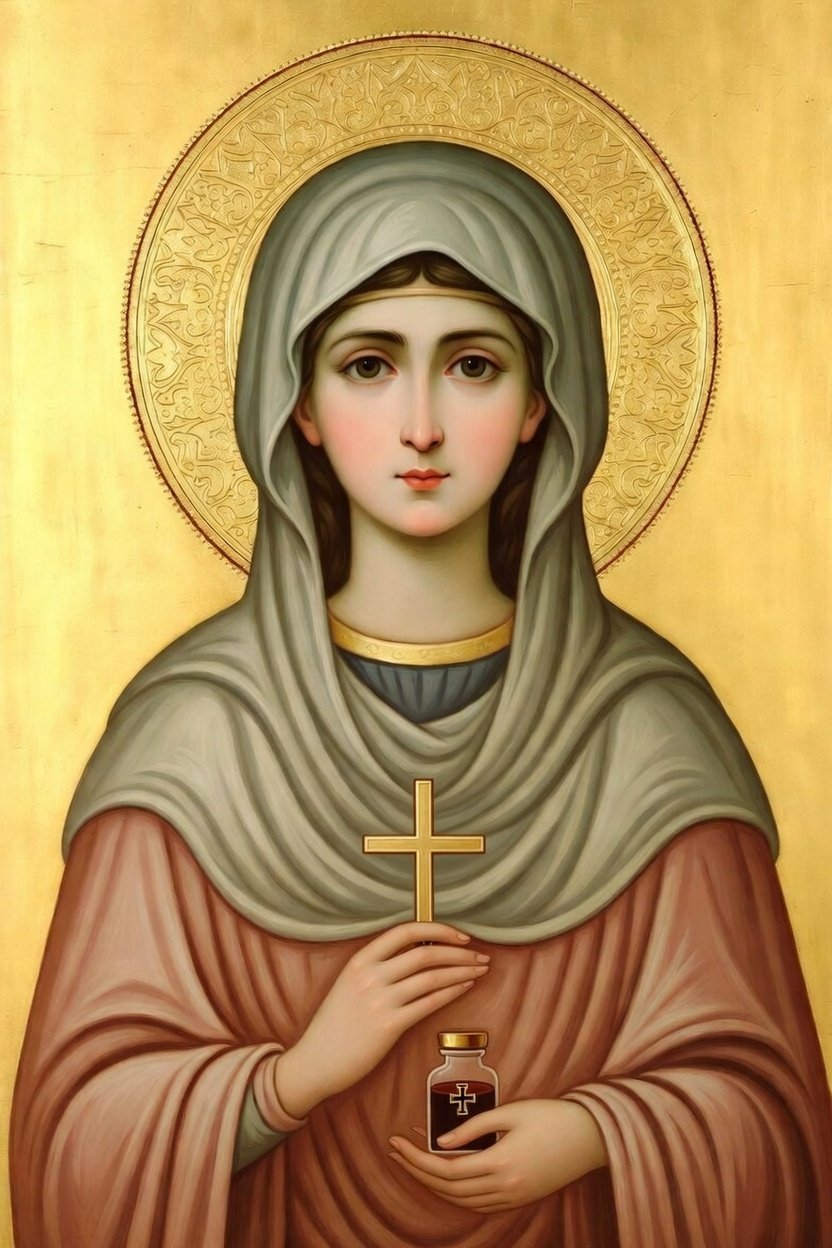
Saint Anastasia the Deliverer from Potions, known in Greek as Pharmakolytria, is a great martyr of the early Church. She is associated with Sirmium, a major city of Roman Pannonia that is now Sremska Mitrovica in Serbia, and with the persecution under the emperor Diocletian. The Byzantine Church keeps her feast on December 22. The old Roman tradition kept her on December 25.
Her name means resurrection in Greek. What can be said with confidence is modest: a Christian martyr named Anastasia was honored at Sirmium, and her cult spread to Constantinople and to Rome. Most of her biography comes from a late Latin Passio, a martyr story built from several older traditions, and it cannot be checked against independent records.
This article therefore separates three layers. The first is what history supports, the early cult and its relics. The second is what is plausible but uncertain, such as her date of death. The third is the story told by the Passio, which is marked here as tradition. The aim is to honor her without claiming more than the evidence allows.
Early Life and Family
According to the Passio, Anastasia was born in Rome to a wealthy family. Her father, named Praetextatus in some sources, was a pagan nobleman. Her mother Fausta was a secret Christian who taught her daughter the faith. The names come from the late narrative, and the Catholic Encyclopedia treats the Roman birth as legendary.
The same tradition says that she was instructed by Chrysogonus, an educated Christian remembered as a martyr of Aquileia, who became her spiritual guide and wrote to encourage her. These letters are literary and cannot be authenticated as real correspondence. The details are TRADITION, and the story may combine martyr traditions that began separately.
The Passio adds that her father married her to a wealthy pagan named Publius. She wished to keep her virginity and avoided married life by claiming to be ill. After her mother's death her husband opposed her faith and the visits she made to imprisoned Christians. None of this can be treated as established biography.
Charity in the Prisons
In the tradition, Anastasia's vocation is not withdrawal from the world but service to Christians in prison. She is said to have entered the jails dressed as a poor woman, bringing food, medicine and clothing to those awaiting trial or death. The Orthodox Church in America adds that she dressed wounds and sometimes paid for release.
When her husband discovered what she was doing, the story says that he beat her and kept her at home. She kept in touch with Chrysogonus, who urged her to endure. The husband then died, and she was free to give away her wealth and take up her work again. This is TRADITION.
Later the Passio ties the martyrdom of Chrysogonus at Aquileia to her own journey toward Sirmium. There she is joined by a Christian widow named Theodota. The pairing is important in the Eastern tradition, though the link between the two women may come from combining separate stories.
Ministry to the Suffering
The works attributed to Anastasia are works of mercy: feeding the imprisoned, washing and dressing wounds, buying what they needed, comforting those about to die and helping to bury the martyrs. The Greek Orthodox Archdiocese stresses her care for imprisoned Christians. These activities explain why she was seen as a healer.
Her later title Pharmakolytria extends that image. The Greek words point to deliverance from drugs, poisons and harmful substances. It is a devotional title and does not mean that she practiced medicine, and no documented cures from her lifetime are known.
She founded no hospital, monastery or community that can be proved, and no writing of hers survives. Her importance lies in the cult that grew around her and in the ideal it preserved: mercy toward the persecuted, shown at personal cost.
Trial and Martyrdom
The Passio places her martyrdom in the persecution begun by Diocletian in 303. Sirmium was an important administrative and military city at the time and was home to a living tradition of martyr memory. The Catholic Encyclopedia holds that the long Roman biography has no secure historical base, while it accepts the link with Sirmium.
The Oxford study by Efthymios Rizos describes the Passio as a compilation of earlier martyr traditions that may contain an older Pannonian core about her trial at Sirmium. Anastasia should not be dismissed as fiction, and the late text should not be taken as an eyewitness report.
The tradition tells of several ordeals. She is said to have been condemned to starve, and to have been sustained by the appearance of Theodota. She and other prisoners are said to have been put on a boat made to sink, and to have been saved. According to the Orthodox account, 120 people were converted and baptized before their own martyrdom. All of these are TRADITION, and the number is not independently verified.
Death and Burial
The strongest tradition places her death at Sirmium. The year is UNCERTAIN. The Orthodox Church in America gives about 304, the Greek Orthodox Archdiocese of America gives 290, and the Archdiocese of Zadar gives December 25, 304. These figures should not be forced into one answer.
The manner of her death also differs between traditions. Byzantine accounts describe her being stretched between pillars and burned alive. A later Latin tradition, reported by the Catholic Encyclopedia, says she was beheaded on the island of Palmaria. Vatican News follows the burning tradition. Neither version rests on a contemporary witness.
Her cult is attested early. Her name appears on December 25 in the Martyrologium Hieronymianum, a very old Latin martyrology. A study by Ivana Popović and Snežana Ferjančić, published in 2013, examines an inscription from Sirmium that seems to mention a basilica of Anastasia. The exact place of her original tomb is not established.
Relics and Churches
According to the historian Theodorus Lector, her remains were moved to Constantinople during the patriarchate of Gennadius, from 458 to 471, and placed in a church once called the Anastasis, meaning Resurrection. This move helped spread her cult across the Byzantine world. How the relics were later divided cannot be fully traced.
In Rome the church of Sant'Anastasia al Palatino stands near the Palatine hill. The older titulus may have been named for a Roman benefactress and not for the martyr of Sirmium. By the late fifth century her veneration was strong in Rome, and her name entered the Roman Canon. Her feast was tied to the second Mass of Christmas. A church of that name is not proof that her body lies there, and Rizos notes that no relic transfer to Rome is documented.
The cathedral of Zadar in Croatia holds the best documented medieval relic tradition. The Archdiocese of Zadar reports that Bishop Donatus received her relics from Constantinople in 810 and had a sarcophagus made, with inscriptions naming her. This shows medieval devotion but does not prove the remains are those of the martyr of Sirmium. The Orthodox Church in America says her head and a hand were taken to the monastery of Saint Anastasia near Mount Athos, which is TRADITION.
The Passio in Scholarship
The Latin Passio Anastasiae is edited and studied by P. F. Moretti in a critical edition of 2006. Earlier, the Bollandist Hippolyte Delehaye studied the Roman legends of November and December and showed how martyr stories were joined and expanded.
Rizos has traced how martyrs of the northwest Balkans entered the Byzantine tradition, and he separates three things: the movement of relics, the circulation of stories, and the growth of liturgical devotion. In the case of Anastasia, all three are visible, though they did not always travel together.
Scholars also warn against merging women of the same name. The Orthodox Church also keeps Anastasia the Roman in October, and the traditions sometimes blur. Anastasia of Sirmium is the martyr honored on December 22 with the title Deliverer from Potions.
Devotion Through the Year
The Byzantine Church keeps December 22, and the Greek Orthodox Archdiocese and the Orthodox Church in America publish hymns and a life for the day. The hymns are received liturgical texts. They praise her service to persecuted Christians and her endurance, and they are not words of the saint.
In the West her name stands in the Roman Canon, in the list of women martyrs, and her old commemoration fell on December 25. Zadar keeps a local feast on January 15, and pilgrims visit the cathedral that bears her name.
People ask her prayers against poison and harmful substances, and for the healing of the sick and the help of prisoners. Because the title came to her through devotion, it is best understood as a sign of trust and not as a claim of a documented gift.
Lord Jesus Christ, who raised the lowly and comforted the imprisoned, grant us hearts that serve the suffering. Through the prayers of Saint Anastasia the Deliverer from Potions, protect us from what harms body and soul, and give us courage to show mercy. Amen.
This prayer is an original composition for devotion. It is not an official liturgical text and was not written by the saint.
Why Anastasia Matters to the Eastern Churches
Anastasia is a link between the churches. Her cult began in Roman Pannonia, passed to Constantinople, and became important in Rome. Her story shows how a martyr's memory could cross languages and borders.
Her observance remains in the Byzantine calendar, which gives Eastern Catholics who follow the Byzantine rite a shared context for her veneration. Each church uses its own approved calendar, so no universal claim is made here.
Her example speaks of endurance under persecution, care for prisoners, and hope in the resurrection. These readings come from the character of her cult and not from independent proof of every episode told about her.
Frequently Asked Questions
Ask Her Prayers
Saint Anastasia the Deliverer from Potions shows mercy at cost, and faith that does not break under pressure. Ask her prayers, and keep her prayer card where you will see it each day.
View Prayer Card