Saint Alexis the Man of God: Voluntary Pauper of Edessa and Rome
The anonymous beggar of Edessa who became the beloved Alexis, and a legend of poverty and hidden love that traveled from Syria to Constantinople and Rome.
At a Glance
- Born
- Traditionally Rome, late fourth century (uncertain)
- Died
- Traditionally 411 or 417; Edessa in the earliest Life, Rome in later versions
- Titles
- Venerable, Man of God, Confessor, Voluntary Pauper
- Feast
- March 17 (Byzantine); July 17 (older Western calendar)
- Veneration
- East and West; no formal canonization date is recorded
- Patronage
- Popularly beggars, the poor and pilgrims; no formal patronage
Who Was Saint Alexis the Man of God?
Saint Alexis the Man of God is one of the best loved saints of the Christian East and West, and one of the hardest to pin down. The story that carries his name tells of a young Roman of great wealth who left his bride on their wedding night, lived as a beggar in Edessa, and later returned unrecognized to his father's house. He is commemorated on March 17 in the Byzantine calendar and was long kept on July 17 in the West.
The earliest form of this story is not about Alexis at all. It is a Syriac Life of an unnamed holy man, called simply the Man of God, set in the city of Edessa. The name Alexis, the Roman chapters and the staircase are later growths. A careful biography has to separate three layers: the early Syriac tale, the Byzantine and Latin expansion, and the liturgical cult.
For that reason this article tells the traditional story plainly and marks it as tradition. His dates, family, place of death and relics are uncertain. What is certain is the long and well documented devotion to him, and the power of the ideal that Christians saw in his story: wealth given up, love kept hidden, and a humility that asked for no reward.
Early Life and Family
The Syriac Life, preserved in manuscripts from the sixth century and thought to have been composed at Edessa around the middle of the fifth century, says that the Man of God came from a wealthy Christian family in Rome. His parents had long been childless, and he was born in answer to their prayers. This is TRADITION, since no independent record confirms his birthplace or parents.
The familiar names Euphemianus for his father and Aglais for his mother belong to the later Greek and Byzantine tradition and do not appear in the earliest Life. In that tradition his parents are noble and charitable. The Orthodox Church in America's account adds that he studied Scripture from childhood, gave alms, fasted and secretly wore penitential clothing beneath fine garments, all details of the received legend.
His parents arranged a marriage for him. According to the tradition, on the night of the wedding he gave his bride objects of value, often described as a ring and a belt, and left secretly for the East. The bride is not named in reliable sources. Modern readers may find this hard, and the story should not be read as permission to abandon a spouse or other lawful duties. Its theme is renunciation of wealth and rank, told in the language of late antique asceticism.
The Road to Edessa
The saint does not convert from another faith. The story shows a Christian who chooses an extreme ascetic vocation. In the earliest Syriac version he travels from Rome by way of Seleucia to Edessa, where he takes his place among the poor at the door of a church.
By tradition he stays there for seventeen years. He keeps only what he needs to live and gives away the rest of his alms to others who are poorer than he is. This detail gives the early Life its moral center, since in it poverty and generosity belong together. The seventeen years are a figure of the legend and are not a verified chronology.
The Life says that an attendant of the church, a kind of sacristan, came to see that the beggar was no ordinary man. The earliest version respects the holy man's wish to remain unknown. The later Byzantine version brings a miracle, in which an icon of the Mother of God speaks and names him. This is TRADITION, and it is the event that drives him to leave Edessa to escape the honor that follows.
Return to Rome
In the longer Byzantine and Latin versions, Alexis sets out for Tarsus, the city of Saint Paul, but a storm drives his ship to Italy. He comes to Rome and goes to his father's house, where no one knows him. The father allows the beggar to stay on the property. This is TRADITION, and it does not appear in the earliest Syriac Life.
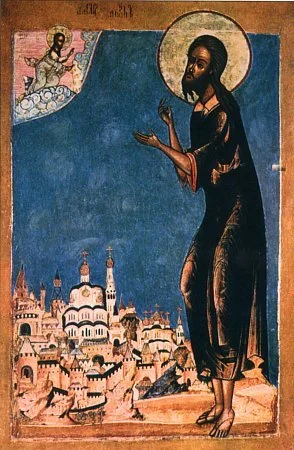
The legend gives him another seventeen years there, living under a staircase or in a small place near the entrance, and enduring the mockery of servants. The detail of the staircase belongs to the expanded story and is not established as history. The Roman basilica on the Aventine shows a staircase that tradition links to him, but no reliable evidence ties it to his father's house.
Alexis founded no monastery and held no office, and no writing of his survives. His ministry, in all versions, is the witness of a hidden life. The sources give a man who prays, fasts, receives the Eucharist and lives in plain sight among people who do not see him. The hymn of Joseph the Hymnographer in the ninth century is one of the sources that give the name Alexis to the anonymous figure, according to the study by Anna Rogozhina.
Trials and Hidden Love
The sufferings in the legend are hunger, cold, ridicule and the pain of hearing his own family grieve for him while he keeps silent. In the Roman version his bride and his parents mourn a son whom they cannot find, and he hears them. These are TRADITION, and the pathos of the story is a large part of why it was loved.
The story also raises questions that historians cannot settle. The Catholic Encyclopedia places the early Life in the time of Rabbula, bishop of Edessa from 412 to 435, but the Life was written well after the period it describes. The Roman version names the emperors Honorius and Arcadius and Pope Innocent I together, but Arcadius died in 408 and Innocent I reigned until 417, so the details cannot all be true at once.
Scholars have also noted how close the tale is to the legend of John the Hut-Dweller, another young man who leaves a rich home and lives unknown near his parents. The similarities may come from borrowing or confusion, and they do not prove that the two are one person. The honest conclusion is that the story is hagiography that grew over time around an anonymous holy beggar of Edessa.
Death and Discovery
In the earliest Syriac Life the Man of God dies at Edessa. The sacristan then tells the bishop who he was, and when the clergy go to the grave they find it empty. The bishop is moved to greater care for the poor. This is TRADITION, but it belongs to the oldest layer of the story.
The later version says that Alexis died in his father's house, holding a paper that told who he was. A voice was said to have been heard in the churches, announcing that a man of God lay in the house of Euphemianus. When the paper was finally taken from his hand, the family learned the truth, and they wept. The Orthodox Church in America gives 411 as the year of death, and the Catholic Encyclopedia mentions 417, but these are traditional dates and not verified ones.
The Orthodox account also says that fragrant myrrh flowed from his remains and healed the sick, which is TRADITION. He was given a solemn funeral in the later story. There is no formal canonization or glorification date for him. His sainthood was recognized by the liturgical cult that grew up around him, as it was for many saints of that early period.
The Roman Cult and the Relics
The cult of Alexis in Rome is better documented than his life. According to the Catholic Encyclopedia, Pope Benedict VII gave the church of Saint Boniface on the Aventine hill to Sergius of Damascus in 972. A community of Greek and Latin monks formed there, and devotion to Alexis became attached to the church. Rome's tourism authority dates the addition of Alexis to the church's dedication to 986. These are two different developments and not conflicting dates for one event.
The church is now the Basilica of Saints Boniface and Alexis. Relics were reported found in 1216, according to the Orthodox Church in America, and Rogozhina records a quarrel with the clergy of Saint Peter's, who also claimed to have his body. Rome's tourism authority says relics of Boniface and Alexis were placed under the main altar in 1217.
Other relic claims exist as well. A head said to be his is kept at the monastery of Agia Lavra in Greece, and a right hand was once kept at Saint Sophia in Novgorod. These are historical claims of possession and veneration, and not scientific proof. With the empty grave of the earliest Life, and with several rival claims, the place of his remains cannot be fixed.
The Legend in Scholarship
The key modern study is Anna Rogozhina's article on the anonymous saint in the Armenian tradition, published in 2022. It traces the Syriac, Greek and Armenian forms of the story and shows how the name Alexis entered a tale that began without a name. The older edition of the Syriac legend by Arthur Amiaud in 1889 and the notes of the Bollandists in the Acta Sanctorum are the older foundations of this work.
Scholars still disagree about the exact direction of borrowing between the later Greek and Syriac versions. It would be wrong to call every Greek detail later than every Syriac one. The Catholic Encyclopedia of 1907 stressed the Eastern origin of the cult, and more recent work has refined the picture without overturning it.
The story also spread widely. It was told in Greek, Syriac, Armenian, Arabic, Slavic and the languages of Western Europe, and it became a favorite of medieval storytellers because of its drama of hidden identity and recognition. That history is itself part of the saint's importance.
Veneration Today
In the Byzantine calendar Alexis is kept on March 17, and the Orthodox Church in America and the Greek Orthodox Archdiocese of America both publish a Life and hymns for the day. The troparion praises him for giving up worldly goods to seek Christ, and the hymn is a received liturgical text and not a prayer of the saint.
In the West his feast was July 17. It was removed from the General Roman Calendar in the reforms of 1969, which did not forbid honoring him as a saint. Pilgrims still visit the Aventine basilica, and artists have shown him in poor clothes, holding a letter or standing near a staircase.
Popular devotion links him with beggars, the poor and pilgrims, though no formal patronage has been declared. People who ask his prayers often seek help to let go of wealth and status, to give generously, and to bear being overlooked.
Lord Jesus Christ, who had nowhere to lay your head, loosen our hold on wealth and reputation. Through the prayers of Saint Alexis the Man of God, teach us to give with an open hand, to love the poor, and to be content when no one notices us. Amen.
This prayer is an original composition for devotion. It is not an official liturgical text and was not written by the saint.
Why Alexis Matters to the Eastern Churches
Alexis is a bridge between the churches. His story began in Syriac Edessa, was given its name in Byzantine hymns, and entered Rome through the Greek and Latin monks of the Aventine. In him the traditions of Syria, Constantinople and Rome meet.
Rogozhina documents an Armenian reception of the tradition as well, with Armenian versions that present him as a voluntary pauper and evidence of his place in Armenian synaxaria by the fourteenth century. This does not show that every Eastern Catholic church keeps the same feast, and no such claim is made here.
Readers can hold the story in two ways. As history, it is a tradition that grew from an anonymous Syriac tale. As devotion, it is a long witness to the value of poverty, hidden charity and humility. Both are honest, as long as the legend is not presented as proven fact.
Frequently Asked Questions
Ask His Prayers
Saint Alexis the Man of God shows that a life can be given away quietly and still bear fruit. Ask his prayers, and keep his prayer card where you will see it each day.
View Prayer Card