Saint Symeon the Fool of Emesa: Holy Fool and Ascetic of Syria
A desert ascetic who walked into a Syrian city as a fool so that no one would honor him, and whose Life shaped the whole tradition of holy foolishness.
At a Glance
- Born
- Traditionally Edessa (date unknown)
- Died
- Emesa (Homs), Syria; year uncertain, sixth century
- Titles
- Venerable, Holy Fool, Fool for Christ, Ascetic
- Feast
- July 21 with his companion John (Byzantine calendar)
- Veneration
- Eastern Orthodox; no formal canonization date is recorded
- Patronage
- No formal patronage; sometimes invoked by those who suffer mental illness
- Who Was Saint Symeon the Fool?
- Early Life and Family
- Pilgrimage and the Desert
- The Fool in the Streets of Emesa
- Accusation and Dishonor
- Death and Burial
- Miracles and Traditions
- Symeon in Modern Scholarship
- Veneration and the Calendar
- Why Symeon Matters to the Eastern Churches
- Frequently Asked Questions
Who Was Saint Symeon the Fool?
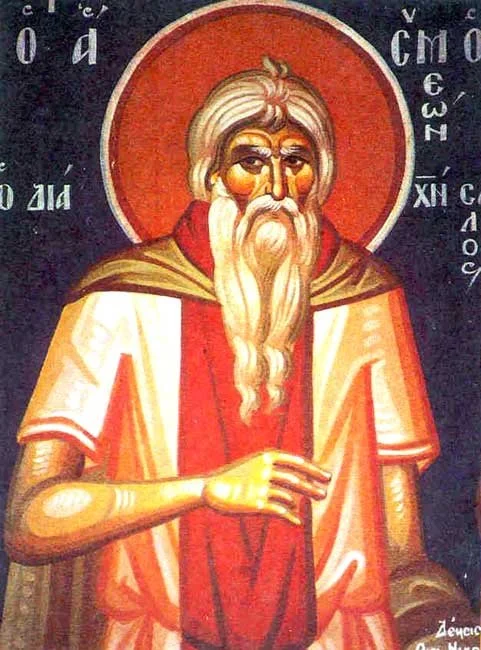
Saint Symeon the Fool of Emesa, also called Symeon Salos, is the best known of the early holy fools of the Christian East. He is remembered as a desert ascetic who returned to a Syrian city and pretended to be mad so that his virtue would stay hidden and his pride would stay low. The Byzantine Church commemorates him on July 21 together with his companion John.
Two ancient writers tell his story. Evagrius Scholasticus, who wrote an Ecclesiastical History in the late sixth century, gives a short account in Book IV. Leontius of Neapolis, a bishop on Cyprus, wrote a much longer Life in the middle of the seventh century. Most of what is told about Symeon comes from Leontius, and the two accounts do not always agree.
Modern scholars, above all Derek Krueger in his 1996 study, treat the Life as a work of literature as well as a source of history. That does not erase Symeon. It means that his family, years in the desert, miracles and death are described here as the Life tells them, and that dates and details are marked as uncertain where the evidence is thin.
Early Life and Family
According to Leontius, Symeon came from Edessa in Mesopotamia, a city with a deep Syriac Christian heritage. His father had died, and he lived with his mother, whom the Life describes as very old. Her age, like other details, comes from the Life and not from an independent record.
His close friend was John, another young man of Edessa. John was married and had family duties. The two became inseparable, and their friendship stays at the center of the story. The Orthodox Church in America gives the ages of thirty for Symeon and twenty-four for John when they set out for Jerusalem, but these figures are tradition and cannot be checked.
One touching feature of the Life is that Symeon does not stop loving his mother. The narrative describes his grief at leaving her and his later prayers for her soul. Holiness here is not coldness toward family but affection offered to God. The sources disagree about how the two friends met, since Leontius has them meeting on pilgrimage while some summaries make them friends from childhood, and the earlier witness Evagrius says nothing on the point.
Pilgrimage and the Desert
The Life tells that Symeon and John went on pilgrimage to Jerusalem. After visiting the holy places they began to see how short earthly life is, and they decided to give themselves entirely to God. They were received as monks by an abbot named Nikon, whose monastery lay near the Jordan.
Later the two friends left the community for the wilderness near the Dead Sea. By tradition they lived there for about twenty-nine years in fasting, prayer and vigilance, though some later summaries speak of more than thirty years. These round figures are traditional and not verified.
The turning point came when Symeon decided that he must leave the desert to serve others. He feared that a reputation for holiness would feed vanity. John stayed in solitude. Symeon went to Emesa, and the Life says that there he chose to put on the appearance of a fool.
The Fool in the Streets of Emesa
The Greek word salos means a fool or a madman. In Christian use it names an ascetic who accepts contempt in order to hide his virtue, humble his pride and call others to repentance. Symeon is the model. Evagrius describes a man who avoided honor, behaved strangely in public and slipped away whenever people tried to venerate him.
Leontius adds many scenes, each a TRADITION. Symeon is said to have entered Emesa dragging a dead dog, which at once ruined any hope of being taken for a respectable holy man. Another scene shows him scattering nuts in a church. He is also shown eating and mixing with people of poor reputation, always as part of a hidden purpose.
Behind these scenes the Life shows a man who helps the poor, rebukes hypocrisy and leads sinners to repentance. He founded no monastery and wrote nothing. Krueger notes that Leontius shaped the episodes after patterns found in earlier literature, so not every story can be taken as a recorded event. The Life is a portrait of a way of holiness more than a diary.
Accusation and Dishonor
Evagrius preserves a story that shows the cost of the vocation. A woman accused Symeon of being the father of her child, and he did not defend his name. The story is told as TRADITION, and its point is that he preferred dishonor to exposing his hidden holiness.
The sources also differ about the earthquake he is said to have foretold. Evagrius ties it to a known quake, which has been dated to 551. Leontius places an earthquake prophecy under the emperor Maurice, who reigned from 582 to 602. The two cannot be joined into one timeline, so no firm date for Symeon can be drawn from them.
Leontius wrote on Cyprus, probably between 642 and 649 according to Krueger, about a man who had lived generations earlier. He names a deacon, John of Emesa, as his source. Whether a real eyewitness lies behind this is UNCERTAIN, and Krueger reads the claim as a literary convention. Sergey Ivanov adds that the Church itself later set limits on feigned madness, and a canon of the Council in Trullo warns against it, so Symeon's life is not offered as a pattern for ordinary Christians.
Death and Burial
The Life says that Symeon withdrew to his poor dwelling in Emesa and prepared for death. The year is UNCERTAIN. The Greek Orthodox Archdiocese of America gives 570, but other reference works give other dates, and a range of 522 to 588 found in some library records is not a settled fact.
According to Leontius, before dying he spoke with John the deacon about charity, repentance and reconciliation before approaching the altar. The Life presents his last counsel as a call to care for the poor and not to seek admiration for spiritual feats. These words belong to the Life and are not given here as a quotation.
After his death, poor people of the city found his body and buried it without ceremony. Tradition says a former Jewish glassblower, who had become a Christian through Symeon, heard heavenly singing at the burial. When John the deacon and others later came to move the body to an honored grave, they found the tomb empty. Leontius reads this as divine glorification, and it is a TRADITION. No relics are known to survive.
Miracles and Traditions
The Life gives many stories of healing and of deliverance from evil spirits, always told so that Symeon keeps his public reputation as a fool. The Orthodox Church in America lists healing, exorcism and conversions among the works attributed to him. All of these are TRADITION and cannot be confirmed by independent sources.
A few stories stand out. In one, a generous mule driver sees his wine turn to vinegar, and Symeon quietly intervenes so that the man's livelihood is restored. In another, a sick man dreams of a contest with death over dice and promises to give up infidelity, and Symeon is linked to his recovery. Each tale joins a small miracle to a call to repent.
These stories come from different layers of memory. Evagrius represents an earlier layer, with the earthquake and the accusation. Leontius represents a later and richer layer, with the funeral singing and the empty grave. Readers can value the spiritual meaning of each story without treating them all as equally close to Symeon's own life.
Symeon in Modern Scholarship
Derek Krueger's Symeon the Holy Fool, published by the University of California Press in 1996, is the standard study in English. It includes a translation of the Life and argues that Leontius built his portrait with care, using patterns drawn from earlier stories of philosophers and from the Gospels.
Sergey Ivanov's Holy Fools in Byzantium and Beyond, published by Oxford University Press in 2006, places Symeon in the wider history of holy foolishness. Ivanov points out that scandalous behavior was never universally approved and that the Church sometimes restricted it.
The Life also had a long afterlife. Scholars trace its influence on later Byzantine hagiography, including the Life of Andrew the Fool for Christ. The line of influence was mostly literary, and not a chain of disciples handing the practice down. Symeon is also named in discussions of the history of mental illness, but the ancient sources give no basis for a diagnosis, since both Evagrius and Leontius present his behavior as deliberate.
Veneration and the Calendar
Symeon is commemorated on July 21 together with John in the Byzantine calendar. The Greek Orthodox Archdiocese of America and the Orthodox Church in America both publish the commemoration, with a biography and hymns for the two ascetics. The hymns are received liturgical texts, not words of Symeon himself.
An older Western tradition lists a Saint Simeon Salus on July 1. Sabine Baring-Gould, in his Lives of the Saints, says that Cardinal Baronius placed Symeon in the Roman Martyrology on that date. This is a historical observance, and it should be kept apart from the Byzantine date and not read as a feast in the present Roman calendar.
No tomb or shrine is known, so devotion to Symeon is a devotion of imitation. Those who ask his prayers ask for freedom from the need to be admired, for kindness toward people whom society dismisses, and for the courage to do good quietly. He is sometimes invoked by those who suffer from mental illness, although no formal patronage has been established.
Lord Jesus Christ, who became poor and despised for our sake, free us from the need to be admired. Through the prayers of Saint Symeon the Fool of Emesa, teach us to do good quietly, to love the people others overlook, and to seek only your approval. Amen.
This prayer is an original composition for devotion. It is not an official liturgical text and was not written by the saint.
Why Symeon Matters to the Eastern Churches
For Orthodox readers, Symeon opens the long tradition of holy fools that later flowered in Constantinople and in Russia. He stands for the saying of Saint Paul that the wisdom of this world is foolishness with God, and the Life draws on that teaching in its opening pages.
His commemoration with John also teaches that holiness takes more than one shape. John stays hidden in the desert, and Symeon returns to the city. The Church honors both, and the Life insists that Symeon's life in the city is the fruit of his years of prayer and not a break from them.
For Eastern Catholics, the themes of humility, prayer and compassion belong to the shared heritage of the Christian East. A specific commemoration of Symeon in an Eastern Catholic calendar has not been verified in the sources used for this article, and none is claimed here.
Frequently Asked Questions
Ask His Prayers
Saint Symeon the Fool of Emesa shows that love can hide itself, and that real goodness does not need an audience. Ask his prayers, and keep his prayer card where you will see it each day.
View Prayer Card