Saint Thomas the Fool of Syria: Monk and Holy Fool of Antioch
A sixth-century monk who hid his holiness behind feigned foolishness, and whose burial was remembered in Antioch for generations.
At a Glance
- Born
- Unknown (neither date nor birthplace is recorded)
- Died
- Sixth century, at Daphne near Antioch (exact year uncertain)
- Titles
- Venerable, Monk, Holy Fool, Fool for Christ
- Feast
- April 24 (Byzantine calendar)
- Veneration
- Eastern Orthodox; no formal canonization date is recorded
- Patronage
- No formal patronage is established
- Who Was Saint Thomas the Fool of Syria?
- Early Life and Family
- A Vocation of Hidden Holiness
- The Monk of the Errand
- The Blow at Antioch
- Death and Burial at Daphne
- Miracles and Traditions
- Holy Foolishness in Scholarship
- Veneration Today
- Why Thomas Matters to the Eastern Churches
- Frequently Asked Questions
Who Was Saint Thomas the Fool of Syria?
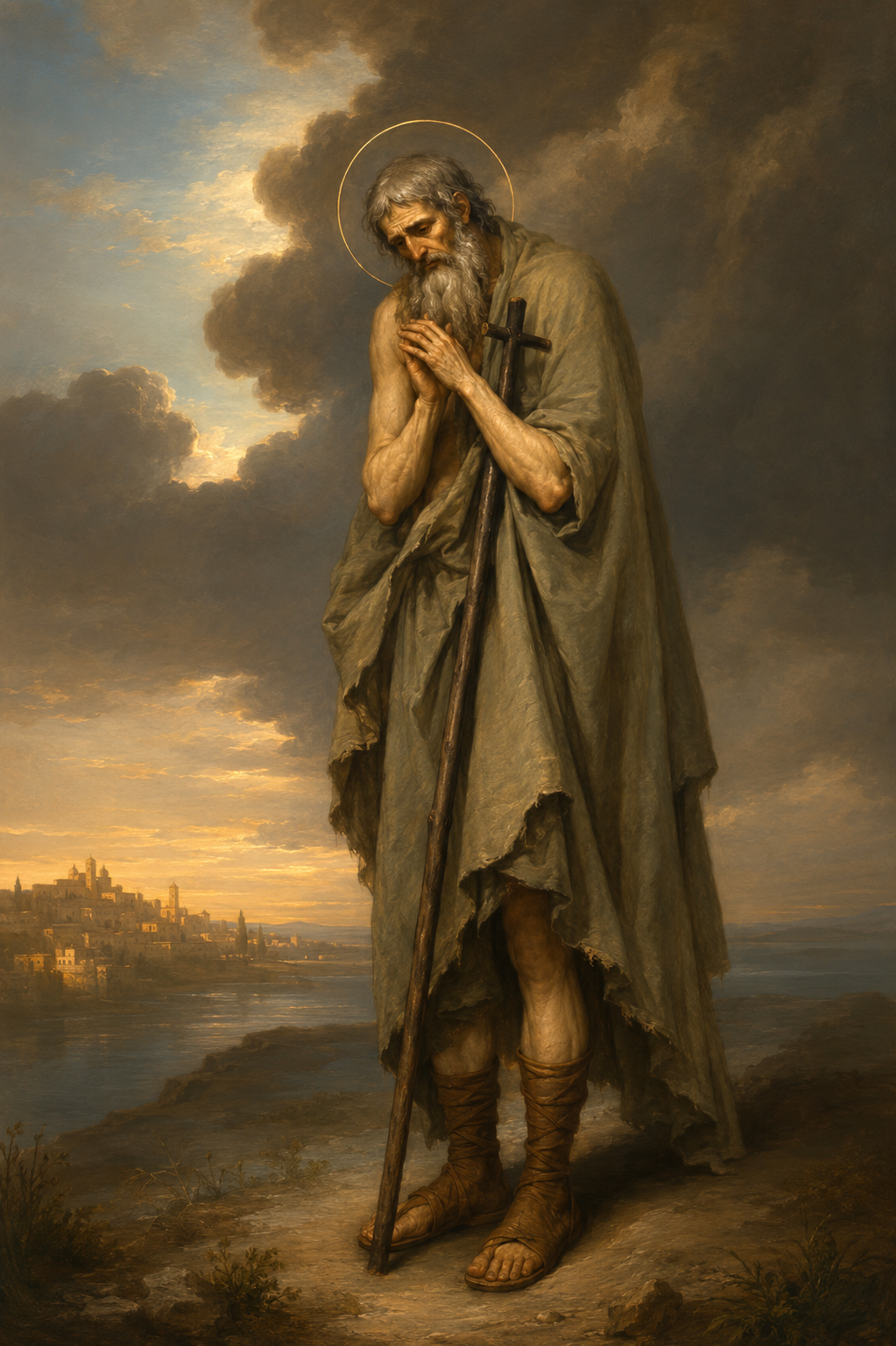
Saint Thomas the Fool of Syria was a monk of the sixth century who is remembered in the Christian East as a holy fool, one of those ascetics who chose to appear foolish so that their virtue would stay hidden. He is commemorated on April 24 in the Byzantine calendar. Unlike many saints, he left no writings, founded no monastery, and held no office in the Church.
What we know of him comes mainly from two early witnesses. The first is Evagrius Scholasticus, who wrote an Ecclesiastical History at Antioch in the late sixth century and gave Thomas a short chapter in Book IV. The second is John Moschus, whose Spiritual Meadow preserves a further account of Thomas and his burial. Both agree on the central facts, though they differ in some details.
Thomas should not be confused with Saint Symeon the Fool of Emesa, whose chapter immediately precedes his in Evagrius. The two men practiced a similar kind of asceticism and lived in the same region, but they are distinct people. Thomas is also not the same as the unnamed nun who feigned madness in the Lausiac History of Palladius, who belongs to an earlier Egyptian setting.
Early Life and Family
Nothing reliable survives about Thomas's birth, parents, childhood or education. His birthplace is UNCERTAIN. The title Syrian points to the region where he was active, not necessarily to his ethnicity or native language, since Greek, Syriac and other tongues were used by Christians in late antique Syria.
Even the location of his monastery is disputed in the sources. Evagrius places his ascetic activity in Coele-Syria. John Moschus describes him as the representative of a communal monastery in the district of Apamea. Some later Orthodox summaries instead place his monastery at Caesarea in Cappadocia. These accounts have not been reconciled, and it is safest to say only that Thomas belonged to a monastic community in the Roman East.
There is no record of his baptism or of a dramatic conversion. The earliest accounts meet him when he is already a monk. This silence is itself instructive: the writers who preserved his memory cared about the shape of his sanctity and not about the details of his biography.
A Vocation of Hidden Holiness
The ascetic path Thomas followed is called in Greek the way of the salos, the fool. The biblical root is Saint Paul's phrase in the First Letter to the Corinthians, where he says that the apostles are fools for Christ's sake. Later Christians read in this a call to let the world misjudge them for the sake of humility.
Evagrius explains Thomas's conduct by placing it beside the practice of Symeon of Emesa. The behavior was understood as deliberate, a concealment of spiritual maturity under an appearance of folly, and not as a sign of true illness. Some devotional summaries add that Thomas undertook this discipline with his abbot's blessing, but that detail is not found in Evagrius or Moschus, so it should be treated with caution.
We do not know the name of his abbot, the moment he began this way of life, or how long he kept it. What the sources do record is that his hidden asceticism did not cut him off from ordinary duty. He remained a working member of a monastery, and his most important recorded task was an errand of obedience.
The Monk of the Errand
According to Evagrius, Thomas's monastery received a yearly allowance from the revenues of the Church of Antioch, and Thomas was the monk who traveled to the city to collect it. John Moschus uses a term that means representative or delegate, which fits this picture of a brother entrusted with the community's practical business.
This detail matters. It shows that Thomas was not a wandering eccentric but a monk under obedience, serving the material needs of his brothers. Holy foolishness in his case was joined to quiet, unglamorous responsibility.
Beyond this errand there is nothing to say of a public ministry. No sermons, letters or instructions of Thomas have survived, and no church or monastery can be credited to him in his lifetime. His significance lies in the example of his life and in the devotion that grew around his grave.
The Blow at Antioch
The best-attested episode in his life is his meeting with Anastasius, an administrator of the Church of Antioch. Evagrius reports that Thomas came repeatedly about the monastery's allowance. Anastasius lost patience and struck him on the head.
Bystanders objected to the treatment of the monk. Thomas, according to Evagrius, said that he would take nothing further from Anastasius and that Anastasius would give nothing further either. Anastasius died the next day, and Thomas died while returning to his monastery.
Christian tradition reads these words as prophecy, and the telling is a TRADITION in the sense that no independent record confirms the circumstances. The text should not be rewritten to say that Thomas cursed Anastasius or caused his death, because the sources do not say so. The background was a hard age: Justinian's wars with Persia, the sack of Antioch in 540, and the great plague that began in the early 540s.
Death and Burial at Daphne
Both Evagrius and Moschus place Thomas's death at Daphne, a suburb of Antioch. Evagrius says he died in a house for the sick. Moschus names the shrine of Saint Euphemia, and some later Orthodox accounts name a church of Saint Euthymius. The relation between these places is UNCERTAIN, so each name should be tied to its source.
He was first buried in a place reserved for strangers. The exact year of his death cannot be fixed. Evagrius links the report of his burial to Patriarch Ephraim of Antioch, who held office from 527 to 545, while Moschus links it to Patriarch Domninus, whose tenure began around 545 and ended around 559. Later calendars sometimes use a date near the middle of the century, but this is only an approximation.
Neither source describes a formal act of canonization. His sainthood was recognized as it was for many early saints, through local devotion, the honoring of his relics and a yearly commemoration at Antioch. Evagrius says that the people of Antioch still kept his annual festival in his own day.
Miracles and Traditions
The burial story is the heart of his cult. Evagrius says that Thomas's body rose above the bodies of others placed in the same grave. Moschus gives a longer version in which the body of a woman buried over Thomas was thrown out, and a second burial had the same result, after which the witnesses decided he should have a separate grave. These are TRADITION, and the differences between the two versions suggest a story told and retold.
Evagrius also reports that a plague at Antioch ceased after Thomas's relics were carried in procession from Daphne into the city. Moschus mentions candles, the singing of psalms, the placing of the relics near those of martyrs, and a small oratory built over the grave. These details show a cult already organized and public within a generation or two.
Modern Orthodox summaries speak of many healings at the small church over his relics, but they name no persons, dates or conditions. It is more honest to describe them collectively than to invent individual stories. His relics are said to have been moved to Antioch, and their present whereabouts are unknown.
Holy Foolishness in Scholarship
Modern study of holy fools has been shaped by Derek Krueger's work on Symeon the Holy Fool and the late antique city, published by the University of California Press in 1996. Krueger stresses that stories of holy fools are literary as well as historical, and that individual episodes cannot always be reconstructed as events.
Thomas is an interesting test case because he is attested by a historian who wrote within living memory and by a later collector of monastic stories, who agree on the main outline. That gives his existence a firmer footing than many hagiographic figures have, even while the miracles remain matters of religious testimony.
Scholars also note the pairing in Evagrius of Symeon and Thomas, which suggests that holy foolishness was recognized as a distinct and respected form of holiness in sixth-century Syria. The category was not yet a fixed type, and Thomas's story shows how it grew from practice into literature.
Veneration Today
No shrine of Thomas survives in a form that can be visited as his tomb. His memory is kept chiefly through the liturgy. The Orthodox Church in America publishes his commemoration on April 24, together with a troparion and kontakion in the Eighth Tone, and the Prologue from Ohrid carries a short life under the same date.
The Old Calendar observance falls on May 7 on the modern civil calendar, which is a matter of calendar conversion and not a separate feast. In the West, no independent Roman Catholic feast has been found in the sources consulted.
Because he has no tomb to visit, devotion to Thomas is largely a devotion of imitation: those who ask his prayers are asking for humility, for patience under unjust treatment, and for faithfulness in small tasks done for the sake of others.
Lord Jesus Christ, who chose the lowly and the hidden, teach us to love humility more than praise. Through the prayers of Saint Thomas the Fool of Syria, grant us patience when we are wronged, faithfulness in the small tasks you give us, and a heart that seeks only your approval. Amen.
This prayer is an original composition for devotion. It is not an official liturgical text and was not written by the saint.
Why Thomas Matters to the Eastern Churches
For Orthodox readers, Thomas is a saint with an established place on the calendar and a modest but ancient cult. His life gives an early example of obedience joined to hidden asceticism, a pairing that later Byzantine and Slavic holy fools would carry far beyond Syria.
For Eastern Catholics, his story belongs to the shared heritage of the Christian East before the later divisions. A specific commemoration in a Maronite, Melkite, Syriac or other Eastern Catholic calendar has not been verified in the sources used for this article, and none is claimed here.
Readers should hold the story in two ways at once. The outline is supported by early witnesses, and the wonders rest on faith in the communion of saints. Both can be respected without pretending that the evidence says more than it does.
Frequently Asked Questions
Ask His Prayers
Saint Thomas the Fool of Syria teaches that holiness often goes unseen and that obedience and humility are worth more than reputation. Ask his prayers, and keep his prayer card in a place where you will see it each day.
View Prayer Card