Saint Andrew the Fool for Christ of Constantinople: Holy Fool and Seer of Blachernae
A Scythian-born servant of Constantinople who became a holy fool, and whose Life lies behind the feast of the Protection of the Theotokos.
At a Glance
- Born
- Unknown; the Life calls him a Scythian, later tradition a Slav
- Died
- Unknown; traditional dates such as 936 are not established
- Titles
- Blessed, fool for Christ, Andrew Salos
- Feast
- October 2 (Slavic and Byzantine Catholic calendars); May 28 in Greek sources
- Veneration
- Orthodox and Byzantine Catholic liturgical commemoration; no canonization date found
- Patronage
- No formal patronage established
- Andrew Salos of Constantinople
- A Scythian in the House of Theognostos
- The Dream of the Two Armies
- Teaching Through Foolishness
- Dating a Life Without a Date
- A Death Without a Tomb
- The Vision at Blachernae
- Sources and Cautions
- Remembering Andrew in Worship
- Why Andrew Matters to Eastern Christians
- Frequently Asked Questions
Andrew Salos of Constantinople
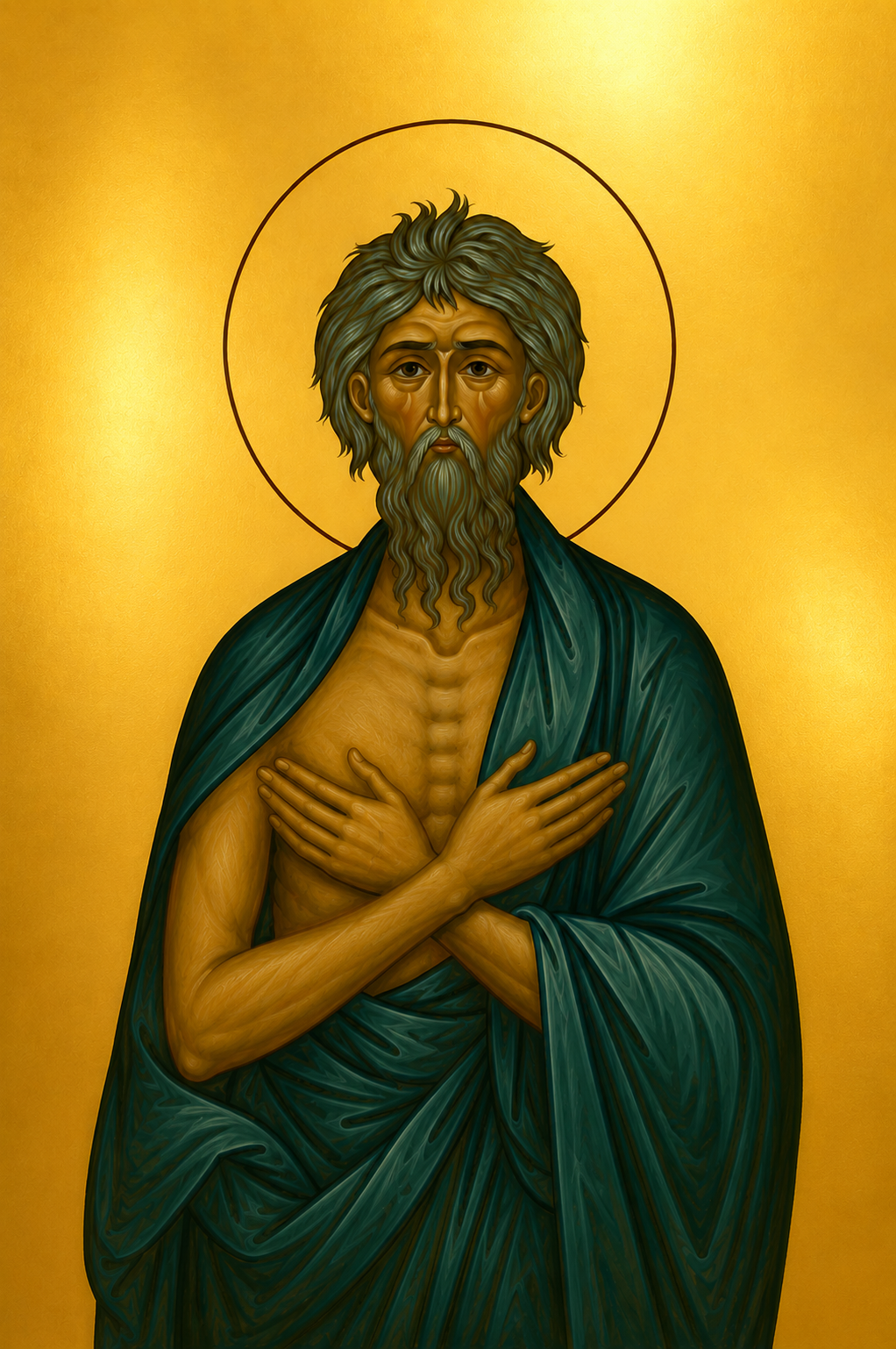
Saint Andrew the Fool for Christ, also called Andrew Salos from the Greek word for fool, is known mainly from a long Greek Life attributed to a priest of Hagia Sophia named Nicephorus. The Life tells of a foreign-born servant in Constantinople who gave up an ordinary career to live as a holy fool, and it describes his vision of the Mother of God at Blachernae.
He is an established figure of Eastern Christian worship, but his historical biography is unusually uncertain. Popular Orthodox accounts place him in tenth-century Constantinople, while the Life itself sets him in the fifth century under Emperor Leo I. Modern scholars generally treat the Life as literary hagiography written long after its setting. His influence is better documented than his historical existence.
We therefore present the received story as the Church tells it, mark each narrative as TRADITION, and say plainly where the historical record is silent.
A Scythian in the House of Theognostos
TRADITION: the Greek Life says that Andrew was a young Scythian brought to Constantinople and placed in the household of Theognostos, a high official with the title protospatharios. He is described as gifted and quick to learn Greek, and the story says he served as his master's notary or secretary. The author seems to want readers to see that Andrew was capable and educated before he turned away from ordinary life.
His parents, family, home and childhood are UNCERTAIN, and nothing independent confirms them. The word Scythian is an old geographical label and should not be turned into a modern ethnic claim. The Orthodox Church in America calls him a Slav, but given the doubts about the Life, a precise ethnicity is not secure.
The safest description is that the Life shows him as a foreign-born servant in Constantinople, traditionally called Scythian or Slavic. Later retellings sometimes add detail, and such additions should be treated with care.
The Dream of the Two Armies
The Life does not present a conversion from paganism with a baptism. It shows a young man already interested in God whose calling grows through unusual experiences. TRADITION: Andrew has a dream of two armies, one of God and one of demons, with heavenly crowns for those who overcome evil. The Orthodox Church in America names this vision as the turning point of his spiritual life.
After this, he gives up the standing and prospects that came with his education and place in the household and begins to act in ways that make people think him insane. This is the center of the Life. His apparent disorder hides prayer, poverty and humility, in the spirit of Saint Paul's words in the First Letter to the Corinthians about being fools for Christ.
TRADITION: he wears too little, goes hungry, sleeps outdoors, accepts ridicule and gives away what he receives. These are presented as a refusal to base identity on wealth, honor or comfort. Historically, they belong to a literary narrative whose match to a real person has not been shown.
Teaching Through Foolishness
Andrew is not remembered as a founder, bishop, missionary or author. The Life shows him as a hidden ascetic in the streets and public spaces of the city. TRADITION: he wanders, endures deprivation, refuses honor and prays in secret, and the author reads this as a way of giving up even the reputation of virtue.
The Life also teaches. His meetings with others expose hypocrisy, challenge attachment to possessions and call for repentance. Scholars place the work within the Byzantine tradition of holy-fool literature, with themes shared by the earlier Life of Symeon of Emesa, though the two heroes differ. The study by Sergey Ivanov, Holy Fools in Byzantium and Beyond, treats the Life as one of the most influential Byzantine treatments of the subject.
TRADITION: a young man named Epiphanius becomes his disciple and confidant, and their conversations fill much of the Life, with questions and answers on Scripture, temptation and the spiritual life, and a long apocalyptic discourse about the end of the world. Epiphanius is UNCERTAIN as a historical person, and the discourse is a literary one placed in Andrew's mouth by the author. No writings by Andrew himself are known.
Dating a Life Without a Date
The greatest scholarly problem is the gap between the story's setting and the time it was written. The Life places Andrew in the reign of Leo I, from 457 to 474. According to the Oxford Dictionary of Byzantium, Cyril Mango suggested a date between 674 and 695, John Wortley held that the later form could not be earlier than 920, and Lennart Rydén favored about 950 to 959. These are dates for the text and not for Andrew's life.
Rydén's critical edition of 1995 became the standard reference. Later tradition adds a third setting, in the late ninth and early tenth century under Leo VI, linked to the Protection vision. The Orthodox Church in America gives 936 for his death in one place and 956 in another, and the Catholic encyclopedia of 1948 gave about 880 to 946. These differences show that none of the dates is secure.
TRADITION: the Life tells of repeated humiliation, blows and exposure. A later account in the Prologue from Ohrid says that Theognostos had Andrew taken to the Church of Saint Anastasia because he seemed to be mentally disturbed and then released him from service. The Byzantine tradition itself did not treat every holy fool as a saint, and it knew of pretenders. Andrew's Life shows an ideal and is not an instruction to copy every outward behavior.
A Death Without a Tomb
His death date is UNCERTAIN. The OCA gives 936 in one text and 956 in another, and a Byzantine Catholic calendar from Pittsburgh links him with 911. These are different received traditions and not independent records.
TRADITION: the Life shows Andrew spending his last period close to Epiphanius and his household, and later summaries describe a death after solitary prayer. Devotional accounts say his body vanished after death, sometimes with a sweet fragrance. This is a tradition and not a historical explanation.
We could not find a burial site, surviving relics or a history of their translation. A responsible article should not say that his relics are at Blachernae, Hagia Sophia or a particular monastery without a source. No decree of canonization or date of glorification has been found, and his recognition rests on the growth of liturgical veneration.
The Vision at Blachernae
TRADITION: his best known vision takes place in the Church of the Mother of God at Blachernae in Constantinople. During a night service, Andrew sees the Theotokos with heavenly attendants, praying for the people and spreading her covering over the congregation. Epiphanius shares the vision and becomes its witness. The account is the main source for the feast of the Protection of the Theotokos, kept especially in the Slavic churches on October 1.
The Greek Orthodox Archdiocese ties the feast to Andrew's Life, and in Greek practice the Protection is also kept on October 28, a custom begun in the twentieth century. UNCERTAIN: the date October 1, 911 belongs to the received liturgical story and cannot be confirmed as the date of a historical event. Later readings that link the vision to a particular siege should not be treated as the same testimony as the original narrative.
TRADITION: he is credited with revealing hidden faults, noticing spiritual dangers and foretelling events, and the Life describes encounters with demons and with angels. Scholars read these as part of the literary design, which pictures Christian life as spiritual warfare.
Sources and Cautions
The main modern edition is The Life of St Andrew the Fool, edited by Lennart Rydén and published by Uppsala University in 1995, with a Greek text, English translation and notes. The Oxford Dictionary of Byzantium gives a concise summary of the literary evidence and the dating proposals.
Wolfram Brandes has studied the manuscripts and the apocalyptic material, and reports a manuscript tradition of more than ninety codices, which speaks to the reach of the text and not to the number of churches. Other sources are the OCA's commemorative life, the Prologue from Ohrid by Saint Nikolai Velimirovich, the Greek Orthodox Archdiocese's explanation of the Protection and a calendar published by the Metropolitan Cantor Institute of the Byzantine Catholic Archeparchy of Pittsburgh.
The firmly supported points are that a long Greek Life attributed to Nicephorus circulated widely, that it shaped Byzantine and Slavic writing, and that Andrew is commemorated in Orthodox and Byzantine Catholic worship. His historical existence as described, his ethnicity, his dates, the identity of Nicephorus, the date of the vision and any relics remain uncertain.
Remembering Andrew in Worship
There is no known tomb to visit. Andrew is remembered through worship and especially through the feast of the Protection of the Theotokos. Churches that keep that feast preserve the memory of the vision at Blachernae, and many icons show the Mother of God holding her veil over the faithful, sometimes with Andrew and Epiphanius beside her.
His own commemoration is October 2 in the Slavic Orthodox calendars and in the Byzantine Catholic calendar of the Metropolitan Cantor Institute, which is October 15 in the civil calendar for churches on the Julian calendar. Greek sources also name May 28. Neither date should be treated as universal throughout the Christian East.
The Orthodox Church in America publishes a troparion for him that cites Saint Paul's words about being fools for Christ's sake, but we do not quote it here. A longer service exists in English translation from the Slavonic Menaion.
undefined
undefined
Why Andrew Matters to Eastern Christians
For Orthodox Christians, Andrew is a saint of the calendar and a source of the feast of the Protection, which is deeply loved in Slavic lands. His Life is also a major work of Byzantine spiritual literature on humility, hidden holiness and the danger of pride.
For Eastern Catholics, the case is clearer than for most Russian holy fools. A Byzantine Catholic calendar in the Archeparchy of Pittsburgh lists the Holy Andrew, Fool for Christ, on October 2, which shows that his commemoration exists in a Catholic Byzantine setting. That is a documented parish calendar and not an entry in the universal Roman calendar, and no Roman canonization is known.
The Life invites readers to see the Pauline paradox of God's wisdom looking foolish to the world, as in the First Letter to the Corinthians, and to take care that sincere folly is not confused with pretense. We cannot show any direct historical link with a particular desert father or Philokalia author, though the themes are shared.
Frequently Asked Questions
Ask His Prayers
Saint Andrew points the faithful to the Mother of God, whose protection he is said to have seen. Ask him to pray for humility, for the poor and for the Church.
View Prayer Card