Saint John the Hairy of Rostov: Fool for Christ and Ascetic
A sixteenth-century holy fool of Rostov the Great whose origins are unknown and who is traditionally said to have died in 1580.
At a Glance
- Born
- Unknown; birthplace and family are not recorded
- Died
- Traditionally September 3, 1580; the year is uncertain
- Titles
- Blessed, fool for Christ, ascetic, wonderworker of Rostov, John the Merciful
- Feast
- September 3 (Julian), which is September 16 in the civil calendar; also November 12
- Veneration
- Russian Orthodox Church; old local cult; no individual canonization date found
- Patronage
- No formal patronage established
The Hairy One of Rostov
Saint John the Hairy of Rostov was a Russian Orthodox ascetic and fool for Christ who lived in the town of Rostov the Great in the sixteenth century. He is also called John Vlasaty, from the Russian word for hairy, and John the Merciful. Tradition says he died on September 3, 1580, though manuscripts give other years.
Almost nothing is known about where he came from, and that is part of his story. The early lives describe a gentle and humble man who appeared in Rostov without any account of his birthplace or past. His fame rests on his poverty, constant prayer and the healings reported at his grave.
The strongest scholarly source is the entry in volume 23 of the Orthodox Encyclopedia, which studies the manuscripts and the history of his shrine. We separate the little that is documented from the later stories and mark open questions as UNCERTAIN.
An Unknown Origin
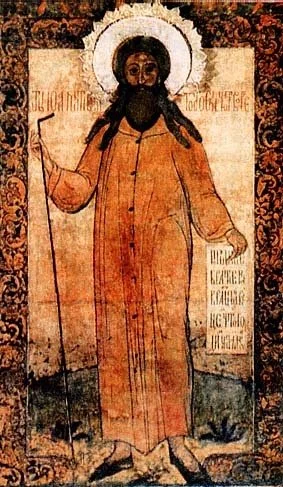
His birth date, birthplace, parents and early life are all UNKNOWN. The earliest versions of his Life describe a man of gentle manner with light brown or dark blond hair and a thick beard who wore a hairshirt under a garment like a monk's. There is no reliable evidence that he had been tonsured as a monk.
One striking item is a Psalter in Latin, written in Gothic script, linked to him in later testimony. The text says he read from it in his prayers. This led some writers to guess that he came from Western Europe or had an unusual education. UNCERTAIN: a book alone cannot show his nationality, and it does not prove that he was German, Polish or Lithuanian or a convert from Roman Catholicism.
Some manuscripts say he prayed in Greek, while later accounts stress the Latin book, so the sources disagree about his language. No record names his parents, siblings, marriage, schooling or earlier work, and later theories on these questions remain guesses.
Foolishness for Christ in Rostov
There is no recoverable conversion story. What the sources show is a way of life. John took up the Eastern Christian path of yurodstvo, or foolishness for Christ, with poverty, no settled home and a disregard for social honor. Its Scriptural root is Saint Paul's words about being fools for Christ in his First Letter to the Corinthians.
He appeared in Rostov in the reign of Tsar Ivan IV, known as Ivan the Terrible, and early manuscripts suggest about 1570 or 1571, though the year is UNCERTAIN. He had no permanent home, slept in church porches, sometimes stayed with an elderly widow and visited his spiritual father, a priest named Peter of the Church of All Saints.
These details show that he was not cut off from the Church. One of the most important links in the tradition is with Saint Irenarchus of Rostov, to whom John is said to have given counsel and encouragement. Some later accounts say John was a foreigner who entered Orthodoxy in Russia, but no reliable record supports such a conversion.
Poverty, Prayer and Counsel
John founded no monastery, community or charity. His ministry was personal and ascetic. The accounts stress humility, patience, ceaseless prayer and endurance of hardship. He taught by example and counsel and not as a bishop, priest or monastic superior.
His bond with Irenarchus is the clearest case. Later sources describe John encouraging Irenarchus in spiritual struggles, which fits a long Russian tradition of personal spiritual direction among ascetics. Irenarchus later became known for a severe life of enclosure.
The Latin Psalter has a place in the record of his veneration. It was kept at his tomb, and when Saint Dimitry of Rostov became metropolitan of Rostov in 1702, he is said to have had the worn manuscript rebound. Whether John owned the book all his life and which languages he understood remain uncertain. No writings by John are known, so no letters, prayers or prophecies should be credited to him.
Terror Under Ivan IV
Ivan IV ruled from 1547 to 1584, and his reign brought centralization, war and the violence of the oprichnina. The fear of those years forms the background to John's poverty and anonymity. UNCERTAIN: there is no reliable evidence that he was imprisoned, tortured or persecuted by the tsar, and the idea that he fled Moscow during the terror is a later guess.
The hardships in his Life are mundane ones, namely homelessness, exposure and the misunderstanding that came with his calling. He lived without secure support and accepted that.
He must also not be mixed up with other Russian holy fools named John. John the Hairy is a different person from John the Big Cap, another ascetic linked with Rostov and later Moscow, and the two appear separately in the sources. Stories can easily slip from one to the other in popular retelling.
Burial by the Church of Saint Blaise
The usual date of his death is September 3, 1580. UNCERTAIN: the Orthodox Encyclopedia lists conflicting manuscript years, including 1572, 1582 and 1589, and most accounts favor 1580. The early narratives describe his death after long ascetic labor, and say he asked to be buried beside the Church of Saint Blaise, behind its altar.
Father Peter, his spiritual father, and the widow who sometimes sheltered him are named as taking part in the burial. Some manuscripts say the burial happened three days after his death, but since the sources differ, we do not count this as established.
The grave became the center of a local cult, with healings, pilgrims and prayer services. A merchant named Mikhail Guryev is credited with paying for a church after help attributed to John's prayers. The old complex was later replaced, and the present stone Church of the Tolga Icon of the Mother of God was consecrated in 1767, with John's tomb kept inside.
The Healings at His Tomb
The most solid evidence of his later reputation is the set of miracle accounts in seventeenth-century manuscripts. The earliest collection seems to have held four accounts, and expanded versions reached eleven. They are testimony of devotion and do not independently prove the events.
TRADITION: in the best known story, Metropolitan Kirill of Rostov became so disabled that he could no longer serve. After hearing of healings at John's tomb he asked to be taken there, and during the reading of the Gospel he found strength to walk. The Orthodox Encyclopedia places this near the end of 1617, using the traditional account and Kirill's death on May 7, 1619.
TRADITION: another account tells of Agrippina of the village of Porechye, who suffered paralysis of her hand and speech and recovered after prayers at the grave and drinking water mixed with earth from the burial place. We report this as history of a custom and do not recommend it as a remedy. Other narratives name monks and townspeople, including a monk Manuel and Abbot Leontius of the Petrovsky Monastery, and some manuscripts speak of thunder, lightning and fires at his death, which cannot be confirmed.
Sources and Cautions
The key source is the Orthodox Encyclopedia entry on John, volume 23, published in 2013, which covers manuscript criticism, competing death dates, the miracle collections, the history of the shrine and glorification. Another important witness is the early Life in the Milyutin Menologion, a seventeenth-century manuscript dated about 1646 to 1654, which we did not inspect.
Other works include the account of the Orthodox Church in America, the monastery history from Makhrishche published in 2020, the Russian church calendars and the nineteenth-century notes of Metropolitan Filaret of Chernigov, whose suggestions about John's origin are speculation and not settled fact.
The firm points are his place in Rostov, his tie to Father Peter and Irenarchus, the Psalter, the burial and the local cult. The uncertain ones are his birth, family, language, the exact year of death and any individual act of canonization.
The Tolga Church in Rostov
His tomb and relics are traditionally kept in the Church of the Tolga Icon of the Mother of God in Rostov the Great. The relics lie beneath the tomb structure and are not openly displayed. The Orthodox Encyclopedia records that both the Latin Psalter and crosses linked to him were kept at the shrine in later centuries.
A monastery history from 2020 says the church stayed open during the Soviet period and had an important place in keeping Orthodox worship alive in Rostov. A seventeenth-century icon shows scenes from his miracles, which shows that his cult already had a rich visual tradition within about a century of his death.
His feast is September 3 in the Julian calendar, which is September 16 in the civil calendar, and he is also remembered on November 12 and in the Synaxis of the Saints of Rostov and Yaroslavl, which was established in 1964. That date marks the collective commemoration and not a personal canonization. The Orthodox Church in America publishes hymns for him, but we do not quote them here.
undefined
undefined
Why He Matters to Eastern Christians
For Russian Orthodox Christians, John is a saint of Rostov with a feast, a shrine and a continuing devotion. His life shows the Eastern Christian conviction that holiness does not need office or achievement, only prayer, poverty and repentance.
His tie to Saint Irenarchus also shows the weight of personal spiritual guidance among Russian ascetics. For Eastern Catholics and others who study the Christian East, he is a case of Byzantine-Slavic asceticism that both traditions can learn from.
We found no Eastern Catholic cult dedicated to him and no individual Catholic beatification or canonization, so his Orthodox veneration should not be described as Catholic recognition. The mystery of his Latin book is a modest reminder of how little we know about him, and how much the Church remembers through prayer.
Frequently Asked Questions
Ask His Prayers
Saint John the Hairy shows that a person with no name or home can be known to God. Ask him to pray for the poor, for the sick and for the people of Rostov.
View Prayer Card