Saint Maximus of Totma: Priest, Fool for Christ and Wonderworker
A Russian priest of the Totma region who lived as a holy fool and died in 1650; locally glorified in 1715.
At a Glance
- Born
- Unknown; neither date nor place is established
- Died
- January 16, 1650, at an advanced age
- Titles
- Blessed, righteous, priest, fool for Christ, wonderworker of Totma
- Feast
- January 16 (Julian), which is January 29 in the civil calendar; also the third Sunday after Pentecost with the Saints of Vologda
- Veneration
- Russian Orthodox Church; locally glorified February 20, 1715
- Patronage
- Associated with Totma; no formal patronage established
- A Priest and Holy Fool of Totma
- Almost Nothing Is Known of His Youth
- Priest and Fool Together
- Prayer, Fasting and Priestly Service
- After the Time of Troubles
- Burial at Varnitsy and the Shrine
- The Glorification of 1715
- Sources and Cautions
- Relics and Veneration in Totma
- Why He Matters to Eastern Christians
- Frequently Asked Questions
A Priest and Holy Fool of Totma
Saint Maximus of Totma was a Russian Orthodox priest who also took up the hard path of foolishness for Christ. He lived in the Totma region of northern Russia, died on January 16, 1650, and was honored for his fasting, constant prayer and healings reported at his grave. His names include Maximus Makarievich Popov, Blessed Maximus and Righteous Maximus.
The best scholarly source is the entry on Maximus in volume 43 of the Orthodox Encyclopedia, by E. V. Romanenko, which relies on archival documents about his glorification and the reported miracles. Much early biographical material was lost, so his priesthood, death, burial and local cult are better documented than his childhood or daily life.
We therefore state what the records support, call the reported healings TRADITION as testimony preserved in church records and not as medical findings, and say UNCERTAIN where the sources are silent.
Almost Nothing Is Known of His Youth
His birth date and birthplace are UNCERTAIN, since neither survives. His patronymic, Makarievich, points to a father named Makarii, and the surname Popov also appears. The Orthodox Church in America calls his father a priest, while the Vologda Metropolia says that further priests among his ancestors are possible but not firmly established.
No source names his mother or siblings or describes his schooling or home. He became linked with Totma, a settlement of the Russian North in the old church territory of Vologda, and more precisely with the Church of the Resurrection at Varnitsy near the town. Cadastral records from 1620 mention this church, which proves that the place existed but says nothing about his early years.
UNCERTAIN: it is not known whether he was born in Totma, moved there young or came after ordination. We prefer to leave the gap open and not fill it with invented detail.
Priest and Fool Together
His life is not remembered through a conversion from unbelief. The tradition stresses that he was an ordained priest of the Resurrection church who took up foolishness for Christ while keeping his priestly standing. That combination is the key to his memory. He was not a wandering eccentric later called holy, but a clergyman who chose an unusual path.
The tradition credits him with forty-five years of this vocation. Counting back from 1650 would put the start near 1605, but that is only our inference and not a recorded date. Some popular accounts say forty years, while the Orthodox Church in America and the Orthodox Encyclopedia say forty-five, and the longer figure appears in the glorification petition, so it has the stronger documentary support. The exact length remains UNCERTAIN.
The Scriptural basis for this way of life is Saint Paul's phrase about being fools for Christ in his First Letter to the Corinthians. No source names a spiritual director, a monastery or a vision that began his calling, and his age at ordination is unknown.
Prayer, Fasting and Priestly Service
His recorded ministry was his priestly service and his ascetic witness at Totma. The Orthodox sources say that he prayed without ceasing, fasted severely, wore too little clothing and paid no attention to bodily comfort. These are the traditional marks of the holy fool.
The hymns written for him present his teaching as an example and not as eloquent preaching, and connect his care for his flock with his unusual life. They show how the Church understands his vocation but do not prove particular sermons, appointments or pastoral acts.
No church, monastery, school or charity can be confidently credited to him, and no authentic writings are known. Quotations attributed to him should not be trusted without a documented source. His influence passed through his reputation, the veneration of his grave, miracle accounts, icons and hymns.
After the Time of Troubles
He lived in the years after the Time of Troubles, when the Romanov dynasty was being established. We found no source that ties him to a particular political crisis, campaign, persecution or church dispute. His recorded hardship was the severe life he chose.
Descriptions of exposure to weather, scant clothing, fasting and sustained prayer belong to the Russian tradition of holy foolishness, where a person rejects respectability and honor. They should be read in their religious setting and not as clinical records. There is no reliable evidence that he suffered from mental illness, and equally the sources do not allow a modern diagnosis.
The main historical difficulties concern the thin records. One example is the healing of Theodore Mamoshov, which some church publications place in 1703, while the Orthodox Encyclopedia, citing archival descriptions, dates his vision to November 5, 1706. We follow the archival date.
Burial at Varnitsy and the Shrine
Maximus died on January 16, 1650, reportedly at an advanced age, and was buried beside the Church of the Resurrection at Varnitsy near Totma. His grave soon became a place linked with healings.
The early records were damaged. A first collection of miracle accounts was lost when the Resurrection church burned in 1676, and a second begun in 1680 also lost its original manuscript. The encyclopedia notes that later copies and archival evidence preserve several miracles, including copies sent to the Holy Synod in 1745, so it is wrong to say that every early record vanished.
After the fire, a church of Saint Paraskeva was built over the burial place. In 1868, a carved wooden shrine with painted panels of healings attributed to him was set over his traditional grave in the lower Church of Saint Nicholas of the rebuilt complex.
The Glorification of 1715
Father John Rokhletsov and the parishioners of the Resurrection church petitioned Archbishop Joseph of Veliky Ustyug and Totma to allow public veneration. The archbishop approved a shrine and icon over the grave and the serving of molebens, which are prayer services of supplication. On February 20, 1715, a shrine with his image was set up at the Church of Saint Paraskeva, and Father John served a moleben to him. The encyclopedia calls this his local canonization.
Later, in 1841, Maximus was included in the Synaxis of the Saints of Vologda. The Russian theologian Protopresbyter Michael Pomazansky uses the 1715 case in his Orthodox Dogmatic Theology as an example of local veneration approved by a bishop.
TRADITION: five posthumous healings are preserved in archival records. They concern Boris Tarunin of Totma, healed of paralysis in 1680 after prayer and a memorial service at the grave, Arethas Malevinsky, healed of a nine-week fever in 1691, Theodore Mamoshov, who after a vision on November 5, 1706 of a man in a simple shirt walked after nine years of paralysis, Anna Tataurova, who recovered from a mental disturbance in 1705 after a dream that told her to arrange two memorial services, and Anna Yakovleva, restored from blindness in 1708. These are testimonies and not verified medical cases, though several name priests or deacons as witnesses.
Sources and Cautions
The most important source is the Orthodox Encyclopedia entry by Romanenko, which cites documents in the Russian State Historical Archive and manuscripts in the Russian National Library. Other sources are the Orthodox Church in America, which gives his life and liturgical hymns in English, and the Vologda Metropolia's modern account.
Nineteenth-century work by Archpriest I. Veryuzhsky preserved extracts of the glorification petition and miracle accounts, and a study by A. A. Romanova covers the manuscript history of the miracles. We did not read either one ourselves.
The strongest evidence is for the Resurrection church, his death in 1650 and his local glorification in 1715. The least certain parts are his birth, the dates of his ordination and the start of his foolishness, and the details of the recent relic reports.
Relics and Veneration in Totma
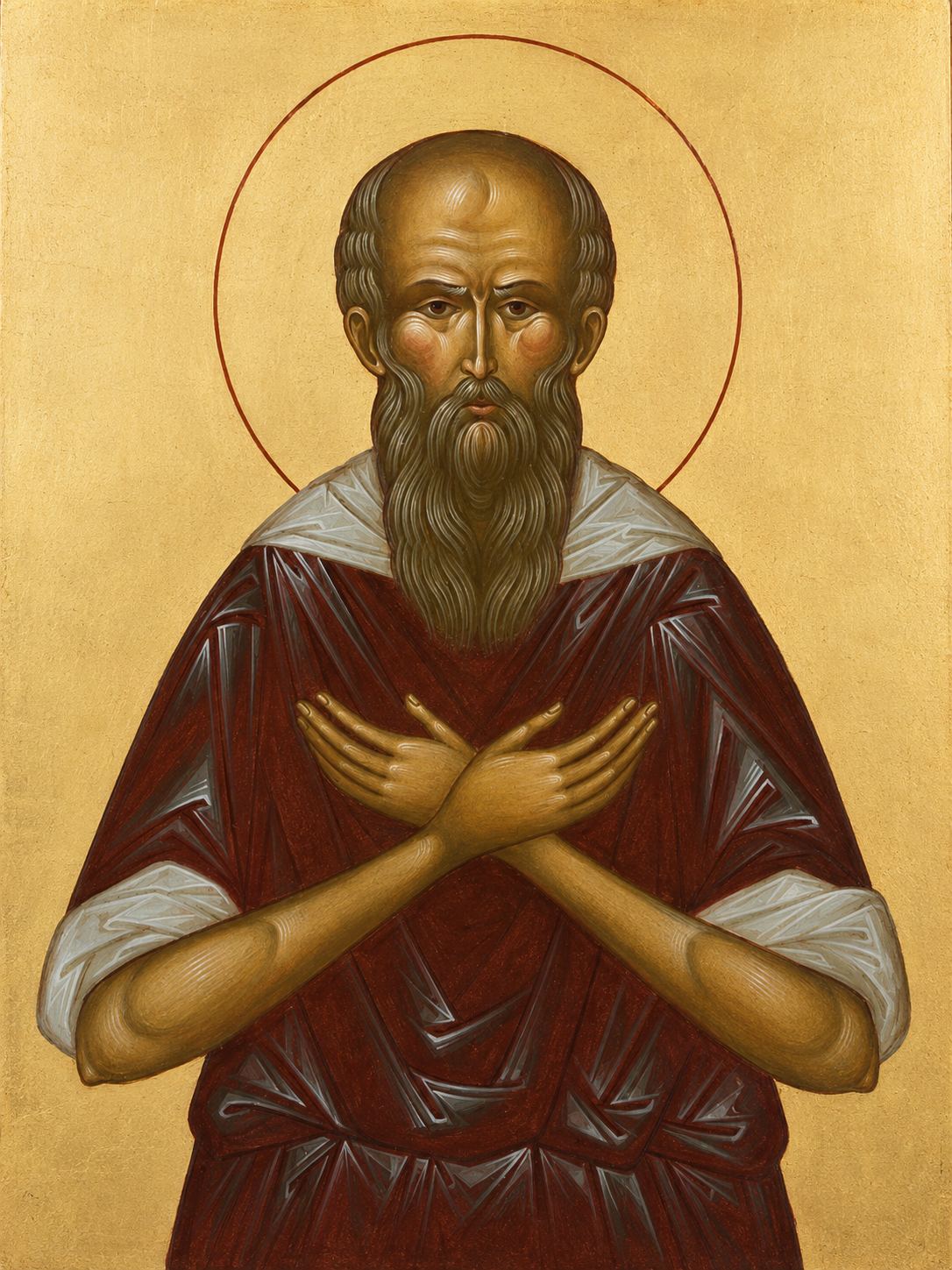
Veneration began at his grave and gained a permanent focus in 1715 with the shrine and icon. Later icons often show him with Blessed Andrew of Totma, another Russian fool for Christ, usually as an elderly man with short hair and a beard, sometimes barefoot or in a long light shirt. These are devotional images and not portraits.
The Vologda Metropolia reported that his relics were found on June 1, 2024, with the blessing of Patriarch Kirill. News reports say they were presented for veneration at the Spaso-Prilutsky Monastery in Vologda on June 28 and 29, 2025 and then taken to Totma, and a July 2026 regional report says relics attributed to him were to be brought to a church in Saratov. A reported examination in Moscow was said to support the identification, but we could not see the underlying report, so the present location of his relics and the methods of identification are UNCERTAIN.
His feast is January 16 in the Julian calendar, which falls on January 29 in the civil calendar, and he is remembered with the Saints of Vologda on the third Sunday after Pentecost. The hymns to him are published by the Orthodox Church in America, but we do not quote them here. The events of 2025 concerned the recovery of relics and not a new canonization.
undefined
undefined
Why He Matters to Eastern Christians
For Russian Orthodox Christians, Maximus is an established saint of the local tradition, recognized through the petition of his parish, the bishop's approval and later commemoration. His life joins priestly service with the radical humility of the holy fool.
For Eastern Catholics and other readers interested in Byzantine spirituality, he is a historical example of Eastern Christian asceticism. We found no evidence of a commemoration in an Eastern Catholic calendar, so his Orthodox recognition should not be taken as a Catholic beatification or canonization.
His case is also a useful example of how local sainthood works in the Russian Church, where a bishop could approve veneration that had already grown from the faith of the people.
Frequently Asked Questions
Ask His Prayers
Saint Maximus shows that a priest can serve at the altar and also carry hidden humility. Ask him to pray for priests, for the sick and for the people of Totma.
View Prayer Card