Saint Nicholas Kochanov of Novgorod: Fool for Christ and Wonderworker
A medieval Novgorod holy fool, traditionally from a wealthy family, who gave up honor and died about 1392.
At a Glance
- Born
- Fourteenth-century Novgorod; date unknown
- Died
- Traditionally July 27, 1392; the year is uncertain
- Titles
- Blessed, fool for Christ, wonderworker of Novgorod
- Feast
- July 27 (Julian), which is August 9 in the civil calendar; also with the Saints of Novgorod
- Veneration
- Russian Orthodox Church; old local cult; date of glorification uncertain
- Patronage
- No formal patronage established
- A Holy Fool of Medieval Novgorod
- A Wealthy Family of Novgorod
- Giving Up Respectability
- Witness in the Streets of Novgorod
- Sophia Side, Trading Side
- Burial, a Church and an Empty Shrine
- The Cabbage, the Wine and the Debt
- Sources and Cautions
- The Church of Saint Panteleimon
- Why He Matters to Eastern Christians
- Frequently Asked Questions
A Holy Fool of Medieval Novgorod
Saint Nicholas Kochanov was a medieval Russian ascetic remembered as a fool for Christ and a wonderworker of Novgorod. Tradition says he died on July 27, 1392, although scholars question the year. His name appears in several forms, among them Nikola Kochanov, Konchanov and Kachanov.
His veneration is well documented, but many of the stories told about him are found only in later manuscripts. The most important scholarly source is the entry by A. A. Romanova in the Orthodox Encyclopedia, which examines the manuscripts, the dates, the history of his cult and the fate of his relics.
This article follows that distinction. We call documented what is supported by liturgical, manuscript and building records, we mark popular stories as TRADITION, and we say UNCERTAIN where the evidence does not decide the matter.
A Wealthy Family of Novgorod
According to his traditional biography, Nicholas was born in Novgorod to a wealthy and respected family. His parents were Maxim and Juliana. The Orthodox Encyclopedia reports that both the Novgorod commemorative registers, called synodika, and the encomium written in his honor name them, which gives these names more support than is usual. His birth date is unknown.
His mother Juliana was honored as righteous. The encyclopedia says she died eight years before Nicholas, while an older narrative gives nine years. UNCERTAIN: the interval cannot be treated as established. The family may have belonged to the boyar class of the Nerevsky district, since they were buried near the Church of Saint James, but no genealogy has been proven, and two historical boyars named Maxim cannot be tied to his father.
The hagiographical sources describe him in conventional terms as a youth who prayed, fasted, gave alms and preferred church to the pastimes of young nobles. These descriptions come from devotional literature and not from records of his childhood, and no schooling or exact birthplace in the city is known.
Giving Up Respectability
Nicholas's life does not include a conversion from another faith. The turning point was a change in how he lived his Christianity. The encomium says he grew uneasy about the praise his piety drew from leading citizens, and he responded by leaving the respectability his family expected.
He took up the Russian ascetic way called yurodstvo, or foolishness for Christ. Its Scriptural root is Saint Paul's phrase in the First Letter to the Corinthians about being fools for Christ's sake. The tradition says he gave up his wealth, wore poor clothes and wandered the streets of Novgorod, enduring cold, insult and rough treatment while he prayed.
His admirers understood the foolishness as a chosen discipline and not as an illness. UNCERTAIN: no contemporary evidence allows historians to separate his actual behavior from the usual patterns of holy-fool hagiography, and the historian Sergei Ivanov has asked whether the surviving descriptions show distinct signs of holy foolishness at all.
Witness in the Streets of Novgorod
Nicholas was not a priest, a monastic founder or a theologian. His work took place in the public spaces of Novgorod, especially around the Sophia side. The traditional life stresses a ministry of repentance and example, aimed at pride, love of wealth, social prestige and hostility between citizens.
The best known part of his tradition concerns another Novgorod holy fool, Blessed Theodore. The two are said to have staged a rivalry that mirrored the quarrel between the Sophia side and the Trading side of the city. The Orthodox Encyclopedia notes that this rivalry and the cabbage story do not appear in the earlier surviving writings about Nicholas but in later narratives and in the literary tradition around Theodore, so we treat them as TRADITION.
No writings by Nicholas himself are known. What survives is literature about him, including an encomium, a church service, miracle accounts and later lives. Manuscripts of the encomium and the service from the sixteenth century are known, and a collection made under Metropolitan Cornelius between 1674 and 1695 included the service, two miracle accounts and the encomium.
Sophia Side, Trading Side
Nicholas lived in the Novgorod Republic, a trading city shaped by merchants, boyar rivalries, church institutions and competition between districts. The Volkhov River divided the Sophia side from the Trading side, and the traditional story places Nicholas on the first and Theodore on the second. Many read their quarrel as a symbol of the condemnation of factional pride.
A study by A. V. Petrov on the two holy fools and their quarrel, published in 2014, is cited by the encyclopedia as specialized work on this tradition. The disagreement among scholars is a reason for care. The general pattern of poverty, humiliation and refusal of honor is well attested in the tradition, while the exact events of his life are less certain.
No reliable evidence we found shows that Nicholas was imprisoned by civil authorities, tried for heresy or involved in a specific church controversy. His struggle, as the tradition understands it, was the surrender of wealth, status and personal security.
Burial, a Church and an Empty Shrine
Tradition gives July 27, 1392 as his death date. UNCERTAIN: the Orthodox Encyclopedia doubts the exact year, explaining that it may come from an incomplete chronological note that later writers interpreted. We therefore call 1392 the traditional year.
The hagiography says he asked to be buried by a road at the edge of the cemetery of the Church of Saint James, near his mother's grave in the Nerevsky district. The encyclopedia reports that Archbishop Pimen of Novgorod laid the foundation of a stone church of the Great Martyr Panteleimon on June 20, 1554, supported by references to the Novgorod chronicles. The building became known as the Nikolo-Kochanov Church.
Popular biographies say his relics rest beneath this church. The encyclopedia records that his reliquary was opened in 1927 and found empty, citing a work by M. N. Petrov published in 2000 and an inspection document, though it does not say what became of any remains. UNCERTAIN: the present location and survival of the relics are not verified.
The Cabbage, the Wine and the Debt
TRADITION: in the best known story, Theodore fled across the Volkhov River by walking on its surface, and Nicholas followed in the same way and threw a cabbage at him. The story is linked to his surname through the Russian word for a head of cabbage. It is absent from the earlier surviving texts about Nicholas, so it is a later tradition and not established history.
TRADITION: one of the older recorded miracles tells that a rich man invited Nicholas to a banquet, but servants drove him away, and the wine then disappeared from its containers. After the host invited Nicholas back and he prayed, the wine returned. He is said to have wished to hide the miracle. Another account tells of a cleric named John, falsely doubted over a debt document between Nicephorus and Isaac, who prayed at the grave and had a vision of the saint, after which Isaac admitted his dishonesty.
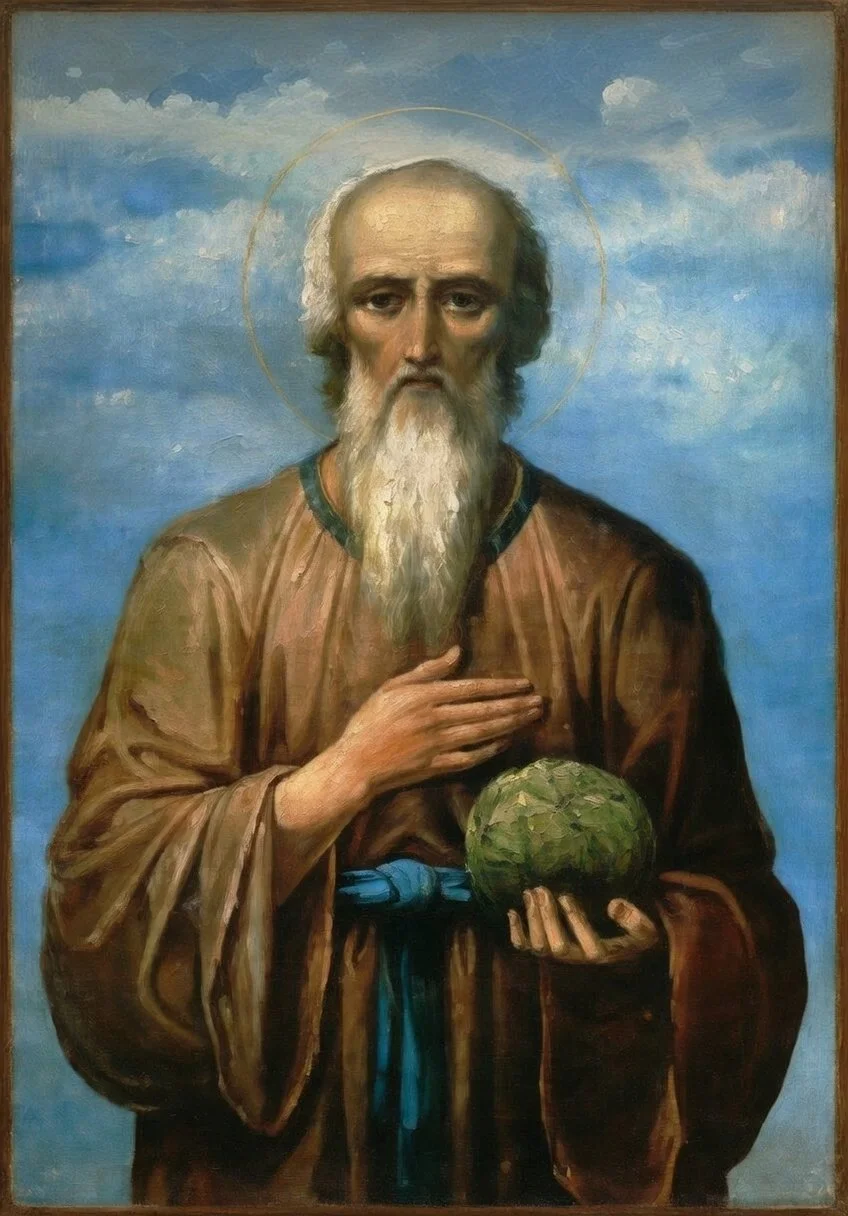
TRADITION: pilgrims prayed at his grave for the healing of children, took sand from the place and later used blessed water from the church. These practices show confidence in his prayers, though the individual healings cannot be verified. The encyclopedia also notes that early images often show him in boyar or princely dress and that later ones add a cabbage, which reflects the growth of the popular story.
Sources and Cautions
The essential source is the Orthodox Encyclopedia entry by A. A. Romanova, volume 50, which is careful about manuscripts, dates, glorification, relics and iconography. We also used the account of the Orthodox Church in America and the life published by the Novgorod Diocese.
Other works cited by the encyclopedia include Petrov's 2014 study of the quarrel, E. A. Ryzhova's work on the motif of walking on water in holy-fool lives, S. A. Ivanov's cultural history of holy foolishness and Klyuchevsky's classic study of old Russian saints' lives as a historical source. We did not read these ourselves.
The documented material is the liturgical veneration, the manuscripts and the church built over his burial place. The least secure points are his personal life, the cabbage and water story, the year of death and the relics.
The Church of Saint Panteleimon
The center of his memory is the Church of Saint Panteleimon in Novgorod, also called the Nikolo-Kochanov Church. His commemoration appears in a late fifteenth-century calendar manuscript, and sixteenth-century manuscripts give stronger evidence of a cult. Scholars disagree whether his commemoration was set up before or after the Russian Church Council of 1547, and no dated act of canonization has been found.
His cult received attention under the Russian emperors. On July 27, 1831, a son was born to Emperor Nicholas I, the future Grand Duke Nicholas Nikolaevich, and the family linked the name to Saint Nicholas Kochanov. The emperor is said to have supported the veneration and given 2,000 rubles in 1832 for the shrine.
His feast is July 27 in the Julian calendar, which falls on August 9 in the civil calendar, and he is also remembered on the third Sunday after Pentecost with the Saints of Novgorod. A hymn to him is published in Russian sources, but we do not quote it. Visitors to Novgorod can pray in the church and learn about the other holy fools of the city.
undefined
undefined
Why He Matters to Eastern Christians
For Russian Orthodox Christians, Nicholas is an established local saint, with a church service, a historical church and a continuing commemoration. His life shows the Eastern Christian path of voluntary poverty, humility and refusal of worldly prestige, in the Russian form of the holy fool.
Eastern Catholics can study him as part of the wider Byzantine heritage. We found no approved cult of Nicholas Kochanov in an Eastern Catholic Church and no Catholic calendar entry, so his Orthodox veneration should not be taken as universal Catholic recognition.
His story is also a reminder that holiness may be hidden under a poor surface. Matthew's account of Christ's call to the rich young man and Paul's description of apostolic suffering are natural companions to his life, though these connections are ours and not statements from his sources.
Frequently Asked Questions
Ask His Prayers
Saint Nicholas Kochanov shows that a person can leave wealth and honor and find peace in humility. Ask him to pray for the city of Novgorod, for children and for those who suffer false accusation.
View Prayer Card