Saint Procopius of Vyatka: Fool for Christ and Wonderworker of Khlynov
A Russian lay ascetic who lived as a holy fool in Khlynov, now Kirov, and died in 1627.
At a Glance
- Born
- Traditionally 1578; birthplace near Khlynov uncertain
- Died
- December 21, 1627 (some references say 1628)
- Titles
- Blessed, fool for Christ, wonderworker of Vyatka
- Feast
- December 21 (Julian), which is January 3 in the civil calendar; also October 8 with the Saints of Vyatka
- Veneration
- Russian Orthodox Church; local cult for centuries; exact date of glorification uncertain
- Patronage
- Regional intercessor of Vyatka; no formal patronage established
- A Holy Fool of Vyatka
- Born to Peasants Near Khlynov
- Choosing Foolishness for Christ
- Silence, Gestures and Refused Gifts
- The Time of Troubles and a Difficult Text
- Death in 1627 and Burial at the Cathedral
- Healings and the Vision of Martha
- Sources and Cautions
- Veneration in Kirov and Vyatka
- Why He Matters to Eastern Christians
- Frequently Asked Questions
A Holy Fool of Vyatka
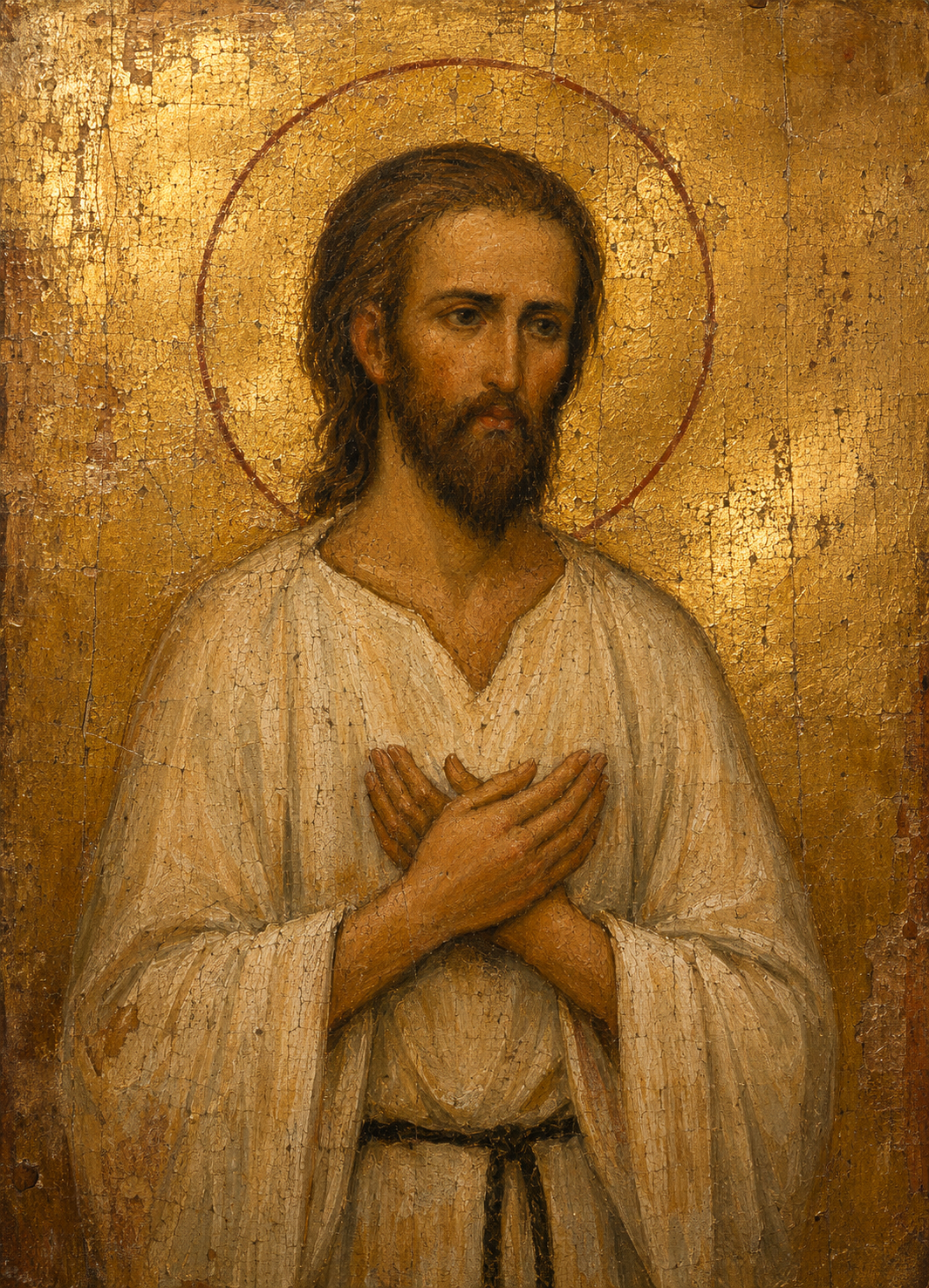
Saint Procopius of Vyatka was a Russian Orthodox layman who lived as a fool for Christ in Khlynov, the old town that is now the city of Kirov. Tradition places his life between 1578 and 1627. He is remembered for poverty, silence, patience under insult and a reputation for foreseeing events and healing the sick. He was not a monk or a priest, and no writings of his are known.
The strongest modern source is the entry on Procopius in volume 58 of the Orthodox Encyclopedia, which draws on manuscript research. It shows that his Life holds a real historical core, with local clergy and officials who can be identified, together with miracle stories and a few details that do not match the record.
We therefore separate what is reasonably documented, such as his place in Khlynov, his early local cult and his burial tradition, from what rests on devotional testimony. Birth date, birthplace, the year of death and the date of formal glorification all carry qualifications.
Born to Peasants Near Khlynov
Procopius is traditionally said to have been born in 1578 to Maxim and Irina, peasants near Khlynov. His family name appears in variants such as Plishkov and Plushkov. The usual biography names his village as Koryakinskaya, but the Orthodox Encyclopedia says the village has not been securely identified, and scholars have suggested other nearby places. His birthplace is UNCERTAIN.
He worked in the fields with his parents. TRADITION: at about twelve, during a thunderstorm, he fell from a horse and lay unconscious, and his parents prayed to Saint Nicholas the Wonderworker. When he woke, he is said to have acted strangely, tearing his clothes and wandering without them. His parents brought him to the Dormition Monastery at Khlynov, where Saint Tryphon of Vyatka is said to have prayed over him and sprinkled him with holy water.
The Life reports that he recovered and went with his parents' blessing to Slobodskoy, where he served a priest named Hilarion at Saint Catherine's Church for about three years. Hilarion is a real priest known from local records, which is one reason scholars see a historical core in the Life. The childhood episode should not be read as a medical diagnosis or as a miracle proved by independent evidence.
Choosing Foolishness for Christ
There was no conversion from another religion. Procopius was raised an Orthodox Christian. His turning point came when his parents tried to arrange his marriage. The Life says that around 1597 or 1598, at about twenty, he left home in secret and returned to Khlynov to take up the ascetic way called yurodstvo, or foolishness for Christ.
The year is UNCERTAIN. The Orthodox Encyclopedia notes that the manuscript gives the year 7105 in the old Byzantine reckoning, which corresponds to 1596 or 1597 depending on the method, while modern summaries often say 1597 or 1598. The spiritual model is Saint Paul's words in his First Letter to the Corinthians about being fools for Christ's sake.
TRADITION: Saint Tryphon blessed him for this calling. His spiritual father was Father John Kolachnikov, also written Kolashnikov, a priest of the Church of the Ascension. The Life says that Procopius usually stayed silent but spoke normally with his confessor, and the Vyatka Diocese says he confessed and received Communion regularly, traditionally each week. His odd public behavior was thus joined to the sacramental life of the Church.
Silence, Gestures and Refused Gifts
Procopius founded no monastery and left no sermons or letters. His witness lay in the streets, churches and homes of Khlynov. According to the Life, he owned little clothing, slept wherever he could, spent much time outdoors and bore hunger and cold.
TRADITION: he is credited with silent gestures that warned people of coming events. People came to read his visits to the sick as a sign that they would recover or die, and other stories speak of foretelling arrests and changes of fortune. These accounts belong to the received tradition, and several contain details that do not fit the historical record.
The Life also tells of his dealings with local officials. Prince A. D. Priimkov-Rostovsky and his wife Natalia are said to have taken him in and given him costly clothing, which he refused. Researchers have found independent evidence for several officials and clergy named in the Life, and the critical edition by S. A. Ivanov, published in 2000, examines these links. That a person existed does not prove that every miracle linked to him took place.
The Time of Troubles and a Difficult Text
He lived through the last decades of the sixteenth century and the Time of Troubles in early seventeenth-century Russia. A holy fool stood outside ordinary social protection. The Life describes mockery and attacks by townspeople, including children, and exposure to harsh weather. The ideal behind it is humility before God and not the wish for recognition.
The text also has difficulties. One story names the courtier Mikhail Tatishchev as someone exiled by Tsar Michael Romanov, yet the historical Tatishchev died in 1608, before Michael became tsar in 1613. Ivanov suggested that the story may concern another prisoner, Peter Urusov. UNCERTAIN: the manuscript is historically inconsistent here, so the prophecy cannot be presented as verified.
The Life was probably first compiled during the time of Bishop Alexander of Vyatka, between 1657 and 1674, and developed under later bishops. It is therefore a later devotional and historical source, not a diary kept in Procopius's lifetime, and it mixes checkable local detail with traditional miracle accounts.
Death in 1627 and Burial at the Cathedral
The accepted date of death is December 21, 1627, though the Orthodox Encyclopedia keeps open the possibility of 1628. TRADITION: the Life says he foresaw his death, attended morning prayers, went into a ravine, rubbed his body with snow, prayed and lay down facing east, where he died peacefully.
His spiritual father, Father John, is said to have helped with the funeral, together with local clergy and officials named in the Life, including Archimandrite Jonah Mamin and the clerk Simeon Pavlov. He was buried near the Dormition Cathedral of Saint Tryphon's Monastery at Khlynov.
The Vyatka Diocese places his resting place under the floor near the southern part of the sanctuary of the Dormition Cathedral in Kirov. The encyclopedia notes that Saint Tryphon's relics were found in 1684 and moved in 1690, but there is no documented uncovering of Procopius's remains. Claims about their condition are UNCERTAIN and not independently documented.
Healings and the Vision of Martha
The Life holds nine miracle narratives, eight from his lifetime and one after death, according to the Orthodox Encyclopedia. Their presence shows the history of the tradition but does not verify the events.
TRADITION: on March 3, 1666, an eighteen-year-old woman named Martha Pushkaryova was reportedly healed after a vision of two radiant men who spoke to each other as Tryphon and Procopius. The account became a basis for honoring the two saints together. Scholars note that it arose during a church dispute affecting the new Vyatka diocese, so its communal meaning matters along with its devotional one.
TRADITION: other stories include a governor's hat taken and carried toward a prison as a sign of his coming arrest, the cure of a priest's wife named Anisia from severe toothache, and a young man pushed into the sanctuary in church as a sign that he would become a priest. In the last case, a 1629 record names a man with a different first name, which adds doubt. Several of these stories have identifiable inconsistencies and are best read as tradition.
Sources and Cautions
The best scholarly source is the Orthodox Encyclopedia, volume 58, pages 361 to 365, published online in 2024. It records the manuscript history, the conflicting dates and the historical identifications, and it is careful to mark tradition as tradition.
Other sources are the Vyatka Diocese's official biography, the English summary of the Orthodox Church in America, S. A. Ivanov's 2000 edition of the first Life, A. V. Markelov's research on local veneration published in 2019, and nineteenth-century devotional works from Vyatka. We did not examine the manuscripts or print editions ourselves.
The unresolved questions are his exact birthplace, the year of death, the original date of ecclesiastical glorification and the documentary history of his relics. A responsible account says what the sources support and leaves the rest open.
Veneration in Kirov and Vyatka
Procopius was venerated locally long before modern times. In 1902, Bishop Nikon of Vyatka told the Holy Synod that prayer services to him had been held since the eighteenth century. The encyclopedia says his status is confirmed by his place in the Synaxis of the Saints of Vyatka, established on October 21, 2007. That date concerns the regional synaxis and not an original canonization, which has not been precisely dated.
A chapel at his traditional birthplace was consecrated in 1897, and a church dedicated to him was consecrated in the Sosheni district of Kirov in 2009. Icons often show him beside Saint Tryphon, reflecting their joint memory.
His feast is December 21 in the Julian calendar, which falls on January 3 in the civil calendar, and he is also remembered on October 8 with the Saints of Vyatka. Visitors to Kirov can pray at the Trifonov Monastery near his traditional burial place. A troparion to him is published by the diocese, but we do not quote it here.
undefined
undefined
Why He Matters to Eastern Christians
For Orthodox readers, Procopius is a direct and documented saint of the Russian tradition. His life shows the holy fool, whose voluntary shame is a form of humility, and the link between that unusual path and confession, Communion and the life of the parish.
For Eastern Catholics and other readers interested in Byzantine spirituality, he offers a historical example of Russian ascetic Christianity. We found no authoritative evidence of an Eastern Catholic calendar entry or a separate Catholic process of recognition, so he should be called a Russian Orthodox saint.
His story also reminds readers that holy fools were not excused from ordinary duties. His closeness to a confessor and his regular Communion show that his strange conduct was meant to serve repentance and the care of souls.
Frequently Asked Questions
Ask His Prayers
Saint Procopius shows that humility can look foolish to the world and be precious to God. Ask him to pray for patience, for the sick and for the people of Vyatka.
View Prayer Card