Saint Andrew the Apostle: The First-Called, Brother of Peter and Patron of Many Nations
A Galilean fisherman who followed John the Baptist, brought his brother to Jesus, and became the first-called of the Twelve.
At a Glance
- Born
- Bethsaida in Galilee, date unknown (no contemporary source gives a year)
- Died
- Traditionally at Patras in Achaia, about 60 to 66 AD (the year is uncertain)
- Titles
- Apostle, First-Called (Protokletos), Martyr
- Feast
- November 30, in Catholic and Orthodox calendars (December 13 in the Gregorian count for Julian calendar churches)
- Veneration
- Catholic Church, Eastern Orthodox Church, Eastern Catholic Churches; no formal canonization, as veneration is ancient
- Patronage
- Scotland, Romania, Russia, the Ecumenical Patriarchate, Patras, Amalfi, fishermen
The First-Called
Saint Andrew is one of the twelve apostles and the brother of Simon Peter. In the Byzantine tradition he carries the title First-Called, in Greek Protokletos, because the Gospel of John presents him as one of the first two disciples to follow Jesus. Rome honors Peter as its apostolic founder and Constantinople honors Andrew, which has made the two brothers a lasting symbol of the link between East and West.
What we know for certain about Andrew comes from the New Testament. We know his hometown, his trade, his brother, the episodes in which he appears and his place among the Twelve. What we know about his missionary journeys and death comes from later tradition of uneven reliability, and this article tries to keep that line visible from start to finish.
He is a patron of many places, including Scotland, Romania, Russia, Patras and Amalfi, and he is honored by fishermen. These patronages grew from different local traditions, and some have a stronger historical basis than others. The common thread in all of them is a simple image: Andrew is the apostle who goes to find someone and says, come and meet him.
A Fisherman of Bethsaida
John 1:44 names Bethsaida as the hometown of Andrew, Peter and Philip. Bethsaida was a fishing settlement near the Sea of Galilee. The Gospels describe Andrew and Peter as fishermen, and Mark 1:29 mentions the house of Simon and Andrew at Capernaum, which suggests the brothers later had a household there. How and when they moved from Bethsaida is not recorded.
Andrew's name is Greek, and Pope Benedict XVI pointed to this in his general audience of June 14, 2006, as a sign of the mixed cultural world of Galilee. A Greek name alone does not prove his ethnicity or first language. The Greek Orthodox Archdiocese names his father as Jonas, while the New Testament calls Peter the son of John, so family naming traditions vary. His mother's name is not reliably known.
His age, education and marital status are not stated in the New Testament. Scripture mentions Peter's mother-in-law but says nothing similar about Andrew, and later Orthodox writing sometimes describes him as unmarried, which cannot be shown from the Gospels. Even the question of which brother was older is not answered by the text, though some later biographies treat Andrew as the elder.
From the Baptist to the Messiah
Before he followed Jesus, Andrew was a disciple of John the Baptist. John 1:35 to 40 tells how the Baptist pointed to Jesus as the Lamb of God and how Andrew and another disciple followed him and stayed with him. The other disciple is unnamed, and later readers often identify him with John the Evangelist.
Andrew's next act gave him his title. According to John 1:41 and 42, he went to find his brother Simon, told him that he had found the Messiah, and brought him to Jesus. The title First-Called refers to this order of events in John's Gospel. It does not claim that Andrew held authority over the other apostles. Benedict XVI used the scene to show Andrew's readiness to bring people to Christ.
Matthew 4:18 to 20 and Mark 1:16 to 18 describe another moment, when Jesus called Peter and Andrew from their nets by the lake, and they left everything to follow him. Many interpreters see the Johannine meeting and the Galilean call as different stages of one discipleship. The Gospels do not give a timeline that settles the question, so the order should be described with some caution.
Andrew in the Gospels
Andrew appears in the lists of the Twelve in Matthew 10:2, Mark 3:18, Luke 6:14 and Acts 1:13. He is not as prominent as Peter, James and John, yet in the Gospel of John he repeatedly connects others to Jesus. In John 6:8 and 9 he points out the boy with five barley loaves and two fish before the feeding of the crowd. In Mark 13:3 and 4 he joins Peter, James and John in asking Jesus privately about the end of the Temple.
In John 12:20 to 22, some Greek-speaking visitors ask Philip to see Jesus, and Philip goes to Andrew, and the two bring the request to the Lord. Later readers saw in this scene a link between Andrew and the Greek-speaking world, and it helped shape his traditional role as an apostle to the Greeks. The text itself says only that Andrew and Philip passed the request along.
After Pentecost the Acts of the Apostles does not follow Andrew's own journeys. Eusebius of Caesarea, writing in the early fourth century, records in his Church History that Scythia was assigned to Andrew, and he presents it as received tradition. The word Scythia covered a wide area north of the Black Sea, so this statement does not by itself place Andrew in any modern country.
Traditions of His Mission
Later writers expanded the picture of Andrew's travels. The Catholic Encyclopedia lists traditions linking him with Asia Minor, the Black Sea region, Epirus and Achaia, and cites authors such as Gregory of Nazianzus, Jerome and Theodoret. These testimonies show how broad his tradition became, but they do not give a verifiable route.
One well-known tradition says that Andrew preached at Byzantium, the city that became Constantinople, and appointed Stachys as its first bishop. The Ecumenical Patriarchate honors Andrew as its apostolic founder. Historians note that no first-century document shows this appointment, so it is best described as an important tradition whose details are not documented.
No book of the New Testament is attributed to Andrew, and no surviving writing can be shown to be his own. The Acts of Andrew is an apocryphal work usually dated to the second century. Only part of its text survives, and scholars rebuild it from manuscripts and later versions, including the sixth-century Miracles of Andrew by Gregory of Tours. It is valuable as evidence of early devotion, but it is not an eyewitness biography.
Martyrdom at Patras
The strongest continuing tradition places Andrew's death at Patras, in the Roman province of Achaia, by crucifixion. Both Catholic and Orthodox sources keep this tradition. The year is uncertain: the Catholic Encyclopedia gives 60, while the cathedral of Saint Andrew at Patras elsewhere presents about 66, and neither date should be treated as settled.
According to the apocryphal Acts, Andrew came into conflict with a Roman official named Aegeates, whose wife Maximilla became a follower of the apostle and withdrew from married life. Andrew was imprisoned and condemned to the cross. These events are part of the apocryphal martyrdom tradition, and their historical details cannot be confirmed from other sources.
The story is often set in the reign of Nero, who ruled from 54 to 68. That setting does not show that Andrew died in the persecution after the fire of Rome in 64, as the chronology is too uncertain for such a link. It is plausible that a traveling preacher met hostility from local officials, but the legal proceedings described in later writings are not documented elsewhere.
The Cross and the Relics
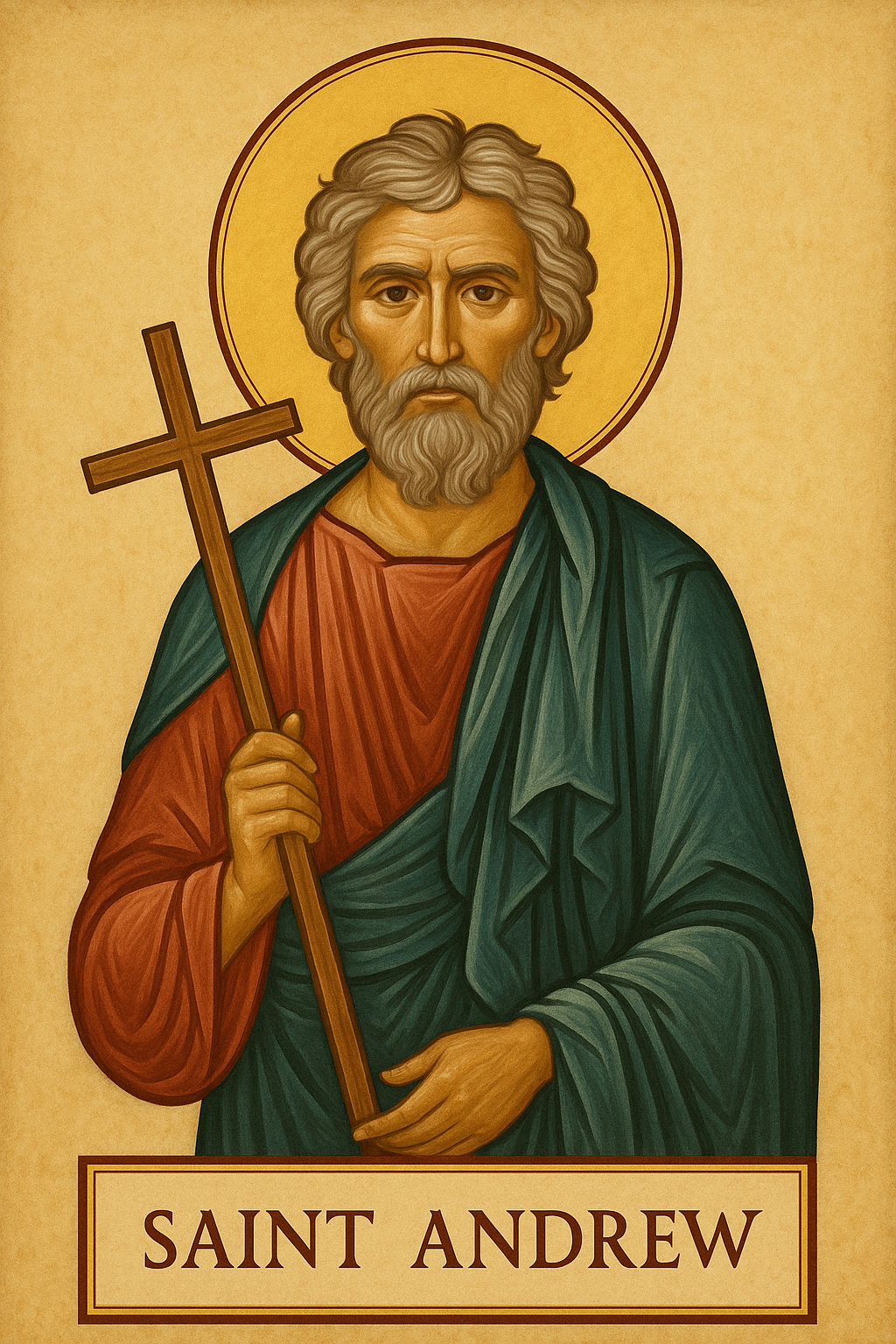
Andrew is now almost always shown on an X-shaped cross, called the saltire or Saint Andrew's cross. This is a tradition that appears late. The Catholic Encyclopedia notes that good evidence for the diagonal cross is no earlier than the late Middle Ages, and the cathedral at Patras itself acknowledges that earlier images show a conventional cross. The shape is an iconographic tradition, not a verified fact of his execution.
According to Byzantine tradition, Andrew's relics were taken from Patras to Constantinople around 357 and placed in the Church of the Holy Apostles. After the Latin capture of Constantinople in 1204, relics attributed to him went to Amalfi in southern Italy. The date of this transfer is given as 1208 in tradition and 1206 in another Catholic Encyclopedia article, so sources do not agree.
In September 1964 Pope Paul VI returned the relic of Andrew's head, which had been kept in Rome, to the Greek Orthodox Church at Patras, a gesture later cited by Benedict XVI as a sign of friendship between Rome and Constantinople. In January 1980 a cross traditionally linked to his martyrdom was returned to Patras from Marseille. Whether this wooden cross is the actual instrument of his death has not been established, and its importance rests on tradition and veneration.
Legends and Patronage
The Gospels do not credit Andrew with any miracle of his own. Later writings, especially the Acts of Andrew and Gregory of Tours, tell of healings, exorcisms and even a boy raised from death, and they are marked here as tradition. They are evidence of early devotion, not independently documented events.
In Scotland, a legend tells how a holy man named Regulus, or Saint Rule, brought relics of Andrew to the coast of Fife, where the town of Saint Andrews grew up. Another story says a white diagonal cross appeared against a blue sky before a battle, which explains the Scottish saltire flag. Historic Environment Scotland and the Catholic archdiocese of Saint Andrews and Edinburgh both present these as legends of uncertain origin.
The Romanian Orthodox Church teaches that Andrew brought Christianity to Scythia Minor, roughly the area of Dobruja, and proclaimed him patron of Romania in 1997. Eusebius gives an early basis for the Scythian tradition, but it does not show that he stood on specific Romanian ground. Russian tradition places Andrew's journey as far as the hills of Kyiv, a story that grew within Slavic Christianity and has no documents from his own time.
Scholarship and Sources
For Andrew's life, the surest sources are the New Testament passages already named, together with Eusebius for the early Scythian tradition. The apocryphal Acts and their later adaptations come next in age, but they are literary works with their own purposes, and they present apostles as ideal teachers who overcome rulers and demons.
Scholarly guides include J. K. Elliott's collection of apocryphal writings published in 1993 and the e-Clavis entry on the Acts of Andrew by the North American Society for the Study of Christian Apocryphal Literature. The Catholic Encyclopedia of 1907 remains useful, but its dates should be checked against later work. Benedict XVI's audience of June 14, 2006 gives a clear Catholic summary.
A careful reader can sort the material into three groups. First, what the New Testament establishes: his hometown, his trade, his brother and his place among the Twelve. Second, what ancient tradition supports without independent proof: a mission in Scythia and death at Patras. Third, later or uncertain details: exact dates, the appointment of Stachys, many miracles and the shape of the cross.
Holy Apostle Andrew, first to follow and first to bring another to Christ, pray for us. Teach us to share our faith simply and gently, beginning with those closest to us. Protect fishermen and travelers, bless the nations that honor you, and bring peace between the Churches of East and West. Help us to answer Christ's call without delay and to leave behind whatever holds us back. Amen.
This prayer is an original composition for devotion. It is not an official liturgical text and was not written by the saint.
Andrew in the Eastern Churches
In Byzantine Christianity Andrew is honored above all as First-Called. His feast on November 30 is also the patronal feast of the Ecumenical Patriarchate, sometimes called the Feast of the Throne, since the see of Constantinople looks to Andrew as its apostolic patron. The Byzantine liturgy keeps his memory in its hymns, which are not quoted here.
For Byzantine Catholics, the feast keeps an Eastern liturgical inheritance without any break in communion with Rome. For Orthodox Christians, it expresses the continuity of the Church of Constantinople with the apostles. The fact that Peter and Andrew were brothers lets both sides speak of Rome and Constantinople as sister Churches, a theme Benedict XVI used in speaking of Andrew.
Anyone can learn from his plain manner. He is remembered not for great speeches but for bringing a brother, a boy with loaves and some visiting Greeks to Jesus. The prayer card is a modest way to ask for that gift: the habit of introducing others to Christ without display.
Frequently Asked Questions
Ask His Prayers
Andrew simply brought people to Jesus. Keep his prayer card near you as a reminder to do the same for those around you.
View Prayer Card