Blessed Augustine Thevarparampil: Kunjachan, the Little Priest of Kerala
A Syro-Malabar parish priest who spent nearly five decades serving Dalit families in central Kerala, and who left a diary and a testament of simple poverty.
At a Glance
- Born
- April 1, 1891, in Ramapuram, Travancore (now Kerala, India)
- Died
- October 16, 1973, in Ramapuram, aged 82
- Titles
- Blessed, Priest, known as Kunjachan (Little Priest)
- Feast
- October 16, the anniversary of his death (Syro-Malabar Catholic Church)
- Veneration
- Syro-Malabar Catholic Church; beatified April 30, 2006, at Ramapuram
- Patronage
- No formal patronage; devotionally associated with Dalit Catholics and the poor
- The Little Priest
- Family and Childhood
- Seminary and Ordination
- The 1926 Mission and a Life Among the Dalits
- Caste, Opposition and Difficult Questions
- The Diary and Last Years
- Tomb and Beatification
- The Recognized Healing and Local Traditions
- Sources and Cautions
- Kunjachan in the Eastern Churches
- Frequently Asked Questions
The Little Priest
Blessed Augustine Thevarparampil is known throughout Kerala as Kunjachan, a Malayalam name that means Little Priest. He was a diocesan priest of the Syro-Malabar Catholic Church, one of the Eastern Catholic Churches that traces its heritage to the apostle Thomas and keeps the East Syriac liturgical tradition. He is remembered less for books or buildings than for steady daily work among people whom society pushed to the edge.
His main work began in 1926 and continued for decades among Dalit communities around Ramapuram and nearby villages. He taught, baptized, heard confessions, visited the sick and tried to help hungry and uneducated families. Official Church biographies credit him with bringing more than five thousand people into the Church, a figure that comes from ecclesiastical sources and has not been independently audited.
He was beatified on April 30, 2006, in Ramapuram. This article tells his life from the sources available, marks where they disagree, and treats the later devotional stories as traditions and not as established events.
Family and Childhood
Augustine Thevarparampil was born on April 1, 1891, in Ramapuram, then part of the princely state of Travancore. He was the youngest of five children of Itty Iype Mani and Eliswa, who belonged to the Thevarparampil family. His family belonged to the Saint Thomas Christian community of Kerala, so he grew up inside an Eastern Catholic tradition and did not come to the faith as an adult convert.
He was baptized at Saint Augustine's Church in Ramapuram and was named after the parish patron. The date of his baptism is uncertain: the Syro-Malabar Church and the Eparchy of Palai list April 7, 1891, while the Ramapuram shrine's chronology gives April 8. The baptismal register would need to be checked to settle it.
His first schooling was in a village kalari, a traditional school where local teachers called ashans taught children to read and write. He then attended the primary school at Ramapuram and later Saint Ephrem's School at Mannanam, where he boarded. The diocesan account notes that he studied alongside children of other religions and had Hindu teachers, and that his parents shaped his devotion to Mary. His small stature gave him the affectionate name Kunjachan, a family nickname and not a title given by Church authority.
Seminary and Ordination
After school Augustine entered the Saint Thomas minor seminary at Changanacherry. The shrine biography describes a journey made partly on foot and partly by boat, a reminder of how limited travel was in the region. He continued his training at Puthenpally Seminary in Varapuzha, which he entered in June 1915, and he received the cassock on July 16, 1915.
He was ordained a priest on December 17, 1921, by Mar Thomas Kurialacherry, Bishop of Changanacherry, according to the Vatican's Dicastery for the Causes of Saints and the official Church summaries. The longer narratives on the diocesan and shrine websites give December 21, 1921. The first date has better support, but the discrepancy should be recorded.
His first assignments were in Ramapuram and at Kadanad, where he became assistant vicar in February 1923. Poor health sent him back to Ramapuram. That apparent setback turned out to be a turning point, because it put him in the village at the moment when his life's work would begin.
The 1926 Mission and a Life Among the Dalits
In 1926, during a parish mission at Ramapuram, visiting preachers gathered about two hundred Dalit residents for religious instruction. According to the Vatican biography, their wish to receive baptism led Kunjachan to give himself to their spiritual and everyday welfare. From that year until his health failed, this became the center of his priesthood.
His method was personal. He learned the names of individuals and families, kept records of their circumstances and went to their homes and places of work. The shrine biography describes small educational gatherings held in sheds on the old kalari model, where children and adults who had little access to schools could begin to read. It also tells of a small act of care: using leftover cloth from cassock-making to provide blouses for women through Sister Scholastica.
The Syro-Malabar Church stresses his devotion to the Blessed Sacrament, his prayer before and after his journeys, his Marian devotion, the Divine Office and a simple, fasting life. He was not a famous preacher, scholar or administrator, and he did not found a religious order. The Church presents him as a parish priest whose main achievement was sustained service.
Caste, Opposition and Difficult Questions
Kerala in the late colonial and early independence era knew deep caste divisions. Dalit families faced untouchability, barred or limited education and heavy economic dependence on landowners. The Vatican biography records that Kunjachan met criticism and opposition not only from higher-caste non-Christians but also from within established Christian communities, a reminder that caste attitudes existed inside the Church as well.
A careful biography should also note a difficult question. The diocesan account of the 1926 mission says that some landowners brought their dependents to the retreat where baptism was offered. The available sources do not show whether anyone was pressured on that occasion, and they do not justify treating every conversion as forced. Motives are best left to more detailed testimony than the published accounts give.
The Vatican biography also reports that he was discouraged when government benefits were denied to Dalit converts, a matter tied to the legal treatment of caste and religion in India, which changed over time. His other lasting difficulties were illness and poverty. A serious decline began in 1959 and slowly limited his travel, and no evidence was found of any trial, imprisonment or state persecution.
The Diary and Last Years
Unlike many saints known mainly from later stories, Kunjachan left his own records. The Ramapuram shrine publishes English excerpts from a diary covering August 17, 1930, to August 16, 1931. The entries describe early prayer, Mass, confessions, baptisms, trips between villages and daily expenses. One entry records roughly forty confessions and eight baptisms on a busy Sunday.
These entries are valuable because they show a working priest and not only a legend. The excerpts, however, are in translation, and the shrine's selection has not been compared here with the original manuscript, so completeness and accuracy cannot be confirmed. The Vatican also refers to a record of the families he served in three volumes. No theological treatise or collection of sermons by him is known.
Illness limited his work in his last years, and he needed help from relatives and others. He died on October 16, 1973, in Ramapuram at the age of eighty-two. His spiritual testament says that he owned neither land nor money, and it asks for a simple funeral and burial among the Dalit Christians he had served.
Tomb and Beatification
His wish to be buried among the poor was not carried out. Instead, he was buried in a tomb near the altar of Saint Augustine in the old parish church at Ramapuram. Pilgrims began to visit soon after, and the site became the main center of devotion to him. Anniversary celebrations at the tomb are recorded from 1974.
The diocesan cause was opened on August 11, 1987, giving him the title Servant of God. His tomb was formally opened on March 10, 1990, as part of the process, and his remains were examined and placed back in the tomb. Pope John Paul II recognized his heroic virtue on June 22, 2004, which made him Venerable.
Pope Benedict XVI authorized the decree recognizing a miracle on December 19, 2005. On April 30, 2006, Cardinal Varkey Vithayathil, Major Archbishop of the Syro-Malabar Church, beatified him at Ramapuram on behalf of the pope. His feast is kept on October 16. He remains Blessed and has not been canonized, and no authenticated relics beyond those at Ramapuram have been recorded.
The Recognized Healing and Local Traditions
The miracle accepted for his beatification concerns Gilson Varghese, born on August 8, 1981, with a congenital clubfoot. According to the Ramapuram shrine, the family prayed at Kunjachan's tomb, and the deformity corrected itself on June 25, 1991. A diocesan tribunal in 1997 heard eighteen witnesses, including six doctors, and the papers were sent to Rome in 1998 before the decree of December 2005.
The Church's recognition settles the case for the purposes of beatification, but the full medical file was not available for review here. It also should not be taken to mean that every reported healing has been investigated and approved. Other stories are devotional testimony, and they are marked here as tradition.
One tradition tells of a farmer whose ginger crop was being eaten by worms, and who said the pest ended after Kunjachan prayed and sprinkled holy water. Others recall farmers asking his blessing on cattle, and pilgrims taking small amounts of soil from his tomb in hope of favors. These accounts show the rural setting of his ministry and the shape of local devotion, but they are not independently documented, and the soil has no power in itself.
Sources and Cautions
The most solid sources are the Vatican's Dicastery for the Causes of Saints, the Eparchy of Palai, the Syro-Malabar Church and the Ramapuram shrine, along with the decree announcement of December 2005 and a news report by Agenzia Fides in April 2006. The shrine also publishes the diary excerpts. Much of the Vatican biography is in Italian.
The outline of his life can be stated with confidence: his dates, his ordination, his work among the Dalits, his beatification and his feast. Some details deserve care before they are repeated. These are the baptism date, the exact ordination date, the number of converts and the finer points of his social work, all of which would benefit from the parish registers and the original diary.
It is also worth saying plainly what the sources do not support. They give no formal patronage conferred by Rome, no authenticated Orthodox veneration and no complete set of authorized liturgical texts for his feast. His life is best read as the life of an ordinary priest who stayed faithful for a very long time.
Blessed Kunjachan, humble priest of Ramapuram, pray for us. Teach us to see Christ in the poor and the forgotten, and to serve them with patience and respect. Strengthen priests who walk long roads to reach their people, console the sick and the hungry, and break down every wall of caste and contempt. Help us to live simply, to love the Eucharist and to remain faithful to small duties. Amen.
This prayer is an original composition for devotion. It is not an official liturgical text and was not written by the saint.
Kunjachan in the Eastern Churches
Kunjachan belongs to the Syro-Malabar Church, an Eastern Catholic Church in full communion with Rome whose heritage reaches back to Saint Thomas. His beatification was celebrated in Ramapuram, in his own parish land, with the Major Archbishop presiding for the pope. For Eastern Catholics he is a model of holiness lived in an ordinary parish and not in a monastery, a school or a martyrdom.
The available evidence does not show any official veneration of him in the Eastern Orthodox or Oriental Orthodox Churches. It would be wrong to call him an Orthodox saint or to give him an Orthodox feast. Readers from those traditions may still recognize in his life familiar themes: prayer, humility, simple living, sacramental care and love for the poor.
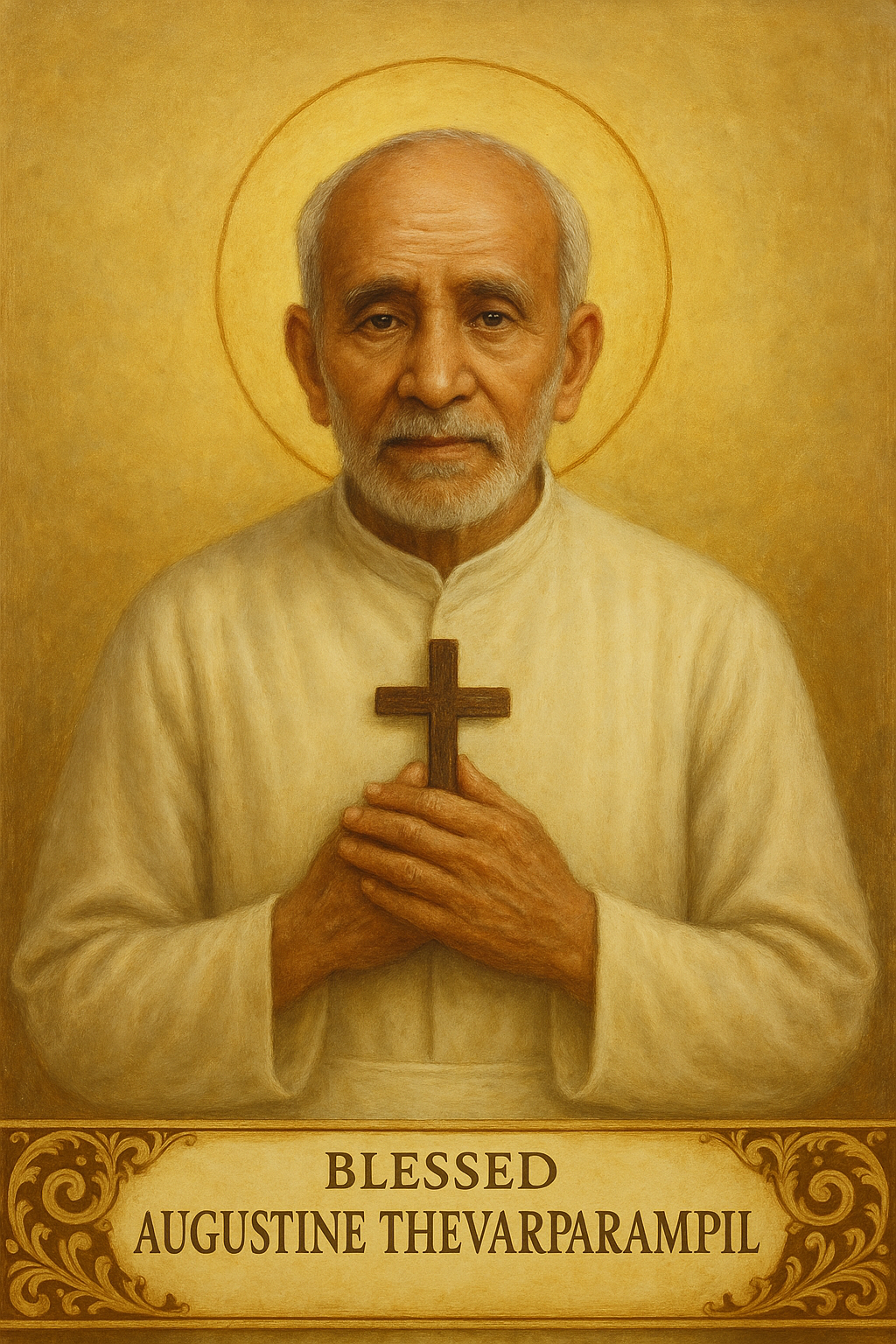
For many Kerala Catholics he remains the priest who went to those whom others avoided. His prayer card is a modest sign of that memory. It invites us to ask how we might serve the people nearest to us who are overlooked.
Frequently Asked Questions
Ask His Prayers
Kunjachan served quietly for nearly fifty years. Keep his prayer card near you as a reminder to serve those who are easily overlooked.
View Prayer Card