Blessed Nicholas Charnetsky: Redemptorist Bishop and Confessor of the Faith
A village boy from Galicia who became a Redemptorist missionary and bishop, survived eleven years in the Soviet camps and kept the Church alive in Lviv until his death.
At a Glance
- Born
- December 14, 1884, in Semakivtsi, Galicia (one reference work gives September 14)
- Died
- April 2, 1959, in Lviv, aged 74
- Titles
- Blessed, Bishop, Redemptorist, Hieromartyr; Titular Bishop of Lebedus, Apostolic Exarch of Volhynia, Polissia and Pidlasha
- Feast
- June 27 with the Ukrainian martyrs (July 10 on the Julian civil calendar); April 2 in some calendars as his death anniversary
- Veneration
- Ukrainian Greek Catholic Church; beatified June 27, 2001, in Lviv
- Patronage
- No formal patronage; devotionally honored by prisoners and the persecuted
A Bishop Who Would Not Be Silenced
Blessed Nicholas Charnetsky, in Ukrainian Mykola Charnetsky, was a priest of the Ukrainian Greek Catholic Church, a member of the Redemptorist congregation and a bishop. He was a teacher of seminarians, a missionary in the borderland of Volhynia and, after 1945, a prisoner of the Soviet state. He lived from 1884 to 1959 and spent eleven of his last fourteen years in custody or in ruined health.
His story belongs to the larger history of the Soviet attack on the Greek Catholic Church. When the state arrested the bishops of the Church in 1945 and then staged a council in Lviv in 1946 to dissolve the union with Rome, Charnetsky was one of those who refused to cooperate. After his release he returned to Lviv, very ill, and quietly continued his ministry.
Pope John Paul II beatified him in Lviv on June 27, 2001, with twenty-four companions. This article follows his life from a peasant home to a Roman college, a Redemptorist cell, a bishop's office and a prison cell, and it marks the places where the sources differ.
Semakivtsi and Rome
Mykola Charnetsky was born on December 14, 1884, in the village of Semakivtsi, in the Horodenka district of Galicia, then part of Austria-Hungary. The Vatican and the Encyclopedia of Ukraine give this date, while Catholic-Hierarchy lists September 14. The weight of the sources favors December, though a baptismal register would settle the question.
His parents, Oleksa and Paraskevia, were farmers, and Mykola was the eldest of nine children. The Ukrainian Greek Catholic Church's biography records that his father worked on the estate of the parish priest, which put the boy in regular contact with parish life. He began school locally and continued at a gymnasium in Stanislaviv, now Ivano-Frankivsk.
A fellow student, later Father Athanasius Tymkiv, remembered him as prayerful, quiet and unwilling to join in gossip. These recollections come through later Church retellings and should be read as testimony and not as a full documentary record. With the support of Bishop Hryhoriy Khomyshyn he went to Rome in 1903 to study at the Ukrainian college of Saints Sergius and Bacchus.
Priest and Redemptorist
Charnetsky was ordained a priest on October 2, 1909, by Bishop Khomyshyn, who was himself later beatified as a martyr. He celebrated his first Divine Liturgy in his native village. The Ukrainian Greek Catholic Synod dates his doctoral defense in Rome to November 16, 1909.
He returned to Galicia and taught philosophy and theology at the seminary in Stanislaviv, and served as a spiritual director, a post he held from about 1910 to 1919. During the First World War he also served communities left without priests and, according to the Church's biography, caught typhus and recovered.
In 1919 he entered the novitiate of the Redemptorists near Lviv, and he professed his first vows in 1920 and perpetual vows in 1923. Becoming a Redemptorist did not mean giving up his Byzantine tradition. The Redemptorists of the Byzantine rite served in Galicia and Volhynia in their own liturgy, and Charnetsky's mission belonged to that Eastern tradition.
Bishop in Volhynia
Volhynia, in the interwar Polish state, held large Orthodox populations alongside Ukrainian Greek Catholics and Latin Catholics. The Redemptorists opened missions there to serve Byzantine-rite Catholics and to improve relations with the Orthodox. The Ukrainian Catholic Archeparchy of Philadelphia notes that his familiarity with Byzantine worship and spirituality earned respect even among Orthodox neighbors.
He was consecrated a bishop on February 2, 1931, in Rome, under Pope Pius XI, with the titular see of Lebedus. He was apostolic exarch for Volhynia, Polissia and Pidlasha. Some later biographies wrongly attribute the appointment to Pius XII, who did not become pope until 1939. The sources also differ on the timing of his earlier mission: the Vatican biography places an appointment as visitor in 1926, while the formal episcopal record gives January 16, 1931, and the original decrees would be needed to decide.
Polish authorities limited his freedom to act, so his official commission was not always the same as the power he could use. One public moment stands out. In 1932 he took part in the International Eucharistic Congress in Dublin, where, according to the Philadelphia archeparchy, he celebrated a Byzantine hierarchical Divine Liturgy in Church Slavonic at the Jesuit church on Gardiner Street. He is said to have translated works of Saint Alphonsus Liguori, but titles and dates of these translations could not be confirmed.
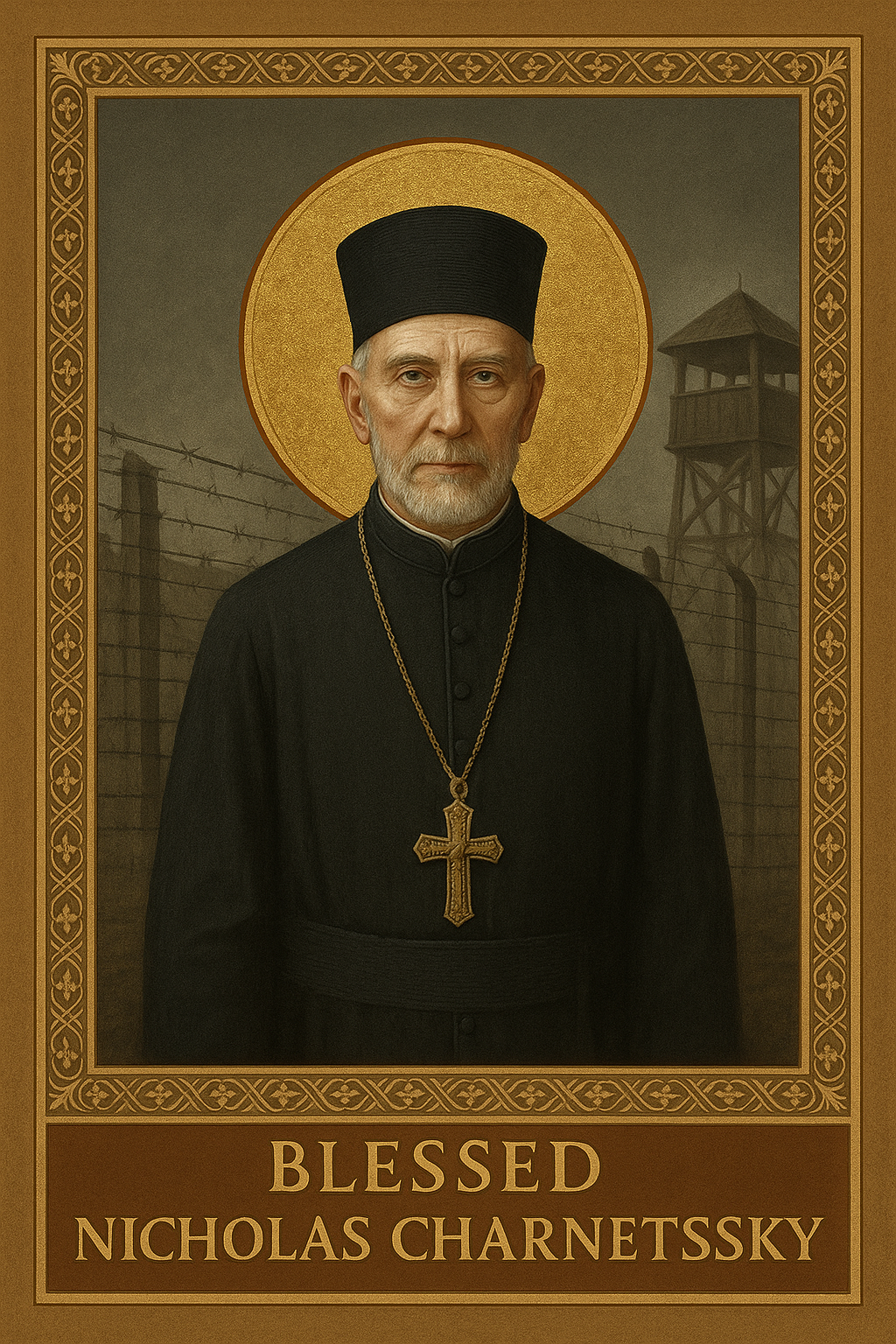
The Soviet Suppression
Soviet troops returned to Lviv in 1944, and pressure on the Greek Catholic Church grew. The state viewed the Church's communion with Rome and its link to Ukrainian national life as a political danger. In April 1945 the bishops, including Charnetsky, were arrested, and in 1946 a council staged by the authorities declared that the union with Rome was dissolved and that the faithful would join the Russian Orthodox Church. The Greek Catholic Church has never accepted that council as a free act.
It is fair to separate the actions of the Soviet state from the beliefs of individual Orthodox Christians, many of whom were persecuted themselves. The relationship between the state, the Russian Orthodox leadership and the suppressed Greek Catholics was complicated, and the sources do not support a simple account.
Charnetsky was arrested on April 11, 1945. The Vatican biography reports a sentence of six years of forced labor, while other Ukrainian Catholic and Redemptorist accounts speak of ten years, so the exact sentence is uncertain. His actual imprisonment lasted from 1945 until 1956. He was accused of serving Vatican interests, and no credible evidence of real espionage has been found.
Eleven Years in Prison
The Church's accounts describe his imprisonment at Mariinsk in the Kemerovo region of Siberia, where he met Metropolitan Josyf Slipyj. Redemptorist accounts say that he passed through about thirty prisons and camps, and the Ukrainian Greek Catholic Church speaks of some six hundred hours of interrogation. These figures are repeated in Church biographies, but they have not been checked against Soviet prison records.
Fellow prisoners and the Church's accounts present him as a spiritual father in the camps, who heard confessions, encouraged others and tried to keep to a rule of prayer despite the conditions. Such testimony comes from memory after the fact and should be read as witness testimony, but it fits the pastoral character he had shown all his life.
By 1956 his health had collapsed. The Church reports that he spent part of his last imprisonment in a prison hospital in Mordovia, and that the authorities finally let him return to Lviv, apparently because of his grave condition. He was then a very sick man of seventy-one with little time left.
The Last Years in Lviv
Back in Lviv, Charnetsky resumed a quiet ministry in a Church that now had no legal existence. He helped form priests in secret, and the Church's account says he ordained more than ten priests after his return. That number is from the Church's own record, and a complete list of those ordained was not found.
His secret episcopal work mattered because the Greek Catholic Church was operating underground without public institutions or legal protection. A single bishop, ill and watched, was one link that tied the underground priests and faithful to the wider Church.
He died in Lviv on April 2, 1959, at the age of seventy-four. The Church records that his last words called on Our Mother of Perpetual Help, the Marian devotion closely tied to the Redemptorists. The exact wording is not reliably transcribed, so it is not quoted here. His funeral was held on April 4, 1959.
Burial, Relics and Beatification
He was first buried in the Kulparkiv cemetery in Lviv, and when that cemetery was closed in the 1960s his remains were moved to the Lychakiv cemetery. Even under Soviet rule his grave became a place of quiet devotion. The Church's account says that work toward his beatification began in 1960, soon after his death.
In 2001 the eparchial investigation was completed, his martyrdom was examined and the pope approved the decree. On June 27, 2001, Pope John Paul II beatified him in Lviv with twenty-four companions. His death came after his release, and the Church recognized him as a martyr because of the long persecution, the suffering it caused and the hostility to the faith behind it.
On July 4, 2002, his relics were moved to the Church of Saint Josaphat in Lviv, which is the main documented place of his relics. His feast falls on June 27 with the other Ukrainian martyrs, which is July 10 on the Julian civil calendar. Some Redemptorist communities keep June 28, and April 2, the day of his death, appears as a personal feast in some calendars, though a separate authorized observance has not been verified.
Stories of Devotion
Several stories are told about Charnetsky, and they are marked here as tradition. One says that a Soviet interrogator who struck him was met with gentleness, and later repented and asked for baptism. The story shows the ideal of answering persecution without hatred, but no contemporary record of the man's name or baptism has been found.
Another tells of a woman threatened with the loss of an arm who took soil from his grave, applied it to the arm and recovered. The practice of taking earth from his grave grew from this and similar accounts. The Church records the story, but the diagnosis and medical evidence were not available for review, so it is a reported healing and not a proven miracle.
His survival after release is a historical fact, and his own community saw it as providential. That reading is a matter of faith. Believers pray at his grave and before his relics and report favors, and it is safest to say that, without claiming that every reported cure has been formally authenticated.
Blessed Nicholas, shepherd who stayed with your people through prison and illness, pray for us. Obtain for us patience in suffering and gentleness toward those who wrong us. Strengthen priests and bishops who serve under pressure, console prisoners and the sick, and keep the faithful steady in hard times. Teach us to pray with the Church of East and West and to trust Christ and his Mother in every trial. Amen.
This prayer is an original composition for devotion. It is not an official liturgical text and was not written by the saint.
Charnetsky and the Eastern Churches
Charnetsky matters to Eastern Catholics because his life shows how the Byzantine liturgy, the sacraments and the office of bishop survived under persecution. His work in Volhynia also bears on Catholic and Orthodox relations, since the Church records that his knowledge of Eastern worship won respect among the Orthodox.
His beatification is a Catholic act, and it is not a recognition by the Orthodox Churches. No Orthodox canonization has been found, and it would be wrong to say that Orthodox Christians share his veneration or all of his missionary aims. What the sources do support is that he was a witness of perseverance and a missionary concerned with relations between the two communities.
For any reader he remains a plain example of a teacher turned bishop who kept his post under hardship. The prayer card asks for something simple: the patience to stay faithful when the circumstances are hostile.
Frequently Asked Questions
Ask His Prayers
Blessed Nicholas stayed faithful through eleven years of hardship. Keep his prayer card near you as a reminder to remain steady in your own trials.
View Prayer Card