Blessed Nykyta Budka: First Ukrainian Catholic Bishop of Canada and Martyr
A missionary bishop who built the Ukrainian Catholic Church in Canada, made costly mistakes, and died as a prisoner in Kazakhstan.
At a Glance
- Born
- June 7 or September 7, 1877, in Dobromirka, Galicia (sources disagree)
- Died
- Probably September 28, 1949, at the Karadzhar camp near Karaganda, Kazakhstan (other sources give October 1 or 6)
- Titles
- Blessed, Bishop, Hieromartyr; Titular Bishop of Patara, Apostolic Exarch for Canada, Auxiliary Bishop of Lviv
- Feast
- September 28 (Ukrainian Greek Catholic calendar in Canada); June 27 shared memorial in the Canadian Roman calendar
- Veneration
- Ukrainian Greek Catholic Church; beatified June 27, 2001, in Lviv
- Patronage
- No formal patronage; associated devotionally with Ukrainian immigrants and persecuted Eastern Christians
- A Pioneer Bishop and a Martyr
- Galicia, Innsbruck and the Priesthood
- Emigrants and the Call to Canada
- Building a Church on the Prairies
- Crisis in Wartime
- Resignation and Return to Lviv
- Arrest and Death in Kazakhstan
- Beatification and Feast Days
- Sources and Cautions
- Budka in the Eastern Churches
- Frequently Asked Questions
A Pioneer Bishop and a Martyr
Blessed Nykyta Budka was the first bishop appointed to serve Ukrainian Greek Catholics in Canada. Named in 1912, he took charge of a scattered immigrant Church that had few priests, little money and almost no institutions. He spent sixteen years building parishes, schools and a legal structure, and he was then asked to resign. He returned to Lviv, and after the Second World War the Soviet state arrested him and sent him to a camp in Kazakhstan, where he died.
His life is not a simple success story, and the sources do not present it as one. The Eparchy of New Westminster calls him a gifted missionary but a poor administrator. He made a serious political mistake at the start of the First World War, and he was drawn into bitter disputes in the Ukrainian community. This article tries to keep those facts in view along with his courage at the end.
Pope John Paul II beatified him in Lviv on June 27, 2001, among the Ukrainian Greek Catholic martyrs. Several key dates in his life are given differently in credible sources, and they are marked as uncertain below.
Galicia, Innsbruck and the Priesthood
Nykyta Budka was born in Dobromirka, in the Zbarazh district of eastern Galicia, then part of Austria-Hungary. The date is disputed. The eparchies of New Westminster and Toronto give June 7, 1877, while the Encyclopedia of Ukraine and the Archeparchy of Winnipeg give September 7. A baptismal record would be needed to settle it.
The historian Stella Hryniuk describes his parents as fairly prosperous and politically active, while the Ukrainian Diaspora Museum speaks more simply of a peasant family. The two are not necessarily in conflict. The sources consulted do not reliably give the names of his parents or siblings. He attended school in Ternopil, paid his way by tutoring and finished secondary school in 1897.
He worked as a tutor for the children of Prince Leo Sapieha and did Austrian military service and officer training before entering theological studies at the University of Innsbruck in 1902. He was ordained by Metropolitan Andrey Sheptytsky in October 1905. New Westminster gives October 14, and other Church sources give October 25. Afterward he became prefect of the Greek Catholic seminary in Lviv.
Emigrants and the Call to Canada
In Lviv Budka advised a matrimonial tribunal and took up the cause of Ukrainians leaving for other countries. He joined the Saint Raphael Emigrant Welfare Society, helped organize its Galician branch, visited Ukrainian migrants in Prussia and Bosnia and edited a periodical called Emigrant, which offered spiritual and practical advice.
Metropolitan Sheptytsky had visited Ukrainian settlements in Canada in 1910 and asked Rome to send a bishop. Budka, with his experience of emigrant needs, was chosen. He was appointed on July 15, 1912, and consecrated in October 1912 at Saint George's Cathedral in Lviv by Sheptytsky. Sources give either October 13 or 14 for the date. He was named titular bishop of Patara.
He was enthroned at Saint Nicholas Church in Winnipeg on December 22, 1912. The Eparchy of New Westminster describes this as the first time Rome appointed an Eastern Catholic bishop with full jurisdiction outside Europe and Asia. His territory was huge, his priests were few and his communities were struggling to hold on to the faith of their homeland.
Building a Church on the Prairies
Ukrainian settlers lay scattered across the Prairie provinces, and Hryniuk estimates that about 128,000 of them fell within his care. He began traveling at once by rail, horse and on foot, celebrating the Divine Liturgy and the sacraments and urging families to keep up regular worship.
His most lasting achievement may have been legal. In 1913 he incorporated the Ruthenian Greek Catholic Episcopal Corporation of Canada, which gave the Church a legal structure to hold its property and eased fears that church buildings paid for by immigrants would pass into outside hands. He issued four pastoral letters and two booklets for immigrants that year.
He worked to protect the Byzantine tradition. His writings, as Hryniuk describes them, gave instructions on the placement of altars and icons, the use of candles, liturgical singing and the differences between Byzantine and Latin worship. He promoted family prayer, church attendance and religious education, supported schools and bilingual teaching, recruited priests from Europe and encouraged local vocations.
Crisis in Wartime
On July 27, 1914, shortly before the First World War began, Budka issued a pastoral letter on the duties of Ukrainian immigrants who were still subjects of Austria-Hungary. He told those with military obligations to be ready to serve. When Britain, and with it Canada, went to war against Austria-Hungary, the letter looked like disloyalty.
On August 6, 1914, he issued a second letter reversing his advice, but the damage was done. Suspicion fell on Ukrainian immigrants in an era of surveillance and internment. According to New Westminster, he was arrested at Hafford, Saskatchewan, on July 8, 1918, and cleared of treason charges on November 26, 1919. He became a British subject on November 23, 1920.
He also faced conflict within the Ukrainian community, with secular nationalists and others who thought the clergy held too much control over institutions. Disputes over schools, property and the Mohyla Institute in Saskatoon contributed to the founding of the Ukrainian Greek Orthodox Church of Canada in 1918. The Encyclopedia of Ukraine admits that his temperament and administration made these quarrels worse, but the split also involved wider questions about identity, married clergy and Latin influence, and it cannot be blamed on him alone.
Resignation and Return to Lviv
Budka's missionary energy came with constant money problems. The Eparchy of New Westminster says his jurisdiction depended on outside help and often faced bankruptcy. He was exhausted and had major surgery at the Mayo Clinic in Minnesota on July 1, 1927. After failing to obtain enough assistance, he was asked to resign, and the eparchial chronology dates the request to November 9, 1928.
He returned to Lviv and became vicar general of the archeparchy in August 1930. From 1930 to 1939 he also supervised the Marian shrine at Zarvanytsia. His later ministry unfolded under Polish, Soviet and Nazi rule in turn, and his Canadian story, with its achievements and failures, was behind him.
The sources disagree on a few smaller matters. His doctoral status is one: several biographies call him a doctor of theology, while Hryniuk reports that he prepared a dissertation he could not defend. The degree would need to be checked against university records.
Arrest and Death in Kazakhstan
After the war, the Soviet state moved to destroy the Ukrainian Greek Catholic Church's independent structure and its communion with Rome. On April 11, 1945, the police arrested Budka with the other Greek Catholic bishops. He was held in Kyiv and convicted on June 3, 1946, on a charge described in Church records as treason against the Soviet state. On July 5, 1946, he was sent to the Karadzhar camp near Karaganda in Kazakhstan.
He died in the camp in the autumn of 1949. The New Westminster chronology gives September 28 and records a burial near the camp on October 2, but other sources give October 1 or October 6, and the date remains unsettled. His grave has never been identified securely.
His conviction was political and not based on a real crime. After Ukraine became independent he was rehabilitated on September 19, 1991. The Archeparchy of Winnipeg keeps some of his episcopal belongings, which can be honored as personal items, but they should not be mistaken for bodily relics.
Beatification and Feast Days
On June 27, 2001, Pope John Paul II beatified Budka in Lviv with Bishop Mykola Charnetsky and twenty-four other Ukrainian Greek Catholic martyrs. The Vatican list describes him as an auxiliary bishop of Lviv and the first bishop for Ukrainian Catholics in Canada. A martyr does not need a verified miracle for beatification, and none has been established for him individually.
His memory is kept on September 28 in the Ukrainian Greek Catholic calendar used in Canada. In 2016 the Holy See approved an optional memorial on June 27 in the Roman Catholic calendar for Canada, shared with Blessed Vasyl Velychkovsky. He has been beatified but not canonized.
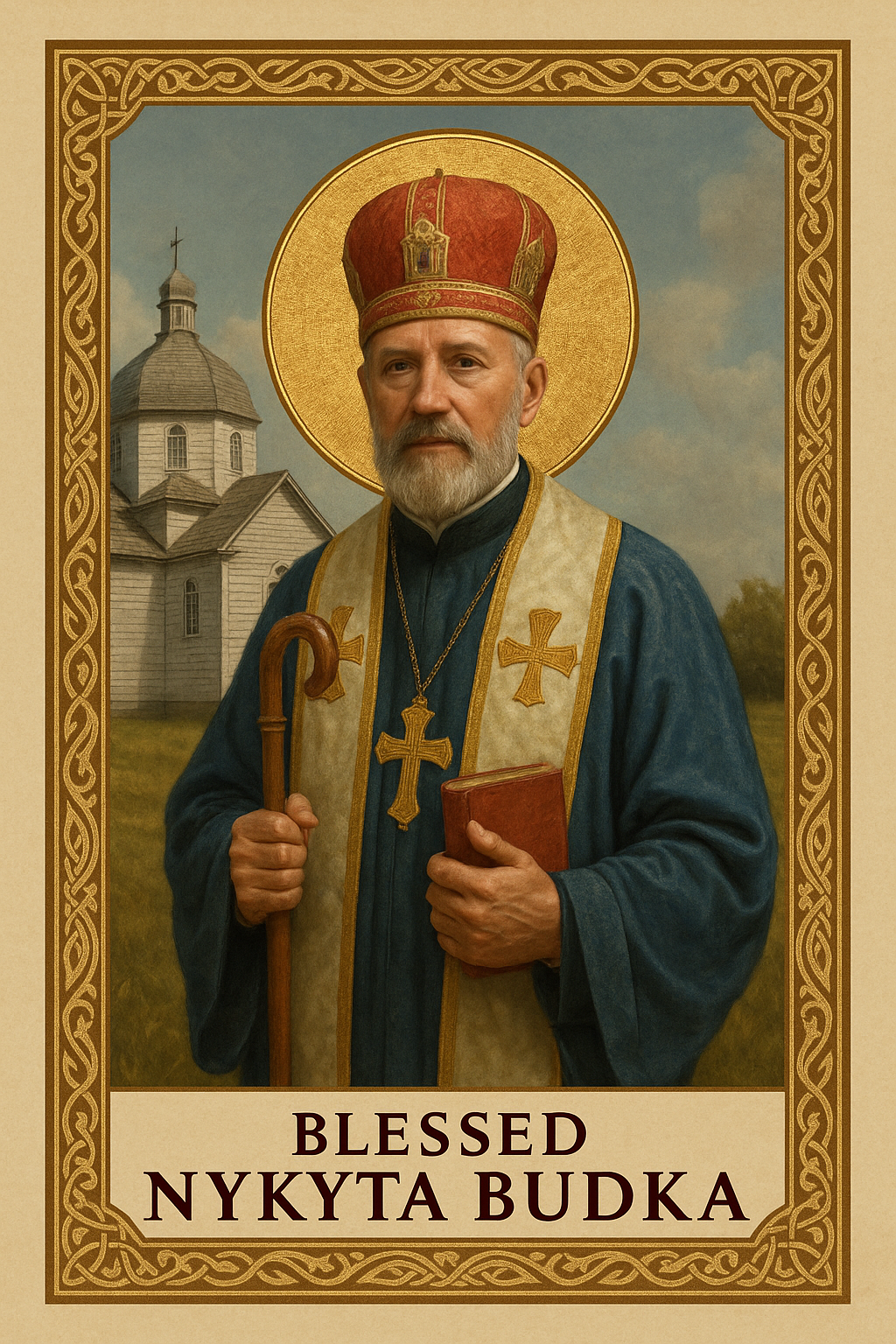
No account of visions or prophecies by Budka rests on documents, and the sources caution against attaching such stories to him. Devotion to him is expressed through icons, publications and the commemorations of Ukrainian Catholic communities in Canada. Images show him in Byzantine episcopal vestments, sometimes with a martyr's sign, and these express his recognized rank and not any special event.
Sources and Cautions
The main studies are Stella Hryniuk's article of 1988 on his Canadian years and Athanasius McVay's archival biography of 2014, which draws on material from Canada, Ukraine, Poland, Kazakhstan and the Vatican. The earlier book by Shykula and Korchinski, published in 1990, is also cited. Church records from the eparchies of New Westminster, Toronto and Winnipeg and from the Synod of the Ukrainian Greek Catholic Church give the chronology.
A careful account holds several points loosely: his birth date, his ordination and consecration dates, his doctorate and his death date. It also keeps in mind that a quotation attributed to him about his responsibility before God and history comes from a summary of McVay's research and not from a reproduced document, so it is not quoted here.
It is fair to say two things at once. He helped create lasting institutions for Ukrainian Catholics in Canada, and he made real administrative and political errors. Both statements are supported by the sources, and neither cancels the other.
Blessed Nykyta, shepherd of immigrants and prisoner for the faith, pray for us. Obtain for us courage to serve with little, humility to admit our mistakes and faith to keep going when we fail. Watch over those who leave their homes for a new land, strengthen priests who serve far from family, and console the persecuted. Help us to remain faithful to Christ and his Church to the end. Amen.
This prayer is an original composition for devotion. It is not an official liturgical text and was not written by the saint.
Budka in the Eastern Churches
For Eastern Catholics, Budka is a bishop who worked to keep Byzantine worship, icons, language and clergy alive among immigrants who lived among Latin Catholics and Protestants, while remaining in communion with Rome. His story shows the pressure on Eastern Christians who moved to North America.
For Orthodox readers, his legacy is more complicated. His conflicts with community organizations belong to the shared history of Eastern Christianity in Canada, including the founding of the Ukrainian Greek Orthodox Church of Canada. It is not accurate to say that he was widely accepted by Orthodox Christians, nor to describe the division as mere hostility toward religion.
His imprisonment belongs to the wider Soviet persecution of Christians, which touched Catholics and Orthodox alike. No Orthodox canonization has been found, and his formal veneration is Catholic. The prayer card remains a simple way to ask for patience and perseverance for those who make mistakes and still stay faithful.
Frequently Asked Questions
Ask His Prayers
Blessed Nykyta served with both strengths and flaws and stayed faithful to the end. Keep his prayer card near you as a reminder to persevere.
View Prayer Card