Blessed Vasyl Velychkovsky: Redemptorist Bishop and Martyr of the Underground Church
A priest of Galicia, a prisoner of Vorkuta, a secret bishop and an exile who died in Winnipeg
At a Glance
- Born
- June 1, 1903, Stanislaviv (now Ivano-Frankivsk), Ukraine
- Died
- June 30, 1973, Winnipeg, Canada
- Titles
- Blessed, Bishop, Hieromartyr, Redemptorist priest
- Feast
- June 27
- Veneration
- Beatified June 27, 2001 by Pope John Paul II in Lviv
- Patronage
- Prison ministry of the Ukrainian Greek Catholic Church; persecuted Christians
- A Childhood in Galicia
- War, Study and the Road to the Seminary
- Novitiate, Vows and Priesthood
- A Missionary in Volhynia
- The War Years and a Great Procession
- Arrest and the Sentence of Death
- Vorkuta and Vladimir
- A Secret Bishop of the Underground Church
- Second Arrest, Exile and Winnipeg
- Death, Beatification and Legacy
- Frequently Asked Questions
A Childhood in Galicia
Vasyl Velychkovsky was born on June 1, 1903, in Stanislaviv, a city of Galicia that is now called Ivano-Frankivsk in western Ukraine. At that time the region belonged to the Austro-Hungarian Empire, and the Greek Catholic Church was a central part of Ukrainian life there. His father, Volodymyr, was a priest, and his mother was named Anna. The family lived in the ordinary rhythm of a clergy household, shaped by the church calendar.
The family later moved to the village of Shuparka, near Borshchiv, where the boy grew up among farmers and parish traditions. Priestly families in Galicia were often close to the villagers, sharing their hardships and their feasts. Vasyl learned the faith through songs, fasts and pilgrimages, and he absorbed the habit of prayer long before he understood what it would one day cost him.
In 1911, when Vasyl was a small boy, Redemptorist missionaries preached a parish mission at the church of his grandfather in Probizhnia. The mission was dedicated to the Mother of God, and the sermons, processions and confessions made a deep impression on the family. Later accounts tie his attraction to the Redemptorists to this event, though the exact way the idea formed in him is told in a devotional style. Later accounts tie his attraction to the Redemptorists to this event.
War, Study and the Road to the Seminary
The collapse of the empire in 1918 brought a struggle for Ukrainian independence in Galicia, and some sources say that Vasyl, still a teenager, served briefly in the Galician Army. Details of this service are thin, and it should be treated as a modest part of the record. What is clear is that he came of age during a time of armed conflict and shifting borders, and that Galicia soon came under Polish rule.
In 1920 he entered the seminary in Lviv, the main center of Greek Catholic priestly formation under Metropolitan Andrey Sheptytsky. The seminary offered a thorough education in theology, liturgy and pastoral work. Sheptytsky was a towering figure who encouraged both deep spirituality and care for the poor, and his influence on the young men of the seminary was lasting.
Vasyl was ordained a deacon in the early 1920s, with sources giving 1923 or 1924, so that date is uncertain. He then chose to follow the call he had felt since the mission of his childhood and asked to join the Redemptorists. This meant leaving the possibility of an ordinary parish and accepting the discipline of community life.
Novitiate, Vows and Priesthood
In 1924 Vasyl entered the novitiate of the Redemptorists at Holosko, near Lviv. The novitiate was a year of silence, study of the rule and long hours of prayer, intended to test whether a candidate could live the common life. He took his religious vows in August 1925, promising poverty, chastity and obedience in the service of the community.
He was ordained a priest on October 9, 1925, by Bishop Botsian, and the ordination is usually placed at Zboisk. Accounts of the exact ceremony are brief, so the safest statement is that he became a Greek Catholic priest of the Redemptorist community in that year.
As a young Redemptorist he took up the characteristic work of the congregation, which was preaching missions and retreats in parishes. He traveled from village to village, hearing confessions for hours and giving sermons about repentance and trust in God. This work trained him in the simple, direct style of speaking that people later recalled with affection.
A Missionary in Volhynia
In 1928 Father Velychkovsky was sent to Kovel, in the region of Volhynia. This was a very different setting from Galicia, because many people there were Orthodox, and relations between the Churches were delicate. The Redemptorists were asked to serve a small Greek Catholic community in a place where the Eastern tradition was strong and where a careless word could cause offense.
He worked there for several years, and accounts describe him as respectful toward the Orthodox neighbors while firm in his own loyalty to the Catholic communion. He used the Eastern liturgy, kept the Eastern fasts and spoke warmly of the shared inheritance of the Christian East. His method was patient presence rather than argument.
He left Volhynia in 1935 and returned to Galicia, where the community assigned him to other duties. The years in Kovel gave him a lasting sense of the importance of ecumenical sensitivity, and he carried this into later work. They also taught him how to live as a minority, a skill that proved essential under Soviet rule.
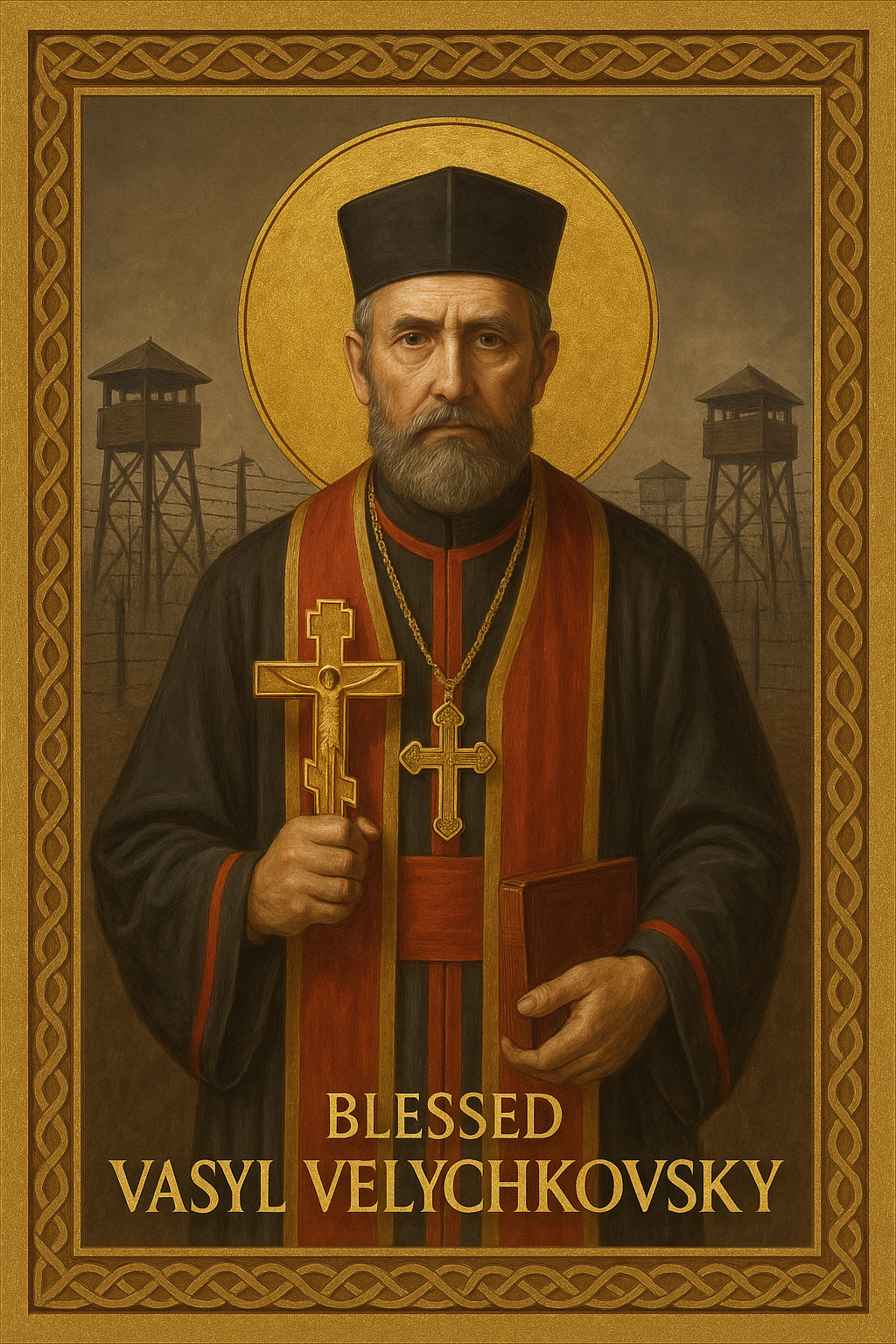
The War Years and a Great Procession
The Second World War swept across Galicia in 1939 and 1941, first with Soviet occupation and then with German occupation. In 1940 the Soviet authorities were already hostile to the Church. Redemptorist sources mention a large Marian procession in Stanislaviv in that period, with a figure of about twenty thousand participants, though that number should be treated as an estimate rather than a verified count. Father Vasyl was briefly arrested around this time.
In 1941 he served in Kamianets-Podilskyi, and by 1944 he was in Ternopil, where he was superior of the Redemptorist monastery. These were years of fear and shortage. Priests tried to keep the sacraments available while armies moved through the countryside, and the Redemptorists kept their houses open to those in need.
When the Red Army returned in 1944, everyone understood that the Greek Catholic Church was in danger. The Soviet government wanted to bring it under the control of the Russian Orthodox Church. Father Vasyl, like many others, had to decide how he would respond when pressure came, and he already seemed to know what his answer would be.
Arrest and the Sentence of Death
On August 7, 1945, Father Velychkovsky was arrested in the Redemptorist monastery at Ternopil. He was one of many Greek Catholic clergy seized in that period as the authorities moved against the Church. Accounts say that he was offered release if he would join the Russian Orthodox Church, and that he refused. The exact words he spoke are not reliably recorded, so they are not given here.
He was taken to Kyiv and held in prison during a long investigation. On June 26, 1946, he was sentenced to death. For about three months he waited in a cell with the sentence hanging over him. Later sources report that the sentence was commuted to ten years of forced labor, and that this was a surprise to him.
Those months of waiting are often described as a time of intense prayer. Whatever the inner details, the outcome is clear: he did not buy his freedom with a betrayal of his communion, and he came out of the death cell as a prisoner rather than a corpse. For the Greek Catholic faithful, this made him a living witness.
Vorkuta and Vladimir
After the commutation he was sent to the camps in the far north, in the Vorkuta region, one of the most severe parts of the Soviet prison system. Prisoners worked in coal mines and endured bitter cold, hunger and disease. Many priests and bishops of the Greek Catholic Church were in this system, and fellow prisoners later wrote about the way the clergy secretly kept prayer alive.
In the camps Father Vasyl is remembered as a pastoral presence. He heard confessions in whispers, encouraged the discouraged and shared what little he had. Such accounts rely on the memories of survivors and are devotional in tone, but they agree with one another in pointing to a priest who treated imprisonment as a place of ministry.
In 1953 he was moved to the Vladimir prison, a notorious facility east of Moscow. He was released on July 9, 1955, after about ten years in custody, broken in health but not in spirit. He returned to Ukraine as a man who had spent almost his entire adult priesthood either preaching or imprisoned.
A Secret Bishop of the Underground Church
After his release he lived in Lviv, where the Greek Catholic Church was officially banned. He worked in secret, celebrating the liturgy in homes, baptizing children, hearing confessions and quietly encouraging the clergy who remained. The Church of the catacombs depended on such priests, who lived ordinary jobs by day and served the faithful at night.
In the later 1950s and early 1960s, Metropolitan Josyf Slipyj, who had himself been imprisoned, sought to ensure that the Church would have bishops. Sources give the date of Father Vasyl being named a bishop as 1959, while most place his secret episcopal consecration in 1963. The ordination is said to have taken place in Moscow, in a hotel, where Slipyj was staying after his release.
The consecration was secret by necessity, and only a few knew of it. Bishop Velychkovsky returned to Ukraine to continue his hidden ministry, serving as a pastor of an underground flock. He could not wear episcopal vestments in public or announce his role, but he ordained priests and strengthened the faithful in the shadows.
Second Arrest, Exile and Winnipeg
On January 27, 1969, the secret police arrested him a second time. The reasons given in Church accounts include his contacts with Vatican Radio, his baptisms and his writings about Our Lady of Perpetual Help. He was sentenced to three years and sent to a camp at Komunarsk. Reports of torture and mistreatment exist, but the details are disputed and should be read cautiously.
He was released in 1972 and, under international pressure, was expelled from the Soviet Union. On June 15, 1972, he arrived in Winnipeg, Canada, at the invitation of Metropolitan Maxim Hermaniuk. For the first time in decades he could worship openly, wear the vestments of his office and speak freely to the faithful, many of them immigrants from Ukraine.
His time in Canada was short. He helped the local community, spoke about the Church he had left behind, and quietly continued his priestly life. He lived about a year in Winnipeg, and those who met him often said that he seemed to carry his suffering with great peace.
Lord Jesus Christ, You strengthened Your servant Vasyl in prison, in exile and in the long hidden years of his ministry. Give courage to all who are persecuted for Your name. Comfort the prisoners, protect the priests who serve in secret, and keep Your Church faithful to the truth. Through the prayers of Blessed Vasyl and of the Mother of God, grant us patience in trial and love for our enemies. Amen.
This prayer is an original composition for devotion. It is not an official liturgical text and was not written by the saint.
Death, Beatification and Legacy
Bishop Vasyl Velychkovsky died in Winnipeg on June 30, 1973, at the age of seventy. Some accounts suggest that his death was caused by poison from Soviet agents, but this has not been confirmed and remains unproven. He was buried on July 5, 1973, in All Saints Cemetery in Winnipeg, and the faithful soon began to visit his grave.
His cause for sainthood advanced, and Pope John Paul II beatified him in Lviv on June 27, 2001, along with a group of other Ukrainian Greek Catholic martyrs. In September 2002 his tomb was opened, and reports state that his remains were found remarkably well preserved. This report is a Church claim and has not been independently reviewed. His relics were enshrined in St Joseph Ukrainian Catholic Church in Winnipeg on September 22, 2002.
In 2014 Major Archbishop Sviatoslav Shevchuk proclaimed him a patron of the prison ministry of the Ukrainian Greek Catholic Church, a fitting title for a man who ministered inside prison walls. His life remains a reminder that fidelity can be lived quietly, over decades, and that faith survives even when the structures around it are removed.
Frequently Asked Questions
Ask His Prayers
Blessed Vasyl teaches that faith is proved over a lifetime, in small acts and in great trials. Ask him to pray for prisoners, for persecuted Christians and for every priest and bishop who serves under pressure, and ask that we too may remain faithful when it is costly.
View Prayer Card