Blessed Elias Peter Hoayek: Maronite Patriarch and Father of Greater Lebanon
A village priest's son who became Patriarch of Antioch, founded a sisterhood and fed a starving mountain
At a Glance
- Born
- December 4, 1843, Helta, northern Lebanon (Holy See record)
- Died
- December 24, 1931, Bkerke, Lebanon
- Titles
- Blessed, Maronite Patriarch of Antioch and All the East
- Feast
- June 5 (annual memorial reported at his beatification)
- Veneration
- Venerable 2019; beatified July 25, 2026 at Dimane
- Patronage
- No formal patronage verified
- A Village Priest's Son in Helta
- Schools, Rome and the Priesthood
- Archbishop at Bkerke
- The Sisters of the Holy Family
- Elected Patriarch of Antioch
- Between the Sultan and the Mountain
- Famine in Mount Lebanon
- Paris, 1919, and Greater Lebanon
- Last Years and Death
- The Road to Beatification
- Frequently Asked Questions
A Village Priest's Son in Helta
Elias Hoayek was born in Helta, a village in the Batroun district of northern Lebanon, then part of the Ottoman Empire. The Holy See records his birth as December 4, 1843, while the narrative biography of the Maronite Sisters says he was born toward the end of December. The sources differ, so the Vatican date is used here as the official one. He was baptized on January 5, 1844, in the village church of Our Lady.
His father, Tadros, who was known as Father Boutros, was a married Maronite priest, a normal arrangement in the Eastern Catholic tradition. His mother was Ghorra Tannous. According to the Sisters' account, Elias was the eldest of seven children, three sons and four daughters. The family had modest means but valued prayer, learning and honest conduct.
The same account preserves a charming detail that his first lessons were given under a village oak tree. This is a devotional touch and should be read as such, but it fits the picture of a mountain boy whose education began at home and in the parish. Nothing in the record suggests that he converted from any other faith. His vocation grew inside a practicing Maronite household.
Schools, Rome and the Priesthood
In 1851 he entered the school of Saint John Maron at Kfarhay, one of the traditional centers of Maronite education. In 1859 he went on to Ghazir, and in 1866 he was sent to Rome for advanced theological study. These dates come from the published chronology of the congregation he later founded and are consistent with the usual path of a talented Maronite seminarian.
He was ordained a priest on June 5, 1870. The congregation records that he finished his doctorate in theology that August and then returned to Lebanon. That date of his ordination later gained a new importance, because it was chosen as his annual liturgical memorial at his beatification.
Back in Lebanon he was soon noticed for his intelligence and reliability. In 1872 Patriarch Boulos Massaad made him his personal secretary. The work gave the young priest an inside view of church government, correspondence with Rome and the delicate relations between the patriarchate and the Ottoman authorities.
Archbishop at Bkerke
On December 14, 1889, Hoayek was consecrated titular Archbishop of Arca and became an auxiliary to the Maronite patriarch. The patriarchal seat at Bkerke, above the bay of Jounieh, was the administrative heart of the Church. From there he took part in many of its negotiations at home and abroad.
His duties included representing the patriarchate in Constantinople and Rome. In 1897, at the request of Pope Leo XIII, he took responsibility for the direction of the Pontifical Maronite College in Rome, which trained priests from the Maronite homeland. These assignments taught him how to speak with both Ottoman officials and Roman authorities.
Years later, those skills would prove to be as important as his piety. A Maronite bishop of that era was a spiritual leader, a mediator among communities and often the person to whom ordinary people turned when civil authority failed. Hoayek grew into that role gradually and without fanfare.
The Sisters of the Holy Family
On August 15, 1895, the feast of the Assumption, Hoayek founded the Maronite Sisters of the Holy Family, together with Mother Rosalie Nasr and Sister Stephanie Kardouche. The congregation records that he had met Rosalie Nasr in 1893. The first community lived in a convent at Jbeil and moved to Ebrine in 1896.
The sisters were given a particular mission among girls in rural villages, where schooling was scarce and women had few opportunities. In time their work expanded to include health care and charitable service. Hoayek saw the education of girls as essential to the future of families, and the congregation reflects that conviction.
He stayed closely involved in the community's growth, and in 1928 he approved its constitutions. Today the sisters continue their work in Lebanon and elsewhere, and they preserve his memory. Many Catholics consider this foundation to be his most lasting spiritual legacy, apart from his work as Patriarch.
Elected Patriarch of Antioch
After the death of Patriarch Youhanna El Hage in December 1898, the Maronite bishops elected Hoayek as the new patriarch. Catholic-Hierarchy lists the selection on January 6, 1899, with confirmation on June 19, 1899, while the congregation's account gives January 7 for the election. The dates differ slightly, but the beginning of his patriarchate in early 1899 is clear.
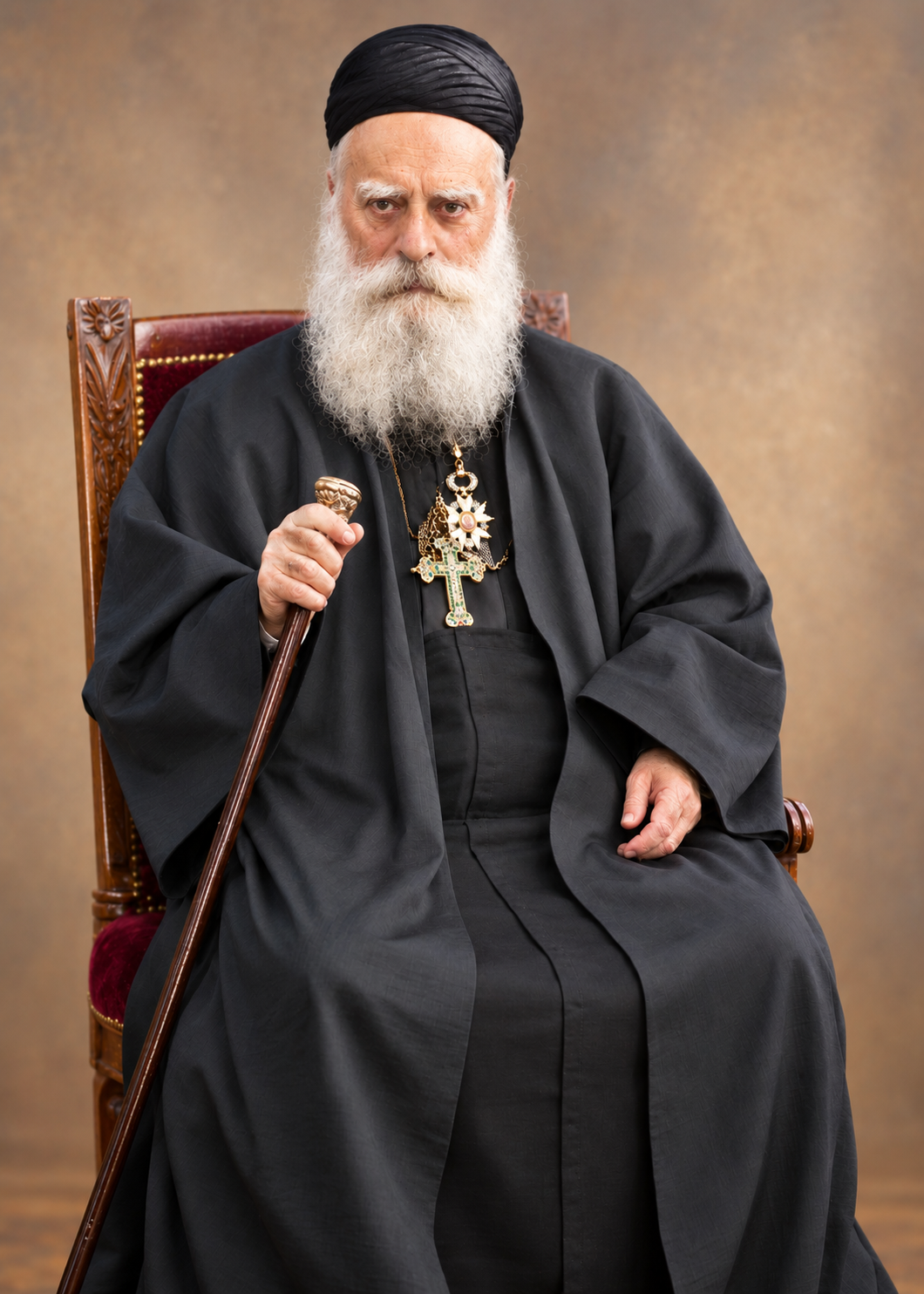
He took the title of Patriarch of Antioch and All the East, and he governed the Maronite Church for nearly thirty-three years, until his death. His reign covered the last decades of Ottoman rule, the First World War, the creation of Greater Lebanon and the first years of the French mandate.
Among his pastoral initiatives, the Maronite Eparchy of Saint Maron records the establishment of a patriarchal vicariate for Egypt in 1904, an early step in the organization of Maronite communities abroad. He also supported the shrine of Our Lady of Lebanon at Harissa, which the chronology connects with May 3, 1908, and developed the patriarchal summer residence at Dimane.
Between the Sultan and the Mountain
The Maronite patriarchs tried to keep their Church independent while living under Ottoman rule. One sore point was the berat, an official Ottoman acknowledgment of a patriarch's appointment, which Maronite leaders resisted because they feared it would compromise their autonomy. Hoayek also met opposition from anticlerical and liberal groups who disliked the Church's influence.
During the First World War these tensions became life and death matters. Ahmed Cemal Pasha, the Ottoman commander in the region, insisted on recognition of the patriarch's office through the berat, and under wartime pressure Hoayek eventually submitted. Rumors that he might be arrested because of his sympathies for France are reported by the sources only as rumors.
This part of his story is not that of a simple hero. It is the story of a church leader who sometimes had to bend to survive, and who tried to protect his people from harm. Historians of the period tend to see this pragmatism as part of the reason that the patriarchate remained a force in Lebanese life after the war.
Famine in Mount Lebanon
The First World War brought a terrible famine to Mount Lebanon. Blockade, military requisitions, broken trade and a plague of locusts left many people without food. A leading scholarly article reports estimates that about one third of the population of Mount Lebanon died of hunger and disease. The figure is an estimate, not a precise census count.
In 1916, according to the Maronite Sisters' chronology, Hoayek told the monasteries to open their doors to the starving. Church property became a source of shelter and food at a time when other structures had failed. His charity during the famine is one of the main reasons that Lebanese Christians recall him with gratitude.
Details of how much food was distributed, and how, are thinly documented in the sources consulted. The safest statement is that he is credited with directing church resources to relief, and that this humanitarian response became central to later accounts of his holiness. His example reminds us that sanctity is often revealed in times of crisis.
Paris, 1919, and Greater Lebanon
After the Ottoman collapse, Hoayek led a Lebanese delegation to the Paris Peace Conference of 1919. He argued for an enlarged Lebanon that would include Beirut, Tripoli, Sidon, Tyre and the Bekaa Valley, rather than only the old Mount Lebanon district. He believed a larger territory with ports and farmland would be economically viable.
He also favored French protection under the new mandate system. This is an important nuance. The independence that he sought in 1919 was not immediate, unrestricted sovereignty, but a distinct Lebanese state under French guidance. French authorities had their own regional aims, and Lebanese opinion on the future was divided.
On September 1, 1920, French High Commissioner Henri Gouraud proclaimed the State of Greater Lebanon, which largely met Hoayek's territorial goals. Supporters of Syrian or Arab unity, including many Muslims, opposed separation from Syria. For that reason he is rightly honored as the Father of Greater Lebanon, though he was not its only founder, and his legacy remains discussed in Lebanon today.
Last Years and Death
In the 1920s Hoayek continued to govern the Church, to guide the sisters and to write pastoral letters. The congregation records an apostolic letter called The Love of the Homeland in 1931. No full critical English edition was found in the research, so its arguments are not described here beyond its title.
He died at Bkerke on December 24, 1931, according to the Holy See decrees and the Maronite Sisters. One historical article from the Eparchy of Saint Maron gives December 31, so that date is uncertain, and the Vatican date is preferred. He was first buried at Bkerke.
According to Family of Saint Sharbel USA, his remains were moved on May 11 and 12, 1936, to the convent of the Sisters of the Holy Family at Ebrine, where his tomb became a place of prayer. The sisters kept his memory alive for decades before the Church formally studied his life.
Lord Jesus Christ, Good Shepherd, You raised up Your servant Elias to feed the hungry and to guide Your flock in a time of fear. Give wisdom to every bishop and priest who serves in troubled lands. Protect the people of Lebanon and the Christians of the Middle East. Teach us to trust in Your providence and to build peace with patience. Through the prayers of Blessed Elias and of Our Lady of Lebanon, hear us. Amen.
This prayer is an original composition for devotion. It is not an official liturgical text and was not written by the saint.
The Road to Beatification
The cause for his canonization was opened in 2011, through the initiative of the Maronite Eparchy of Batroun. On July 5, 2019, Pope Francis authorized the decree recognizing his heroic virtue, and he became Venerable. The cause then waited for a miracle attributed to his intercession.
On May 22, 2026, Pope Leo XIV authorized the decree recognizing a miracle. The healing involved Nayef Abou Assi, a Druze officer in the Lebanese army, who reportedly recovered from a serious spinal condition in 1965 after a dream of the patriarch. The Vatican decree is the firm fact. The medical details come from a devotional account, and the full medical file was not available for review.
He was beatified on July 25, 2026, at Dimane, with Cardinal Bechara Boutros Rai presiding and Cardinal Marcello Semeraro representing the Pope. News reports say his annual memorial is June 5, the anniversary of his ordination. He has not been canonized. Orthodox churches have not recognized him as a saint, so this is a Catholic act.
Frequently Asked Questions
Ask His Prayers
Blessed Elias shows that a shepherd can serve both the altar and the hungry. Ask him to pray for Lebanon, for patriarchs and bishops, and for all who work for peace in the Middle East.
View Prayer Card