Saint Mariam Thresia: Syro-Malabar Mystic and Foundress of the Holy Family Sisters
A mystic of Kerala who carried the sick, the poor and troubled families into her prayer
At a Glance
- Born
- April 26, 1876, Puthenchira, Kerala, India
- Died
- June 8, 1926, Kuzhikkattussery, Kerala
- Titles
- Saint, Virgin, Mystic, Foundress of the Congregation of the Holy Family
- Feast
- June 8
- Veneration
- Beatified April 9, 2000; canonized October 13, 2019
- Patronage
- Invoked for families, married couples, the sick and couples hoping for children (devotional)
- A Child of Puthenchira
- Loss, Prayer and a Hidden Vocation
- Spiritual Direction and Testing
- The House of Solitude
- Serving the Sick and the Poor
- Growing a Congregation
- Criticism and Scrutiny
- Visions, Stigmata and Tradition
- Final Illness and Death
- Beatification and Canonization
- Frequently Asked Questions
A Child of Puthenchira
Thresia Chiramel Mankidiyan was born on April 26, 1876, in Puthenchira, in the Thrissur district of Kerala, India. She was baptized on May 3 of that year in her parish church and was given the name Thresia in honor of Saint Teresa of Avila. Her family belonged to the ancient Saint Thomas Christian community, which traces its faith to the apostle Thomas and which is today part of the Syro-Malabar Catholic Church.
She was the third of five children of Thoma and Thanda Chiramel Mankidiyan. According to the Vatican biography prepared for her beatification, the family had once held land and standing, but it lost much of its wealth, partly through the costs of providing dowries for seven daughters in her grandfather's generation. The same account mentions alcohol-related troubles involving her father and brother, so her childhood was marked by money worries and suffering.
Her mother, Thanda, taught her the first prayers. The Vatican biography describes a girl of unusual seriousness, who fasted several times a week, prayed the Rosary often and, at about ten years old, privately offered her virginity to Christ. She made her first Holy Communion at about nine, which was early for her community. Her mother, worried for her health, tried to moderate her penances.
Loss, Prayer and a Hidden Vocation
Her mother died in 1888, when Thresia was twelve. Her formal schooling ended, and she took on more of the work of the household. This early loss pressed her toward prayer, and accounts agree that she grew quietly more devout rather than dramatically changing her life.
There was no conversion from another faith. She remained within the Syro-Malabar tradition from baptism to death. Her path is better described as a long discernment. Around 1891, when she was about fifteen, she thought of leaving home to live as a solitary in prayer and penance. The plan was dropped, but the attraction to a hidden life of prayer stayed with her.
With three young women friends she began a simple pattern of parish service. They cleaned and decorated the church, prayed together, visited the sick and helped poor families who had been neglected by their neighbors. These small acts of service became, in time, the seed of a religious community. She did not set out to found anything. The work grew from daily attention to people who needed help.
Spiritual Direction and Testing
In 1902 Father Joseph Vithayathil became her spiritual director. He would guide her for decades, and he later became the main collaborator in her foundation. He died on June 8, 1964, which happens to be the anniversary of her own death. He guided her through spiritual difficulties and through questions about her unusual religious experiences.
In 1903 she asked Bishop John Menachery of Trichur for permission to establish a house of prayer and solitude. The bishop did not approve it at once. He asked for more discernment and suggested she look at existing religious communities, including the Franciscan Clarists. In 1912 she spent time with the Carmelite sisters at Ollur but concluded that her calling was different from theirs.
The Church treated her experiences with caution. According to the Vatican biography, between 1902 and 1905 Father Vithayathil performed repeated exorcisms under the bishop's direction. These show that church authorities took seriously the possibility that her experiences came from an evil source. They do not prove that she was possessed, and they are not by themselves proof of a supernatural origin either. Her reputation for holiness was not accepted without examination.
The House of Solitude
In 1913 Bishop Menachery finally authorized a small house of prayer at Puthenchira. The House of Solitude was blessed on September 23, 1913, and Thresia moved in the following month. Her companions joined her there, and for the first time the little group lived a settled common life.
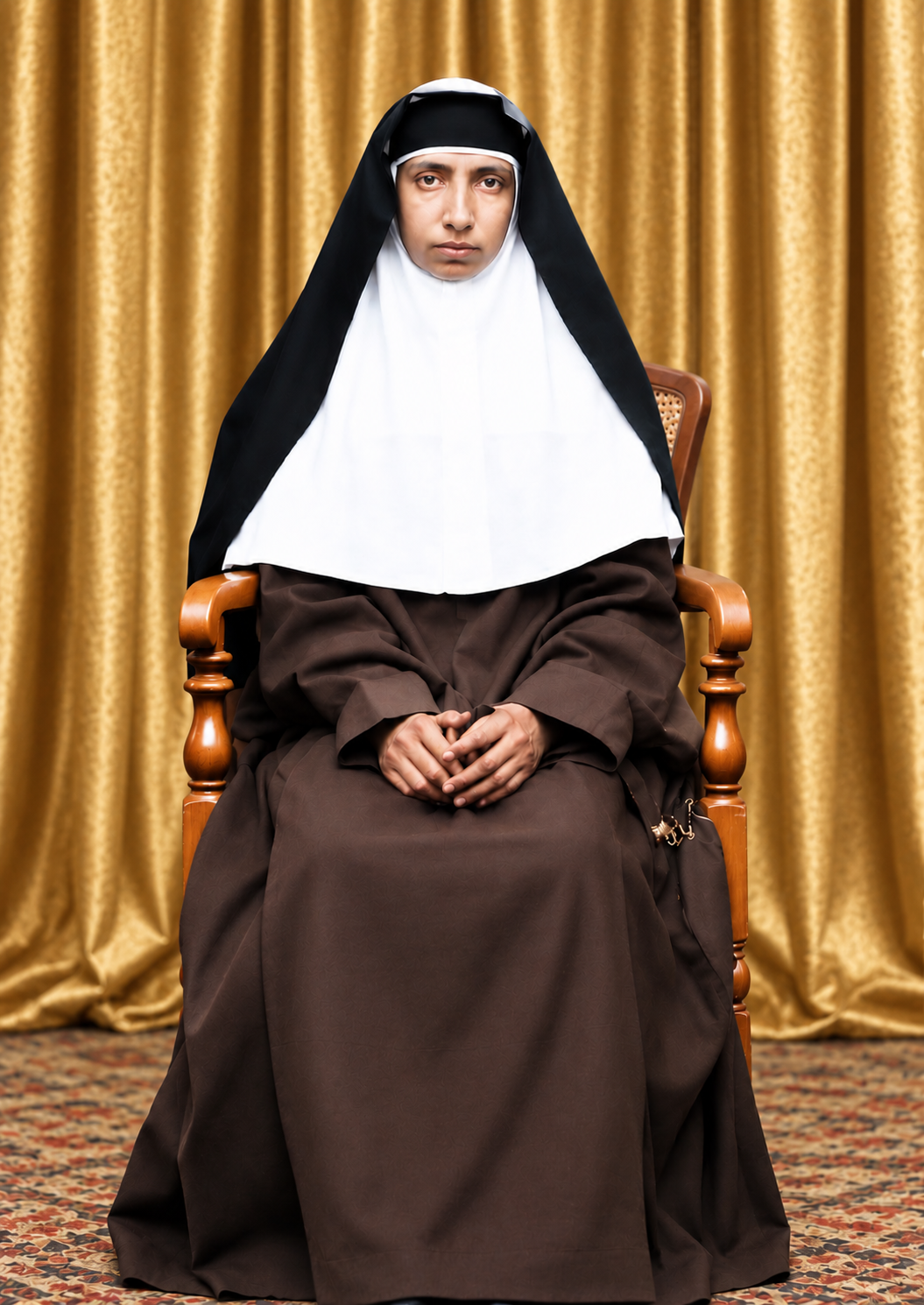
On May 14, 1914, the bishop canonically established the Congregation of the Holy Family, and Mariam Thresia made her religious profession as its first superior. The community was placed under the patronage of Jesus, Mary and Joseph, the model of Christian family life. Father Vithayathil remained their spiritual director.
At first the sisters had no constitutions of their own. Bishop Menachery gave them rules adapted from those of the Holy Family Sisters of Bordeaux. The order began in a hard time, since the First World War began just months after its foundation. Even so, its works of charity and education kept growing during those years.
Serving the Sick and the Poor
The distinctive mark of Mariam Thresia's ministry was her desire to strengthen ordinary families. She and her companions went into homes to find who was suffering and to help. The Vatican biography records that they cared for people with leprosy and smallpox, including patients who had been abandoned because of their illness.
They visited the dying, comforted people who were alone, supported poor households and cared for children whose parents had died. Their service went beyond their own community, and it crossed the caste lines of that society. For a time and a place in which women had little public freedom, such work was unusual and drew attention.
She wanted prayer and service to be one thing. The Holy Family sisters were not meant to retreat from the world but to bring the peace of the home of Nazareth into the homes of others. Many of the later works of the congregation, such as schools for girls and care for children, continue that vision.
Growing a Congregation
Under her leadership the congregation opened three more convents, two schools, two boarding houses, a study house and an orphanage. These numbers come from the Vatican biography of 2000. At her death in 1926 the community had fifty-five sisters, thirty boarders and ten orphans in its care.
These figures describe the order as it was in 1926, and they should not be taken as the size of the congregation today. They do show that a woman with little formal schooling managed to build a lasting institution in under twelve years. Her practical gifts were as real as her mystical ones.
She left a short autobiography, written in obedience to her spiritual director, and fifty-five surviving letters, of which fifty-three were addressed to Father Vithayathil. These writings are the best primary source for her inner life. Pope John Paul II quoted one of her letters in his beatification homily, but the wording is not repeated here because the English rendering has not been checked against the original-language manuscript.
Criticism and Scrutiny
Kerala in her day was shaped by strong caste distinctions, patriarchal customs and sharp economic inequality. Her habit of walking with women companions through villages to visit homes drew criticism. The Vatican biography records objections to the sight of young women moving about without male escorts, and some of this criticism was supported by clergy.
There were also questions about her mystical life. The sources describe ecstasies, visions and other unusual experiences, and they report that she tried to keep some of them hidden. The Church's early response was caution, as seen in the bishop's slow approval and in the exorcisms.
This history is useful for readers today. It shows that her sanctity was proved over time and under pressure, not simply declared. It also shows that she accepted correction from her spiritual director and her bishop, and that obedience was part of her spiritual path from the start.
Visions, Stigmata and Tradition
TRADITION. Catholic biographical sources say that she experienced visions of Jesus, Mary and Joseph. The Vatican biography reports that in 1904 she began to use the name Mariam after she believed that the Virgin Mary had told her to. The congregation places this on December 8, 1904. That she took the name is documented. The reported instruction from Mary is religious testimony.
TRADITION. The congregation dates the beginning of her stigmata experiences to 1905 and says that visible wounds appeared in 1909. The Vatican biography also reports that she bore the stigmata and tried to conceal them. These accounts belong to her recognized spiritual biography, but the published sources do not give a clinical history, so they should not be presented as independently verified medical findings.
TRADITION. The beatification biography also records reports of ecstasy, levitation, prophecy, sweet fragrances and spiritual attacks. These descriptions cannot be verified from the published material. It is important to remember that her canonization does not require Catholics to treat every extraordinary event in her life story as established history. What the Church has formally examined are the miracles accepted for beatification and canonization.
Final Illness and Death
In 1926 she was injured at a ceremony at the new convent in Thumbur, when a part of the sanctuary railing collapsed and hurt her leg. She was treated at a government hospital in Chalakudy and underwent surgery. Her diabetes made the wound heal poorly, and her condition grew worse.
She was brought to the convent at Kuzhikkattussery on June 7, 1926, where she received the Anointing of the Sick and Holy Communion. She died there on June 8, 1926, at the age of fifty. The congregation keeps an account of her last words to her sisters, which stress charity, obedience and care for the young community, but the exact wording is known only from the congregation's tradition.
Her funeral took place on June 9, 1926, and she was buried at Kuzhikkattussery, where her tomb became a place of pilgrimage. The congregation records that her remains were examined and identified on January 3, 1981, during the preparation of her cause. A full inventory of relics has not been published in the sources consulted.
Lord Jesus, You grew up in the home of Mary and Joseph. Through the prayers of Saint Mariam Thresia, bless our families. Heal what is broken, comfort those who suffer in body or spirit, and teach us to serve the poor with gentle hands. Give peace to married couples, patience to parents and strength to those who care for the sick. Make our homes places of prayer and welcome. Amen.
This prayer is an original composition for devotion. It is not an official liturgical text and was not written by the saint.
Beatification and Canonization
Pope John Paul II declared her heroic virtue on June 28, 1999, and beatified her on April 9, 2000. The miracle accepted for her beatification concerned Mathew Pellissery, who was born with deformed feet and was reported to have been healed in 1970 and 1971. The Church recognized the healing as miraculous on January 27, 2000.
A second miracle was approved by Pope Francis on February 12, 2019. It involved a newborn child in Thrissur in 2009 who had severe breathing difficulty, and who recovered after the family prayed through her intercession. Vatican medical consultants judged the recovery medically inexplicable. This is an ecclesiastical finding, not scientific proof of supernatural cause.
Pope Francis canonized her on October 13, 2019, in Saint Peter's Square, together with John Henry Newman, Giuseppina Vannini, Dulce Lopes Pontes and Marguerite Bays. Her feast is June 8, the day of her death. She is a saint of the Catholic Church who belonged to the Syro-Malabar Catholic Church, not the Latin Church. The Eastern Orthodox Churches have not glorified her, and no Orthodox commemoration was found.
Frequently Asked Questions
Ask Her Prayers
Saint Mariam Thresia shows that a hidden life of prayer can open the door of every home. Ask her to pray for your family, for the sick and for those who care for them, and for the Christians of Kerala.
View Prayer Card