 Image 1 of 1
Saint Benedict of Nursia
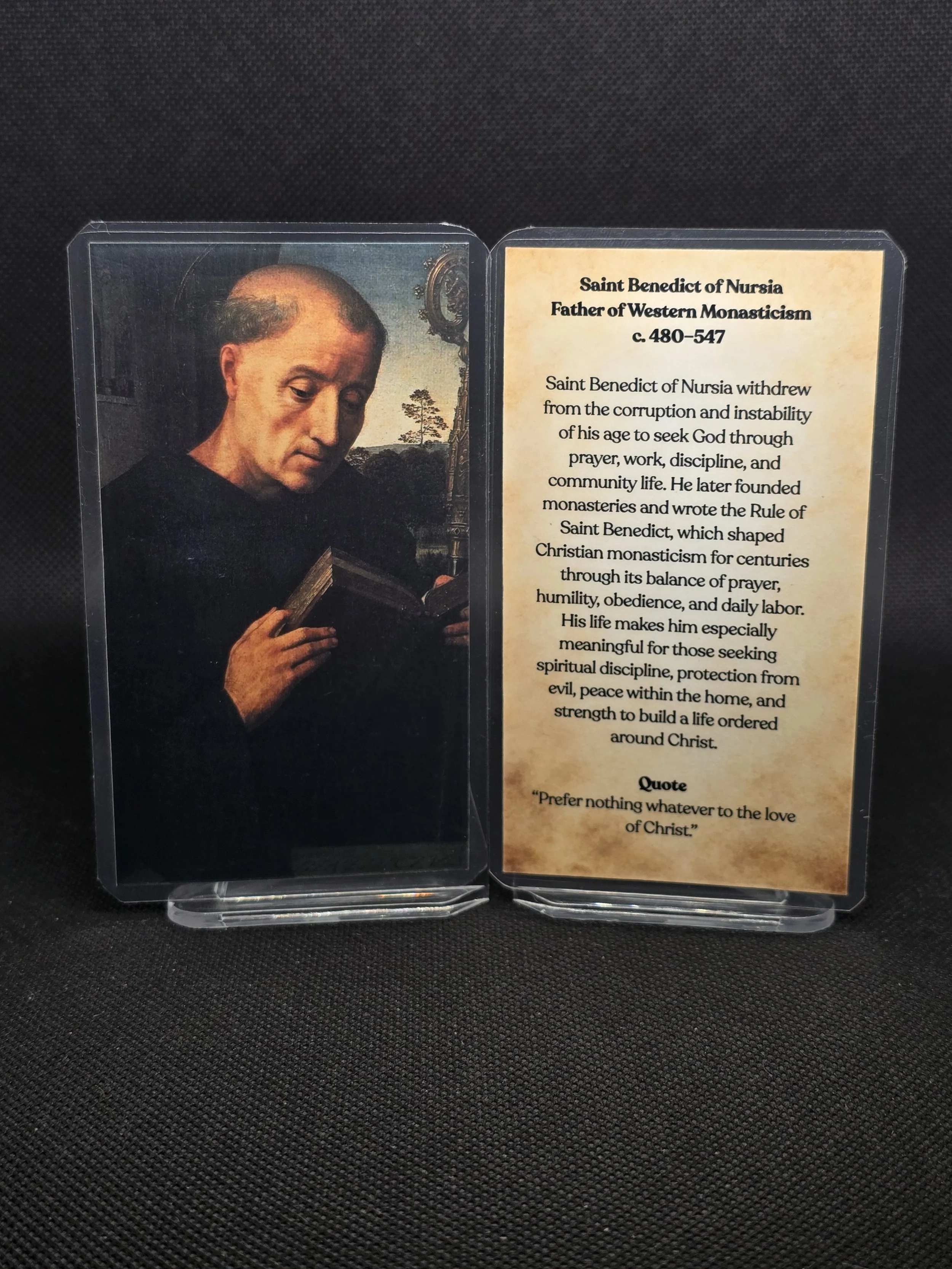
Saint Benedict of Nursia is a Catholic saint for anyone trying to build a life that does not collapse under distraction, ambition, exhaustion, or disorder. He is the father of Western monasticism, the author of the Rule of Saint Benedict, and one of the most influential spiritual builders in Christian history. His genius was not that he invented a dramatic spirituality for rare souls, but that he gave ordinary human beings a repeatable way to live faithfully day after day.
Saint Benedict is especially meaningful as the unofficial patron saint of daily rhythm, quitting projects, and balancing work and prayer. His Rule built an entire way of life around the simple insistence that prayer and labor belong together rather than competing for the same hours. For entrepreneurs trying to find a sustainable rhythm, for people who begin ambitious projects and abandon them within weeks, and for households trying to build a daily rule that survives contact with real life, Saint Benedict remains one of Christianity’s most practical guides.
Born around 480 in Nursia, Italy, Benedict was sent to Rome for his education, but he was disturbed by the moral chaos and emptiness he found there. Rather than being absorbed by the disorder around him, he withdrew in search of God. He first lived as a hermit, hidden in prayer and solitude, before eventually becoming the spiritual father of monastic communities. His path moved from withdrawal to leadership, from silence to structure, from personal conversion to the building of a way of life that would shape centuries.
Saint Benedict eventually founded the monastery at Monte Cassino, where he wrote the Rule that bears his name. The Rule is not long, but its influence is enormous. It teaches stability, obedience, humility, prayer, work, hospitality, moderation, and perseverance. It gives shape to the day, the community, the soul, and the ordinary duties that make up a faithful life. It is not a motivational speech. It is a tested blueprint for repeatable faithfulness.
This is why Saint Benedict is so powerful for people who struggle with quitting projects. Many people do not fail because they lack vision. They fail because they lack rhythm, limits, accountability, humility, and a livable rule. Saint Benedict understood that holiness is not built by bursts of intensity alone. It is built by returning to the work, returning to prayer, returning to obedience, returning to the schedule, and remaining faithful when the first excitement fades.
His life also speaks strongly to modern households. A family does not need to become a monastery to learn from Benedict. A home can still have a rhythm of prayer, work, meals, rest, hospitality, silence, and responsibility. The Rule of Saint Benedict helps remind families that spiritual life cannot be separated from laundry, dishes, children, business, chores, meals, money, sleep, and the thousand ordinary duties of daily life.
Saint Benedict’s spiritual wisdom is often summarized by the Benedictine spirit of prayer and work. The point is not that prayer should replace labor or that labor should crowd out prayer. The point is that both belong to God. Work becomes disordered when it forgets prayer, and prayer becomes shallow when it refuses responsibility. Saint Benedict teaches that a faithful life needs both: the heart lifted to God and the hands given to the work of the day.
This prayer card is created for entrepreneurs, homemakers, students, workers, parents, monks, oblates, those building a daily rule, those struggling to finish what they start, those trying to balance work and prayer, and anyone seeking a more stable, ordered, faithful life. Saint Benedict reminds the soul that holiness is not only found in heroic moments. It is also found in the ordinary rhythm of beginning again and remaining faithful.
Saint Benedict’s patronage includes monks, Europe, students, schoolchildren, protection from evil, spiritual discipline, daily rhythm, perseverance, work and prayer, households seeking order, entrepreneurs seeking sustainable structure, those who abandon projects, and those trying to build a life of faithful consistency.
Each card is handmade in Austin, TX and created to order. We do not keep stock, because every prayer card is treated as a unique devotional offering. They are printed on museum-quality photo paper, not cardstock. Every card is made slowly, during prayer, with intentional reverence for the saint or holy image and for the person who will receive it. Names are lifted before Christ. Intentions are held carefully. Each piece is handled multiple times in prayerful silence, asking God for mercy and asking the saint to intercede for the soul it is being made for. This is not production work. It is devotional craftsmanship shaped with patience, care, and spiritual responsibility, because every soul and every prayer matters.
THE LIFE & STORY
Saint Benedict of Nursia was born around 480 in central Italy, during a time of political instability, cultural decline, and moral confusion after the weakening of Roman power in the West. He came from a respectable family and was sent to Rome for his studies, but the life he found there troubled him deeply. Rather than losing himself in ambition, pleasure, and social decay, Benedict withdrew from the city to seek God in solitude.
He eventually lived as a hermit in a cave near Subiaco, where he spent years in prayer, silence, fasting, and spiritual battle. His holiness became known, and others began seeking him out. Some monks asked him to become their abbot, but they resisted the seriousness of his discipline. According to tradition, their opposition became so severe that they even attempted to poison him. Benedict survived and continued following the path God had set before him.
Over time, Benedict founded monastic communities and became a father to monks seeking a stable life of prayer and conversion. His early experience taught him that zeal alone was not enough. A community needed structure. Prayer needed order. Work needed purpose. Authority needed humility. Discipline needed moderation. Human beings needed a way of life that could be repeated every day, not merely admired from a distance.
At Monte Cassino, Benedict founded the monastery most closely associated with his legacy. There he composed the Rule of Saint Benedict, a guide for monastic life that would shape Western Christianity for centuries. The Rule is practical, balanced, and deeply human. It provides guidance for prayer, silence, work, meals, sleep, correction, hospitality, leadership, humility, and the daily ordering of a community seeking God.
One of the great themes of the Rule is stability. Benedict understood that people often want holiness somewhere else, later, under better conditions, with different people, in a more inspiring season. Stability teaches the soul to stay, to be formed, to stop running from the ordinary tools God uses for conversion. This is why Saint Benedict is such a strong intercessor for people who quit projects, abandon routines, or keep waiting for perfect conditions before becoming faithful.
His Rule also teaches moderation. Benedict was not interested in spiritual laziness, but he also knew that extremes can destroy people. He built a way of life that considered weakness, age, illness, work, rest, community, and human limits. This balance is one reason his Rule lasted. It was demanding enough to form saints and practical enough to be lived.
Saint Benedict died around 547 at Monte Cassino. Tradition says he died standing in prayer, supported by his monks, having received the Eucharist. His life became one of the great foundations of Western Christian spirituality, and his Rule became the backbone of countless monasteries, schools, communities, and spiritual lives. In 1964, Pope Paul VI declared him patron of Europe.
For modern Christians, Saint Benedict is not only a saint of monks. He is a saint for anyone trying to live with order in a disordered world. His life says that prayer needs a place in the day, work needs to be sanctified, rest must be protected, hospitality must be practiced, and the soul must be trained by steady faithfulness rather than constant novelty.
MIRACLES & PATRONAGE
Saint Benedict is remembered for many miracle traditions, including protection from poison, spiritual authority over evil, prophetic insight, and the power of the Cross against demonic attack. These stories are part of why the Saint Benedict Medal has become one of the most recognized Catholic sacramentals associated with protection, spiritual warfare, and confidence in Christ.
Yet one of the greatest miracles of Saint Benedict’s life is the endurance of his Rule. Written for monks in the 6th century, it has continued to shape Christian life for nearly fifteen centuries. Few spiritual documents have proved so durable, practical, and fruitful. The Rule survived because it understands the human person and gives a way to order life around God.
Saint Benedict’s official and traditional patronage includes monks, Europe, students, schoolchildren, protection from evil, and many needs connected with spiritual discipline. His unofficial patronage of daily rhythm, quitting projects, and balancing work and prayer flows naturally from the heart of his Rule. He is the saint of ordered days, faithful repetition, and sustainable spiritual structure.
For entrepreneurs, Saint Benedict is a powerful intercessor because business life easily becomes disordered. Work can expand until prayer disappears, ambition can replace vocation, and constant urgency can make a person feel productive while actually becoming spiritually scattered. Benedict teaches that a strong life requires rhythm, boundaries, accountability, humility, and a higher purpose than success alone.
For people who quit projects, his witness is equally important. The Benedictine vow of stability speaks directly to the restless heart. Many people love beginnings, but holiness is often found in the middle: when the novelty fades, the work is boring, the results are slow, and the temptation to start something new feels stronger than the call to remain faithful. Saint Benedict reminds us that perseverance is not glamorous, but it is fruitful.
For households, Saint Benedict offers a realistic model of daily order. A home needs more than good intentions. It needs repeated practices: prayer, meals, work, rest, chores, hospitality, reconciliation, silence, and shared responsibility. A household rule does not have to be severe to be holy. It simply has to help the family return to God and to one another each day.
People ask Saint Benedict’s intercession when they are trying to build a prayer routine, balance work and family, create a household rhythm, finish a project, resist distraction, persevere through boredom, protect their home spiritually, or order their life around Christ. He is also invoked against evil, temptation, spiritual attack, and disorder of soul.
Saint Benedict teaches that faithfulness is not usually built by dramatic reinvention. It is built by a rule of life humble enough to repeat and strong enough to carry the soul through changing moods, busy seasons, fatigue, and temptation.
PRAYERS
A simple invocation may be prayed often: Saint Benedict of Nursia, pray for us.
For daily rhythm, one may pray: Saint Benedict, father of monks and teacher of ordered life, pray that my days may be shaped by prayer, work, rest, and faithful responsibility. Help me build a rhythm that serves Christ rather than my distractions.
For balancing work and prayer, one may pray: Saint Benedict, pray for me as I try to unite labor and devotion. Ask Christ to protect me from both laziness and overwork, and teach me to offer my tasks, business, household duties, and prayers to God with a steady heart.
For finishing what was started, one may pray: Saint Benedict, pray for me when I am tempted to abandon the good work God has placed before me. Help me resist restlessness, discouragement, perfectionism, and the desire to escape into something new before I have been faithful with what is already in my hands.
For entrepreneurs, one may pray: Saint Benedict, pray for entrepreneurs, builders, makers, and all who carry the burden of creating something. Ask the Lord to give them discipline, humility, perseverance, right priorities, honest work, and a rhythm that protects their souls.
For households, one may pray: Saint Benedict, pray for our home. Help us build a daily rule of prayer, work, meals, rest, service, and love. May our household become more peaceful, ordered, hospitable, and centered on Christ.
For protection, one may pray: Saint Benedict, powerful intercessor against evil, pray that Christ may guard my home, my work, my family, my mind, and my soul from every darkness, temptation, and disorder that would pull me away from God.
This prayer card is especially fitting for a prayer corner, desk, home office, kitchen, workspace, family command center, school area, or anywhere a person needs to remember that ordinary daily structure can become a path to holiness.
FAQ
Who is Saint Benedict of Nursia?
Saint Benedict of Nursia was a 6th-century Catholic monk, founder of Monte Cassino, author of the Rule of Saint Benedict, and father of Western monasticism. His life and Rule shaped Christian spirituality, monastic life, education, and European culture for centuries.
Is Saint Benedict Catholic?
Yes. Saint Benedict is a Catholic saint and one of the most important figures in Western Christianity. He is also respected by many Christians outside the Catholic Church because of the deep influence of his Rule.
What is Saint Benedict the patron saint of?
Saint Benedict is widely known as the patron of Europe, monks, students, schoolchildren, protection from evil, and spiritual discipline. Devotionally, he is also a fitting unofficial patron of daily rhythm, finishing projects, balancing work and prayer, and building a stable rule of life.
Is Saint Benedict officially the patron saint of daily rhythm, quitting projects, and balancing work and prayer?
Saint Benedict is best described as the unofficial patron saint of daily rhythm, people who quit projects, and balancing work and prayer. His Rule is one of Christianity’s most tested guides for ordering a life around prayer, labor, stability, community, and perseverance.
Why is Saint Benedict good for people who quit projects?
Saint Benedict is a strong saint for people who quit projects because his spirituality emphasizes stability, perseverance, humility, and daily faithfulness. His Rule teaches that transformation comes through staying with the work, returning to prayer, and remaining faithful after the first excitement fades.
Why is Saint Benedict meaningful for entrepreneurs?
Entrepreneurs often struggle with overwork, distraction, ambition, unfinished projects, lack of rhythm, and the constant pressure to build. Saint Benedict offers a model of ordered work, prayer, discipline, limits, and perseverance, making him a powerful intercessor for business owners and builders.
What is the Rule of Saint Benedict?
The Rule of Saint Benedict is a short but deeply influential guide for monastic life. It contains instructions on prayer, work, silence, obedience, humility, leadership, hospitality, meals, sleep, correction, and community. Its wisdom has shaped Christian life for nearly 1,500 years.
What does “ora et labora” mean?
“Ora et labora” means “pray and work.” While it is a later summary of Benedictine spirituality rather than a simple slogan from the Rule itself, it captures the Benedictine vision that prayer and labor both belong to God and should be held together in a faithful life.
Why is Saint Benedict connected to daily rhythm?
Saint Benedict is connected to daily rhythm because his Rule orders the day around prayer, work, reading, meals, rest, and community life. He understood that holiness needs structure, not just desire.
Can a family learn from Saint Benedict without becoming monastic?
Yes. Families can learn from Saint Benedict by creating a simple household rhythm of prayer, work, meals, rest, hospitality, responsibility, and peace. A family rule does not need to be complicated; it simply needs to help the household return to Christ each day.
Can I give this prayer card to someone starting a business or project?
Yes. This prayer card is especially fitting for entrepreneurs, writers, builders, students, families, or anyone beginning a serious project who needs perseverance, balance, structure, and prayer.
Can I give this prayer card to someone who struggles with discipline?
Yes. Saint Benedict is one of the best saints for someone who wants more discipline but needs a sustainable, merciful structure rather than a burst of intensity that quickly collapses.
What is the Saint Benedict Medal?
The Saint Benedict Medal is a Catholic sacramental associated with Saint Benedict and used in prayers for protection against evil, temptation, and spiritual danger. It is one of the most widely known Catholic devotional medals.
When is Saint Benedict’s feast day?
Saint Benedict’s feast day is July 11 in the current Roman calendar. March 21, traditionally associated with his death, is also important in Benedictine tradition.
What is the main message of Saint Benedict’s life?
The main message of Saint Benedict’s life is that holiness is built through ordered, repeatable faithfulness. Prayer, work, rest, humility, stability, hospitality, and perseverance are not competing pieces of life; they can become one offering to God.
Saint Benedict of Nursia is a Catholic saint for anyone trying to build a life that does not collapse under distraction, ambition, exhaustion, or disorder. He is the father of Western monasticism, the author of the Rule of Saint Benedict, and one of the most influential spiritual builders in Christian history. His genius was not that he invented a dramatic spirituality for rare souls, but that he gave ordinary human beings a repeatable way to live faithfully day after day.
Saint Benedict is especially meaningful as the unofficial patron saint of daily rhythm, quitting projects, and balancing work and prayer. His Rule built an entire way of life around the simple insistence that prayer and labor belong together rather than competing for the same hours. For entrepreneurs trying to find a sustainable rhythm, for people who begin ambitious projects and abandon them within weeks, and for households trying to build a daily rule that survives contact with real life, Saint Benedict remains one of Christianity’s most practical guides.
Born around 480 in Nursia, Italy, Benedict was sent to Rome for his education, but he was disturbed by the moral chaos and emptiness he found there. Rather than being absorbed by the disorder around him, he withdrew in search of God. He first lived as a hermit, hidden in prayer and solitude, before eventually becoming the spiritual father of monastic communities. His path moved from withdrawal to leadership, from silence to structure, from personal conversion to the building of a way of life that would shape centuries.
Saint Benedict eventually founded the monastery at Monte Cassino, where he wrote the Rule that bears his name. The Rule is not long, but its influence is enormous. It teaches stability, obedience, humility, prayer, work, hospitality, moderation, and perseverance. It gives shape to the day, the community, the soul, and the ordinary duties that make up a faithful life. It is not a motivational speech. It is a tested blueprint for repeatable faithfulness.
This is why Saint Benedict is so powerful for people who struggle with quitting projects. Many people do not fail because they lack vision. They fail because they lack rhythm, limits, accountability, humility, and a livable rule. Saint Benedict understood that holiness is not built by bursts of intensity alone. It is built by returning to the work, returning to prayer, returning to obedience, returning to the schedule, and remaining faithful when the first excitement fades.
His life also speaks strongly to modern households. A family does not need to become a monastery to learn from Benedict. A home can still have a rhythm of prayer, work, meals, rest, hospitality, silence, and responsibility. The Rule of Saint Benedict helps remind families that spiritual life cannot be separated from laundry, dishes, children, business, chores, meals, money, sleep, and the thousand ordinary duties of daily life.
Saint Benedict’s spiritual wisdom is often summarized by the Benedictine spirit of prayer and work. The point is not that prayer should replace labor or that labor should crowd out prayer. The point is that both belong to God. Work becomes disordered when it forgets prayer, and prayer becomes shallow when it refuses responsibility. Saint Benedict teaches that a faithful life needs both: the heart lifted to God and the hands given to the work of the day.
This prayer card is created for entrepreneurs, homemakers, students, workers, parents, monks, oblates, those building a daily rule, those struggling to finish what they start, those trying to balance work and prayer, and anyone seeking a more stable, ordered, faithful life. Saint Benedict reminds the soul that holiness is not only found in heroic moments. It is also found in the ordinary rhythm of beginning again and remaining faithful.
Saint Benedict’s patronage includes monks, Europe, students, schoolchildren, protection from evil, spiritual discipline, daily rhythm, perseverance, work and prayer, households seeking order, entrepreneurs seeking sustainable structure, those who abandon projects, and those trying to build a life of faithful consistency.
Each card is handmade in Austin, TX and created to order. We do not keep stock, because every prayer card is treated as a unique devotional offering. They are printed on museum-quality photo paper, not cardstock. Every card is made slowly, during prayer, with intentional reverence for the saint or holy image and for the person who will receive it. Names are lifted before Christ. Intentions are held carefully. Each piece is handled multiple times in prayerful silence, asking God for mercy and asking the saint to intercede for the soul it is being made for. This is not production work. It is devotional craftsmanship shaped with patience, care, and spiritual responsibility, because every soul and every prayer matters.
THE LIFE & STORY
Saint Benedict of Nursia was born around 480 in central Italy, during a time of political instability, cultural decline, and moral confusion after the weakening of Roman power in the West. He came from a respectable family and was sent to Rome for his studies, but the life he found there troubled him deeply. Rather than losing himself in ambition, pleasure, and social decay, Benedict withdrew from the city to seek God in solitude.
He eventually lived as a hermit in a cave near Subiaco, where he spent years in prayer, silence, fasting, and spiritual battle. His holiness became known, and others began seeking him out. Some monks asked him to become their abbot, but they resisted the seriousness of his discipline. According to tradition, their opposition became so severe that they even attempted to poison him. Benedict survived and continued following the path God had set before him.
Over time, Benedict founded monastic communities and became a father to monks seeking a stable life of prayer and conversion. His early experience taught him that zeal alone was not enough. A community needed structure. Prayer needed order. Work needed purpose. Authority needed humility. Discipline needed moderation. Human beings needed a way of life that could be repeated every day, not merely admired from a distance.
At Monte Cassino, Benedict founded the monastery most closely associated with his legacy. There he composed the Rule of Saint Benedict, a guide for monastic life that would shape Western Christianity for centuries. The Rule is practical, balanced, and deeply human. It provides guidance for prayer, silence, work, meals, sleep, correction, hospitality, leadership, humility, and the daily ordering of a community seeking God.
One of the great themes of the Rule is stability. Benedict understood that people often want holiness somewhere else, later, under better conditions, with different people, in a more inspiring season. Stability teaches the soul to stay, to be formed, to stop running from the ordinary tools God uses for conversion. This is why Saint Benedict is such a strong intercessor for people who quit projects, abandon routines, or keep waiting for perfect conditions before becoming faithful.
His Rule also teaches moderation. Benedict was not interested in spiritual laziness, but he also knew that extremes can destroy people. He built a way of life that considered weakness, age, illness, work, rest, community, and human limits. This balance is one reason his Rule lasted. It was demanding enough to form saints and practical enough to be lived.
Saint Benedict died around 547 at Monte Cassino. Tradition says he died standing in prayer, supported by his monks, having received the Eucharist. His life became one of the great foundations of Western Christian spirituality, and his Rule became the backbone of countless monasteries, schools, communities, and spiritual lives. In 1964, Pope Paul VI declared him patron of Europe.
For modern Christians, Saint Benedict is not only a saint of monks. He is a saint for anyone trying to live with order in a disordered world. His life says that prayer needs a place in the day, work needs to be sanctified, rest must be protected, hospitality must be practiced, and the soul must be trained by steady faithfulness rather than constant novelty.
MIRACLES & PATRONAGE
Saint Benedict is remembered for many miracle traditions, including protection from poison, spiritual authority over evil, prophetic insight, and the power of the Cross against demonic attack. These stories are part of why the Saint Benedict Medal has become one of the most recognized Catholic sacramentals associated with protection, spiritual warfare, and confidence in Christ.
Yet one of the greatest miracles of Saint Benedict’s life is the endurance of his Rule. Written for monks in the 6th century, it has continued to shape Christian life for nearly fifteen centuries. Few spiritual documents have proved so durable, practical, and fruitful. The Rule survived because it understands the human person and gives a way to order life around God.
Saint Benedict’s official and traditional patronage includes monks, Europe, students, schoolchildren, protection from evil, and many needs connected with spiritual discipline. His unofficial patronage of daily rhythm, quitting projects, and balancing work and prayer flows naturally from the heart of his Rule. He is the saint of ordered days, faithful repetition, and sustainable spiritual structure.
For entrepreneurs, Saint Benedict is a powerful intercessor because business life easily becomes disordered. Work can expand until prayer disappears, ambition can replace vocation, and constant urgency can make a person feel productive while actually becoming spiritually scattered. Benedict teaches that a strong life requires rhythm, boundaries, accountability, humility, and a higher purpose than success alone.
For people who quit projects, his witness is equally important. The Benedictine vow of stability speaks directly to the restless heart. Many people love beginnings, but holiness is often found in the middle: when the novelty fades, the work is boring, the results are slow, and the temptation to start something new feels stronger than the call to remain faithful. Saint Benedict reminds us that perseverance is not glamorous, but it is fruitful.
For households, Saint Benedict offers a realistic model of daily order. A home needs more than good intentions. It needs repeated practices: prayer, meals, work, rest, chores, hospitality, reconciliation, silence, and shared responsibility. A household rule does not have to be severe to be holy. It simply has to help the family return to God and to one another each day.
People ask Saint Benedict’s intercession when they are trying to build a prayer routine, balance work and family, create a household rhythm, finish a project, resist distraction, persevere through boredom, protect their home spiritually, or order their life around Christ. He is also invoked against evil, temptation, spiritual attack, and disorder of soul.
Saint Benedict teaches that faithfulness is not usually built by dramatic reinvention. It is built by a rule of life humble enough to repeat and strong enough to carry the soul through changing moods, busy seasons, fatigue, and temptation.
PRAYERS
A simple invocation may be prayed often: Saint Benedict of Nursia, pray for us.
For daily rhythm, one may pray: Saint Benedict, father of monks and teacher of ordered life, pray that my days may be shaped by prayer, work, rest, and faithful responsibility. Help me build a rhythm that serves Christ rather than my distractions.
For balancing work and prayer, one may pray: Saint Benedict, pray for me as I try to unite labor and devotion. Ask Christ to protect me from both laziness and overwork, and teach me to offer my tasks, business, household duties, and prayers to God with a steady heart.
For finishing what was started, one may pray: Saint Benedict, pray for me when I am tempted to abandon the good work God has placed before me. Help me resist restlessness, discouragement, perfectionism, and the desire to escape into something new before I have been faithful with what is already in my hands.
For entrepreneurs, one may pray: Saint Benedict, pray for entrepreneurs, builders, makers, and all who carry the burden of creating something. Ask the Lord to give them discipline, humility, perseverance, right priorities, honest work, and a rhythm that protects their souls.
For households, one may pray: Saint Benedict, pray for our home. Help us build a daily rule of prayer, work, meals, rest, service, and love. May our household become more peaceful, ordered, hospitable, and centered on Christ.
For protection, one may pray: Saint Benedict, powerful intercessor against evil, pray that Christ may guard my home, my work, my family, my mind, and my soul from every darkness, temptation, and disorder that would pull me away from God.
This prayer card is especially fitting for a prayer corner, desk, home office, kitchen, workspace, family command center, school area, or anywhere a person needs to remember that ordinary daily structure can become a path to holiness.
FAQ
Who is Saint Benedict of Nursia?
Saint Benedict of Nursia was a 6th-century Catholic monk, founder of Monte Cassino, author of the Rule of Saint Benedict, and father of Western monasticism. His life and Rule shaped Christian spirituality, monastic life, education, and European culture for centuries.
Is Saint Benedict Catholic?
Yes. Saint Benedict is a Catholic saint and one of the most important figures in Western Christianity. He is also respected by many Christians outside the Catholic Church because of the deep influence of his Rule.
What is Saint Benedict the patron saint of?
Saint Benedict is widely known as the patron of Europe, monks, students, schoolchildren, protection from evil, and spiritual discipline. Devotionally, he is also a fitting unofficial patron of daily rhythm, finishing projects, balancing work and prayer, and building a stable rule of life.
Is Saint Benedict officially the patron saint of daily rhythm, quitting projects, and balancing work and prayer?
Saint Benedict is best described as the unofficial patron saint of daily rhythm, people who quit projects, and balancing work and prayer. His Rule is one of Christianity’s most tested guides for ordering a life around prayer, labor, stability, community, and perseverance.
Why is Saint Benedict good for people who quit projects?
Saint Benedict is a strong saint for people who quit projects because his spirituality emphasizes stability, perseverance, humility, and daily faithfulness. His Rule teaches that transformation comes through staying with the work, returning to prayer, and remaining faithful after the first excitement fades.
Why is Saint Benedict meaningful for entrepreneurs?
Entrepreneurs often struggle with overwork, distraction, ambition, unfinished projects, lack of rhythm, and the constant pressure to build. Saint Benedict offers a model of ordered work, prayer, discipline, limits, and perseverance, making him a powerful intercessor for business owners and builders.
What is the Rule of Saint Benedict?
The Rule of Saint Benedict is a short but deeply influential guide for monastic life. It contains instructions on prayer, work, silence, obedience, humility, leadership, hospitality, meals, sleep, correction, and community. Its wisdom has shaped Christian life for nearly 1,500 years.
What does “ora et labora” mean?
“Ora et labora” means “pray and work.” While it is a later summary of Benedictine spirituality rather than a simple slogan from the Rule itself, it captures the Benedictine vision that prayer and labor both belong to God and should be held together in a faithful life.
Why is Saint Benedict connected to daily rhythm?
Saint Benedict is connected to daily rhythm because his Rule orders the day around prayer, work, reading, meals, rest, and community life. He understood that holiness needs structure, not just desire.
Can a family learn from Saint Benedict without becoming monastic?
Yes. Families can learn from Saint Benedict by creating a simple household rhythm of prayer, work, meals, rest, hospitality, responsibility, and peace. A family rule does not need to be complicated; it simply needs to help the household return to Christ each day.
Can I give this prayer card to someone starting a business or project?
Yes. This prayer card is especially fitting for entrepreneurs, writers, builders, students, families, or anyone beginning a serious project who needs perseverance, balance, structure, and prayer.
Can I give this prayer card to someone who struggles with discipline?
Yes. Saint Benedict is one of the best saints for someone who wants more discipline but needs a sustainable, merciful structure rather than a burst of intensity that quickly collapses.
What is the Saint Benedict Medal?
The Saint Benedict Medal is a Catholic sacramental associated with Saint Benedict and used in prayers for protection against evil, temptation, and spiritual danger. It is one of the most widely known Catholic devotional medals.
When is Saint Benedict’s feast day?
Saint Benedict’s feast day is July 11 in the current Roman calendar. March 21, traditionally associated with his death, is also important in Benedictine tradition.
What is the main message of Saint Benedict’s life?
The main message of Saint Benedict’s life is that holiness is built through ordered, repeatable faithfulness. Prayer, work, rest, humility, stability, hospitality, and perseverance are not competing pieces of life; they can become one offering to God.