Saint Clement of Ohrid: Bishop, Teacher of the Slavs and Equal to the Apostles
A disciple of the Slavic apostles who built a school of Slavonic learning at Ohrid
At a Glance
- Born
- About 840 (UNCERTAIN). Birthplace unknown, possibly Macedonia
- Died
- July 27, 916, at Ohrid, in the First Bulgarian Empire
- Titles
- Bishop, hierarch, Equal-to-the-Apostles, Enlightener of the Slavs
- Feast
- July 27 (Julian calendar, August 9 on the civil calendar) and November 25
- Veneration
- Long venerated at Ohrid. No formal canonization date is documented
- Patronage
- Ohrid, teachers, students and Slavonic literacy
Who Was Saint Clement of Ohrid?
Saint Clement of Ohrid, known in the Slavic lands as Kliment Ohridski, was a missionary, teacher, writer and bishop who lived in the ninth and early tenth centuries. He belonged to the circle of disciples around Saints Cyril and Methodius, the brothers who brought Christian worship and learning to the Slavs in their own language.
His own life was lived mostly in the southwest of the First Bulgarian Empire, around Devol and Ohrid, in the region that is today North Macedonia. There he trained clergy, taught Scripture and the liturgy, preached to ordinary people and, near the end of the ninth century, became a bishop.
The honest historical picture is this. Clement's role as a teacher and bishop, his work in Bulgaria and his death in 916 are well supported. His birth, his family, the exact reach of his see and many details of the traditional biography are UNCERTAIN, and the miracle stories belong to TRADITION. This article keeps those three levels apart.
Early Life and Family
Almost nothing certain is known about Clement's childhood. His birth is often placed around 840, but that is an estimate and not a documented date. Reference works commonly say he came from Macedonia, yet his exact birthplace and his ethnic origin remain UNCERTAIN, and modern national labels should not be read back into the ninth century.
No reliable early source names his parents or describes his home. Claims that he came from a noble family, or that he was born a pagan and converted as an adult, are not supported by early evidence. The safest conclusion is that he received a thorough Christian education and gained real skill in language and writing.
He is traditionally called a disciple of both Cyril and Methodius. Scholars debate how close he was to Cyril. Some argue that he joined the missionary circle only after Cyril had died, so that his teacher in the strict sense was Methodius. For devotion the title disciple of the Slavic apostles is fitting, but it is UNCERTAIN that he knew both men.
Vocation and the Move to Bulgaria
Clement's vocation cannot be separated from the mission to the Slavs. Cyril and Methodius began their work in Great Moravia in 863, translating Scripture and worship into Slavonic. Clement became part of the community that carried this work forward, learning to teach the faith in a language that ordinary people actually spoke.
After Methodius died in 885, his disciples were left in a difficult position. Disputes over church jurisdiction, the language of worship and political loyalty brought pressure and expulsion. The later biography by Theophylact describes imprisonment and hardship before the disciples escaped south. The movement of the disciples into Bulgaria is well supported, though individual dramatic episodes need caution.
In Bulgaria the ruler Boris welcomed the exiles. His kingdom had been Christian for only a generation and needed trained clergy who could serve a Slavonic speaking people. This was the turning point of Clement's life. He was sent to the southwest, to the region called Kutmichevitsa, where he would spend the rest of his working years.
Teacher, Bishop and Writer
From about 886 to 893 Clement worked mainly as a teacher around Devol and Ohrid. He prepared clergy, organized Christian communities and shaped the use of Slavonic in worship. Rather than depend on priests trained in Greek or Latin, he built a system of local education that taught people to read Scripture, preach and celebrate the liturgy.
His school is called the Ohrid Literary School. Theophylact reports that Clement taught about three and a half thousand disciples. That number comes from a later hagiographical account and not from any surviving register, so it should be read as a reported total and not as a verified statistic. His companion Saint Naum carried the educational work forward after Clement became a bishop.
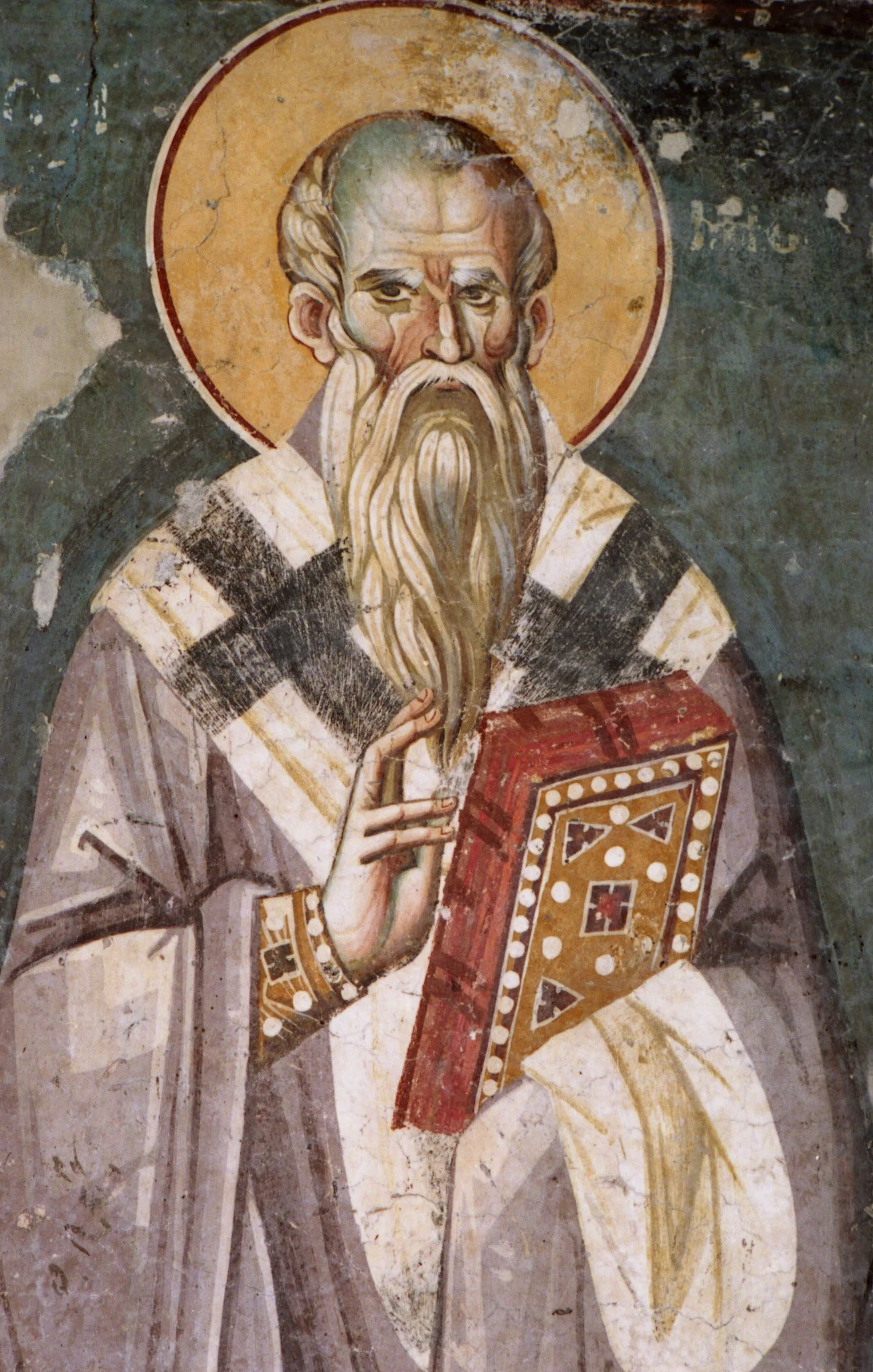
In 893 or 894, under Tsar Simeon, Clement was appointed bishop of Velitsa, also called Dragvista. Theophylact calls him the first bishop to serve in the Slavonic language. The exact location and boundaries of his see are UNCERTAIN. He also founded a monastery of Saint Panteleimon at Plaosnik above Lake Ohrid, which became a center of his teaching.
Trials and Historical Context
Clement lived through a difficult stage in the Christianization of central and southeastern Europe. In Moravia, German speaking bishops defended older jurisdictions while the Slavic missionaries sought a church that could pray in Slavonic. It is a mistake to describe this simply as a clash between Catholics and Orthodox, since those later divisions did not yet exist in that form.
Pope John VIII approved the use of Slavonic in the liturgy in 880. After Methodius died, policy changed under Pope Stephen V, and Slavonic worship was restricted in the Moravian lands around 890. So it is wrong to say that Rome always opposed Slavonic worship, and equally wrong to say the missionaries rejected communion with Rome. The history was mixed and political.
A further difficulty concerns the sources. Theophylact wrote the long biography of Clement long after his death, partly from earlier Slavonic material and partly from the concerns of his own day. It is valuable but it is not an eyewitness account. Careful writers use it for the traditional story, use Clement's own writings for his teaching, and use modern scholarship for the limits of certainty.
Death and Burial
According to the traditional account Clement kept working as his health declined. He is said to have asked Tsar Simeon to let him retire from his duties and to have been urged to stay. He continued translating and teaching until the end. These details come from hagiography and are not independently confirmed.
He died in 916 and was buried at his monastery of Saint Panteleimon in Ohrid. The year is well established in the biographical tradition, though scholars have examined the precise anniversary. The tradition adds that he prepared his own coffin, a detail that belongs to TRADITION and lacks early independent support.
His relics were later moved. Study of his tombstone points to a transfer to the church of the Most Holy Theotokos Perivlepta in Ohrid, but the date of that move is UNCERTAIN. After the Plaosnik church was rebuilt in 2001 and 2002, his relics were returned there. The tomb remains the chief place of devotion to him.
Traditions and Devotion
The hagiographical tradition describes Clement as a wonderworking bishop who healed the sick and helped the suffering. These are TRADITION. The Prologue from Ohrid and other devotional works speak of such miracles, but there is no medical record for any individual healing, and this article does not present them as established events.
Devotion has also grown around his relics. Orthodox accounts associate his tomb with continuing healing and answered prayer. The hymns of the Church address him as hierarch, teacher, intercessor and Equal-to-the-Apostles. Such language expresses how the faithful understand his place, and it does not depend on any single miracle account.
He is also remembered together with the Seven Apostles of Bulgaria, the name given to Cyril, Methodius, Clement, Naum, Gorazd, Sava and Angelar. Their shared memory, which falls around July 27, honors the whole group that gave the Slavs Scripture and worship in their own tongue, and Clement stands among its most important teachers.
Writings and Scholarship
Clement's literary reputation rests on homilies, praises of saints, hymns and translations. Works attributed to him include sermons for Easter, Palm Sunday and the Holy Trinity, and praises of the missionary brothers. His preaching urges repentance, honesty and moral change in daily life, and warns against drunkenness, false accusation and dishonesty.
The texts reached the wider Slavonic world through later manuscripts, including twelfth century collections copied in Russia. Some circulated anonymously and some under the names of other Church Fathers, so scholars must separate securely attributed works from doubtful ones. Whether he wrote a particular life of Cyril is UNCERTAIN and debated.
A popular claim says Clement invented the Cyrillic alphabet. That is not securely demonstrated. The earlier Glagolitic script is traditionally linked with Cyril, and early Cyrillic developed in Christian Bulgaria, often associated with the Preslav center. Clement's circle remained closely tied to Glagolitic. His importance as a founder of Slavonic learning does not depend on that claim.
Pilgrimage to Ohrid
Ohrid, on the shore of its great lake in North Macedonia, is the center of devotion to Saint Clement. The church of Saint Panteleimon at Plaosnik stands on the site of his monastery. Archaeological work between 1999 and 2002 examined the medieval church and older Christian remains beneath it.
The church was rebuilt and finished in July 2002. It follows the historical foundations, but it should not be mistaken for a fully preserved ninth century building. Parts of the excavated remains are kept visible, so pilgrims can see both the ancient layers and the modern reconstruction.
Pilgrims come to venerate his relics, to pray for teachers and students, and to honor the work of the Slavic apostles. The city also keeps his memory in its schools and in the celebrations around July 27 and November 25. Anyone planning a visit should check local church information for current opening times.
Holy Clement, teacher of the Slavs and bishop of Christ's flock, you taught the faith in words that simple people could understand. Pray for all who teach and all who study. Help us to read the Scriptures with humility, to speak the truth with kindness, and to hand on the faith with patience. Pray for us, that we may follow Christ as you did. Amen.
This is a short original prayer for private use. It is not an official liturgical text.
Saint Clement and the Eastern Churches
For Eastern Orthodox Christians, Clement stands for the continuation of the Cyrillo-Methodian mission through education, monastic life, episcopal care and worship in the people's own language. His school helped lay the literary and theological ground on which Scripture and the Fathers became available to Slavic peoples.
For Eastern Catholics the connection is through the shared inheritance of Cyril and Methodius, whose mission the Catholic Church has honored. Pope John Paul II recalled it in Slavorum Apostoli in 1985, and Pope Leo XIII defended it in Grande Munus in 1880. This is a real link, especially for Byzantine Catholic traditions that keep Slavonic worship.
We should also be plain about what the sources do not show. They do not establish a feast of Saint Clement on the general Roman calendar, or that every Eastern Catholic Church keeps one. His place for Catholic readers rests on his history, his link to the Slavic apostles and the common witness of the undivided Church of the first millennium.
Frequently Asked Questions
Ask His Prayers
Saint Clement spent his life teaching people to know Christ in their own language. We can ask his prayers for teachers, for students, and for everyone who struggles to understand the faith. May he help us to learn with humble hearts and to share what we learn with others.
View Prayer Card