Saint Euphrosyne of Polotsk: Orthodox Abbess, Princess of Polotsk and Patroness of Belarus
A princess who chose the cloister, founded two monasteries, promoted learning and the copying of books, and died on pilgrimage to Jerusalem in the twelfth century.
At a Glance
- Born
- About 1101 to 1104, in Polotsk, as Predslava (UNCERTAIN)
- Died
- Traditionally May 23, 1173, in Jerusalem (UNCERTAIN; 1167 and May 24 also appear)
- Titles
- Venerable; Abbess of Polotsk; Princess of Polotsk; monastic founder
- Feast
- May 23 (Julian calendar), also with the Saints of Belarus on the third Sunday after Pentecost
- Veneration
- Orthodox, early local veneration; listed on May 23 in a Byzantine Catholic Menaion; no dated canonization found
- Patronage
- Patroness of Belarus in a devotional and cultural sense; associated with learning and women monastics
- Who Was Saint Euphrosyne of Polotsk?
- A Princess of Polotsk
- Refusing Marriage for the Cloister
- The Monastery at Seltso
- A Second Monastery, a Marian Icon and the Cross of 1161
- Pilgrimage to Jerusalem and Death
- Miracles and Traditions
- Her Books, Her Teaching and Her Churches
- Relics and Veneration
- Saint Euphrosyne and the Eastern Churches
- Frequently Asked Questions
Who Was Saint Euphrosyne of Polotsk?
Saint Euphrosyne of Polotsk was a princess of the ruling house of Polotsk who became a nun and abbess in the twelfth century. She is remembered as the founder of two monasteries, a patron of church building and sacred art, and a promoter of reading and the copying of books. She died on pilgrimage to Jerusalem and is honored as the patroness of Belarus.
Her place in history is firmer than that of many saints of her time. Three things anchor her story: the stone Church of the Savior that still stands near Polotsk, a dated inscription on the reliquary cross made for her in 1161, and manuscript evidence of early liturgical honor. Her Life, written later, supplies the rest, and much of it is TRADITION.
This article follows the usual rule of the site. It tells the story as the sources give it, marks TRADITION where a tale rests on the Life alone, and marks UNCERTAIN where dates, family details or later claims are disputed. Her birth and death years, the date of any formal canonization, and the story of her relics all fall into that last group.
A Princess of Polotsk
She was born Predslava, a member of the dynasty that ruled the principality of Polotsk. Her father was Prince Svyatoslav Vseslavich, also called George, and her grandfather was the famous Prince Vseslav of Polotsk. Some short biographies name only George or Vseslav, and the fuller genealogy in the Orthodox Encyclopedia is the safer reference for a historical account.
Her birth date is not fixed. The Orthodox Encyclopedia favors about 1104, while a study of the architecture of her monastery reports 1101 or 1102 from the chronology of the Life (UNCERTAIN). Her mother is not securely identified, and the details of her childhood are not established by the sources.
The Life describes a clever and devout girl who loved reading and received an education in Scripture and religious books. That would have been unusual for a girl of her day, which is part of why the portrait stands out. Polotsk had its own Cathedral of Holy Wisdom and links with other principalities and with Byzantium, and these contacts mattered later in her life.
Refusing Marriage for the Cloister
Euphrosyne was raised as a Christian and there is no sign of a conversion in the usual sense. Her turning point was the choice of monastic life. According to the Life, when she was about twelve her family began to look for a suitable marriage, and she refused and asked to be received in a convent.
The Orthodox Encyclopedia links her tonsure to about 1116 and says that the abbess was the widow of her uncle, Prince Roman Vseslavich. She took the name Euphrosyne after Saint Euphrosyne of Alexandria. The story of her persuading the abbess, and of the secrecy and the opposition of her family, comes mainly from the Life and should be read as TRADITION and not as a record of conversations.
After her tonsure she received permission from Bishop Elias of Polotsk to live more secluded near Saint Sophia Cathedral. The Life says that she prayed, fasted, studied and copied books, and that she sold the copies and gave the money to the poor. No surviving manuscript can be named as copied by her hand, and a scholar who studied the question warns that her personal learning cannot be fully reconstructed (UNCERTAIN).
The Monastery at Seltso
Around 1127 to 1128 Euphrosyne founded the monastery for women of the Savior at Seltso, outside Polotsk, with the blessing of Bishop Elias. The date is worked out partly from the reign of Prince Boris Vseslavich, who appears in the foundation story. She taught the sisters prayer, ascetic discipline, reading, singing, copying of books, sewing and other practical skills.
Her sister Gorislava entered the community as Eudokia, and her cousin Zvenislava became the nun Eupraxia. Other women, among them members of the princely family, joined them. The Life shows an abbess who cared for the inner growth of her sisters and taught humility, prayer, fasting and patience. The monastery is also linked with the education of girls, though the curriculum and the number of pupils cannot be rebuilt with confidence.
Her most lasting work in stone is the Church of the Savior, often called the Transfiguration Church. The Life names the architect as John. The church dates to the middle of the twelfth century and survives as a major monument of Polotsk, with frescoes that show the religious life of the place. Scholars suggest that small chambers in the building may have served for secluded prayer and perhaps for copying, but the exact use of each room and the location of her own cell are matters of interpretation (UNCERTAIN).
A Second Monastery, a Marian Icon and the Cross of 1161
Euphrosyne is also credited with founding a monastery for men dedicated to the Mother of God. The Life ties this foundation to a new church and to the gaining of a revered icon of the Virgin from the Byzantine world, with letters to Emperor Manuel I Komnenos and Patriarch Luke Chrysoberges. The Orthodox Encyclopedia puts the acquisition between about 1157 and 1169, but the order of events is uncertain.
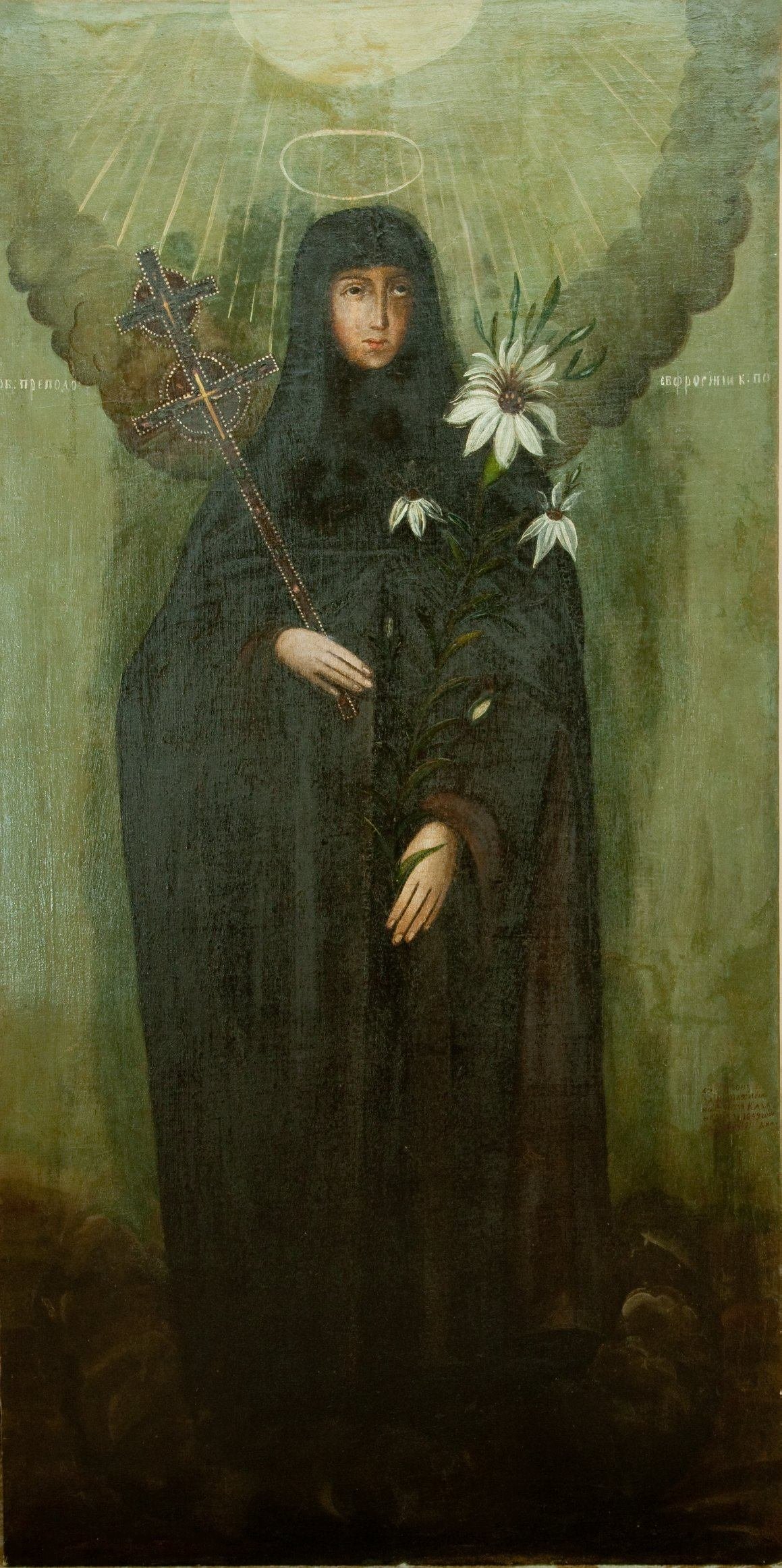
TRADITION says that the icon was linked to an image painted by Saint Luke the Evangelist. That claim belongs to icon tradition and cannot be shown by art history. By contrast, the reliquary cross made for her by the goldsmith Lazar Bohsha carries an inscription dated 1161 that names its maker and purpose, and it is the best datable witness to her patronage.
The cross, made of precious metals and enamel with space for relics, disappeared during the Second World War, usually dated to 1941, and its fate is unknown. A reconstruction by the Belarusian craftsman Nikolai Kuzmich was finished in 1997. Behind these works lay a hard political age, when the Polotsk princes were drawn into conflict with Kyiv. A study mentions the exile of Polotsk princes to Constantinople in 1129, but how that affected her monastery is not clear (UNCERTAIN). No source shows that Euphrosyne was ever imprisoned or tried for her faith.
Pilgrimage to Jerusalem and Death
Near the end of her life she set out for Jerusalem. The Life says that she left her monastery in the care of Eudokia and traveled with relatives, including Eupraxia and a man named David. Sources differ about David: the Orthodox Encyclopedia calls him her brother, and the Orthodox Church in America calls him her nephew (UNCERTAIN).
Her journey is said to have passed through Constantinople, where she visited churches and received a patriarchal blessing, and then reached Jerusalem, at that time under Latin Christian rule. She prayed at the Holy Sepulchre and gave gifts. She fell ill and died in the Holy Land. The usual date is May 23, 1173, yet the original Life gives no firm year, and a connection with Byzantine military events has led some to propose 1167 (UNCERTAIN).
Her first burial is linked with the monastery of Saint Theodosius near Jerusalem. TRADITION says that she wished to be buried at the Lavra of Saint Sabbas but was refused because she was a woman. The pilgrimage itself is accepted by major Orthodox accounts as part of the tradition, but the route, the people with her and the dates are less certain.
Miracles and Traditions
Several wonders appear in her hagiography, and all are TRADITION. One tells that she and Bishop Elias received heavenly guidance that a monastery should be built at Seltso. Another says that during the building of the Church of the Savior the builders ran short of bricks, and that after Euphrosyne prayed the needed bricks were found in the kiln the next morning. No independent source confirms these stories.
A later story gives her a prophecy that her remains would one day return to Polotsk. A modern historical study argues that this tale grew up in the nineteenth century during efforts to bring her relics home, so it should not be reported as an authentic medieval prophecy (UNCERTAIN). The icon tradition linked to Saint Luke belongs here as well.
The lasting devotion to Euphrosyne does not rest only on these stories. People honor her for renouncing a princely life, for teaching, for leading a community and for prayer. That makes her a fitting saint for readers who care about learning and faithful service, and the sources support those themes better than they support any single miracle.
Her Books, Her Teaching and Her Churches
No book, commentary or letter by Euphrosyne is known to survive (UNCERTAIN). Her Life preserves passages of spiritual teaching attributed to her, especially about humility and the inner change that monks and nuns are called to, but these cannot be treated as word for word records. She was almost certainly part of a culture of religious learning, yet claims that she wrote many identifiable texts go beyond the evidence.
What survives is more material. The Church of the Savior, the inscription on the cross of 1161 and the early manuscript witnesses give historians a base. A hymn connected with her appears in a manuscript dated about the late twelfth or early thirteenth century, and later manuscripts hold fuller services and versions of her Life.
Modern scholars have also studied how she came to be called the patroness of Belarus. The language of national patronage developed centuries after her death, in the early modern and modern periods. It is fair to call her a patroness of Belarus in a devotional and cultural sense, but it would be wrong to say that she held that title in the twelfth century.
Relics and Veneration
Later tradition says that her remains were moved from Jerusalem to the Kyiv Caves Monastery, and the year 1187, tied to the conquest of Jerusalem by Saladin, is often repeated. The Orthodox Encyclopedia states that the circumstances and the date of the move are unknown, so 1187 is traditional and not proven (UNCERTAIN).
Her relics were solemnly returned from Kyiv to Polotsk in 1910. They were later taken by the Soviet authorities and shown in a museum, and they were returned to the religious community in the Second World War. The Orthodox Encyclopedia gives October 23, 1943 for their return to the Polotsk monastery and 2007 for a new reliquary. The Savior Euphrosyne Monastery in Polotsk is the center of her veneration today.
Her cult began locally, probably soon after her death, and no exact date of formal canonization is known. Her feast is May 23, and she is also remembered with the Saints of Belarus on the third Sunday after Pentecost. Pilgrims visit Polotsk to see the church and the shrine. We do not quote her troparion here, but it is easy to find in the published services.
Lord Jesus, Your servant Euphrosyne turned from a princely life to serve You in humility and to teach Your people. Through her prayers, give me a love of Your word, the courage to choose what is good, and a heart open to those in need. Help me to walk the road You set before me with patience and trust. Amen.
This is a short original devotional prayer, not an official liturgical text, and it was not written by Saint Euphrosyne.
Saint Euphrosyne and the Eastern Churches
Euphrosyne belongs to the shared inheritance of medieval Rus, which Orthodox and Byzantine Catholic Christians both honor in different ways. Her life shows many marks of Eastern monasticism: prayer, ascetic effort, teaching, veneration of icons and worship that aims to change the whole person.
For Orthodox readers, her importance rests on her continuing commemoration, the honor given to her relics and her place in the history of Belarus. For Eastern Catholics there is direct evidence of a different kind. The Menaion of the Byzantine Catholic Metropolitan Cantor Institute lists the venerable Euphrosyne, abbess of the Monastery of the Holy Savior in Polotsk, on May 23.
That listing shows her presence in at least one Byzantine Catholic calendar. It does not prove a separate papal canonization or a universal feast in the Roman calendar, and none was found. As elsewhere, the honest course is to distinguish local veneration, liturgical commemoration and formal canonization, and to admire a woman whose faith, learning and courage are remembered across traditions.
Frequently Asked Questions
Ask Her Prayers
Saint Euphrosyne shows how learning, prayer and service can work together in one life. If you wish to ask her prayers for wisdom and for courage in your own calling, you may keep her prayer card in your home.
View Prayer Card